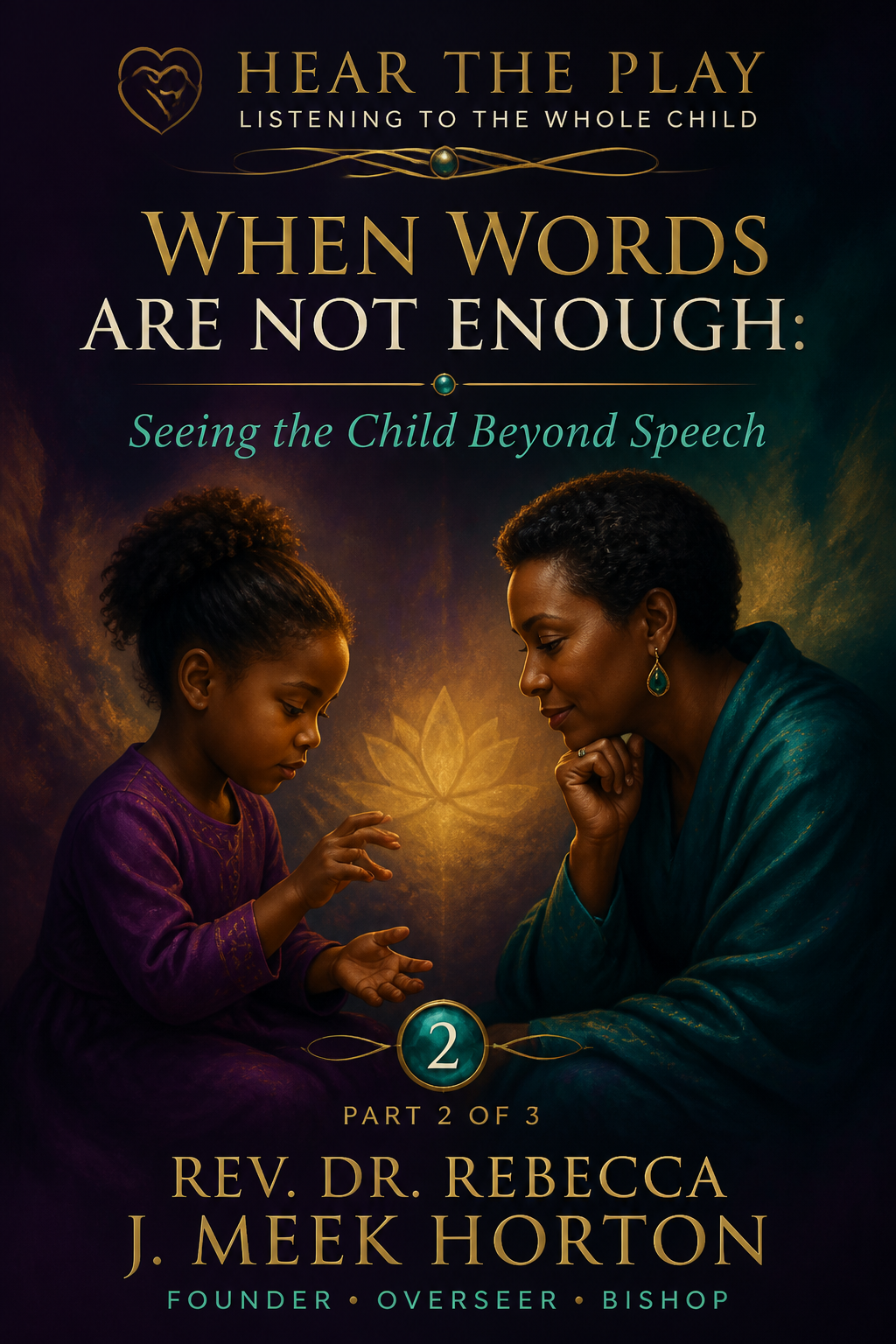
Hear the Play: Listening to the Whole Child · Volume 2
The Language of Play: Reading Movement, Gesture, Story, and Silence
Part 2 of 3 in the series "Hear the Play: Listening to the Whole Child". Series theme: Word are not the only way children communicate. Movement and Gestures can speak volumes. Hear in the Silence of Children.. This book focuses on careful observation and interpretation. It examines how children use roles, rules, pacing, objects, boundaries, collaboration, resistance, and repeated themes in play t
Chapter 1 preview
NBCNGMI MASTER KNOWLEDGE LIBRARY Featuring the works of The Sage, Apostle Prophet. Rev. Dr. Rebecca J. Meek Horton, Apostolic Prophetic Architect, NewBeing Creation Network Global Ministries, Inc. Integrated Framework Modalities™
Purpose
I wrote this book to help adults slow down and see the child beyond speech. My hope is that parents, teachers, leaders, and helpers will learn to notice play, movement, silence, gesture, and posture with patience instead of rushing to label or correct. I pray it helps us receive children with the tenderness of Jesus, who said, “Let the little children come to me” (Mark 10:14).
Preface
I did not begin learning children by listening to their words. I began by noticing what happened before the words came.
A child standing close but saying nothing. A hand tightening around a toy. A sudden laugh that did not match the moment. The same story acted out again and again in play. A face turned away, not in defiance, but in protection.
Over time, I began to understand that children are always communicating. Sometimes they speak with sentences. Sometimes they speak with silence. Sometimes their bodies tell the truth before their mouths are ready to form it.
This book was born from that holy noticing.
Many adults love children deeply, but we are often trained to listen only for clear explanations. We ask, “What’s wrong?” or “Why did you do that?” and when the child cannot answer, we may grow frustrated, worried, or quick to correct. But a child’s inability to explain is not the same as an absence of meaning.
Children communicate through play, posture, movement, gesture, repetition, imagination, and retreat. Their silence may carry fear, fatigue, confusion, resistance, grief, or simple need for time. Their behavior may not be the whole story, but it may be the doorway into the story.
Jesus understood something many of us are still learning. When others tried to move children aside, He said, “Let the little children come to me; do not hinder them” (Mark 10:14). He did not treat children as interruptions. He welcomed them as persons.
That is the heart of this book.
This is not a book about labeling children quickly. It is not a book about turning every gesture into a diagnosis or every silence into a problem. It is an invitation to slow down, observe with humility, and receive the child with care.
If you are a parent, teacher, leader, helper, believer, or seeker, I have written this for you. Not so you can master children, but so you can better honor them. Not so you can control every moment, but so you can become more faithful in the moments you are given.
Words matter. But words are not enough.
May this book help us listen with our eyes, our patience, our wisdom, and our love. And may the children in our care feel less managed and more truly seen.
Introduction
A child walks into a room without saying a word.
His shoulders are tight. His eyes search the space before they settle on an adult’s face. He picks up the same toy three times, drops it, then returns to it again. When asked what is wrong, he shrugs. When invited to talk, he turns away. It would be easy to call him stubborn, distracted, dramatic, or disobedient.
But what if he is communicating?
This book begins with a simple truth: children do not speak only with words. They speak through movement, posture, silence, play, repetition, facial expression, imagination, distance, closeness, and the way their bodies respond to the world around them. Sometimes words come later. Sometimes words are not yet safe. Sometimes words are too small for what the child is carrying.
Adults often want children to explain themselves before we have learned how to see them. We ask, “Why did you do that?” when the child may not know. We say, “Use your words,” when the child’s whole body has already been speaking. We rush to correct behavior before we understand the message beneath it.
This does not mean every action has a hidden meaning, or that adults should overread every moment. Wisdom is slower than that. It means we learn to observe with humility. We notice patterns. We ask better questions. We hold our conclusions loosely. We remember that a child is not a problem to solve but a person to receive.
Jesus showed this kind of attention. When others dismissed children as interruptions, He welcomed them. “Let the little children come to me; do not hinder them, for to such belongs the kingdom of God” (Mark 10:14). His welcome was not sentimental. It was holy. He saw children as worthy of attention, protection, and blessing.
That is the spirit of this book.
*When Words Are Not Enough* is the second part of the *Hear the Play* series. The first movement awakens us to the many ways children communicate. This book helps us observe those signals with wisdom, patience, and care. The next book will focus on faithful response: how adults can answer children in ways that build trust and honor their voice.
Here, our work is to slow down and see.
You will be invited to notice how children may communicate through play, gesture, silence, rhythm, imagination, and repeated behavior. You will learn to resist quick labels and practice careful attention. You will also be asked to examine your own reactions, because adults bring our histories, fears, assumptions, and urgency into every interaction with a child.
This may cost you something.
It may cost you the comfort of quick answers. It may cost you the need to control every moment. It may ask you to pause when you want to lecture, observe when you want to label, and listen when no words are being spoken. But the fruit is worth it: deeper trust, wiser care, and a more faithful way of seeing the child before you.
Read this book slowly. Do not use it to diagnose children from a distance or reduce them to signals. Use it as a guide for attention. Let each chapter sharpen one practice of seeing. When an example sounds familiar, pause. Ask, “What might this child be trying to communicate? What do I need to notice before I respond?”
The goal is not to become an expert in children’s hidden language. The goal is to become a more faithful adult: patient, grounded, curious, and loving.
Before you continue, take one small step. Think of one child in your care or influence. For the next day, observe without rushing to correct or explain. Notice posture, pace, play, silence, and repeated actions. Write down what you see, not what you assume. Let careful seeing become the beginning of wiser love.
Chapter 1 — The Quiet Child Is Still Speaking
Mara sat under the classroom table with her knees pulled to her chest.
The room was loud, but she was not. Blocks clicked. Chairs scraped. Children called across the carpet. Her teacher bent down and said, gently, “Use your words.”
Mara looked away.
It would have been easy to call her stubborn. Or shy. Or uncooperative. But her hands were pressed tightly over her ears. Her shoulders were raised near her cheeks. Her shoes were tapping a fast rhythm against the floor.
Mara was speaking.
Not with sentences. Not with explanations. But with her body, her distance, her silence, and her repeated tapping. She was saying something before she could say it in words.
This is the first truth of this book: children do not communicate through words alone. A quiet child may still be speaking through posture, movement, play, silence, facial expression, and the way they move toward or away from the world.
Adults often listen first for language. That is natural. Words are direct. Words help us understand. Words make things easier to name, teach, correct, and solve.
But children, especially when they are young, overwhelmed, afraid, tired, excited, confused, or still learning how to express themselves, often speak in other ways first.
Our task is not to become experts who decode every motion. Our task is to become faithful observers who welcome the whole child.
## We Often Listen Too Narrowly
Many adults have been trained to treat words as the main evidence of what is happening inside a child.
We ask, “What’s wrong?”
The child shrugs.
We ask, “Why did you do that?”
The child stares.
We ask, “Are you upset?”
The child says, “No,” while their face tells a different story.
Then frustration rises in us. We may think, *If they would just tell me, I could help.* That may be true. But it may also miss something important: the child may already be telling us in the only language available to them in that moment.
A child who hides behind a parent’s leg may be speaking caution.
A child who laughs while being corrected may be speaking discomfort.
A child who knocks down the same tower again and again may be speaking through repetition, control, or curiosity.
A child who goes silent after a change in routine may be speaking uncertainty.
None of these signals gives us the whole story. But each one invites us to slow down before we label.
Consider a child in a church hallway after service. An adult kneels and says hello. The child does not answer. They turn their body halfway away and grip their mother’s sleeve. One adult may say, “Don’t be rude. Say hello.” Another may notice the child’s body and say, “You can stay close. I’m glad to see you.”
The second adult has not ignored respect. They have simply started with welcome.
That small difference matters. When we listen too narrowly, we may correct before we understand. When we widen our listening, we make room for the child to become known.
## The Body Often Speaks Before the Mouth
Children live close to their bodies.
Before they can explain fear, their stomach tightens.
Before they can name embarrassment, their face turns away.
Before they can describe overload, their feet begin to move.
Before they can say, “I need space,” they step back.
This does not mean every movement has a hidden meaning. A yawn may simply be a yawn. Running may simply be joy. A quiet child may simply enjoy quiet.
Faithful observation is not suspicion. It is attention.
The body gives us clues. It helps us ask better questions. It reminds us that behavior is not only something to stop. Sometimes it is something to understand.
Imagine a parent at dinner. Their child is poking food, sliding down in the chair, and refusing to answer questions about school. The parent feels irritation building. “Sit up. Eat. Answer me.”
Those instructions may be needed. But if the parent pauses, they may notice more. The child’s eyes are heavy. Their jaw is tight. Their backpack is still on, even though they usually drop it by the door. They have not touched the food they normally like.
The child has not given a speech, but the child has given information.
A wiser first response might be, “You look worn out. We can talk after you eat a little.” Or, “Something about today seems heavy. I’m here when you’re ready.”
This kind of attention does not remove boundaries. It gives boundaries a better foundation.
A child still needs guidance. A child still needs limits. But correction without observation can become careless. We may address the surface while missing the child underneath.
## Play, Silence, and Expression Can Carry Meaning
Children often process life through what they do before they can explain what they feel.
They draw. They build. They repeat. They act out scenes. They hide. They chase. They freeze. They laugh at the wrong time. They make faces. They whisper to toys. They tell stories that sound silly to adults but carry weight for them.
This is why play deserves respect.
Play is not “just play” in the sense of being meaningless. It is one of the natural ways children explore the world. Through play, they practice power, safety, fear, repair, loss, friendship, conflict, and hope.
A child who lines up stuffed animals and gives each one a blanket may simply be enjoying order. A child who makes the same toy “get rescued” many times may simply like the story. We do not need to force a conclusion.
But we can notice.
We can say, “That bear keeps needing help.”
We can say, “You made a safe place for all of them.”
We can say, “Tell me about this part, if you want.”
These are gentle invitations, not interrogations.
Silence also deserves respect.
Many adults feel uncomfortable when a child does not answer. Silence can make us feel powerless. We may rush to fill it, explain it, or break it. But silence is not empty. Sometimes silence is thought. Sometimes it is protection. Sometimes it is uncertainty. Sometimes it is trust growing slowly.
There is a difference between abandoning a child in silence and honoring the pace at which they can speak.
A teacher might ask a question and receive no answer. Instead of pressing harder, she may say, “You don’t have to answer right now. You can draw it, point to it, or come back to me later.”
That sentence tells the child, *I am still listening, even if words are not ready.*
Facial expression also matters. A child’s eyes may brighten before their voice does. A child’s mouth may say, “I’m fine,” while tears gather. A child may smile to please an adult while their body remains stiff.
Again, we are not trying to become mind readers. We are learning to become careful witnesses.
## Observation Is an Act of Welcome
In Mark 10, people were bringing children to Jesus, and the disciples rebuked them. They treated the children as interruptions. Jesus did not.
“When Jesus saw it, he was indignant and said to them, ‘Let the children come to me; do not hinder them, for to such belongs the kingdom of God’” (Mark 10:14).
Jesus welcomed children in a world where many adults overlooked them. He did not treat them as background noise. He did not see them as too small to matter. He received them.
That matters for every parent, teacher, ministry leader, caregiver, and helper.
To observe a child with patience is one way we practice welcome. We say with our attention, *You are not a problem to get past. You are a person to receive.*
This does not mean the child leads the home, classroom, or ministry. Welcome is not the same as permissiveness. Jesus’ welcome was not weakness. It was holy attention. He saw the child’s worth before others saw the child’s usefulness.
Adults often want quick clarity. We want the child to explain, comply, recover, and move on. But children are not assignments to complete. They are souls to steward.
Observation helps us slow our assumptions.
Instead of, “He is being dramatic,” we can say, “Something feels big to him.”
Instead of, “She never listens,” we can say, “I need to notice what happens before she shuts down.”
Instead of, “He just wants attention,” we can say, “He may be seeking connection and does not know how to ask well.”
This is not soft language. It is responsible language. It moves us from shame to stewardship.
The words we use about children shape the way we treat them. A “bad kid” gets managed. A “hurting child” gets tended. A “defiant student” gets watched for failure. A “child struggling to feel safe” gets guided with firmer compassion.
We must be careful. Not every hard behavior has a deep hidden cause. Sometimes a child is testing a boundary. Sometimes they are tired. Sometimes they need correction. Sometimes they need practice doing what is right.
But even then, the child is more than the behavior in front of us.
## The Cost of Listening Beyond Words
This way of seeing asks something from us.
It asks us to slow down when we would rather react.
It asks us to hold our first interpretation loosely.
It asks us to notice our own impatience, embarrassment, fear, and need for control.
It asks us not to use spiritual language to rush past a child’s humanity. Faith does not make us less attentive. It should make us more faithful in how we see.
There is a cost to this kind of welcome. It may take longer. It may disrupt our schedule. It may require apology when we have mislabeled a child. It may require help from someone wiser, especially when a child’s signals are intense, repeated, or connected to harm, trauma, or developmental concerns.
Observation is not a replacement for professional care when care is needed. It is often the first faithful step toward knowing what kind of care may be needed.
We also need humility. We will not always understand what a child is communicating. We may misread. We may miss the signal. We may overfocus on one moment. That is why this book will keep returning to patience, context, restraint, and care.
The goal is not perfect interpretation.
The goal is faithful attention.
A quiet child is still speaking. A moving child may be speaking. A playful child may be speaking. A silent child may be speaking.
The question is whether we will become slow enough, humble enough, and loving enough to listen.
## Key Takeaways
- Children communicate through more than words.
- Observation is not judgment; it is welcome.
- Faithful adults slow down before they label.
## Practice
Choose one child you regularly care for, teach, lead, or love.
For the next day, do not try to interpret everything. Simply notice three nonverbal signals: posture, movement, facial expression, distance, play, or silence.
Write one sentence:
*“Today I noticed ______, and I will stay curious before I conclude.”*
This is the opening chapter. The complete publication is available in the full edition.
Back to the library