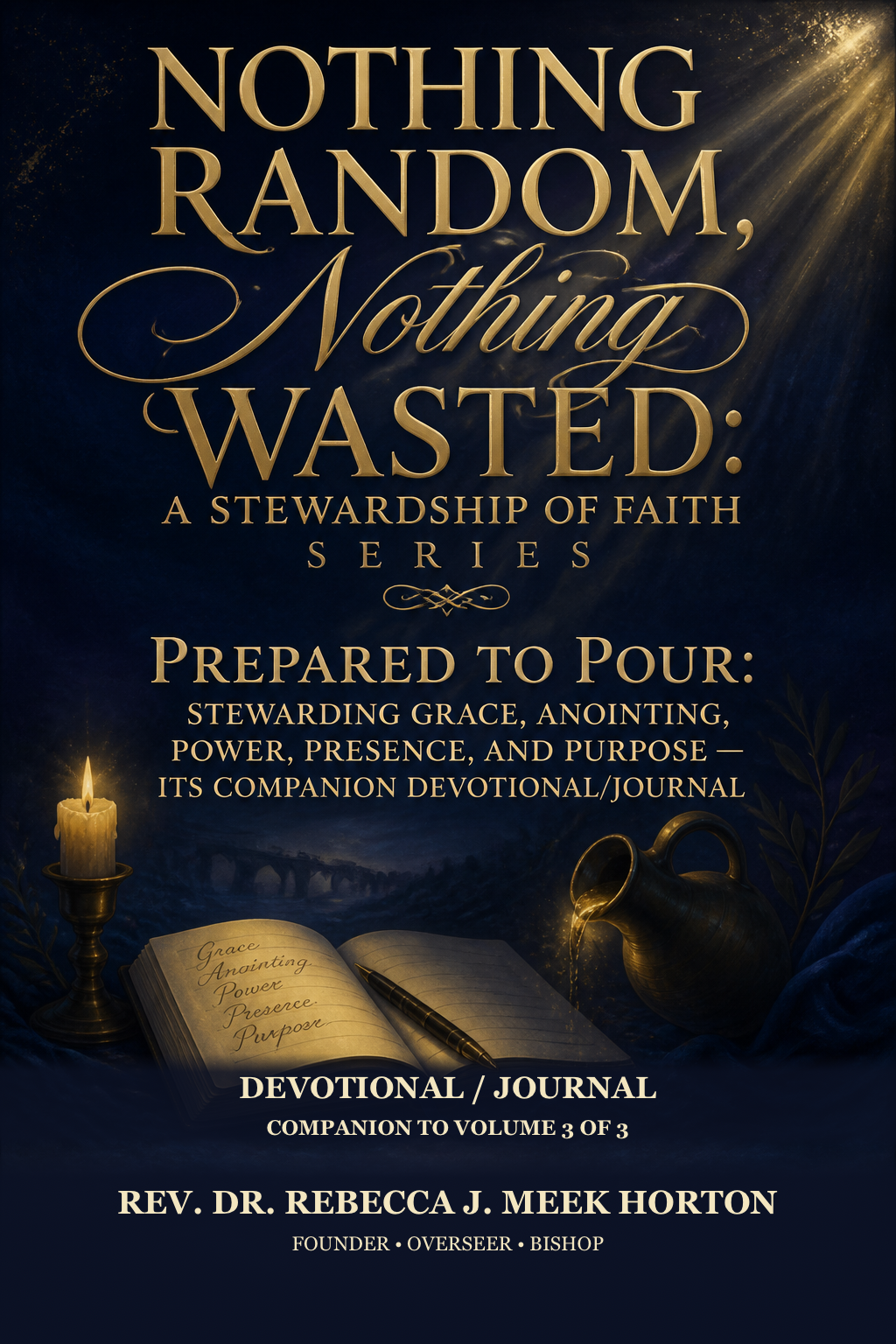
Nothing Random, Nothing Wasted: A Stewardship of Faith Series · Volume 3
Prepared to Pour: Stewarding Grace, Anointing, Power, Presence, and Purpose — Its Companion Devotional/Journal
A companion devotional and journal for "Prepared to Pour: Stewarding Grace, Anointing, Power, Presence, and Purpose". Each chapter becomes five entries — a KJV Scripture reading, a devotional, a prayer, a journal prompt, and space to write — closing with An Apostolic Prophetic Architect Message and lined journal pages.
Chapter 1 preview
NBCNGMI MASTER KNOWLEDGE LIBRARY Featuring the works of The Sage, Apostle Prophet. Rev. Dr. Rebecca J. Meek Horton, Apostolic Prophetic Architect, NewBeing Creation Network Global Ministries, Inc. Integrated Framework Modalities™
Chapter 1 — The Vessel Is Not the Treasure
Entry 1
Scripture Reading
2 Corinthians 4:7-10 (KJV)
But we have this treasure in earthen vessels, that the excellency of the power may be of God, and not of us. We are troubled on every side, yet not distressed; we are perplexed, but not in despair; Persecuted, but not forsaken; cast down, but not destroyed; Always bearing about in the body the dying of the Lord Jesus, that the life also of Jesus might be made manifest in our body.
Devotional
There is treasure, and there is a vessel. The first work of maturity is learning the difference.
Paul does not deny that something holy has been placed within us. He does not say there is no treasure. He says the treasure is carried in earthen vessels. That means God is not embarrassed by human weakness. He is not hindered by our clay. He chooses to place what is excellent inside what is fragile so that no one can confuse the vessel with the Source.
This steadies the believer who is praised, and it steadies the believer who feels weak.
When people say, “God used you,” receive it with gratitude, but do not feed on it. Their encouragement may be real. The fruit may be real. The presence of God may have ministered through your obedience. But the excellency of the power is still of God, and not of us.
This is where pride and despair are both corrected.
Pride says, “I must be special because God used me.” Despair says, “I am too fragile for God to use me.” Both keep the vessel at the center. The gospel restores order. God is the Source. Christ is the treasure. We are entrusted vessels.
Your weakness does not disqualify the treasure. Your usefulness does not make you the treasure.
That distinction will protect your soul.
There will be days when you feel pressed. Days when you feel perplexed. Days when obedience costs more than you expected. Paul tells the truth about the pressure, but he also tells the truth about preservation. Troubled, but not distressed. Perplexed, but not in despair. Cast down, but not destroyed.
Why? Because the life being revealed is not self-manufactured. It is the life of Jesus being made manifest.
Today, let this truth RE-Calibrate your inner posture. You do not have to pretend to be strong enough in yourself. You do not have to carry the weight of being the answer. You do not have to perform the treasure. You are called to yield, obey, and steward what God supplies.
Nothing is random. Nothing is wasted. Even the pressure can become a place where the Source is made clear.
The vessel is not the treasure. But when the vessel stays yielded, the treasure can be seen.
Prayer
Father, I thank You for placing treasure in an earthen vessel like me. I confess that I am not the source of grace, power, presence, anointing, or purpose. Keep me clear when people affirm me, and keep me steady when I feel weak. Teach me to receive encouragement without owning glory. Search my motives, correct my language, and guard my heart from pride and despair. I yield my life to You again. Let the excellency of the power be of You, and not of me. Make the life of Jesus visible through my obedience, my weakness, and my surrender. Amen.
Journal Prompt
From 2 Corinthians 4:7-10, where do I need to remember that I am the vessel and not the treasure? Where have I been tempted to carry pressure as if the power must come from me?
Space to Write [Answer Lines]
Entry 2
Scripture Reading
John 15:1-5 (KJV)
I am the true vine, and my Father is the husbandman. Every branch in me that beareth not fruit he taketh away: and every branch that beareth fruit, he purgeth it, that it may bring forth more fruit. Now ye are clean through the word which I have spoken unto you. Abide in me, and I in you. As the branch cannot bear fruit of itself, except it abide in the vine; no more can ye, except ye abide in me. I am the vine, ye are the branches: He that abideth in me, and I in him, the same bringeth forth much fruit: for without me ye can do nothing.
Devotional
Jesus did not say, “Without me ye can do less.” He said, “Without me ye can do nothing.”
That word can feel severe until we understand it as mercy. Jesus is not humiliating the branch. He is telling the branch where life comes from. A branch is not useless because it depends on the vine. It is alive because it depends on the vine.
Dependence on Christ is not weakness. It is safe order.
In the life of service, the compliment often becomes a test. Someone is helped. Someone is strengthened. Someone says your prayer, teaching, leadership, song, counsel, or presence changed something for them. That moment can be received in humility, or it can begin forming an identity God never assigned.
Fruit is not dangerous. Forgetting the Vine is dangerous.
A branch can bear fruit, but it cannot be the source of fruit. It can carry grapes, but it cannot create life apart from abiding. This is a needed correction for every believer, especially when God begins to use us visibly. The more fruit appears, the more abiding matters.
You do not need to reject every kind word to prove you are humble. False humility can become pride wearing quiet clothes. You can simply say, “Thank you. I am grateful the Lord helped you.” That language keeps the order clean. It receives encouragement and returns glory to the Source.
Abiding is not only a private devotion. It is a posture of continued dependence. It is the inner agreement that says, “I cannot produce lasting fruit apart from Christ.” It is prayer before performance. Obedience before image. Presence before platform. Surrender before service.
And notice the Father’s care. The Father is the husbandman. He knows how to tend the branch. He knows what must be removed. He knows what must be strengthened. He knows how to prepare fruitfulness that lasts.
Sometimes His pruning feels like loss, but it is stewardship. He is not only concerned that fruit appears. He is concerned that fruit remains connected to life.
Today, return to the Vine. Not because you have failed, but because you cannot live any other way. Let your service come from abiding, not striving. Let your words come from communion, not pressure. Let your fruit point back to Christ.
The branch is not the Vine. But the branch that abides can bear much fruit.
Prayer
Father, I come to You as a branch that needs the Vine. I confess that without Christ I can do nothing. Forgive me for any place where I have served from pressure, performance, or the need to be seen. Teach me to abide before I pour. Keep my fruit connected to Your life. Help me receive pruning without resentment and encouragement without pride. I do not want to appear fruitful while becoming disconnected inwardly. Draw me back into dependence, prayer, obedience, and surrender. Let my life bear fruit that honors Christ and serves others well. Amen.
Journal Prompt
From John 15:1-5, what does abiding need to look like in my daily rhythm? Where have I been trying to bear fruit without staying connected to the Vine?
Space to Write [Answer Lines]
Entry 3
Scripture Reading
2 Corinthians 3:4-6 (KJV)
And such trust have we through Christ to God-ward: Not that we are sufficient of ourselves to think any thing as of ourselves; but our sufficiency is of God; Who also hath made us able ministers of the new testament; not of the letter, but of the spirit: for the letter killeth, but the spirit giveth life.
Devotional
“Our sufficiency is of God.”
That sentence can break striving. It can also break arrogance.
Striving says, “I must be enough in myself.” Arrogance says, “I am enough because of myself.” But Paul gives us a cleaner way to live. We can trust through Christ to God-ward, while refusing to claim sufficiency as our own possession.
This is not insecurity. This is spiritual order.
God does make people able. He does form vessels. He does give grace. He does entrust assignments. He does strengthen hands for work, mouths for teaching, hearts for prayer, minds for wisdom, and lives for witness. Humility does not deny this.
But humility knows where ability came from.
There is a difference between saying, “God has helped me,” and saying, “I made myself.” There is a difference between stewarding a gift and building an identity around a gift. There is a difference between walking in responsibility and carrying glory that belongs to God.
The vessel must learn this distinction early, or every open door becomes dangerous.
When sufficiency is of God, you do not have to pretend. You can say, “I need help.” You can rest. You can receive correction. You can prepare without panic. You can serve without needing applause to prove you were effective.
You also do not get to shrink back and call it humility. If God has made you able, then your obedience matters. Fear is not humility. Hiding is not wisdom. Minimizing grace is not reverence.
Paul’s balance is mature. He acknowledges that God made him able, but he does not make himself the source. This is the posture of a prepared vessel.
Grace is received. Anointing is entrusted. Power is given. Presence is hosted with reverence. Purpose is assigned.
The believer’s responsibility is stewardship.
This begins with honest language. Instead of saying, “my power,” say, “the power of God at work.” Instead of saying, “my platform,” say, “the place of service entrusted to me.” Instead of saying, “I built this,” say, “God gave grace, and I obeyed my part.”
This is not wordplay. Language trains the heart.
RE-Language™ moves us from ownership to stewardship. It helps us speak in a way that keeps glory in order.
Today, let this truth settle you. You are not sufficient of yourself. You are not abandoned to yourself. Your sufficiency is of God.
Prayer
Father, I thank You that my sufficiency is of You. I release the pressure to prove that I am enough in myself. I also release the fear that makes me hide from what You have entrusted to me. Teach me to speak truthfully about Your grace without pride and without apology. Correct my language where I have taken ownership of what belongs to You. Strengthen me to obey my part while remembering that the source is always You. Make me a faithful steward, not a self-made vessel. Let my ability serve Your will and bless others. Amen.
Journal Prompt
From 2 Corinthians 3:4-6, where am I striving to be sufficient in myself? How can I reframe my language this week from ownership to stewardship?
Space to Write [Answer Lines]
Entry 4
Scripture Reading
1 Peter 4:10-11 (KJV)
As every man hath received the gift, even so minister the same one to another, as good stewards of the manifold grace of God. If any man speak, let him speak as the oracles of God; if any man minister, let him do it as of the ability which God giveth: that God in all things may be glorified through Jesus Christ, to whom be praise and dominion for ever and ever Amen.
Devotional
Peter says we have received the gift, and then he tells us what to do with it: minister the same one to another.
The gift was not received for self-display. It was received for service.
This matters because giftedness can become distorted when it is separated from stewardship. A person can begin to treat grace as a possession, people as an audience, and service as a way to secure identity. But Peter gives us a different pattern. We are to minister as good stewards of the manifold grace of God.
A steward does not own the house. A steward manages what belongs to another.
That changes everything.
If I am a steward, then I must pay attention to how I carry what I have received. I cannot use people to feed my need to be needed. I cannot pour endlessly while ignoring cracks in my character, motives, body, family, habits, and obedience. I cannot confuse visibility with health or activity with alignment.
Being used does not mean the vessel needs no care.
A vessel can be gifted and tired. Anointed for service and still in need of formation. Fruitful in public and strained in private. This truth is not meant to condemn us. It is meant to call us into sober stewardship.
Nothing is random. Nothing is wasted. Even weariness can tell the truth.
Maybe the vessel is not being refilled. Maybe the schedule is out of order. Maybe the motive has shifted from love to proving. Maybe the assignment has expanded beyond present capacity. Maybe public fruit is hiding private neglect.
Peter brings us back to order: speak as the oracles of God, minister as of the ability which God giveth. That means our speaking and serving must remain under the weight of reverence. We do not handle God’s grace casually. We do not pour from ego. We do not make people dependent on our personality.
The purpose is clear: that God in all things may be glorified through Jesus Christ.
This is how the vessel becomes safe. Not by denying the gift. Not by idolizing the gift. By stewarding the gift in a way that points beyond the vessel.
Today, ask a simple question: Am I serving from the ability God gives, or from pressure I created? That question may become a doorway to RE-Calibration™.
Prayer
Father, I thank You for every gift You have allowed me to receive. I confess that the gift is not mine to display for self-glory. It is entrusted to me for service. Teach me to minister as a good steward of Your manifold grace. Show me where I am tired, misaligned, or pouring from pressure instead of obedience. Help me honor the people I serve and not use them to strengthen my image. Let my words and actions carry reverence. Let my service come from the ability You give. In all things, may You be glorified through Jesus Christ. Amen.
Journal Prompt
From 1 Peter 4:10-11, how am I currently stewarding what I have received? Is there any place where my service needs care, order, or RE-Calibration™?
Space to Write [Answer Lines]
Entry 5
Scripture Reading
James 4:6-10 (KJV)
But he giveth more grace. Wherefore he saith, God resisteth the proud, but giveth grace unto the humble. Submit yourselves therefore to God. Resist the devil, and he will flee from you. Draw nigh to God, and he will draw nigh to you. Cleanse your hands, ye sinners; and purify your hearts, ye double minded. Be afflicted, and mourn, and weep: let your laughter be turned to mourning, and your joy to heaviness. Humble yourselves in the sight of the Lord, and he shall lift you up.
Devotional
Humility is not self-hatred. Humility is agreement with truth.
It agrees that God is the Source. It agrees that we are dependent. It agrees that we are accountable. It agrees that whatever we carry must serve His will, not our image.
James gives a sober promise: God gives grace to the humble. That promise is not decorative. It is necessary for anyone who carries spiritual weight. Pride makes the vessel unsafe. Humility keeps the vessel open to correction, cleansing, nearness, and grace.
Pride is not always loud. Sometimes it hides behind service. Sometimes it speaks in spiritual language. Sometimes it looks like always saying yes because we need to be needed. Sometimes it appears as offense when someone else is used by God. Sometimes it sounds like false humility that refuses responsibility while secretly wanting reassurance.
The issue is not always the size of the platform. The issue is the posture of the vessel.
Some people are proud with a microphone. Others are proud with no microphone at all. Pride does not need a stage. It only needs an unguarded heart.
James does not give us vague inspiration. He gives us movement. Submit yourselves therefore to God. Resist the devil. Draw nigh to God. Cleanse your hands. Purify your hearts. Humble yourselves.
Humility becomes practice.
It is not enough to say, “I want to be humble.” We must let the Lord search the hidden places where pride has been breathing. The need to be praised. The fear of being forgotten. The habit of controlling outcomes. The quiet resentment when correction comes. The secret pleasure of being seen as indispensable.
This kind of honesty can hurt. Sometimes humility feels like death because pride has lived longer than we realized. But this pain is not punishment. It is mercy. It is RE-Calibration™. The Lord is bringing order to the vessel so the treasure is not misrepresented.
And He gives more grace.
That is the hope in this passage. God is not inviting us into humiliation without restoration. He is calling us low so He can lift us rightly. Not lifted by ego. Not lifted by applause. Lifted by His hand, in His order, for His glory.
Today, do not run from the searchlight of humility. Draw nigh to God. Let Him cleanse what has been mixed. Let Him steady what has been inflated. Let Him make the vessel safe.
Prayer
Father, I humble myself before You. I submit my heart, my motives, my service, and my desires to You. I confess that pride can hide in places I do not always recognize. Search me with mercy and truth. Cleanse my hands and purify my heart. Teach me to draw near instead of defending myself. Help me resist every temptation to make Your grace about my image. I receive the grace You give to the humble. Lift me only in the way that pleases You. Make me safe to carry what You entrust. Amen.
Journal Prompt
From James 4:6-10, what form of pride do I need to bring into the light? What humble practice is God calling me to take today?
Space to Write [Answer Lines]
An Apostolic Prophetic Architect Message
Beloved vessel, hear the order of the Lord’s wisdom in this foundation: the treasure is holy, but the vessel must stay yielded. The grace is real, but it is not yours to own. The anointing is real, but it is not yours to perform. The power is real, but it is not yours to boast in. The presence of God is precious, but it must be hosted with reverence. Purpose is assigned, not manufactured by ego.
This is not a small correction. This is a governing truth for the prepared life.
Romans 12:3 (KJV) says, “For I say, through the grace given unto me, to every man that is among you, not to think of himself more highly that he ought to think; but to think soberly, according as God hath dealt to every man the measure of faith.”
Sober thinking is not low thinking. It is ordered thinking. It knows what God has given, and it knows who God is. It does not deny grace, and it does not steal glory. It does not hide from assignment, and it does not build a throne from assignment.
You are being prepared to pour, but first you must be prepared to remain clear.
The vessel must not be intoxicated by applause. The vessel must not collapse under weakness. The vessel must not use humility as an excuse for fear. The vessel must not use giftedness as permission for pride. The vessel must learn stewardship.
This is Governed Movement™. Nothing is random. Nothing is wasted. The compliment, the correction, the weariness, the open door, the closed door, the hidden season, the public assignment, all of it can become formation when submitted to Christ.
So receive this confirmation with sobriety and encouragement: God can use earthen vessels. God can pour through yielded lives. God can make grace visible through ordinary obedience. But the order must remain clean.
The treasure is of God.
The power is of God.
The glory belongs to God.
Your part is to abide, obey, steward, and stay humble.
Do not despise being used. Steward being used. Do not perform the pour. Remain surrendered to the Source. WISDOM is not yours until YOU WALK IT. Today, walk this truth: I am the vessel, not the treasure, and I will carry what belongs to God in a way that points back to Him.
[Journal Page]
[Journal Page]
This is the opening chapter. The complete publication is available in the full edition.
Back to the library