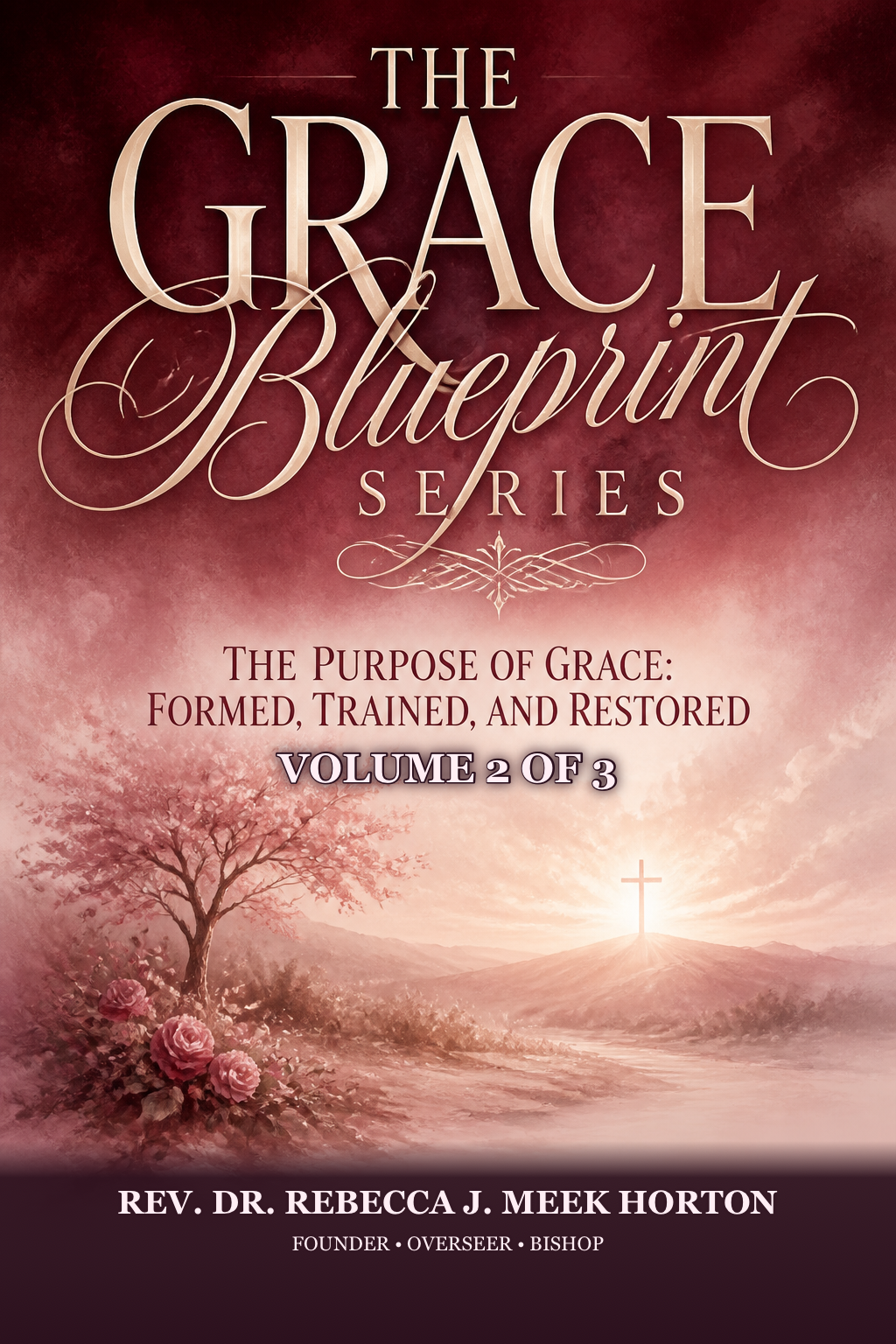
The Grace Blueprint Series · Volume 2
The Purpose of Grace: Formed, Trained, and Restored
Part 2 of 3 in the series "The Grace Blueprint Series". Series theme: Series arc: This series follows the holy movement of God’s grace from foundation to formation to faithful sending. Book One helps readers receive the presence of grace in God, revealed in Jesus Christ, and rest in salvation and identity. Book Two shows how grace forms the heart through holiness, waiting, weakness, endurance, an
Chapter 1 preview
NBCNGMI MASTER KNOWLEDGE LIBRARY Featuring the works of The Sage, Apostle Prophet. Rev. Dr. Rebecca J. Meek Horton, Apostolic Prophetic Architect, NewBeing Creation Network Global Ministries, Inc. Integrated Framework Modalities™
Dedication
To every believer who has wondered if GOD’s Grace is still enough for the weight of the Call: I dedicate this book to you. May you be formed, trained, and restored by the same Grace that saved you, and may you find courage to keep the next faithful step.
Purpose
I wrote this book for every believer who has received GOD’s Grace, yet still wonders how that Grace is able to form, train, steady, and restore the heart.
My prayer is that these pages help you see Grace not only as what saves you, but as GOD’s faithful work within you in holiness, waiting, weakness, endurance, confession, and restoration.
May this book strengthen you to trust the sufficiency of GOD’s Grace, take the next faithful step, and keep walking in obedience before Him. 2 Corinthians 12:9 (KJV)
Preface
I wrote this book for the believer who loves GOD, yet feels tired in the middle of becoming.
There is a grace we receive when we come to Christ. There is also a grace that keeps working in us after we have said yes. That grace does not leave us where it found us. It forms us. It trains us. It corrects what is crooked, strengthens what is weak, and restores what has fallen under pressure.
This second book in The Grace Blueprint Series was born from that holy middle place. Book One helped us rest in the presence of grace revealed in Jesus Christ. This book asks what happens next. What does grace do when the heart is still being shaped? What does grace mean when obedience is costly, waiting is long, weakness is honest, and restoration requires truth?
Many believers wonder if they are failing because the process is harder than they expected. They feel the weight of the Call, but also the limits of their strength. I understand that tension. Grace is not permission to quit growing. Grace is GOD’s sufficiency for the growth He requires.
The Lord said, “My grace is sufficient for thee: for my strength is made perfect in weakness” 2 Corinthians 12:9 (KJV). That word has carried many of us through seasons where we could not carry ourselves.
This book is not written to shame the weary. It is written to steady them. It is not written to excuse sin. It is written to help the heart return to GOD with confession, truth, and hope. It is not written to rush your process. It is written to help you recognize the faithful work of GOD within it.
Grace teaches. “For the grace of God that bringeth salvation hath appeared to all men, Teaching us…” Titus 2:11–12 (KJV). That means grace has purpose beyond rescue. Grace trains the life that has been saved.
As you read, I invite you to come honestly. Bring your weakness, your waiting, your weariness, your questions, and your desire to obey. Do not despise the place of formation. Nothing is random. Nothing is wasted.
Begin with this simple prayer: Lord, form in me what Your grace has already begun.
Introduction
Grace is often received with tears and then misunderstood in the middle of the road.
Many believers know how to say, “I am saved by grace,” but struggle to understand what grace is doing when life becomes slow, painful, correcting, or hidden. We rejoice when grace forgives us. We may feel confused when grace trains us. We thank GOD when grace lifts guilt, but we may resist when grace confronts habits, purifies motives, teaches patience, exposes weakness, and calls us back after failure.
This book is written for that place.
The Purpose of Grace: Formed, Trained, and Restored is the second book in The Grace Blueprint Series. Book One helped establish grace as the gift and presence of GOD revealed in Jesus Christ, grounding the believer in salvation, sonship, and identity. This book asks the next question: What does grace do after it has received us?
The answer is simple, but not shallow.
Grace forms us.
Grace is not only GOD’s mercy toward the guilty. Grace is also GOD’s power at work in the yielded. It does not merely cover the old life; it teaches us how to walk in the new one. Scripture says, “For the grace of God that bringeth salvation hath appeared to all men, Teaching us that, denying ungodliness and worldly lusts, we should live soberly, righteously, and godly, in this present world;” Titus 2:11–12 (KJV).
Grace teaches.
That means grace has a purpose beyond relief. It trains the heart toward holiness. It steadies the soul in waiting. It meets weakness with sufficiency. It gives endurance when the road is longer than expected. It restores the fallen through confession, truth, and mercy. Grace does not flatter us. Grace fathers us.
If you are struggling to fulfill your call, this book is for you. If you feel tired from trying to obey, this book is for you. If you have wondered whether your weakness has disqualified you, this book is for you. If you have fallen and are afraid restoration is no longer possible, this book is for you.
But this book will not tell you that formation is easy.
There is a cost to being trained by grace. Holiness will ask you to release what once comforted you. Waiting will ask you to trust GOD without controlling the timing. Weakness will ask you to stop pretending. Endurance will ask you to keep walking when feelings are quiet. Restoration will ask you to tell the truth without hiding behind shame.
Yet none of this is punishment. This is purposeful grace.
When Paul pleaded for his thorn to depart, the Lord answered him, “My grace is sufficient for thee: for my strength is made perfect in weakness” 2 Corinthians 12:9 (KJV). Grace did not remove every pressure from Paul’s life, but it gave him what was needed to remain faithful inside the pressure. That is part of the mystery and mercy of grace. It does not always change the road first. Sometimes it changes the walker.
Read this book slowly. Do not rush to finish chapters. Let the Scriptures search you. Let the practices become honest places of prayer, repentance, discernment, and obedience. You do not need to perform your way through these pages. You are invited to walk through them with GOD.
Each chapter will carry one clear movement of formation. You will be asked to see what grace is training in you, name where resistance is present, and take one next faithful step. That step may be confession. It may be rest. It may be forgiveness. It may be returning to a holy habit. It may be waiting without resentment. It may be asking for help.
Small obedient steps matter.
Nothing is random. Nothing is wasted.
The grace that saved you is not finished with you. The God of all grace is still forming, training, strengthening, and restoring His people. As Peter wrote, “But the God of all grace, who hath called us unto his eternal glory by Christ Jesus, after that ye have suffered a while, make you perfect, stablish, strengthen, settle you” 1 Peter 5:10 (KJV).
That is the promise held before us.
Grace does not leave you where it found you.
Grace forms you for faithful obedience.
Chapter 1 — When Grace Meets the Unfinished Heart
You can be saved and still feel unfinished.
You can love GOD and still notice impatience rising in your chest. You can carry a real Call and still feel afraid to answer it. You can pray, serve, worship, give, and still wonder why some parts of your heart seem slow to change.
Many believers carry this quiet ache. They do not doubt that GOD has saved them. They doubt whether they are becoming who they are supposed to be. They hear sermons about purpose, destiny, gifts, and assignment, but inside they feel scattered. Their lives are not empty of grace, but they are not yet steady in grace.
This chapter begins there.
Grace is not only GOD’s pardon for the guilty; grace is GOD’s purposeful work in the unfinished heart. It saves us, yes. But it also begins forming us for the life GOD prepared.
Paul wrote, “For by grace are ye saved through faith; and that not of yourselves: it is the gift of GOD: Not of works, lest any man should boast. For we are his workmanship, created in Christ Jesus unto good works, which GOD hath before ordained that we should walk in them” Ephesians 2:8-10 (KJV).
That word workmanship gives hope to the weary soul. You are not a discarded project. You are not a failed believer because you still need forming. You are GOD’s workmanship.
There is comfort here, but there is also direction. Grace does not only tell you that you are forgiven. Grace tells you that you are being made. You are not trying to invent a new self by pressure, comparison, or fear. You are being formed in Christ by the GOD who saves, keeps, corrects, strengthens, and sends.
The ache of the unfinished heart
A young woman sits in her car after church. She has just served on the ministry team. She smiled, greeted people, helped where she was needed, and prayed for a friend who was struggling.
But now the car is quiet, and tears come.
She is not crying because she hates GOD. She is crying because she loves Him and feels tired. She wonders why obedience still feels so uneven. One week she is full of faith. The next week she is anxious, reactive, and uncertain. She knows she is called, but she does not feel stable enough to carry what she senses.
That ache is more common than many admit.
Some believers hide it behind busyness. Some hide it behind spiritual language. Some hide it behind silence. They say, “I’m fine,” while inwardly asking, “What is wrong with me?”
But the question needs RE-Language™. Instead of asking, “What is wrong with me?” a wiser question is, “What is GOD still forming in me?”
That change does not excuse sin or immaturity. It simply removes shame from the place where responsibility must begin.
Shame often makes the heart collapse inward. It turns conviction into condemnation. It takes a real area of needed growth and uses it as evidence that we are unwanted, unusable, or beyond help. But the Holy Ghost does not need shame to produce holiness. GOD can tell the truth without crushing His children.
The unfinished heart is not an unloved heart.
Peter was unfinished when Jesus called him. He was bold, sincere, and unstable. He spoke quickly. He promised loyalty. He misunderstood suffering. He denied the Lord. Yet Jesus did not treat Peter’s weakness as the end of his story.
Before Peter denied Him, Jesus said, “Simon, Simon, behold, Satan hath desired to have you, that he may sift you as wheat: But I have prayed for thee, that thy faith fail not: and when thou art converted, strengthen thy brethren” Luke 22:31-32 (KJV).
Jesus saw the fall before Peter felt the shame of it. He saw the weakness before Peter admitted it. Yet He also saw the strengthening that would come after restoration. That is grace with holy purpose.
Grace met Peter before he was steady. Grace also restored and strengthened him for the road ahead.
This matters because many believers confuse being unfinished with being disqualified. They see the gap between their salvation and their maturity, and they assume GOD must be disappointed beyond repair.
But Scripture does not teach that grace saves finished people. Grace saves sinners and begins the holy work of formation.
Paul did not say, “Ye are your own improvement project.” He said, “We are his workmanship” Ephesians 2:10 (KJV).
That means GOD is not only interested in where He is sending you. He is also committed to what He is shaping in you before, during, and through the sending.
Sometimes the ache you feel is not proof that grace is absent. It may be proof that grace is working deeply enough to make you honest. A numb heart does not grieve over distance from GOD. A hardened heart does not care about obedience. If you are troubled by what is unformed in you, do not rush to despair. Bring that trouble into prayer. Let it become an invitation.
David knew the ache of needing inward formation. He prayed, “Create in me a clean heart, O GOD; and renew a right spirit within me” Psalm 51:10 (KJV). That is not a polished prayer. It is an honest prayer. It is the cry of a man who knew he needed more than image management. He needed GOD to work in the heart.
There are seasons when the most spiritual thing you can do is stop pretending. Not to indulge weakness. Not to excuse disobedience. But to stand before GOD truthfully and say, “This place is not yet whole. This place is not yet steady. This place is still afraid. Lord, meet me here.”
Grace begins where striving fails
Striving often sounds responsible at first.
“I just need to try harder.”
“I need to be stronger.”
“I cannot let anyone see me struggle.”
“I should be past this by now.”
There is a kind of effort that belongs to obedience. Scripture does not call us to laziness. The Christian life includes discipline, repentance, submission, endurance, and practice. Paul told Timothy, “Exercise thyself rather unto godliness” 1 Timothy 4:7 (KJV). There is holy effort.
But striving is different.
Striving tries to produce spiritual maturity without resting in GOD’s grace. It carries the burden of becoming as if transformation depends on human pressure alone. It is effort separated from dependence. It is labor without abiding. It is obedience attempted from fear instead of love.
That burden becomes heavy.
A man may be called to preach, teach, lead, build, intercede, or serve. He may sense GOD pulling him toward greater obedience. But instead of receiving grace for formation, he tries to perform readiness. He learns the right words. He copies the habits of strong people. He pushes through exhaustion. He mistakes motion for maturity.
For a season, it may look fruitful.
Then pressure reveals what is unformed.
He becomes impatient with people. He avoids correction. He feels threatened by delay. He resents hidden service. He loses tenderness. He keeps moving, but his heart is not being governed by grace.
Nothing is random. Nothing is wasted. Even that exposure can become mercy if he will let grace tell the truth.
Grace does not flatter us. Grace does not pretend we are mature where we are not. But grace also does not shame us into hiding. Grace brings us into the light so GOD can form what performance cannot fix.
This is where many believers become tired. They are not tired only from work. They are tired from trying to carry a spiritual life in their own strength. They are tired from managing appearances. They are tired from measuring themselves against someone else’s season. They are tired from turning every weakness into a private courtroom.
Jesus gives a better invitation. He said, “Come unto me, all ye that labour and are heavy laden, and I will give you rest” Matthew 11:28 (KJV). He did not invite only those who had already mastered rest. He called the weary. He called the burdened. He called those carrying weight they were never meant to carry apart from Him.
Ephesians 2 is clear. “Not of works, lest any man should boast” Ephesians 2:9 (KJV). Salvation is not earned. Neither is formation fueled by boasting. The life that begins by grace must continue by grace.
This does not make us passive. It makes us dependent in the right way.
Dependence is not helplessness. It is stewardship. It is the honest confession that apart from Christ we cannot produce the life of Christ. It is the daily returning of the heart to GOD, saying, “Form in me what I cannot manufacture.”
Jesus said, “Abide in me, and I in you. As the branch cannot bear fruit of itself, except it abide in the vine; no more can ye, except ye abide in me” John 15:4 (KJV). The branch is not useless because it needs the vine. The branch is living according to its design when it receives life from the vine.
So it is with us.
We do not overcome striving by refusing obedience. We overcome striving by returning obedience to its proper root. We obey because we belong to Christ. We repent because grace has opened the door of truth. We practice holiness because the life of GOD is forming us from the inside. We serve because we have received mercy, not because we are trying to purchase it.
When striving fails, grace does not say, “Do nothing.” Grace says, “Come back to the source. Let your obedience flow from Me.”
The Call will reveal what grace must form
A Call from GOD is not only an assignment to do something. It is also a place where the heart is revealed.
The Call exposes motives.
It exposes impatience.
It exposes fear of people.
It exposes the desire to be affirmed.
It exposes the temptation to compare.
It exposes the pain we hoped would stay hidden.
This exposure is not always pleasant, but it is often gracious.
Imagine a clay vessel being shaped on a wheel. The potter’s hands press, steady, lift, and narrow the clay. To the clay, if clay could feel, the pressure might seem like rejection. But the pressure is part of formation. Without it, the vessel cannot hold what it was meant to carry.
GOD’s grace works with holy purpose.
The Lord told Jeremiah, “Arise, and go down to the potter’s house, and there I will cause thee to hear my words” Jeremiah 18:2 (KJV). Jeremiah watched the potter work with the clay. The vessel was marred in the hand of the potter, but the potter did not throw the clay away. Scripture says, “so he made it again another vessel, as seemed good to the potter to make it” Jeremiah 18:4 (KJV).
There is a holy kindness in that image. The clay was still in the potter’s hand. The marring was real, but it was not final. The forming continued.
When you step toward obedience and find weakness in yourself, do not immediately assume you have missed GOD. Sometimes obedience simply brings unformed places to the surface.
A person called to serve others may discover selfishness.
A person called to lead may discover insecurity.
A person called to teach may discover pride.
A person called to prayer may discover distraction.
A person called to reconciliation may discover bitterness.
A person called to generosity may discover fear.
A person called to speak truth may discover the desire to be liked.
A person called to carry responsibility may discover resentment toward hidden preparation.
These discoveries can feel discouraging. But they can also become doorways to maturity if we respond with humility.
This is where RE-Calibration™ begins. We stop pretending. We stop condemning ourselves. We stop blaming everyone around us. We bring the revealed place to GOD and ask for truth, cleansing, and instruction.
David prayed, “Search me, O GOD, and know my heart: try me, and know my thoughts: And see if there be any wicked way in me, and lead me in the way everlasting” Psalm 139:23-24 (KJV).
That is not the prayer of a person trying to hide. It is the prayer of someone who trusts GOD enough to be examined.
The Call does not require a perfect heart before you begin. But it does require a yielded heart as you walk.
This is the difference between shame and stewardship.
Shame says, “Because I am unfinished, I should hide.”
Stewardship says, “Because I am unfinished, I will bring my heart to GOD and obey the next faithful step.”
The difference matters.
If shame leads, we will either retreat from the Call or perform inside it. We will hide from correction, avoid accountability, and call isolation “discernment.” Or we will push harder, speak louder, and try to prove that we are ready while our souls are becoming brittle.
But if stewardship leads, we can tell the truth without giving up. We can say, “This motive needs cleansing.” “This fear needs surrender.” “This habit needs correction.” “This wound needs healing.” “This delay needs patience.” We can take responsibility without taking on condemnation.
GOD is not careless with what He reveals. He does not expose the heart for entertainment. He reveals to redeem. He uncovers to cleanse. He corrects to establish.
Hebrews says, “For whom the Lord loveth he chasteneth, and scourgeth every son whom he receiveth” Hebrews 12:6 (KJV). Correction is not always rejection. In the hand of GOD, correction is often proof of sonship and love.
So when the Call reveals what is unformed, pause before panic. Ask what grace is showing you. Ask what obedience is required now. Ask what counsel, confession, discipline, rest, or surrender may be needed.
Do not Force-The-FiT™. Do not force yourself into an image of readiness that grace has not formed. Let GOD build weight in you before increase comes through you.
Saved by grace, made for walking
Paul says we are saved by grace, and then he says we are “created in Christ Jesus unto good works” Ephesians 2:10 (KJV).
Grace does not end with rescue. Grace gives direction.
The good works do not save us. They are not payment for mercy. They are the prepared pathway of a life that belongs to GOD. Paul says GOD “hath before ordained that we should walk in them” Ephesians 2:10 (KJV).
Walk is a humble word.
It is not flashy. It is not frantic. It is not a performance on a stage. Walking means one step, then another. It means pace. It means direction. It means continuing when the feeling is not dramatic.
Many believers struggle because they look for grace only in big moments. They want grace for the altar, grace for the breakthrough, grace for the open door, grace for the public assignment. But forming grace often meets us in ordinary obedience.
Grace helps you apologize.
Grace helps you tell the truth.
Grace helps you open Scripture when your mind feels crowded.
Grace helps you stay quiet when your flesh wants the last word.
Grace helps you rest instead of proving your worth.
Grace helps you serve in hidden places without becoming bitter.
Grace helps you begin again after failure.
Grace helps you receive correction without collapsing.
Grace helps you forgive when your heart would rather keep rehearsing the wound.
Grace helps you say no to what weakens your obedience.
Grace helps you say yes to what strengthens your walk with GOD.
This is Walking in Obedience™. Not perfection. Not passivity. Not striving. A faithful walk with GOD, one surrendered step at a time.
A mother caring for children in a hard season may feel she is not doing anything “great” for GOD. But grace may be forming patience, tenderness, endurance, and prayer in the unseen room of daily life.
A young minister waiting for an open door may feel delayed. But grace may be forming humility, discipline, and integrity before influence increases.
A believer recovering from a fall may feel ashamed to come close again. But grace may be teaching honest confession and a deeper hatred for hiding.
An older saint who feels overlooked may be learning the quiet holiness of faithfulness without applause.
A worker in a difficult job may be learning how to carry Christlike character under pressure.
A leader who has been slowed down may be learning that timing is as important as motive.
The walk matters.
GOD is not only measuring visible outcomes. He is forming inward substance.
Micah gives us a simple picture of faithful walking: “He hath shewed thee, O man, what is good; and what doth the LORD require of thee, but to do justly, and to love mercy, and to walk humbly with thy GOD?” Micah 6:8 (KJV).
Walk humbly.
Not impress humbly. Not announce humbly. Walk humbly.
There is a grace for the next step that we often miss because we are anxious about the whole journey. We want the full map. GOD often gives enough light for obedience now. Psalm 119:105 says, “Thy word is a lamp unto my feet, and a light unto my path” (KJV). A lamp does not show every mile ahead. It gives light for the step in front of you.
This is mercy. If GOD showed us every pressure, delay, correction, and assignment at once, we might faint under the weight of what we do not yet have grace to carry. So He walks us. He forms us in movement. He teaches us to obey today.
The unfinished heart wants to know, “When will I be fully ready?”
Grace often answers, “Walk with Me.”
The cost of letting grace form you
There is a cost to receiving forming grace.
It will cost you the comfort of pretending you are fine.
It will cost you the pride of self-made strength.
It will cost you the habit of blaming your instability on every circumstance.
It will cost you the secret agreement with shame that says hiding is safer than truth.
It will cost you the right to keep calling delay rejection.
It will cost you the habit of comparing your formation to someone else’s fruit.
It will cost you the need to be seen before you are strengthened.
Grace is free, but formation is not shallow.
When grace meets the unfinished heart, it does not merely soothe the ache. It begins to govern the movement of the heart. It brings order where there has been confusion. It brings weight where there has been immaturity. It brings operation where obedience has been inconsistent. It brings wisdom where timing and desire have been tangled.
This is not instant. It is holy work.
Some days you will feel progress. Other days you will feel exposed. Some prayers will be full of faith. Other prayers will sound like, “Lord, help me.”
That prayer is enough to begin.
The danger is not that you are unfinished. The danger is refusing to be formed.
A believer can turn weakness into hiding. A believer can turn delay into bitterness. A believer can turn calling into performance. A believer can turn grace into a word they admire but do not actually receive for the places that need change.
There is a sober tenderness in this. GOD will not force us into maturity while we protect our excuses. He invites. He convicts. He corrects. He draws. He gives grace. But we must come into the light.
John wrote, “But if we walk in the light, as he is in the light, we have fellowship one with another, and the blood of Jesus Christ his Son cleanseth us from all sin” 1 John 1:7 (KJV).
Walking in the light does not mean pretending there is no darkness to confess. It means we stop making peace with hiding. We let truth have access to us. We let grace cleanse what shame tried to cover.
So the invitation is simple and serious.
Let grace meet the real you.
Not the polished version. Not the ministry version. Not the version that knows what to say. Bring GOD the unfinished heart. Bring Him the fear, the fatigue, the inconsistency, the grief, the desire to obey, and the places where you do not yet know how.
He is not surprised by what He already sees.
And He is not finished with what He has begun.
You may feel unfinished, but you are not abandoned.
You may feel weak, but you are not without grace.
You may feel slow in formation, but GOD is not careless with His workmanship.
The same grace that saved you is able to shape you. The same Christ who received you is able to mature you. The same GOD who began the work knows how to continue it with truth, patience, mercy, and power.
Let this be the first settled place in this book: your unfinished heart is not beyond the reach of grace. It is the very place where forming grace begins its holy work.
Key Takeaways
• Grace is not only GOD’s pardon; it is His purposeful work in the heart.
• Being unfinished does not mean being disqualified.
• The Call reveals what grace is ready to form.
Practice
Take ten quiet minutes today with Ephesians 2:8-10 (KJV).
Read it slowly. Then write one honest sentence in response to this prompt:
“Lord, the unfinished place I need to bring to Your grace is…”
Do not explain it away. Do not condemn yourself for it. Name it truthfully before GOD, and ask Him for the next faithful step.
This is the opening chapter. The complete publication is available in the full edition.
Back to the library