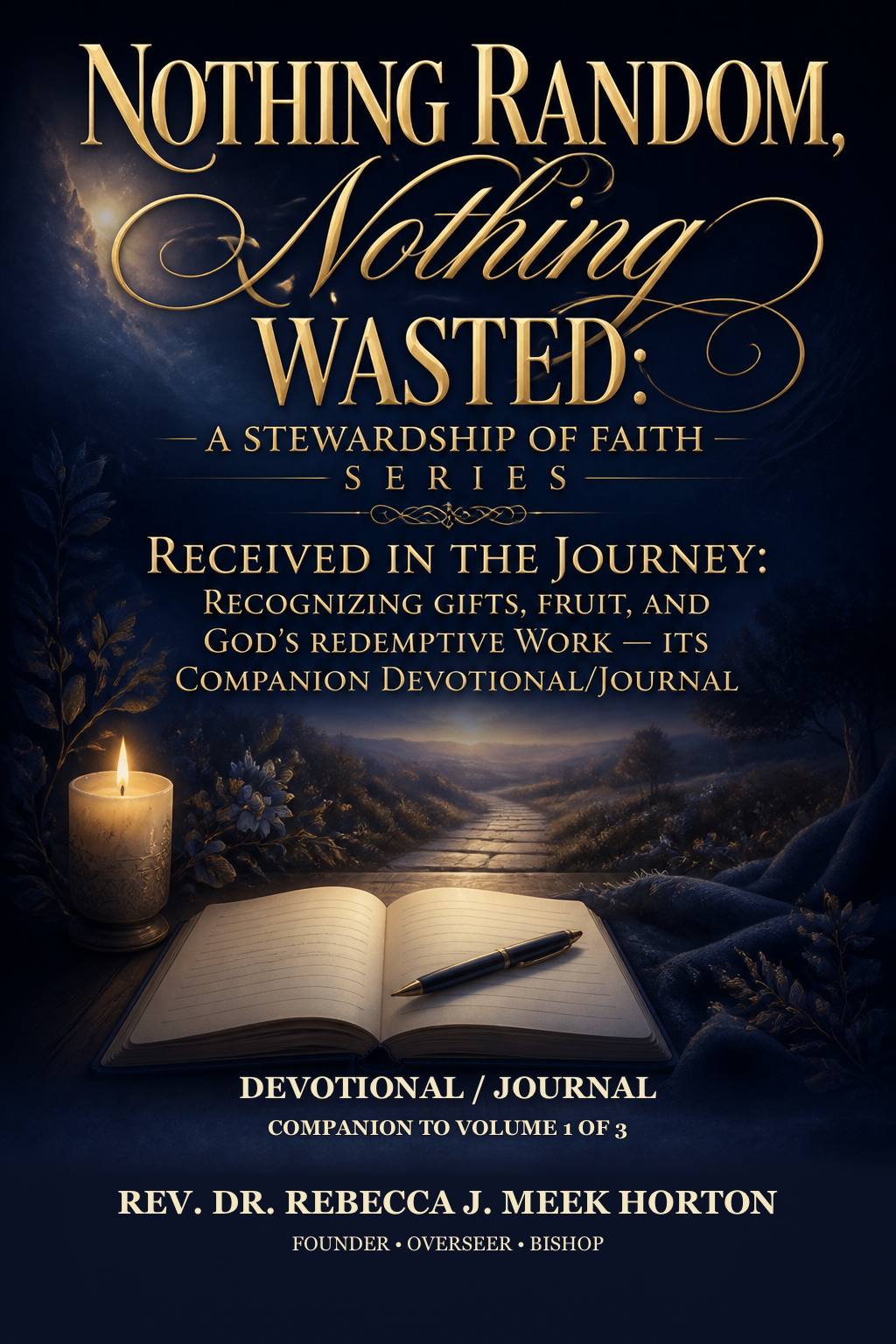
Nothing Random, Nothing Wasted: A Stewardship of Faith Series · Volume 1
Received in the Journey: Recognizing Gifts, Fruit, and God’s Redemptive Work — Its Companion Devotional/Journal
A companion devotional and journal for "Received in the Journey: Recognizing Gifts, Fruit, and God’s Redemptive Work". Each chapter becomes five entries — a KJV Scripture reading, a devotional, a prayer, a journal prompt, and space to write — closing with An Apostolic Prophetic Architect Message and lined journal pages.
Chapter 1 preview
NBCNGMI MASTER KNOWLEDGE LIBRARY Featuring the works of The Sage, Apostle Prophet. Rev. Dr. Rebecca J. Meek Horton, Apostolic Prophetic Architect, NewBeing Creation Network Global Ministries, Inc. Integrated Framework Modalities™
Chapter 1 — When the Journey Has Been Teaching You
Entry 1
Scripture Reading —
Romans 8:28-30 (KJV)
And we know that all things work together for good to them that love God, to them who are the called according to his purpose.
For whom he did foreknow, he also did predestinate to be conformed to the image of his Son, that he might be the firstborn among many brethren.
Moreover whom he did predestinate, them he also called: and whom he called, them he also justified: and whom he justified, them he also glorified.
Devotional —
There are seasons we remember mostly by what hurt. The hospital bracelet. The email. The empty chair. The Sunday we almost stayed home. The conversation that changed something. The door that closed. The version of ourselves that had to keep breathing when we did not know how the next day would look.
Romans 8:28 does not ask us to call all of that good. It teaches us to trust the God who can work in all things for good. That distinction protects our hearts from denial. Faith does not require us to pretend that every moment was right, fair, or easy. Faith gives us courage to say, “This happened, and God was still present.”
Many believers survive a season and then move forward without receiving what God formed in them. Survival says, “I made it through.” Receiving asks, “Lord, what did You develop in me while I was getting through?”
That question matters.
You may have gained patience you did not notice. You may now carry compassion for tired people because you have been tired. You may pray with less performance and more honesty. You may listen better. You may have learned what you will not repeat. You may have learned where your boundaries need wisdom. You may have learned that weakness is not always failure. Sometimes weakness becomes the place where dependence is formed.
The journey has been teaching you, even when you did not have language for the lesson.
Romans 8:29 shows us that God’s redemptive work is not only about changing circumstances. It is about conforming us to the image of His Son. God is forming character, mercy, endurance, humility, discernment, and obedience. He is not wasting the hidden places. He is not limited by what people did wrong. He is not confused by what you still grieve.
This is not a rushed conclusion. Some parts of the journey need time, prayer, wise counsel, and tender processing. Receiving does not mean reopening every wound at once. It means beginning with honest attention.
Look again, gently. Not to relive the pain. Not to excuse what was wrong. Not to force meaning where your heart still needs care. Look again to recognize grace.
Nothing is random. Nothing is wasted.
God is wise enough to bring good out of places you could not repair on your own.
Prayer —
Father, I come to You with honesty today. I do not want to pretend that every part of my journey was good, but I do want to trust that You are good in every part of my journey. Help me see where Your grace sustained me, where Your wisdom corrected me, and where Your Spirit formed something in me that I did not recognize at the time. Teach me to receive without striving and remember without bitterness. Give me courage to name what happened and faith to notice what You are redeeming. I surrender my need to understand everything at once. Lead me into wisdom one faithful step at a time. Amen.
Journal Prompt —
Romans 8:28-30 (KJV) teaches that God works redemptively in the lives of those who love Him. What is one season you survived, and what good work of God can you now begin to recognize in you?
Space to Write —
[Answer Lines]
Entry 2
Scripture Reading —
James 1:2-5 (KJV)
My brethren, count it all joy when ye fall into divers temptations;
Knowing this, that the trying of your faith worketh patience.
But let patience have her perfect work, that ye may be perfect and entire, wanting nothing.
If any of you lack wisdom, let him ask of God, that giveth to all men liberally, and upbraideth not; and it shall be given him.
Devotional —
James does not say the trial feels joyful. He does not tell the believer to enjoy pain, minimize pressure, or spiritualize exhaustion. He says to count it all joy because something is being worked in the believer that the trial itself does not get to control.
“The trying of your faith worketh patience.”
There is work happening beneath the surface.
Sometimes you do not recognize patience while it is being formed. It may not feel like patience. It may feel like waiting longer than you wanted. It may feel like praying the same prayer with fewer words. It may feel like choosing not to quit, even when your emotions are tired. It may feel like doing what love requires when nobody sees the cost.
This is why the journey needs interpretation. Without wisdom, we may only remember the pressure. With wisdom, we begin to see what pressure revealed and what grace developed.
Patience is not passivity. Biblical patience is not pretending nothing matters. Patience is governed endurance. It is strength under God’s leadership. It is the soul learning not to be ruled by urgency, fear, offense, or despair.
Many of us want the trial to end before patience finishes its work. That is human. We want relief. We want clarity. We want the lesson to be quick and the outcome to be clean. But James says, “let patience have her perfect work.” There are some things God forms slowly because they are meant to carry weight later.
You may be stronger than you were, not because the season was easy, but because God kept you. You may be slower to judge because you now understand how complex obedience can feel in hard places. You may be more careful with your words because you know what careless words can do. You may be more dependent on God because self-reliance broke under the weight.
That is not failure. That is formation.
Then James gives a simple invitation: if you lack wisdom, ask God. The journey cannot be interpreted by memory alone. Memory tells you what happened. Wisdom helps you understand what it meant, what it revealed, and how to walk forward.
Ask Him.
Not with performance. Not with shame. Not with pressure to produce a perfect answer.
Ask the Father who gives liberally.
The journey has been teaching you. Wisdom helps you receive the lesson without being defined by the trial.
Prayer —
Father, I ask You for wisdom today. I do not want to come out of hard places with bitterness where patience should be. I do not want to rush past what You have been forming in me. Help me let patience have its work without confusing waiting with abandonment. Show me where endurance has grown, where my faith has been tested, and where I still need healing. Teach me to ask You honestly instead of pretending I already understand. Give me wisdom that is clean, steady, and rooted in Your truth. I trust You to help me receive what the journey has been teaching me. Amen.
Journal Prompt —
James 1:2-5 (KJV) connects tested faith, patience, and wisdom. Where has God been developing patience in you, and what wisdom do you need to ask Him for now?
Space to Write —
[Answer Lines]
Entry 3
Scripture Reading —
2 Corinthians 4:7-10 (KJV)
But we have this treasure in earthen vessels, that the excellency of the power may be of God, and not of us.
We are troubled on every side, yet not distressed; we are perplexed, but not in despair;
Persecuted, but not forsaken; cast down, but not destroyed;
Always bearing about in the body the dying of the Lord Jesus, that the life also of Jesus might be made manifest in our body.
Devotional —
There is comfort in knowing Scripture tells the truth about pressure. Paul does not describe a life untouched by trouble. He says, “troubled on every side.” He says, “perplexed.” He says, “persecuted.” He says, “cast down.”
But he also says, “not distressed,” “not in despair,” “not forsaken,” and “not destroyed.”
This is not denial. This is holy interpretation.
The believer can tell the truth about the weight and still testify that the weight did not have the final word. The pressure was real. The confusion was real. The wound was real. But so was the sustaining grace of God.
Sometimes we think strength means we never felt the trouble. But Paul reminds us that the treasure is carried in earthen vessels. We are not made powerful by pretending to be unbreakable. We are made faithful by depending on the power of God in the middle of our humanity.
You may have looked back at a season and only seen how fragile you were. You may remember tears, fear, silence, disappointment, or fatigue. But look again with wisdom. Was there also grace? Did you keep praying, even if the prayer was short? Did you keep loving, even with trembling hands? Did you get back up? Did you learn to ask for help? Did you discover that God did not forsake you?
That matters.
The journey may have exposed your limits, but exposure is not always condemnation. Sometimes exposure becomes invitation. It shows us where we need God, where we need healing, where we need support, and where we need RE-Calibration™.
There is treasure in you, but it is carried in an earthen vessel. That means you do not have to despise your weakness. You can steward it with humility. You can admit where you are still tender. You can receive care. You can let God strengthen what life strained.
And you can also recognize that something of Christ has been made visible through your endurance. Not because you performed perfectly. Not because you understood everything. But because the life of Jesus kept meeting you in places where your own strength was not enough.
Do not only remember that you were cast down.
Remember that you were not destroyed.
There is formation in that testimony.
Prayer —
Father, I thank You that Your power is not limited by my weakness. I confess that I have often judged myself by how fragile I felt instead of recognizing how faithfully You carried me. Help me tell the truth about trouble without surrendering to despair. Show me where I was troubled but sustained, cast down but not destroyed, pressed but still held by Your grace. Teach me to steward my humanity with humility and receive Your strength without shame. Let the life of Jesus be made visible in me, not through perfection, but through dependence, endurance, and faithful obedience. Amen.
Journal Prompt —
2 Corinthians 4:7-10 (KJV) speaks of being pressed but not destroyed. What pressure have you survived, and where can you now see the sustaining power of God?
Space to Write —
[Answer Lines]
Entry 4
Scripture Reading —
Psalm 139:23-24 (KJV)
Search me, O God, and know my heart: try me, and know my thoughts:
And see if there be any wicked way in me, and lead me in the way everlasting.
Devotional —
Receiving from the journey requires honest attention. Not harsh attention. Not shame-filled attention. Honest attention.
David’s prayer is simple and brave: “Search me, O God.” He does not only ask God to look at his circumstances. He asks God to look within him. His heart. His thoughts. His ways. His direction.
That kind of prayer is not easy, but it is necessary for wisdom.
Many of us can explain what happened to us before we can name what happened in us. We remember the event, the person, the decision, the loss, the disappointment. But we may not notice what formed afterward. Did we become guarded? Did we become discerning? Did we become bitter? Did we become patient? Did we learn truth? Did we learn to hide? Did we learn to pray?
The journey needs interpretation because pain can leave residue. Sometimes what we call protection is really fear. Sometimes what we call discernment is really suspicion. Sometimes what we call strength is really hardness. And sometimes what we called weakness was actually humility being formed.
We need God to search us because we cannot always read ourselves clearly.
This prayer is not an invitation to self-condemnation. The Father is not searching you to destroy you. He searches to lead. David says, “lead me in the way everlasting.” God’s examination is connected to His direction. He reveals what needs healing so He can lead us into wholeness. He reveals what needs correction so we can walk in truth. He reveals what needs surrender so we can move forward with clean hands and a steadier heart.
This is careful work.
You do not have to open every box at once. You do not have to process every painful season in one sitting. Wisdom knows pace. If a memory is too tender, seek wise counsel, pastoral support, or professional help where needed. Faith does not require you to handle everything alone.
But when the Lord invites you to look, do not rush past your own life. There may be grace you missed. There may be wisdom you need. There may be an old agreement that needs to be broken. There may be a new strength that needs to be named.
The prayer “Search me” is a doorway into receiving.
It says, “Father, I trust You enough to let You show me the truth.”
Prayer —
Father, I invite You to search me with mercy and truth. Know my heart. Know my thoughts. Show me what I have misunderstood about my journey. Reveal where I have hardened, where I have healed, where I have grown, and where I still need Your care. I do not want to carry pain without wisdom or call fear protection when You are offering freedom. Lead me in the way everlasting. Help me slow down without becoming stuck. Help me see clearly without condemning myself. I trust Your searching because I trust Your heart. Guide me into truth, healing, and the next faithful step. Amen.
Journal Prompt —
Psalm 139:23-24 (KJV) invites God to search the heart and lead the way. What part of your journey do you need to bring before God honestly, and what do you need Him to show you?
Space to Write —
[Answer Lines]
Entry 5
Scripture Reading —
Isaiah 43:18-19 (KJV)
Remember ye not the former things, neither consider the things of old.
Behold, I will do a new thing; now it shall spring forth; shall ye not know it I will even make a way in the wilderness, and rivers in the desert.
Devotional —
There is a way to remember that keeps us bound, and there is a way to remember that helps us receive.
Isaiah 43 does not erase Israel’s past. God had already reminded His people of His power, deliverance, and covenant faithfulness. But here He tells them not to remain fixed on the former things in a way that blinds them to what He is doing now.
That is a word for the journey.
Some seasons become so large in our memory that they define how we expect the future to behave. If we were disappointed, we expect disappointment. If we were betrayed, we expect betrayal. If we were delayed, we expect every door to close. If we were unseen, we assume we will always have to fight to be recognized.
But God says, “Behold, I will do a new thing.”
Receiving what the journey taught you does not mean living inside the old season. It means gathering the wisdom, honoring the grace, healing what needs healing, and walking forward with God. You do not have to drag the whole wilderness into the next place.
The same God who sustained you there can make a way here.
This is where many believers need RE-Alignment™. We have to separate what happened from what we now believe. We have to ask, “Did this season teach me wisdom, or did it teach me fear?” Sometimes both are present. Wisdom can be kept. Fear must be surrendered. Discernment can remain. Suspicion must be healed. Compassion can grow. Bitterness must be brought into the light.
God does not waste the wilderness. He can make a way there. He can bring rivers in the desert. But the new thing must be recognized.
“Shall ye not know it?”
That question matters because God’s work can be present before we perceive it. A new tenderness. A new hunger for truth. A new courage to obey. A new willingness to rest. A new refusal to perform. A new ability to tell the truth. A new peace that does not depend on everything being resolved.
Look for the new thing.
Not with pressure. Not with fantasy. Not by denying the former season.
Look with faith and wisdom.
The journey has been teaching you, but it was never meant to become your prison. Receive the lesson. Release the weight. Keep walking.
Prayer —
Father, I thank You that You are able to do a new thing. Help me not remain trapped in former things in a way that blinds me to Your present work. Teach me to remember with wisdom, not bondage. Show me what I need to carry forward and what I need to release. Make a way in the wilderness places of my heart. Bring rivers into the dry places where hope has felt thin. Help me recognize new grace, new courage, new obedience, and new strength. I trust You to lead me beyond survival into faithful receiving and forward movement. Amen.
Journal Prompt —
Isaiah 43:18-19 (KJV) points to God’s new work. What former thing has been shaping your expectations, and what new work of God do you need to recognize?
Space to Write —
[Answer Lines]
An Apostolic Prophetic Architect Message
Beloved, the journey has not only carried history. It has carried formation.
You have walked through seasons that looked ordinary to others but carried weight in your soul. Some moments were painful. Some were confusing. Some were costly. Some required obedience when you did not feel strong. But hear this with wisdom: survival was not the whole story. God has been forming, teaching, correcting, strengthening, and refining you in places you may not have had language to name.
This is not the hour to pretend everything was good. Redemption is not denial. Romans 8:28 declares, “And we know that all things work together for good to them that love God, to them who are the called according to his purpose” (KJV). The Scripture says God works in all things for good. It does not call all things good. That is holy distinction. That is wisdom. That is clean ground for faith.
Now you must receive.
Receive the compassion that came through sorrow. Receive the discernment that came through exposure. Receive the humility that came through correction. Receive the patience that came through waiting. Receive the courage that came through obedience. Receive the strength that was formed when you kept walking with God, even when your prayers were short and your heart was tired.
But also release what was never meant to define you. Release shame. Release false identity. Release the agreement that the hardest season gets to name your future. The Lord Jesus is Redeemer. He does not waste what is surrendered to Him.
Isaiah 61:3 says, “To appoint unto them that mourn in Zion, to give unto them beauty for ashes, the oil of joy for mourning, the garment of praise for the spirit of heaviness” (KJV).
Beauty for ashes does not mean there were no ashes. It means ashes did not have the final authority.
So take the next faithful step. Open the box with God, not alone in despair. Look again with Scripture, prayer, wisdom, and support where needed. Ask, “Lord, what have You formed in me that I have not yet received?”
Nothing is random. Nothing is wasted.
The journey has been teaching you. Now walk forward with wisdom.
[Journal Page]
[Journal Page]
This is the opening chapter. The complete publication is available in the full edition.
Back to the library