 NBCNGMI™
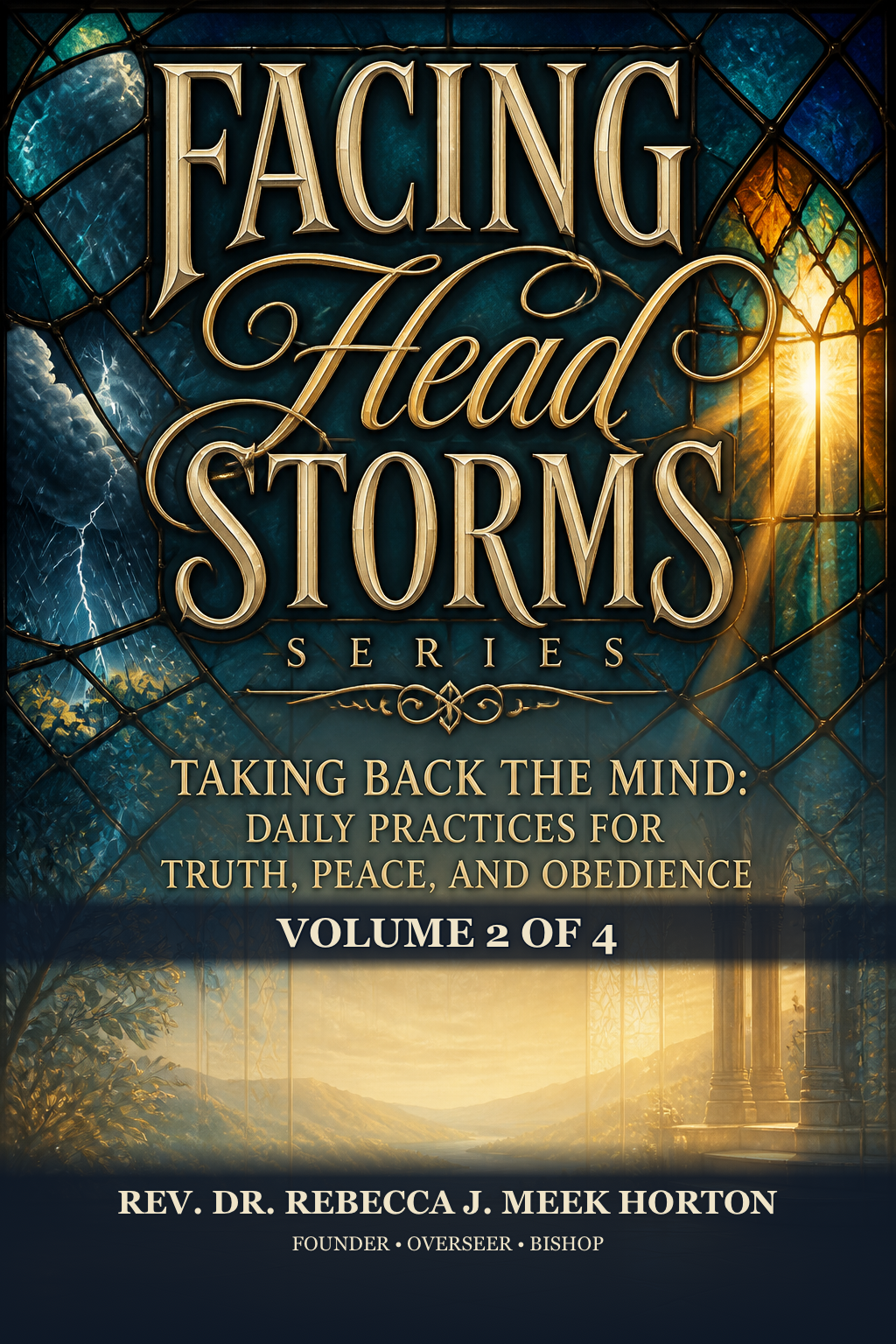
Facing Head Storms · Volume 2
Taking Back the Mind: Daily Practices for Truth, Peace, and Obedience
Part 2 of 4 in the series "Facing Head Storms". Series theme: Ways to facehead storms Series arc: This four-book series moves from recognition to renewal, from renewal to support, and from support to stewardship. The first book helps readers name mental attacks without shame or confusion. The second
Chapter 1 preview
NBCNGMI MASTER KNOWLEDGE LIBRARY Featuring the works of The Sage, Apostle Prophet. Rev. Dr. Rebecca J. Meek Horton, Apostolic Prophetic Architect, NewBeing Creation Network Global Ministries, Inc. Integrated Framework Modalities™
Dedication
I dedicate this book to every mind that has battled noise, fear, pressure, or repeated thoughts and still desires to obey God. May these pages help you return to truth daily, guard your peace with humility, and take the next faithful step without shame.
Purpose
I wrote this book to help you move from naming the head storm to practicing a steady, Scripture-shaped response each day. My prayer is that these pages teach you to guard your mind with truth, prayer, worship, confession, rest, wise self-talk, and obedient action without pretending discipline is a quick fix. May you learn to bring every anxious, accusing, or confusing thought before God, renew your mind through His Word, and keep the next faithful step with peace and responsibility.
Preface
This book came from a pastoral burden: people were learning to name the storm, but many still needed a daily way to stand inside it.
After the first book in Facing Head Storms, I kept thinking about the person who says, “I know this thought is attacking me, but what do I do next?” Recognition matters, but recognition alone is not renewal. Once we can name the mental attack without shame, we must learn how to respond with truth, prayer, Scripture, worship, rest, confession, and wise action.
Taking Back the Mind is not a quick fix. I do not believe in shaming people into peace or pretending that one verse, one prayer, or one good day removes every battle. Some storms require pastoral care, wise counsel, medical support, therapy, family support, and time. Seeking help is not weakness. It can be stewardship.
But I also believe the mind can be trained in truth. I believe Scripture can be hidden in the heart. I believe prayer can interrupt panic. I believe worship can shift the atmosphere. I believe confession can clear the soul. I believe daily obedience matters, even when feelings are still loud.
Philippians 4:6-8 (KJV) Be careful for nothing; but in every thing by prayer and supplication with thanksgiving let your requests be made known unto God. And the peace of God, which passeth all understanding, shall keep your hearts and minds through Christ Jesus. Finally, brethren, whatsoever things are true, whatsoever things are honest, whatsoever things are just, whatsoever things are pure, whatsoever things are lovely, whatsoever things are of good report; if there be any virtue, and if there be any praise, think on these things.
That is the heart of this book.
We are not taking back the mind by force of personality. We are learning to bring the mind under the care and authority of Christ. We are learning to pause, tell the truth, reject the lie, receive peace, and take the next faithful step.
Read slowly. Practice honestly. Do not despise small beginnings. A renewed mind is often formed one obedient thought, one prayed prayer, one surrendered moment, and one Scripture-held decision at a time.
Nothing is random. Nothing is wasted. God can meet you in the storm and teach you how to walk in peace.
Introduction
A head storm can be loud on the inside while everything outside looks normal.
A student may sit in class and fight thoughts nobody can see. A parent may cook dinner while carrying fear about a child. A minister may preach truth and still have to answer accusation in the private place. An educator may hold a room together while their own mind feels crowded. This is why we must learn more than how to name the storm. We must learn how to respond.
This book is Part 2 in the Facing Head Storms series. The first book helped you recognize mental attacks without shame or confusion. This book takes the next step. It teaches daily practices for guarding the mind through Scripture, prayer, truth, worship, rest, confession, wise self-talk, and faithful action.
The argument is simple: taking back the mind does not mean you control every thought that enters. It means you learn to steward your response under God’s truth.
Romans 12:2 (KJV)
And be not conformed to this world: but be ye transformed by the renewing of your mind, that ye may prove what is that good, and acceptable, and perfect, will of God.
Renewal is not magic. It is not pretending. It is not shouting over pain. It is the steady practice of bringing the mind back to truth when fear, accusation, confusion, temptation, or despair tries to take the lead.
Some storms lift quickly. Some must be walked through with patience, counsel, treatment, support, and daily obedience. This book will not shame you for needing help. Prayer and Scripture are vital, and wise pastoral care, safe community, medical support, counseling, and appropriate professional help can also be part of faithful stewardship. Mental illness, trauma, grief, fatigue, and intrusive thoughts are not proof that you are spiritually inferior.
Still, you are not helpless.
God gives His people practices that train attention, strengthen trust, and interrupt destructive patterns. Philippians 4 does not deny anxiety. It teaches us what to do with it.
Philippians 4:6-8 (KJV)
Be careful for nothing; but in every thing by prayer and supplication with thanksgiving let your requests be made known unto God. And the peace of God, which passeth all understanding, shall keep your hearts and minds through Christ Jesus. Finally, brethren, whatsoever things are true, whatsoever things are honest, whatsoever things are just, whatsoever things are pure, whatsoever things are lovely, whatsoever things are of good report; if there be any virtue, and if there be any praise, think on these things.
Notice the order. Bring the real request to God. Receive the keeping peace of God. Then practice directing the mind toward what is true, honest, just, pure, lovely, and worthy of praise.
That is not denial. That is discipline with dependence.
As you read, do not rush. Keep your Bible near. Keep a notebook if you can. Each chapter will give you one teachable idea and one practice. Do not try to master everything at once. Learn the truth. Internalize it. Focus it into one aim. Execute one faithful step.
Isaiah 26:3 (KJV)
Thou wilt keep him in perfect peace, whose mind is stayed on thee: because he trusteth in thee.
A stayed mind is not an untouched mind. It is a mind brought back again and again to the Lord.
Psalm 119:11 (KJV)
Thy word have I hid in mine heart, that I might not sin against thee.
This is how we begin taking back the mind: not by panic, not by shame, and not by willpower alone, but by hiding truth deeply enough that it can answer the storm.
Before you continue, take one quiet minute. Name one thought pattern you need to bring under God’s truth. Write it plainly. Then pray: Lord, teach me to renew my mind, guard my peace, and obey You one step at a time.
Chapter 1 — When the Storm Moves Inside
The first time you name a head storm, there may be relief.
You finally have language for what has been happening. The racing thoughts. The accusing thoughts. The sudden fear. The pressure in your chest. The old memory that shows up without invitation. The sentence that keeps repeating your mind until it feels stronger than truth.
You may say, “This is a mental attack. This is not my identity. This is not the whole truth.”
That matters.
But then morning comes.
The same thought may return while you are brushing your teeth. The same fear may sit beside you in the car. The same pressure may rise while you are teaching, parenting, studying, preaching, working, or trying to sleep. Naming the storm did not make the sky clear forever.
This is the honest starting place of this book: after a mental attack is named, the mind still needs daily guarding.
Recognition is a beginning, not a complete practice. It helps you see what is happening. But once you see it, you must learn how to respond with truth, peace, and obedience. Not with panic. Not with shame. Not with endless self-analysis. Not with pretending everything is fine.
The mind must be stewarded.
Philippians gives us a doorway into that stewardship.
Philippians 4:6-8 (KJV)
Be careful for nothing; but in every thing by prayer and supplication with thanksgiving let your requests be made known unto God. And the peace of God, which passeth all understanding, shall keep your hearts and minds through Christ Jesus. Finally, brethren, whatsoever things are true, whatsoever things are honest, whatsoever things are just, whatsoever things are pure, whatsoever things are lovely, whatsoever things are of good report; if there be any virtue, and if there be any praise, think on these things.
This passage does not shame the anxious person. It teaches the anxious person what to do with anxiety.
Bring it to God.
Receive His keeping peace.
Then practice thinking on what is true, honest, just, pure, lovely, and worthy of praise.
That is not a quick fix. It is a daily return.
Naming Is Not the Same as Guarding
A person can recognize a thief and still leave the door unlocked.
That is how many of us treat the mind. We finally recognize the pattern. We say, “This is fear.” “This is shame.” “This is accusation.” “This is not from God.” But then we leave the same gates open all day.
We feed the fear with more fear. We rehearse the shame. We scroll until our spirit is crowded. We replay the conversation ten times. We seek five opinions but never sit with God. We call it processing, but sometimes we are practicing the very thought that is hurting us.
Recognition gives language. Guarding gives order.
Proverbs speaks plainly about the inner life.
Proverbs 4:23 (KJV)
Keep thy heart with all diligence; for out of it are the issues of life.
To keep the heart is to guard the inner place where thoughts, desires, motives, and responses begin to form. It does not mean we can control every thought that enters the mind. It does mean we can learn not to give every thought a chair, a microphone, and authority.
Think of a school building.
A wise school does not treat every visitor as safe just because they walked through the door. There is a front office. There is a check-in process. There are boundaries. A person must be identified before they are allowed access to children, classrooms, and staff.
The mind needs a similar kind of stewardship.
Not every thought deserves access to your decisions.
Not every feeling should be allowed to interpret God.
Not every memory should be permitted to define your future.
Not every accusation should be received as truth.
This is not denial. It is discernment.
A minister may wake up on Sunday morning with the thought, “You have nothing worth saying.” A student may sit before an exam and think, “You are going to fail like always.” A parent may hear, “You have ruined your child.” An educator may carry, “Nothing you do matters.” A young person may feel, “I am too broken to be helped.”
Those thoughts may feel personal. They may feel convincing. But feeling strong does not make them sovereign.
A thought can be loud and still be false.
A thought can be familiar and still be destructive.
A thought can come from pain and still need correction.
Daily guarding begins when we stop treating every inner sentence as a final verdict.
This is where RE-Language™ helps us move from shame to responsibility.
Not, “My mind is a mess, so I am hopeless.”
But, “My mind is under pressure, so I need faithful guarding.”
Not, “I should never struggle.”
But, “When struggle rises, I can return to truth.”
Not, “This thought is me.”
But, “This is a thought I must test.”
That shift matters. Shame pushes us into hiding. Responsibility brings us back into stewardship.
The Mind Needs a Daily Gate
Philippians 4 does not begin with pretending. It begins with bringing.
“Be careful for nothing” does not mean, “Nothing hard is happening.” It means anxiety is not meant to govern the believer’s inner life. The trouble may be real, but it does not get to become lord.
The instruction is simple and searching: “in every thing by prayer and supplication with thanksgiving let your requests be made known unto God.”
In everything.
Not just in church matters. Not just in large crises. Not just when we have already calmed down enough to sound spiritual.
In the email you are afraid to open.
In the diagnosis you do not understand.
In the classroom where you feel overwhelmed.
In the child you are worried about.
In the ministry assignment that feels too heavy.
In the private thought you are ashamed to admit.
In everything, bring it to God.
A gate is a place of exchange. What comes in is examined. What goes out is directed. Prayer becomes a holy gate for the mind because it interrupts the inward spiral and brings the matter before God.
Without that gate, the mind often builds its own courtroom.
Fear becomes the prosecutor.
Pain becomes the witness.
Shame becomes the judge.
The soul sits there receiving sentence after sentence: guilty, forgotten, abandoned, incapable, unsafe, unwanted.
Prayer opens another court.
God is present. His Word has authority. His mercy speaks. His wisdom leads. His peace keeps.
This does not mean every emotion disappears at once. Many sincere believers have prayed through tears and still felt trembling in the body. Many have asked God for peace and still needed wise counsel, pastoral support, medical care, therapy, rest, or practical help. That is not spiritual failure. It is human stewardship.
Prayer is not a denial of care. Prayer is the first act of dependence.
Imagine a parent whose child comes home from school upset. The child’s words spill out quickly: “Nobody likes me. I am stupid. I never do anything right.” A wise parent does not mock the child for feeling deeply. But neither does the parent confirm every sentence as truth.
The parent slows the moment.
“What happened?”
“What did someone say?”
“What is true?”
“What do we need to do next?”
The child is not helped by being shamed. The child is helped by being guided.
Your mind also needs guidance.
When fear speaks in absolutes, prayer helps you slow down. When anxiety says, “Everything is falling apart,” prayer helps you bring the actual matter to God. When shame says, “You are finished,” prayer helps you remember mercy. When pressure says, “Decide now,” prayer helps you refuse to be mastered by urgency.
The daily gate does not have to be complicated.
It may begin with one honest sentence: “Lord, this is what is in my mind right now.”
Then another: “Help me see what is true.”
Then another: “Lead me in the next faithful step.”
Small prayers are still prayers. Honest prayers are still prayers. Trembling prayers are still prayers.
Peace Is More Than a Feeling
Philippians promises something that cannot be manufactured by human effort.
Philippians 4:7 (KJV)
And the peace of God, which passeth all understanding, shall keep your hearts and minds through Christ Jesus.
The peace of God is not the same as having every question answered.
It “passeth all understanding.” That means it is not limited to what you can explain. It is not dependent on the mind having a full map. It is not fragile enough to disappear every time life becomes hard.
This peace keeps.
The word picture is strong. Peace stands guard over the heart and mind through Christ Jesus. God’s peace is not passive. It protects. It surrounds. It holds the inner life when circumstances are not yet resolved.
But here is where we must be honest. Many people want peace without practice.
They want peace to arrive while they continue feeding panic. They want peace while refusing truth. They want peace while rehearsing resentment. They want peace while ignoring counsel. They want peace while staying in patterns that keep the mind inflamed.
God is merciful, but He is also wise. Peace is a gift, and we must learn to live in a way that agrees with the gift.
If someone receives medicine but keeps drinking poison, the body remains under attack. In the same way, if we ask God for peace but continue to consume, rehearse, and obey what strengthens fear, we make the battle harder than it needs to be.
This is not blame. It is a call to stewardship.
There are head storms we did not choose. Trauma may leave traces. Grief may come in waves. Anxiety may involve the body as well as the mind. Depression may make simple steps feel heavy. Intrusive thoughts may arrive unwanted. These realities require compassion, patience, and sometimes skilled care.
But even there, daily practice matters.
Practice does not mean instant control. Practice means faithful return.
Return to prayer.
Return to truth.
Return to wise counsel.
Return to what is actually yours to do.
Return to the next faithful step.
A musician does not practice scales because the concert has already started. The musician practices before the pressure so the hands know where to go when the pressure comes. An athlete does not train only on game day. A teacher does not prepare only after students enter the room. A minister does not build a prayer life only when the pulpit feels heavy.
The mind also needs training before the storm is at full strength.
Peace is not earned by practice. Peace is guarded through practice.
There is a difference.
We do not practice to force God to be faithful. We practice because God is faithful, and we want our inner life to come under His truth.
What You Think On Will Train You
Philippians 4:8 brings the mind into focus.
It does not say, “Think about whatever enters first.”
It does not say, “Think about whatever fear presents.”
It does not say, “Think about whatever accusation repeats.”
It says to think on what is true, honest, just, pure, lovely, of good report, virtuous, and praiseworthy.
This is not positive thinking in a shallow sense. It is truth-governed thinking.
The difference matters.
Positive thinking may say, “Nothing bad will happen.”
Truth-governed thinking says, “Even if trouble comes, God is present, and I can obey Him in the next step.”
Positive thinking may say, “I am amazing at everything.”
Truth-governed thinking says, “I am God’s workmanship, and I can grow with humility.”
Positive thinking may say, “I should never feel afraid.”
Truth-governed thinking says, “Fear is present, but fear will not be my master.”
The goal is not to flatter the mind. The goal is to govern it with truth.
A garden will grow something. If it is not tended, weeds do not ask permission. They simply spread. The gardener does not scream at the soil because weeds appeared. The gardener returns with tools, patience, and attention. Pull what does not belong. Plant what is good. Water what should live.
Your thought life is not a machine. It is more like a garden.
It needs daily tending.
If you continually think on accusation, accusation grows. If you continually think on worst-case outcomes, fear grows. If you continually think on offense, bitterness grows. If you continually think on failure, despair grows.
But if you return to what is true, truth is strengthened.
If you return to what is honest, deception loses room.
If you return to what is just, your responses become cleaner.
If you return to what is pure, your desires are corrected.
If you return to what is lovely and of good report, gratitude has soil.
If you return to what is praiseworthy, worship begins to reorder attention.
This is why mental attacks cannot only be answered in crisis. Crisis practice matters, but daily practice builds capacity.
Second Corinthians gives us language for the battle.
2 Corinthians 10:4-5 (KJV)
For the weapons of our warfare are not carnal, but mighty through God to the pulling down of strong holds; Casting down imaginations, and every high thing that exalteth itself against the knowledge of God, and bringing into captivity every thought to the obedience of Christ;
Notice the movement. Imaginations are cast down. Thoughts are brought into captivity. The goal is obedience to Christ.
This is not about attacking people. It is about refusing to let lies rule the inner life.
A student who keeps thinking, “I cannot learn,” may stop trying before the lesson begins. A parent who keeps thinking, “There is no hope for this child,” may lose tenderness and wisdom. A leader who keeps thinking, “I must carry everything alone,” may become controlling, exhausted, or resentful. A believer who keeps thinking, “God is disappointed in me all the time,” may avoid the very presence where mercy is found.
Thoughts train responses.
Responses become patterns.
Patterns shape character.
Character affects stewardship.
That is why the mind matters.
The Cost of Daily Guarding
Daily guarding sounds simple until you have to do it while tired.
This is the cost.
It asks you to stop letting your mind run unattended. It asks you to pause before agreeing with fear. It asks you to test thoughts instead of becoming them. It asks you to bring anxiety to God when you would rather rehearse it. It asks you to choose truth when the lie feels familiar. It asks you to practice peace before you feel peaceful.
It also asks for humility.
You may have to admit, “I have been feeding this storm.”
You may have to confess, “I have allowed pain to interpret God.”
You may have to say, “I need help.”
You may have to turn off what keeps agitating your mind.
You may have to set a boundary with a conversation, habit, or environment.
You may have to seek counsel from a mature believer, pastor, mentor, educator, doctor, or licensed professional.
That is not weakness. That is stewardship.
Wisdom-centered practice does not create dependency. It builds maturity. The goal is not for someone else to think for you, pray for you, decide for you, and carry you forever. The goal is that you become more able to walk with God in truth, humility, counsel, and obedience.
There will be days when your practice feels strong.
There will be days when it feels small.
Keep the next faithful step.
Do not despise small obedience. A guarded morning can change the direction of a day. One honest prayer can interrupt a spiral. One Scripture remembered can answer one lie. One wise conversation can prevent one harmful decision. One moment of thanksgiving can loosen fear’s grip.
God often forms steadiness through repeated returns.
Not performance.
Return.
Not panic.
Return.
Not shame.
Return.
The storm may move inside, but it does not have to rule inside.
Christ is not absent from the life of the mind. His peace can keep the heart and mind. His truth can govern thought. His wisdom can guide the next step.
Key Takeaways
• Naming the head storm is a beginning; daily guarding is the practice.
• Prayer becomes a holy gate where anxiety is brought before God.
• What you think on will train how you respond.
Practice
Today, take ten quiet minutes with Philippians 4:6-8.
Write four short answers:
• What anxious thought or mental pressure is present today?
• What request do I need to make known unto God?
• What is one true, honest, and praiseworthy thought I can return to today?
• What is one obedient next step I can take before the day ends?
Then pray this simply:
Lord, I bring You what is in my mind. Help me not to be ruled by fear, shame, or accusation. Teach me to receive Your peace, think on what is true, and take the next faithful step in obedience. Amen.
This is the opening chapter. The complete publication is available in the full edition.
Back to the library