The Grace Blueprint Series · Volume 3
Guard Your TRUST
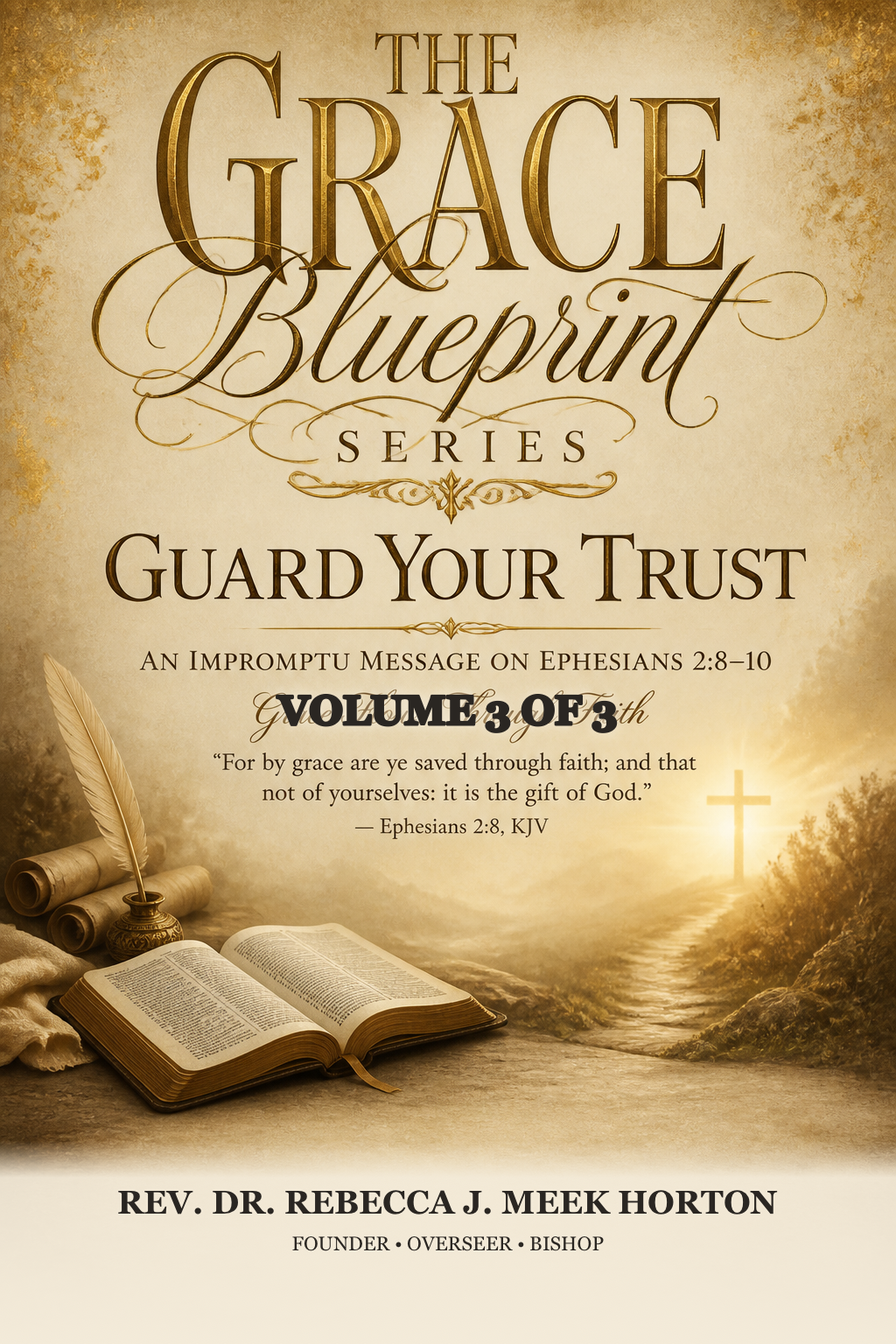
The importance of intentionally guarding your trust in GOD through His Word and your personal relationship with GOD. AN IMPROMPTU MESSAGE ON EPHESIANS 2:8–10 GUARD YOUR TRUST Grace Flows Through Faith “For by grace are ye saved through faith; and that not of yourselves: it is the gift of God.” — Ephesians 2:8, KJV The Sage, Apostle Prophet REV. DR. REBECCA J. MEEK HORTON Founder • Overseer • Bish
Chapter 1 preview
NBCNGMI MASTER KNOWLEDGE LIBRARY Featuring the works of The Sage, Apostle Prophet. Rev. Dr. Rebecca J. Meek Horton, Apostolic Prophetic Architect, NewBeing Creation Network Global Ministries, Inc. Integrated Framework Modalities™
Dedication
I dedicate this book to every believer who has had to trust God in the dark, in the delay, and in the place where answers did not come quickly. May you guard your trust, stand on His Word, and remember that the God who saved you by grace is faithful to sustain you by grace.
Purpose
I wrote this book to call believers back to the place where grace is received and trust is guarded: “For by grace are ye saved through faith; and that not of yourselves: it is the gift of God” (Ephesians 2:8, KJV). My prayer is that these pages help you answer lies with Scripture, steady your mind in the character of God, and keep trusting Him when the path is difficult. I want you to remember that grace is the gift, faith receives, trust leans, obedience walks, and God remains faithful.
Preface
This book began in the quiet hours of the morning, when the house was still and my heart was turned toward the Word of God.
On August 25, 2026, at 1:35 a.m., I recorded an impromptu message from Ephesians 2:8–10. I had opened a journal and found these words before me:
“For by grace are ye saved through faith; and that not of yourselves: it is the gift of God.” Ephesians 2:8, KJV
That verse arrested me again.
Grace is the gift. Faith receives. Trust leans. Obedience walks.
I have taught on faith many times, but this message pressed into one particular place: trust. Not only believing that God is real, but guarding our trust in who God is when life becomes painful, confusing, delayed, or difficult.
It is one thing to trust God when the path is bright. It is another thing to trust Him in the prison process, in the waiting season, in the unanswered question, in the place where the enemy tries to make God seem unfaithful. That is where many believers quietly struggle. They still love God, but their trust has been wounded by disappointment, trauma, accusation, loss, or fear.
This book is written for that place.
It is not written to shame the hurting. It is not written to pretend that suffering is simple. Mental illness, trauma, sickness, grief, and deep wounds are not proof that a believer is spiritually inferior. Prayer, Scripture, pastoral care, wise counsel, Christian community, and appropriate professional support can walk together responsibly.
But even in the mess, our trust must be guarded.
The enemy still asks, “Yea, hath God said?” He still attacks the truthfulness of God’s Word and the goodness of God’s character. We must learn to answer lies with truth, not with panic, pride, or fear.
My prayer is that this book will help you return to the Word, strengthen your personal relationship with God, and stand more steadily in grace.
As you read, do not rush. Read with your Bible open. Ask the Lord to show you where trust has been weakened, where lies have been entertained, and where truth must be restored.
Guard your trust.
God is trustworthy.
Introduction
This book begins with a simple verse and opens into a necessary charge: guard your trust.
Ephesians 2:8–10 says, “For by grace are ye saved through faith; and that not of yourselves: it is the gift of God: Not of works, lest any man should boast. For we are his workmanship, created in Christ Jesus unto good works, which God hath before ordained that we should walk in them” (KJV).
That is the foundation. Grace is the gift. Faith receives. Trust leans. Obedience walks.
This book is not written to make faith complicated. It is written to help believers see where trust is being tested, where lies are being entertained, where pain has started interpreting God’s character, and where the Word of God must become the governing voice again.
Many believers believe in God, but still struggle to trust Him when life becomes painful, delayed, confusing, or unjust. We may trust Him in the blessing but question Him in the prison. We may rejoice when doors open but wonder if He has abandoned us when doors close. We may know Scripture in memory, yet still allow fear, shame, disappointment, trauma, or accusation to speak louder than truth.
That is why trust must be guarded intentionally.
The enemy’s attack in the garden was not only against Eve’s behavior. It was against her trust in the Word and goodness of God. “Yea, hath God said?” became the opening for suspicion. If trust is weakened, disobedience can begin to look like protection. If God’s character is questioned long enough, fear can start sounding wise.
Guard Your TRUST calls the believer back to the revealed character of God. Not fantasy. Not denial. Not pretending pain is painless. True faith does not require us to call evil good or act as though wounds do not matter. Joseph’s brothers meant evil against him, but God worked redemptively through what they did not have the authority to define. Genesis 50:20 says, “But as for you, ye thought evil against me; but God meant it unto good” (KJV).
This is one of the central arguments of the book: difficulty is not automatic proof that God has stopped guiding you. Psalm 37:23–24 says, “The steps of a good man are ordered by the LORD: and he delighteth in his way. Though he fall, he shall not be utterly cast down: for the LORD upholdeth him with his hand” (KJV). Ordered steps and falling appear in the same testimony. The Lord’s guidance does not remove every hard place, but His hand upholds His people in the hard place.
Read this book slowly. Do not rush to finish it. Let the Scriptures search you. Let the examples sit with you. When a sentence exposes a lie you have been carrying, pause. Write it down. Bring it into prayer. Answer it with the Word of God.
This book will ask something of you. It will ask you to stop letting circumstances have the final word about God. It will ask you to examine thoughts instead of obeying every thought. It will ask you to forgive without denying wisdom, to wait without surrendering hope, and to trust without demanding control of every outcome.
That cost is real. But the fruit is maturity.
As you read, keep a Bible near you. Keep a journal if you can. Begin building your own Scripture Tactical Attack Kit. Name the recurring lie. Find the Scripture that answers it. Speak the truth. Pray the truth. Practice the next obedient step.
Do not read only to agree. Read to be strengthened.
Do not read only to receive comfort. Read to become steady.
Do not read only to remember what God has done. Read to trust who God is.
Proverbs 3:5–6 gives the path plainly: “Trust in the LORD with all thine heart; and lean not unto thine own understanding. In all thy ways acknowledge him, and he shall direct thy paths” (KJV).
Begin there.
Before you turn the page, ask yourself this one question: What lie, fear, wound, or unanswered question has been trying to weaken my trust in God?
Name it honestly. Then bring it under the truth of His Word.
Chapter 1 — When Trust Is Under Attack
The first crack in a wall is often small.
You may not notice it at first. The paint still looks smooth. The room still feels safe. But water has found an opening. Pressure is working behind what can be seen. If it is ignored, the crack widens. What began as a line becomes damage.
Trust can be attacked that way.
Many believers expect spiritual attack to arrive loud, dark, and obvious. Sometimes it does. But often the first assault is quieter. It does not begin by saying, “Stop believing in God.” It begins by asking whether God can be trusted.
That is the controlling truth of this chapter: the enemy often attacks the trustworthiness of God before he attacks belief in God.
If your trust in God’s Word is weakened, obedience begins to look unreasonable. If your trust in God’s goodness is weakened, sin begins to look like self-protection. If your trust in God’s timing is weakened, impatience begins to feel wise.
This is why we must guard our trust.
The First Question
The first recorded temptation in Scripture did not begin with a denial of God’s existence. It began with a question about God’s Word.
Genesis 3:1–5 (KJV)
Now the serpent was more subtil than any beast of the field which the LORD God had made. And he said unto the woman, Yea, hath God said, Ye shall not eat of every tree of the garden?
And the woman said unto the serpent, We may eat of the fruit of the trees of the garden:
But of the fruit of the tree which is in the midst of the garden, God hath said, Ye shall not eat of it, neither shall ye touch it, lest ye die.
And the serpent said unto the woman, Ye shall not surely die:
For God doth know that in the day ye eat thereof, then your eyes shall be opened, and ye shall be as gods, knowing good and evil.
Notice the movement.
First, the serpent questions what God said.
Then he contradicts what God said.
Then he suggests that God is withholding something good.
The attack is not only against information. It is against trust.
God had already spoken.
Genesis 2:16–17 (KJV)
And the LORD God commanded the man, saying, Of every tree of the garden thou mayest freely eat:
But of the tree of the knowledge of good and evil, thou shalt not eat of it: for in the day that thou eatest thereof thou shalt surely die.
God’s command included both generosity and boundary.
“Of every tree of the garden thou mayest freely eat.” That is abundance.
“But of the tree of the knowledge of good and evil, thou shalt not eat of it.” That is boundary.
The serpent’s question shifted attention away from God’s generosity and toward the restriction. “Yea, hath God said, Ye shall not eat of every tree of the garden?”
That is how suspicion often works. It magnifies what God has withheld until we forget what God has freely given.
A simple example may help. A parent prepares a whole table of food for a child but says, “Do not touch that hot pan.” The boundary is not hatred. It is protection. But if someone whispers, “Why does your parent keep things from you?” the child may begin to see love as control.
That is what happened in the garden. The serpent framed God’s boundary as if it were deprivation.
Guarding trust begins with remembering the whole truth, not only the part that feels restrictive.
Suspicion Changes How We Hear
Suspicion does not always change the words first. Sometimes it changes the way we hear the words.
A command that once sounded protective begins to sound harsh.
A delay that once required patience begins to feel like rejection.
A closed door that may be mercy begins to feel like punishment.
A correction that could save our life begins to feel like an attack.
This is why trust matters. Trust shapes interpretation.
If a trusted doctor says, “This medicine may taste bitter, but it is necessary,” we receive the bitterness differently. If a stranger with bad motives says the same thing, we may resist. The words may be similar, but trust changes how we respond.
The serpent worked to change how Eve heard God.
“Ye shall not surely die” directly opposed God’s warning. Then came the deeper accusation: “For God doth know...” In other words, God knows something He is not telling you. God is keeping you from becoming what you could be. God’s command is not for your good.
That suggestion still appears in different forms.
It may sound like this:
“God is holding you back.”
“Obedience is costing you too much.”
“If God loved you, this would not be so hard.”
“You need to take control because God is moving too slowly.”
“His Word may be true for others, but your situation is different.”
The language changes. The root is old.
The enemy wants the believer to stand before God’s Word with suspicion instead of surrender.
This does not mean Christians should never ask questions. Honest questions can be part of spiritual growth. Scripture is not afraid of sincere seeking. But there is a difference between asking in order to understand and questioning in order to escape obedience.
Mary asked, “How shall this be?” when the angel announced what God would do through her. That was not rebellion. It was a question seeking understanding.
The serpent’s question was not seeking truth. It was sowing distrust.
We must learn the difference.
A sincere question brings us closer to God’s truth.
A corrosive question pulls us away from trusting God’s character.
A sincere question says, “Lord, help me understand so I can obey.”
A corrosive question says, “I will not obey unless God explains Himself to my satisfaction.”
That difference matters.
The Trustworthiness of God’s Word
To guard trust, we must settle this: God’s Word is trustworthy because God is trustworthy.
Scripture does not present God as unstable, deceptive, or careless. His Word carries His character.
Numbers 23:19 (KJV)
God is not a man, that he should lie; neither the son of man, that he should repent: hath he said, and shall he not do it? or hath he spoken, and shall he not make it good?
This verse is not a slogan. It is a foundation.
God does not lie.
God does not manipulate.
God does not speak in order to mislead His people.
When God warns, His warning is faithful. When God commands, His command is not random. When God withholds, He is not being cruel. When God gives, He gives with wisdom. When God says no, His no is not evidence that He has stopped loving us.
Every word of God is pure.
Proverbs 30:5 (KJV)
Every word of God is pure: he is a shield unto them that put their trust in him.
There is that word again: trust.
God’s Word is not given merely to be admired. It is given to be trusted, received, and obeyed.
This is where many believers experience pressure. We may believe the Bible is true in a general sense, but struggle to trust God’s Word in a personal place.
We believe God forgives, but we struggle to trust Him with our shame.
We believe God guides, but we struggle to trust Him with decisions.
We believe God provides, but we struggle to trust Him when resources feel uncertain.
We believe God loves, but we struggle to trust Him when we feel unseen.
That struggle does not mean a believer is fake. It means trust is being tested.
The question is not whether a difficult thought ever comes. The question is what we do with it when it comes.
Do we let suspicion become the teacher?
Do we let fear interpret God?
Do we let pain rewrite Scripture?
Or do we bring the thought back under the truth that God has already revealed?
Guarding trust does not mean pretending life is easy. It means refusing to let the serpent’s question become the governing voice.
The Doorway From Distrust to Disobedience
Sin often enters through a doorway that distrust has opened.
Before the hand reaches, the heart shifts.
Before the action happens, the interpretation changes.
Before disobedience looks desirable, God’s command begins to look doubtful, unfair, or unnecessary.
That is why the garden matters for us. It shows the anatomy of temptation.
First, God’s Word is questioned.
Second, God’s Word is contradicted.
Third, God’s motive is accused.
Fourth, disobedience is presented as gain.
The fruit did not change. The command did not change. God did not change. But the way Eve saw the fruit changed once trust was weakened.
Genesis 3:6 (KJV)
And when the woman saw that the tree was good for food, and that it was pleasant to the eyes, and a tree to be desired to make one wise...
We will stop there for now because this chapter is not mainly about the full consequence of the fall. It is about the trust attack that came first.
A believer may face a similar pattern.
A relationship God has warned against begins to look like comfort.
A dishonest opportunity begins to look like provision.
A bitter response begins to look like justice.
A hidden habit begins to look like relief.
A delayed obedience begins to look like wisdom.
When trust is unguarded, temptation does not have to announce itself as rebellion. It can dress itself as need, logic, fairness, or self-care.
That is why we must be awake.
Not anxious. Awake.
Not suspicious of everything. Discerning.
Not afraid of life. Anchored in God.
The goal is not to live tense and fearful, looking for the enemy behind every ordinary moment. The goal is to live close enough to God’s Word that we recognize when a voice is trying to make Him seem untrustworthy.
Jesus said in John 10:27 (KJV), “My sheep hear my voice, and I know them, and they follow me.”
The believer grows by learning the Shepherd’s voice.
A strange voice may be loud. A familiar fear may be persuasive. A repeated lie may feel believable. But none of those voices deserves the place that belongs to God.
The Cost of Guarding Trust
Guarding trust has a cost.
It will cost you the comfort of suspicion.
Suspicion can feel powerful because it keeps you from surrender. It lets you stand back, accuse, and delay obedience. But suspicion cannot produce peace. It cannot produce intimacy with God. It cannot produce faithful living.
Guarding trust will cost you the right to make your circumstances the judge of God’s character.
There will be days when life hurts. There will be prayers that seem unanswered longer than you expected. There will be commands that confront your preferences. There will be seasons when obedience feels costly and the fruit is not yet visible.
In those moments, guarding trust means saying, “I do not understand all of this, but I will not accuse God of being unfaithful.”
Guarding trust will also cost you the habit of feeding every voice that feeds doubt.
Some conversations do not help you seek truth. They only train your soul to rehearse suspicion. Some content does not strengthen discernment. It weakens reverence. Some inner narratives do not lead to honest repentance or wise action. They lead to distance from God.
This does not mean you must avoid every hard question. It means you must steward what forms you.
Nothing is random. Nothing is wasted.
What you repeatedly hear can shape what you trust. What you repeatedly rehearse can shape what you obey.
Guarding trust is not passive. It is a daily act of spiritual stewardship.
A person guarding a gate does not create the city. He protects access to it.
You did not create the truth. God has spoken.
You are not the source of grace. God gives.
You are not stronger than every temptation. God is faithful.
But you are responsible to guard what you allow to govern your heart.
The first battle is often not over whether God exists. The first battle is over whether God is good, whether God has told the truth, and whether His Word can be trusted when another voice offers a different explanation.
Guard your trust there.
At the first question.
At the first accusation.
At the first suggestion that disobedience will care for you better than God.
Key Takeaways
• The enemy often attacks God’s trustworthiness before he attacks belief in God.
• Suspicion changes how we hear God’s Word and interpret His boundaries.
• Guarding trust requires daily stewardship of the voices we receive and rehearse.
Practice
Take ten quiet minutes today and write one sentence completing this prompt:
“The place where my trust in God feels most pressured right now is...”
Then read Genesis 3:1–5 (KJV) slowly. Ask yourself:
“Is any voice causing me to question God’s Word, God’s goodness, or God’s motive?”
Name it honestly before God in prayer. Do not argue with it all day. Simply bring it into the light and ask the Lord to strengthen your trust in what He has already spoken.
This is the opening chapter. The complete publication is available in the full edition.
Back to the library