When Anxiety Is Too Loud · Volume 3
Keep the Quiet Step — Its Companion Devotional/Journal
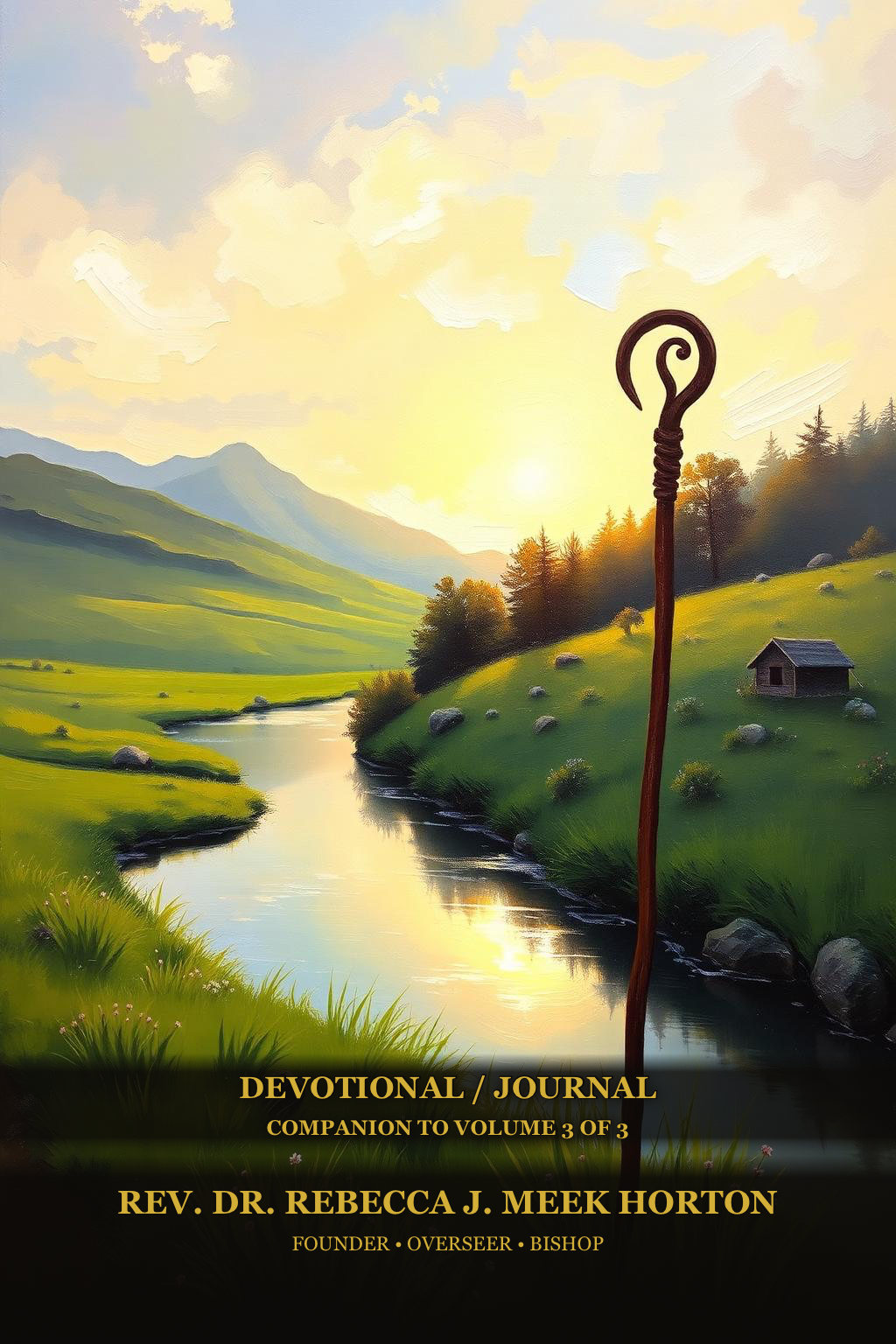
A companion devotional and journal for "Keep the Quiet Step". Each chapter becomes five entries — a KJV Scripture reading, a devotional, a prayer, a journal prompt, and space to write — closing with An Apostolic Prophetic Architect Message and lined journal pages.
Chapter 1 preview
NBCNGMI MASTER KNOWLEDGE LIBRARY Featuring the works of The Sage, Apostle Prophet. Rev. Dr. Rebecca J. Meek Horton, Apostolic Prophetic Architect, NewBeing Creation Network Global Ministries, Inc. Integrated Framework Modalities™
Dedication
To every soul learning to walk with God in stillness, obedience, and trust, I dedicate this companion journal. May these pages help you hear more clearly, surrender more honestly, and keep the quiet step He places before you.
Purpose
I wrote this companion devotional and journal to help you practice the quiet obedience taught in Keep the Quiet Step. My hope is that each entry will slow your heart, strengthen your discernment, and help you move from reflection to Walking in Obedience™ with God, one faithful step at a time. Rooted in Psalm 46:10 (KJV), this book invites you to wait, listen, write honestly, and keep the next quiet step.
Preface
I wrote this companion devotional and journal for the reader who needs room to walk slowly with what has already been taught.
Keep the Quiet Step was written to call the heart back to steadiness, obedience, and quiet movement before GOD. But I know that reading a truth and walking a truth are not the same thing. Sometimes we need to sit with the Word longer. Sometimes we need a prayer that helps us begin. Sometimes we need a blank page where honesty can breathe.
That is the heart of this book.
Each chapter of Keep the Quiet Step has been shaped here into five devotional entries. You will find a KJV Scripture reading, a short devotional, a prayer, a journal prompt, and space to write. The structure is simple on purpose. This is not meant to overwhelm you. It is meant to help you listen, receive, respond, and keep the next faithful step.
Psalm 46:10 (KJV) Be still, and know that I am God: I will be exalted among the heathen, I will be exalted in the earth.
Stillness is not emptiness. Quiet is not weakness. Waiting is not wasted. In the presence of GOD, the quiet place can become the place of RE-Alignment™, RE-Focusing™, and renewed obedience.
I have learned that some of the deepest work of GOD does not begin with noise, speed, or public movement. It begins when the heart becomes teachable. It begins when we stop trying to force the fit and allow wisdom to govern the step. Nothing is random. Nothing is wasted.
Use this journal slowly. Do not rush to fill every line. Let the Scriptures search you. Let the prayers give language to what you may not know how to say. Let the prompts help you recognize what GOD is forming, correcting, healing, or strengthening in you.
My prayer is that this companion helps you move from reading to reflection, from reflection to obedience, and from obedience to steady transformation.
WISDOM is not yours until YOU WALK IT.
Begin with one quiet step. Read. Pray. Write honestly. Then keep what GOD gives you today.
Introduction
Many people want a clear path, but few want the quiet step that forms the person who can walk it.
This companion devotional and journal was created for that work. It is not meant to rush you through inspiration. It is meant to help you slow down, receive instruction, examine your heart, and practice one faithful step at a time. The quiet step is not weakness. It is governed movement. It is the decision to walk with God in stillness, obedience, wisdom, and responsibility when noise is easier and haste feels more impressive.
Psalm 46:10 (KJV) Be still, and know that I am God: I will be exalted among the heathen, I will be exalted in the earth.
Stillness is not emptiness. It is a place of recognition. In stillness, we remember that God is God, we are not, and obedience does not need to perform in order to be faithful. The quiet step teaches us to stop forcing outcomes, stop rushing past conviction, and stop confusing movement with maturity.
This journal is built as a companion to Keep the Quiet Step. Each chapter becomes five devotional entries. Each entry gives you a KJV Scripture reading, a short devotional, a prayer, a journal prompt, and space to write. The structure is simple on purpose. The goal is not to overwhelm you with more information. The goal is to help you receive truth, sit with it honestly, and walk it out with clarity.
Read each entry slowly. Do not treat the Scripture as a quotation to admire. Let it search you. Do not treat the devotional as a thought for the day only. Let it name something real. Do not rush the prayer. Make it your own. Do not answer the prompt with what sounds spiritual. Write what is true. God meets honest hearts, not polished ones.
This book asks something of you.
It asks you to pause when you would rather push. It asks you to listen when you would rather explain. It asks you to write when you would rather avoid. It asks you to obey in small ways that may not be seen by others. That is part of the cost. Quiet obedience often grows in hidden places before it becomes visible fruit.
Proverbs 3:5-6 (KJV) Trust in the LORD with all thine heart; and lean not unto thine own understanding. In all thy ways acknowledge him, and he shall direct thy paths.
This is the argument of the book: the life God forms is often strengthened through small, steady, surrendered steps. We do not mature by noise. We mature through trust, correction, stillness, obedience, and practice. Wisdom is not yours until you walk it.
As you move through these pages, use a simple rhythm:
• Read the Scripture with attention.
• Receive the devotional with humility.
• Pray honestly, not perfectly.
• Write what you are actually seeing, feeling, resisting, and learning.
• Choose one quiet step of obedience before you move on.
At the close of the devotional journey, you will find An Apostolic Prophetic Architect Message and additional lined journal pages. Receive that closing message as a sending moment, not merely an ending. The lined pages are there because God may continue speaking after the entry is finished. Leave room for continued RE-Flection™, RE-Calibration™, and RE-Alignment™.
Before you begin, take one clear step: choose a regular time and place for this devotional practice. Keep it simple. Bring your Bible, this journal, and an honest heart. Then begin quietly.
Nothing is random. Nothing is wasted.
Chapter 1 — When Anxiety Still Speaks
Entry 1
Scripture Reading
Isaiah 26:3 (KJV) Thou wilt keep him in perfect peace, whose mind is stayed on thee: because he trusteth in thee.
Devotional
Anxiety often speaks early.
Before the day has fully opened, before your feet have touched the floor, before you have gathered your thoughts, it may begin offering reports. It tells you what could go wrong. It reminds you of what is unfinished. It reaches for your attention before peace has had room to settle.
This is why Isaiah 26:3 is such mercy. The promise is not that your mind will never feel pressure. The promise is that God is able to keep the one whose mind is stayed on Him. That word keep matters. It means you are not left to guard your own soul by force. You are not asked to manufacture perfect calm before you can belong to peace.
A stayed mind is not a mind that never wanders. It is a mind that knows where to return.
This is a different kind of maturity. Many people feel ashamed when anxiety returns after prayer. They think, If I really surrendered, I would not feel this. But surrender is not proven by the absence of another anxious thought. Surrender is practiced when the anxious thought comes and you do not give it the throne.
Anxiety may still speak, but it does not have to lead.
Today, peace may not arrive as a dramatic emotional change. It may come as a kept step. You pause before reacting. You breathe before answering. You pray before spiraling. You bring your mind back to the Lord, even if you have to bring it back more than once.
That is not failure. That is practice.
Nothing is random. Nothing is wasted. Even the moment anxiety rises can become a place of RE-Calibration™. It can show you where your trust has been pulled toward control, where your attention has been captured by imagined outcomes, and where the Lord is inviting you to return.
Perfect peace is not your performance. It is God’s keeping power meeting your returning trust.
So do not begin this day by arguing with anxiety. Begin by returning. Let your first quiet step be simple: Lord, my mind is coming back to You. I do not have to solve the whole day to be kept in this moment.
A kept mind becomes a kept life, one faithful return at a time.
Prayer
Father, I bring my mind back to You today. I confess that anxiety often speaks before I am ready, and sometimes I have treated its voice as authority. I do not want fear to lead my thoughts, words, decisions, or pace. Teach me to stay my mind on You when pressure rises. Help me trust Your keeping power more than my need to control every outcome. When I wander into worry, call me back without shame. When I feel unsettled, steady me with Your truth. I receive Your peace as mercy, not as something I must manufacture. Keep me as I return to You. Amen.
Journal Prompt
Isaiah 26:3 says God keeps the one whose mind is stayed on Him. Where does your mind most often run when anxiety speaks, and what simple phrase can help you return to God today?
Space to Write
[Answer Lines]
Entry 2
Scripture Reading
Philippians 4:6-7 (KJV) 6 Be careful for nothing; but in every thing by prayer and supplication with thanksgiving let your requests be made known unto God. 7 And the peace of God, which passeth all understanding, shall keep your hearts and minds through Christ Jesus.
Devotional
Anxiety wants to turn every concern into a command.
It says, Fix this now. Answer now. Prepare for everything now. Do not rest until you know how this ends. It makes urgency feel like wisdom and control feel like safety.
But Philippians 4:6-7 teaches another movement. It does not tell us to deny that concerns exist. It tells us where to carry them. In every thing, by prayer and supplication with thanksgiving, we let our requests be made known unto God.
This is not a call to pretend. It is an invitation to relocate the burden.
Prayer is not where you perform calmness for God. Prayer is where you bring the real thing. The unfinished thought. The shaking question. The fear you are tired of managing. The concern that keeps returning even after you thought you released it.
You are not weak because you need to pray again. You are learning where the weight belongs.
The promise is that the peace of God shall keep your hearts and minds through Christ Jesus. Again, the language is keeping. God’s peace does not always explain everything. It passes understanding. That means peace may guard you before the circumstance changes, before the answer comes, before your emotions feel fully settled.
This matters for the quiet step.
Sometimes you are waiting for understanding before you allow peace. God may give understanding, but His peace is not limited to what you can explain. There are days when you will not know enough to feel in control, but you can know enough to pray. You can know enough to bring the request to the Father. You can know enough to take one faithful step without letting anxiety drive the whole day.
This is Governed Movement™. You are not denying the concern. You are refusing to let concern become the governor of your next action.
Thanksgiving also has a holy place here. Gratitude does not erase pain. It repositions attention. It helps the heart remember that the present fear is not the whole story. God has kept you before. God is with you now. God is not confused by what feels complicated to you.
Today, let prayer interrupt the spiral. Not as a formula. Not as pressure. As a return.
When anxiety speaks, do not build an altar to the fear. Make your request known unto God. Let peace guard what anxiety wanted to govern.
Prayer
Father, I bring every anxious concern before You. I do not want to carry burdens in secret while pretending I am at peace. I let my requests be made known unto You today. Teach me to pray honestly, not perfectly. Teach me to give thanks even while I am still waiting. Guard my heart where fear has made it tender. Guard my mind where worry has made it tired. Let the peace of God keep me through Christ Jesus. I release the need to understand everything before I trust You. Help me take the next quiet step with prayer instead of panic. Amen.
Journal Prompt
Philippians 4:6-7 connects prayer, thanksgiving, and the peace that keeps your heart and mind. What concern do you need to bring to God plainly today, and what can you thank Him for while you wait?
Space to Write
[Answer Lines]
Entry 3
Scripture Reading
Psalm 56:3-4 (KJV) 3 What time I am afraid, I will trust in thee. 4 In God I will praise his word, in God I have put my trust; I will not fear what flesh can do unto me.
Devotional
Psalm 56 does not shame fear.
It gives fear a direction.
What time I am afraid, I will trust in thee. That sentence is simple enough to carry into the day, and honest enough to meet you where you actually live. It does not say, If I am spiritual enough, I will never be afraid. It says, When fear is present, trust is still possible.
That is a needed truth for anyone learning to keep the quiet step.
Anxiety often convinces people that the presence of fear means faith has disappeared. But fear and faith may stand in the same room while you decide which one will lead. You may feel your chest tighten and still choose obedience. You may feel uncertain and still speak truth. You may feel afraid and still trust God.
Trust is not always loud. Sometimes trust is the quiet refusal to hand anxiety the steering wheel.
This is where RE-Language™ helps the soul mature. Instead of saying, I am afraid, so I cannot move, you can say, I am afraid, and I will trust God with the next step. Instead of saying, This fear proves something bad is coming, you can say, This fear is present, but God’s Word is still true. Instead of saying, I have no courage, you can say, Courage may begin with one obedient step.
The psalmist also says, In God I will praise his word. Fear often tries to make the imagined future feel more real than the spoken Word of God. It gives pictures. It gives predictions. It gives conclusions without evidence. But the believer has a stronger place to stand.
In God, I will praise His word.
That means you do not have to praise the fear’s report. You do not have to rehearse every outcome anxiety offers. You do not have to agree with the inner voice that says danger has final authority.
You can honor the truth without denying the tremble.
This is steady faithfulness. It does not wait until every feeling is quiet. It chooses trust while fear is still trying to speak. It keeps the next step small, clear, and obedient.
Today, fear may ask for more attention than it deserves. Answer with trust. Not with performance. Not with self-condemnation. With a simple turning of the heart.
What time I am afraid, I will trust in thee.
That is enough for this step.
Prayer
Father, I admit that I do feel afraid at times. I do not want to hide that from You or turn it into shame. When fear rises, teach me to trust You in that very moment. Help me praise Your Word more than I rehearse anxiety’s report. Give me courage to take one faithful step even when I do not feel fully calm. I refuse to let fear become my leader. I place my trust in You, not in my ability to predict, prevent, or control everything. Strengthen my heart with Your truth. Let my response become steady, honest, and obedient. Amen.
Journal Prompt
Psalm 56:3-4 gives you language for fear and trust. What fear has been speaking loudly, and how can you rewrite your response as a statement of trust in God?
Space to Write
[Answer Lines]
Entry 4
Scripture Reading
Proverbs 3:5-6 (KJV) 5 Trust in the LORD with all thine heart; and lean not unto thine own understanding. 6 In all thy ways acknowledge him, and he shall direct thy paths.
Devotional
Anxiety often leans hard on understanding.
It wants a full map. It wants every detail secured. It wants to know how people will respond, how circumstances will unfold, how long the process will take, and whether the outcome will be safe. It tells you that if you can understand enough, you can finally rest.
But Proverbs 3:5-6 gently interrupts that way of living.
Trust in the LORD with all thine heart; and lean not unto thine own understanding.
This does not mean understanding has no value. Wisdom studies. Wisdom asks. Wisdom listens. Wisdom prepares. But there is a difference between using understanding as a tool and leaning on understanding as a savior.
Anxiety turns understanding into something it was never meant to be. It makes you believe that if you can think through every possibility, you can protect yourself from pain, failure, disappointment, or surprise. But the mind was not created to carry the weight of omniscience.
You are not God. That is not an insult. That is mercy.
You are allowed to acknowledge Him in all your ways without knowing all your outcomes. You are allowed to ask for direction without demanding full control. You are allowed to take the next quiet step while the whole path remains unseen.
This is where the cost appears.
Trust will cost you the false relief of overthinking. It will cost you the familiar comfort of rehearsing every possible problem. It will cost you the old belief that you must feel certain before you can be faithful.
But anxiety is also costly. It spends tomorrow’s strength today. It makes ordinary decisions feel heavier than they are. It turns preparation into control. It keeps asking for more information but rarely gives real peace.
The quiet step asks a better question: What is mine to do now?
Not what might happen six months from now. Not what every person may think. Not how to guarantee a painless outcome. What is the next faithful step before me today?
In all thy ways acknowledge him, and he shall direct thy paths.
Direction belongs to the Lord. Acknowledgment belongs to you. You bring Him into the way you think, answer, work, rest, decide, wait, and speak. You stop treating anxiety as your counselor. You stop leaning your whole weight on your own understanding.
Then you move, not carelessly, but dependently.
WISDOM is not yours until YOU WALK IT.
Prayer
Father, I trust You with my heart and with my path. I confess that I often lean on my own understanding when I feel anxious. I try to think far enough ahead to feel safe, but it leaves me tired and unsettled. Teach me to acknowledge You in all my ways today. Help me prepare wisely without trying to control everything. Show me what is mine to do and what I must leave with You. Direct my path as I take the next quiet step. I choose trust over overthinking, obedience over fear, and dependence over control. Amen.
Journal Prompt
Proverbs 3:5-6 calls you to trust the Lord instead of leaning on your own understanding. Where have you been leaning too hard on your need to know, and what one path can you acknowledge God in today?
Space to Write
[Answer Lines]
Entry 5
Scripture Reading
Matthew 6:34 (KJV) Take therefore no thought for the morrow: for the morrow shall take thought for the things of itself. Sufficient unto the day is the evil thereof.
Devotional
Tomorrow can become very loud.
It comes into today before it has permission. It brings questions you cannot answer yet. It asks for strength you have not been given yet. It hands you imagined conversations, imagined losses, imagined problems, and imagined responsibilities. Then anxiety tells you that worrying about tomorrow is the same as preparing for it.
Jesus teaches another way.
Take therefore no thought for the morrow. This is not an invitation to irresponsibility. It is an invitation to right-sized living. The Lord is not telling you to ignore wisdom, planning, or stewardship. He is teaching you not to let tomorrow consume today’s grace.
Sufficient unto the day is the evil thereof.
In other words, today has enough. Today has its own responsibilities, its own obedience, its own mercy, its own light. You do not have to borrow trouble from a day you have not entered.
Anxiety often wants you to live in advance. It pushes your mind into places your body has not reached and asks you to make decisions from imagined danger. But grace meets you in the day you are actually standing in. Not in the thousand versions of tomorrow anxiety has invented.
This is why the quiet step matters.
A quiet step brings you back to today. It asks, What is clear now? What is faithful now? What can I do in the next ten minutes? What can I release because it does not belong to this moment?
This is not small thinking. This is mature stewardship.
Some of us have lived so long in emergency mode that today feels unsafe unless we are worrying about tomorrow. Peace can feel careless. Rest can feel like neglect. Slowness can feel like danger. But the Lord does not measure your faithfulness by how much fear you can carry in advance.
He gives daily bread. He gives present help. He gives mercy for this step.
Do not Force-The-FiT™ by trying to make tomorrow’s assignment fit into today’s capacity. There is a time to plan, and there is a time to release. Timing is as important as motive.
Today, when anxiety reaches into tomorrow, bring your attention back. Not with shame. With stewardship. Let tomorrow remain with God until He gives you the grace to stand in it.
Keep the quiet step that belongs to today.
Prayer
Father, I bring tomorrow back into Your hands. I confess that I often borrow trouble before I have received grace for it. I do not want anxiety to pull me out of today’s obedience. Teach me to live faithfully in the moment You have given me. Help me plan with wisdom but refuse worry as my way of preparing. Show me what belongs to today and what must wait. Give me courage to release imagined outcomes and receive present mercy. Let my next step be quiet, clear, and obedient. I trust You with the days I cannot yet see. Amen.
Journal Prompt
Matthew 6:34 teaches you not to let tomorrow overtake today. What worry about tomorrow has been stealing today’s strength, and what faithful action belongs only to this day?
Space to Write
[Answer Lines]
An Apostolic Prophetic Architect Message
Beloved, what has been built in these five entries is not a denial of anxiety. It is a RE-Alignment™ of authority.
Anxiety may still speak, but it does not have to lead. That is a governing truth for this part of your formation. Do not mistake the return of a feeling for the failure of your surrender. Many surrendered people still have to practice peace. Many faithful people still have to bring their minds back. Many obedient people still tremble while taking the next step.
The question is not, Did anxiety speak today?
The question is, Who governed the step?
God is teaching you the discipline of kept movement. Not rushed movement. Not fear-driven movement. Not performance dressed up as faith. Kept movement. Governed Movement™. The kind of movement that waits, asks, listens, and keeps the next faithful step with God.
Isaiah 26:3 (KJV) Thou wilt keep him in perfect peace, whose mind is stayed on thee: because he trusteth in thee.
Receive the confirmation in this: you are not being asked to become your own keeper. The Lord keeps. Your responsibility is to return. Return your mind. Return your attention. Return your trust. Return your breath to prayer. Return your next decision to wisdom.
This is where maturity begins to take shape. You stop waiting for every feeling to be silent before you obey what is clear. You stop calling anxiety your identity. You stop letting urgency become your shepherd. You learn to say, Anxiety is present, but it is not leading this next step.
That sentence may look small, but it carries weight.
Nothing is random. Nothing is wasted. Even the anxious moment can become instruction when you let God show you where trust needs strengthening, where language needs RE-Calibration™, and where your pace needs to come under peace again.
Do not despise the small step. Do not despise the quiet return. Do not despise the day of practice. WISDOM is not yours until YOU WALK IT.
So walk it today. One prayer. One pause. One truthful sentence. One obedient action. One release of tomorrow. One refusal to let fear hold the steering wheel.
The grace of God is not only present in dramatic deliverance. It is also present in steady formation.
Keep the quiet step. God is faithful to keep you.
[Journal Page]
[Journal Page]
This is the opening chapter. The complete publication is available in the full edition.
Back to the library