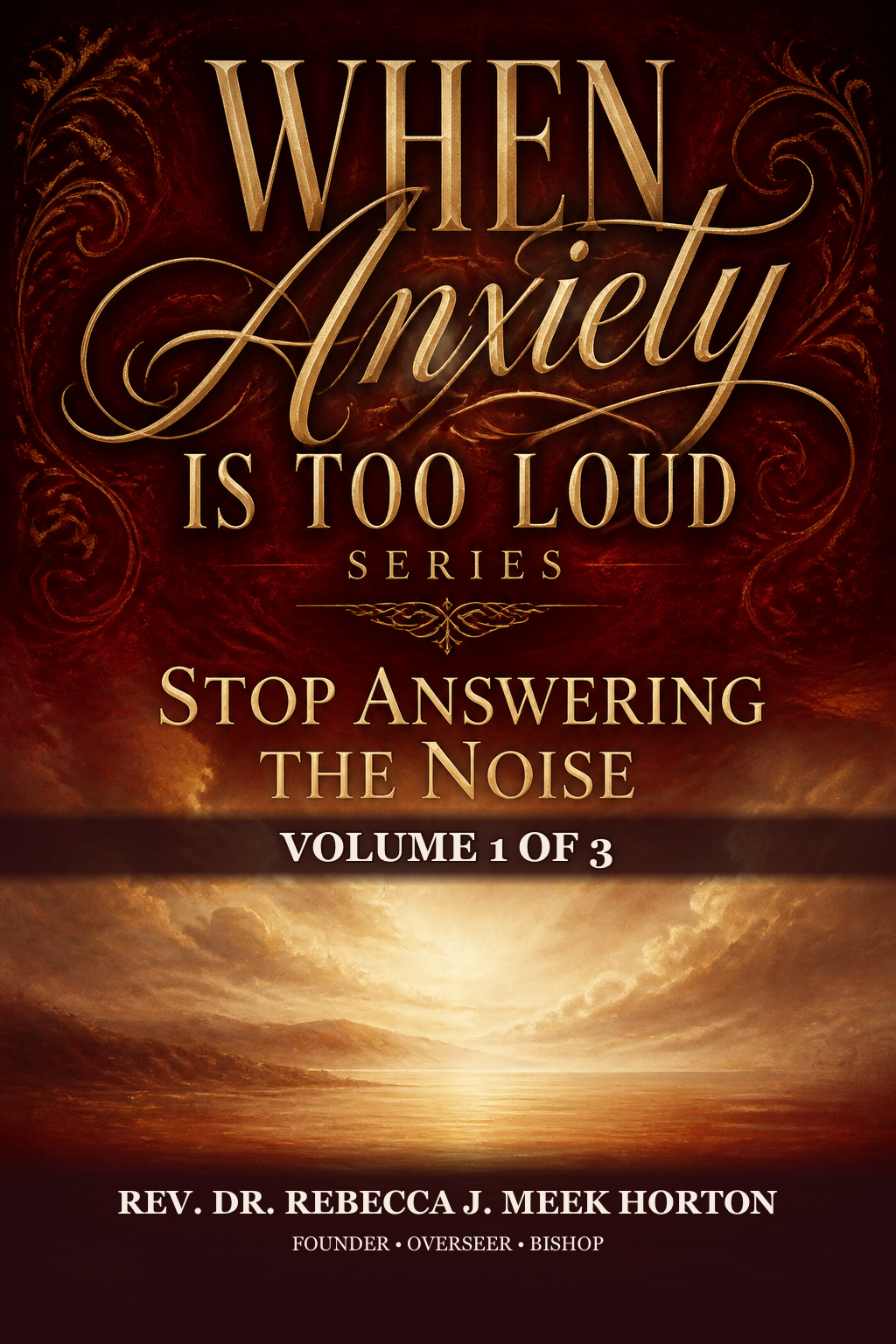
When Anxiety Is Too Loud · Volume 1
Stop Answering the Noise
Part 1 of 3 in the series "When Anxiety Is Too Loud". Series theme: Do not try to fight anxiety or reason with it. Series arc: This three-book series moves from interruption to surrender to steady living. The first book teaches readers to stop arguing with anxiety and create enough quiet to see what is really happening. The second book helps them place fear, control, and uncertainty before God wit
Chapter 1 preview
NBCNGMI MASTER KNOWLEDGE LIBRARY Featuring the works of The Sage, Apostle Prophet. Rev. Dr. Rebecca J. Meek Horton, Apostolic Prophetic Architect, NewBeing Creation Network Global Ministries, Inc. Integrated Framework Modalities™
Dedication
To every person who has felt trapped inside the noise of anxious thoughts, I dedicate these pages with compassion and hope. May you learn to pause, see clearly, trust God more deeply, and take the next faithful step without surrendering your peace to the pressure.
Purpose
I wrote this book to help you stop treating every anxious thought as a command. My hope is that these pages will help you step back from the noise, see what is really happening, and choose the next faithful response with God’s help.
Anxiety may still speak, but it does not have to govern your movement. May this book help you become still enough to trust God, receive wisdom, and walk one clear step at a time.
Preface
I wrote this book for the moment when anxiety gets loud before wisdom has time to speak.
I know that inner pressure. The sudden demand to answer every thought. The urge to explain, defend, solve, rehearse, prepare, and protect yourself all at once. Anxiety can sound urgent, but urgency is not always truth. Noise can be loud and still be wrong.
This book was born from the need to stop treating every anxious thought like an assignment.
Too often, we try to fight anxiety by arguing with it. We reason with it. We chase it through every possible outcome. We try to prove it wrong, calm it down, or make it promise us certainty. But anxiety does not usually become quiet because we outtalk it. Sometimes the first faithful step is not to answer the noise at all.
Sometimes the first step is to be still long enough to see what is really happening.
Psalm 46:10 (KJV) Be still, and know that I am God: I will be exalted among the heathen, I will be exalted in the earth.
This is not a book about pretending anxiety is not real. It is not a book about shaming fear, denying struggle, or acting spiritually strong while suffering silently. If you need pastoral care, wise counsel, medical help, or professional support, receive it with humility and courage. Stewardship includes knowing when to ask for help.
This book is about learning not to let anxiety become your governor.
An anxious thought may visit, but it does not have to rule. A fearful feeling may rise, but it does not have to decide. A loud inner demand may press you to react, but you can pause, breathe, pray, and choose the next faithful response.
Proverbs 3:5-6 (KJV) Trust in the LORD with all thine heart; and lean not unto thine own understanding. In all thy ways acknowledge him, and he shall direct thy paths.
My prayer is that these pages help you create enough quiet to notice what anxiety is trying to make you obey. Then, with GOD’s help, you can stop answering the noise and begin walking in wisdom.
Before you continue, take one small step: name the loudest anxious demand you are carrying today. Write it down. Then say, “This may be loud, but it is not my Lord.”
Introduction
Anxiety often sounds urgent.
It does not always begin as panic. Sometimes it begins as a sentence inside you: Fix this now. Explain yourself. Prepare for everything. What if this goes wrong? What if they misunderstand you? What if you fail? What if God does not come through the way you hoped?
The noise feels important because it is loud. But loud is not the same as true. Urgent is not the same as wise. A thought can demand your attention without deserving your obedience.
This book begins there.
Stop Answering the Noise is not a book about pretending anxiety is not real. It is not a book about shaming yourself for feeling afraid. It is not a quick formula for becoming calm on command. Anxiety can be complex. For some, it is tied to trauma, health, grief, pressure, exhaustion, or long patterns of fear. If your anxiety is severe, persistent, or affecting your safety or daily functioning, wise support from trusted leaders and qualified professionals may be part of your stewardship.
But this book is written for the moment when anxiety starts talking and you start answering.
You argue with it. You defend yourself to it. You rehearse conversations that have not happened. You solve problems that may never come. You build a case, then build a countercase, then build another one. By the end, nothing has been resolved, but your soul is tired.
The first practice of this book is simple: stop answering the noise long enough to see what is really happening.
Psalm 46:10 (KJV) Be still, and know that I am God: I will be exalted among the heathen, I will be exalted in the earth.
Stillness is not denial. Stillness is not weakness. Stillness is the place where you stop letting fear conduct the whole room. It is the pause where you remember that anxiety may be present, but it is not Lord.
This is Part 1 of the series When Anxiety Is Too Loud. The larger journey moves from interruption to surrender to steady living. This first book focuses on interruption. Before you can surrender fear to God with honesty, you must learn to notice how fear is speaking. Before you can build steady daily practices, you must stop treating every anxious thought as an emergency.
That is the core argument of this book: you do not have to fight anxiety or reason with it in order to respond faithfully. You can step back. You can name what is happening. You can choose the next faithful response.
Proverbs 3:5-6 (KJV) Trust in the LORD with all thine heart; and lean not unto thine own understanding. In all thy ways acknowledge him, and he shall direct thy paths.
Read this book slowly. Do not rush to master anxiety. Begin by observing it. Notice the tone anxiety uses. Notice when it demands certainty. Notice when it pushes you to control outcomes, defend your worth, or rehearse tomorrow before you have lived today.
Each chapter will help you separate the thought from the command. You will learn to say, This is anxiety speaking. This is pressure, not instruction. This is fear asking for control. This is a real concern, but it does not need my panic to become responsible action.
Matthew 6:34 (KJV) Take therefore no thought for the morrow: for the morrow shall take thought for the things of itself. Sufficient unto the day is the evil thereof.
This will cost you something. It may cost you the false comfort of overthinking. It may cost you the habit of calling worry preparation. It may cost you the need to answer every fear before you move. But what you gain is space: space to breathe, space to pray, space to discern, space to obey.
Begin with one small practice. The next time anxiety becomes loud, pause before answering it. Write one sentence: This is a thought, not a command. Then ask, What is the next faithful step I can take without obeying the noise?
Chapter 1 — The Thought That Demands an Answer
The text message was only six words long, but it took over the room.
Call me when you can.
Nothing else.
No explanation. No tone. No details. Just a sentence sitting on the screen.
Within seconds, the mind began to work. Did I do something wrong? Is someone upset? Is this bad news? Should I call now? Should I wait? What if waiting makes it worse? What if calling makes me look anxious? What if I say the wrong thing?
The body joined in. Chest tight. Shoulders lifted. Stomach turned. Breath shortened.
Nothing had happened yet. But inside, it felt like everything had happened.
That is how anxiety often enters. Not always as a full storm. Sometimes it comes as a thought that demands an answer. It arrives with urgency and acts like authority.
This chapter’s central truth is simple: an anxious thought may feel urgent, but urgency does not make it true, and pressure does not make it a command.
You do not have to answer every thought that knocks loudly.
The Demand Beneath the Thought
Anxiety rarely says, “Here is a possibility to consider when you have time.”
It says, “Do something now.”
Explain yourself now.
Fix this now.
Defend your motives now.
Find certainty now.
Prevent pain now.
Make everyone okay now.
That pressure is often more powerful than the thought itself. The thought may be brief, but the demand behind it can pull the whole person into motion.
A parent sees their child withdraw after school and anxiety says, You need to get the whole story right now.
A leader notices someone’s facial expression in a meeting and anxiety says, They are disappointed in you. Repair it immediately.
A friend does not reply to a message and anxiety says, You are being rejected. Send another message. Explain more.
The issue is not that concerns are always wrong. Sometimes a situation does need attention. Sometimes a conversation does need to happen. Sometimes wisdom does require action.
But anxiety does not usually invite wisdom. It demands reaction.
It presses for a response before there has been enough time to see clearly.
This is where RE-Language™ helps. Instead of saying, “I have to fix this now,” we can learn to say, “I am feeling pressure to fix this now.”
That small shift matters.
The first sentence treats anxiety as ruler. The second sentence names anxiety as a signal.
A signal may deserve attention. It does not deserve the throne.
Not Every Thought Is Truth
One of anxiety’s strongest tricks is that it makes thoughts feel like facts.
The thought comes: They are angry with me.
The feeling rises: fear, shame, dread.
The body reacts: tension, heat, restlessness.
Then the mind concludes: This must be true because I feel it so strongly.
But intensity is not accuracy.
A thought can be loud and still incomplete. A thought can feel convincing and still be built on assumption. A thought can arrive quickly and still need to be examined.
Scripture teaches us not to let every thought remain unchallenged or ungoverned.
2 Corinthians 10:5 (KJV)
Casting down imaginations, and every high thing that exalteth itself against the knowledge of God, and bringing into captivity every thought to the obedience of Christ;
This verse does not call us to panic over our thoughts. It calls us to bring them into captivity. That means thoughts are not masters. They are not final authorities. They can be examined, submitted, corrected, and refused.
Anxiety often says, If you thought it, you must answer it.
Wisdom says, If you thought it, notice it. Then weigh it.
There is a difference between having a thought and obeying a thought.
You may think, I am going to fail.
That does not mean failure has been declared.
You may think, Something terrible will happen.
That does not mean fear has become prophecy.
You may think, I cannot handle this.
That does not mean God has left you without help.
A thought is not automatically truth. A feeling is not automatically direction. A body response is not automatically a command.
This does not mean we shame ourselves for anxious thoughts. Shame only adds another voice to the noise. We practice responsibility instead.
Responsible language sounds like this:
“I am having the thought that something is wrong.”
“My body feels alarmed, but I do not yet have enough information.”
“This may need attention, but it may not need immediate reaction.”
“I can pause before I respond.”
This is not denial. It is stewardship.
The Body May Be Alarmed Before the Situation Is Clear
Anxiety is not only mental. It often speaks through the body.
A tight chest.
A racing heart.
A clenched jaw.
A restless need to move.
A sudden heaviness.
A stomach that drops before the facts are known.
Many people become afraid of these sensations. Then anxiety doubles. First comes the worry. Then comes worry about the worry. The person begins thinking, Why do I feel this way? What is wrong with me? Why can’t I calm down?
But the body’s alarm does not always mean danger is present. Sometimes it means the body has recognized uncertainty, memory, pressure, fatigue, or overload.
Think of a smoke alarm. Its sound is serious, but it is not the same thing as fire. Sometimes there is fire. Sometimes there is steam. Sometimes the battery is weak. The alarm must be checked, but it must not be worshiped.
The same is true when the body reacts.
If your body is loud, begin by naming what is happening without surrendering to its interpretation.
“My heart is racing.”
“My shoulders are tight.”
“My breathing is shallow.”
“My mind is trying to rush.”
This is the beginning of SAPP™ Discernment: See the situation truthfully before deciding what it means.
Seeing is not solving. Seeing is not surrendering to fear. Seeing is the first act of order.
An example may help.
You receive an email from your supervisor: “Please stop by before you leave.”
Anxiety says, I am in trouble.
Your body reacts as if the meeting has already happened. You replay the week. You search for mistakes. You prepare a defense. You imagine consequences.
But all you have is one sentence.
The faithful first step is not to write a long explanation or assume the worst. The first step is to see.
Fact: I received a request to stop by.
Fear: I may be in trouble.
Assumption: This must be about something I did wrong.
Body signal: I feel tense and rushed.
That separation does not solve the meeting. It keeps anxiety from controlling the story before the story is known.
Urgency Wants Reaction; Wisdom Requires a Pause
Anxiety often moves quickly because it wants to outrun uncertainty.
Wisdom is slower.
Not careless. Not passive. Slower.
Proverbs connects haste with danger because hurried movement can magnify folly.
Proverbs 14:29 (KJV)
He that is slow to wrath is of great understanding: but he that is hasty of spirit exalteth folly.
The phrase “hasty of spirit” is worth noticing. Anxiety often makes the spirit hasty. It pushes the person to speak before listening, decide before discerning, accuse before asking, withdraw before understanding, or overexplain before trust has had room to breathe.
A pause interrupts that haste.
A pause may be one breath before answering a message.
It may be one sentence: “I need a moment before I respond.”
It may be stepping away from the screen.
It may be waiting until morning before sending the emotional email.
It may be praying simply, “Lord, help me see clearly.”
The pause does not make anxiety disappear. That is not the promise. The pause creates enough space to stop treating anxiety as commander.
This is where the WALK™ rhythm begins quietly.
Wait: Do not rush into the demand.
Ask: What is actually happening?
Listen: What is true, and what is only fear?
Keep: Take the next faithful step.
At this point in the book, we are not trying to build the whole practice. We are learning the first interruption: stop answering the noise as if every anxious thought deserves immediate obedience.
The Cost of Not Answering Every Thought
This sounds simple until anxiety is loud.
The cost is real.
You may feel irresponsible at first. Anxiety may accuse you: If you do not act now, you do not care.
You may feel exposed. If you are used to overexplaining, silence may feel unsafe.
You may feel control slipping. If you normally manage fear by planning every possible outcome, stepping back may feel like weakness.
You may disappoint people who are used to immediate access to your energy, attention, and emotional labor.
You may have to admit that some of your reactions were not discernment. They were fear in a hurry.
That is painful, but it is also mercy.
Because maturity begins when we stop calling every inner alarm wisdom.
This chapter is not asking you to ignore real responsibility. It is asking you to stop confusing pressure with responsibility.
Some things need action.
Some things need prayer.
Some things need counsel.
Some things need time.
Some things need to be left unanswered until truth is clearer.
If anxiety is severely disrupting your life, sleep, health, relationships, or safety, it is wise to seek support from a trusted pastor, counselor, physician, or qualified professional. Asking for help is not failure. It is stewardship.
But even with help, this truth remains: the loudest thought in the room does not have to lead.
Key Takeaways
• An anxious thought may feel urgent without being true.
• Pressure is a signal to notice, not a command to obey.
• A pause gives wisdom room to speak before reaction takes over.
Practice
For the next twenty-four hours, notice one anxious thought that demands an immediate answer.
Write four short lines:
Fact: What actually happened?
Fear: What am I afraid this means?
Pressure: What is anxiety demanding I do right now?
Faithful response: What is one steady step I can take without panic?
Do not try to solve your whole life today.
Just practice not answering the noise as if it is in charge.
This is the opening chapter. The complete publication is available in the full edition.
Back to the library