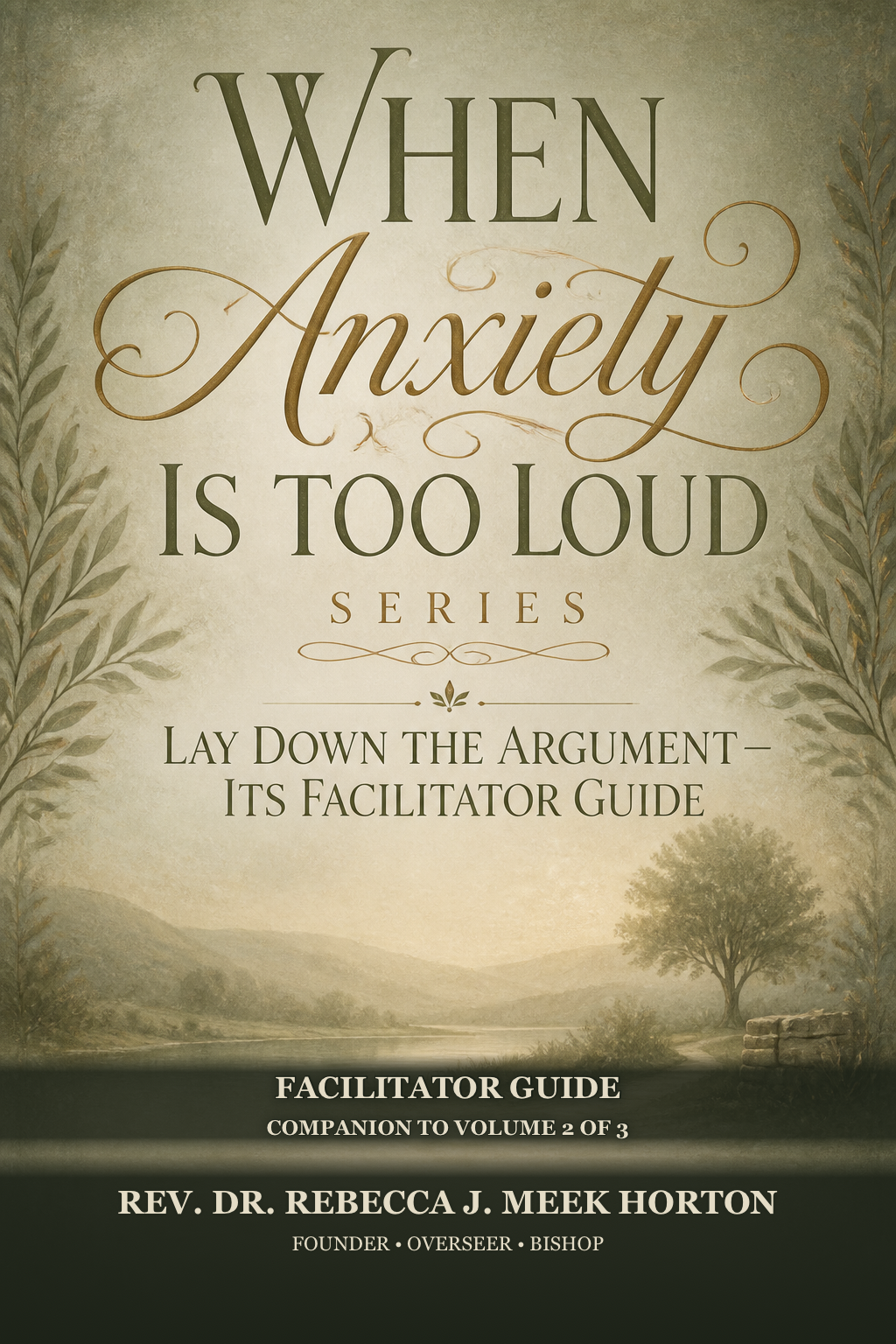
When Anxiety Is Too Loud · Volume 2
Lay Down the Argument — Its Facilitator Guide
A facilitator's guide for "Lay Down the Argument". Every written chapter becomes a 60-minute session: objectives, preparation, timing, teaching outline, discussion questions with suggested answers, an activity, a closing commission, a written closing prayer, and leader's notes.
Chapter 1 preview
NBCNGMI MASTER KNOWLEDGE LIBRARY Featuring the works of The Sage, Apostle Prophet. Rev. Dr. Rebecca J. Meek Horton, Apostolic Prophetic Architect, NewBeing Creation Network Global Ministries, Inc. Integrated Framework Modalities™
Dedication
I dedicate this guide to every faithful facilitator willing to lay down pride, listen with humility, and help others pursue peace with truth. May your leadership carry the wisdom of James 1:19, and may every session you guide become a doorway toward understanding, healing, and obedient love.
Purpose
I wrote this facilitator guide to help leaders carry Lay Down the Argument with clarity, humility, and order. My hope is that each session helps people slow down, hear truthfully, release the need to win, and practice the wisdom of James 1:19 in real conversations. May this guide serve facilitators without replacing prayer, Scripture, or the work of the Holy Spirit in the room.
Preface
I wrote this Facilitator Guide because I know how easily a conversation can become a contest.
We can begin with concern and end in control. We can start with truth and lose tenderness. We can defend what is right while forgetting the spirit in which righteousness must be carried. I have seen arguments wear down families, ministries, friendships, teams, and the quiet places of the heart. I have also seen what happens when one person chooses to pause, listen, repent, and respond with wisdom instead of reaction.
Lay Down the Argument is not a call to silence truth. It is a call to surrender the need to win at the expense of love, clarity, obedience, and peace. This Facilitator Guide was created to help leaders carry that message with care. Every session is designed to move people from hearing to examining, from examining to practicing, and from practicing to walking differently.
James 1:19-20 (KJV) Wherefore, my beloved brethren, let every man be swift to hear, slow to speak, slow to wrath: For the wrath of man worketh not the righteousness of God.
That Scripture sits at the heart of this work. Many of us need a slower mouth, a softer answer, a governed spirit, and a renewed way of handling disagreement. Not because conflict is always avoidable, but because our response must be stewarded.
This guide is practical on purpose. Each 60-minute session includes objectives, preparation, timing, teaching movement, discussion questions, an activity, a closing commission, prayer, and leader’s notes. The structure is here to serve the people, not to control the room. Use it with prayer, patience, and discernment.
Facilitating this material may cost you something. It may ask you to model humility before you teach it. It may require you to lay down your own argument first. But that is where the guide becomes more than a lesson plan. It becomes a practice of obedience.
Before you lead the first session, sit with the material yourself. Ask the Lord where your own speech, reactions, assumptions, or defenses need RE-Calibration™. Then lead from that honest place.
May this guide help every facilitator create room for truth, peace, maturity, and the next faithful step.
Introduction
Some rooms are full of talking, but very little listening.
People can sit close and still protect themselves. They can quote truth and still use it as a weapon. They can explain their position clearly and still refuse the humility required for peace. The argument may be spoken out loud, or it may live quietly in the heart as resentment, suspicion, control, self-defense, or the need to be right.
Lay Down the Argument is not a call to avoid truth. It is not a call to silence conviction, tolerate harm, or pretend that conflict does not matter. It is a call to surrender the kind of arguing that hardens the heart, damages relationship, and blocks obedience.
James 1:19-20 (KJV) Wherefore, my beloved brethren, let every man be swift to hear, slow to speak, slow to wrath: For the wrath of man worketh not the righteousness of God.
This facilitator guide was written to help you lead others through that surrender with clarity, patience, and order. Each written chapter of Lay Down the Argument becomes a 60-minute session. Every session includes objectives, preparation, timing, a teaching outline, discussion questions with suggested answers, an activity, a closing commission, a written closing prayer, and leader’s notes.
The purpose is not to help facilitators control the room. The purpose is to help facilitators steward the room.
A facilitator is not the hero of the session. A facilitator creates space for truth to be studied, weighed, applied, and practiced. You are helping people move from reaction to reflection, from defense to responsibility, and from information to obedience. That work requires more than content. It requires your posture.
Before you teach others to lay down the argument, you must be willing to notice where argument still lives in you.
That may be the hidden cost of this guide. You may prepare a session and realize you are still rehearsing old conversations. You may teach about listening and recognize where you interrupt. You may guide people toward peace while facing your own need for correction. Do not rush past that. The leader’s first work is not performance. It is surrender.
2 Timothy 2:24-25 (KJV) And the servant of the Lord must not strive; but be gentle unto all men, apt to teach, patient, In meekness instructing those that oppose themselves; if God peradventure will give them repentance to the acknowledging of the truth;
Read this guide slowly. Do not treat the sessions as scripts to perform without thought. Use them as ordered support. The timing matters because people need structure. The discussion questions matter because people need to speak honestly. The suggested answers matter because leaders need doctrinal and practical steadiness. The activity matters because wisdom must become practice. The closing commission matters because each session should send participants into one faithful next step.
If you are leading a group, prepare before you gather. Read the assigned chapter first. Review the session objectives. Pray through the Scripture. Notice where the content may touch pain, pride, fear, family wounds, leadership conflict, or spiritual weariness. Some participants may be quiet because they are processing. Some may speak quickly because silence feels unsafe. Some may argue with the lesson because the lesson is confronting something they have protected for years.
Do not Force-The-FiT™. Do not pressure transformation. Teach the truth clearly, hold the room wisely, and trust that faithful instruction can do its work over time.
This guide is for everyone: leaders, parents, spouses, friends, believers, seekers, teams, and communities learning how to handle conflict with more wisdom and less damage. The language is simple on purpose. The goal is not to sound impressive. The goal is to be faithful, accurate, truthful, and simple enough to be understood and practiced.
As you lead, remember this rhythm: slow down, tell the truth, make room for reflection, and send people out with one clear step. Nothing is random. Nothing is wasted. Even the difficult conversations can become places of RE-Calibration™ when humility is present.
Before you begin the first session, take one quiet step: read the opening chapter of Lay Down the Argument and write down one argument you personally need to lay down. Lead from that place of honesty. That is where this work begins.
Chapter 1 — The Argument Is Wearing You Out
Session Overview
A person can be exhausted enough to sleep and still spend the night in court.
Their body is in bed, but their mind is presenting evidence, answering accusations, replaying conversations, and preparing for outcomes that have not happened. Fear asks another question. Regret brings another exhibit. Control demands another plan.
This session helps the group recognize how anxiety can become an inner argument that demands constant answers, proof, and control. The leader will guide participants to see the difference between wise responsibility and exhausting mental negotiation.
The controlling idea for this session is simple: anxiety wears us down when we treat every anxious demand as something that must be answered.
The goal is not to shame anxious people or tell them to “just stop worrying.” The goal is to help them notice when fear is running the meeting and begin practicing surrender through one faithful step.
Participants will examine how anxiety can sound like responsibility, how fear multiplies questions, how regret keeps people circling, and how answering every anxious demand costs attention, rest, discernment, prayer, and relationships.
By the end of the session, the group should understand this key truth: not every anxious thought deserves a debate. Some arguments must be recognized, named, and laid down before God.
This first session sets the tone for the whole guide. It teaches participants to slow down without becoming passive. It helps them see that every thought does not have the same authority. Some thoughts need attention. Some need prayer. Some need wise counsel. Some need to be refused because they keep pulling the heart into fear instead of faith.
The facilitator’s role is to keep the room gentle, clear, and grounded. Anxiety often comes with shame. Many people already feel weak because they cannot “turn it off.” Do not add weight to what they are already carrying. Help them separate feeling anxious from being ruled by anxiety. Feeling fear is part of being human. Letting fear govern every movement is what this session begins to address.
The promise of the session is also simple: participants can learn to recognize the argument, refuse unnecessary debate, and take one faithful step with God.
Session Objectives
• Help participants identify the inner “argument” anxiety creates.
• Distinguish stewardship from control.
• Teach participants to recognize anxious demands without immediately obeying them.
• Practice RE-Language™ by reframing fear-based statements into faithful next steps.
• Encourage surrender as an act of trust, not avoidance.
• Equip participants to leave with one simple practice for the week.
As you lead, keep the objectives practical. The purpose is not for participants to master a concept. The purpose is for them to notice a pattern and practice a different response.
By the end of the hour, participants should be able to say:
• I can name when anxiety is arguing with me.
• I can ask whether this is my responsibility or my attempt to control an outcome.
• I can bring the concern to God instead of building a courtroom in my mind.
• I can choose one faithful step without demanding total certainty.
Preparation
• Read Chapter 1 slowly and mark phrases that name the difference between responsibility and control.
• Read Matthew 6:25-34, Philippians 4:6-7, 1 Peter 5:7, Psalm 55:22, Isaiah 26:3, Psalm 139:23-24, and 2 Corinthians 10:5 in the King James Version.
• Pray for gentleness, because anxiety often carries fear, exhaustion, shame, and hidden pain.
• Prepare a quiet room where participants can reflect without being rushed.
• Bring paper and pens for the group activity.
• Be ready to remind the group that this study is spiritual formation and discipleship support, not a replacement for pastoral care, medical care, counseling, or crisis help when needed.
Before participants arrive, take a few minutes to prepare your own heart. A tense leader can unintentionally create a tense room. You do not need to perform calmness, but you do need to practice it. Sit quietly. Breathe. Ask God for wisdom, tenderness, and restraint.
You may want to write these words somewhere in your notes: Do not argue with the argument for them.
That reminder matters. A facilitator can be tempted to answer every fear participants share. But the purpose of this session is not to become the group’s answer source. The purpose is to help people grow in discernment, prayer, stewardship, and faithful action. Build understanding and maturity; do not create dependency.
If your group includes people who process slowly, allow silence. If someone becomes emotional, do not rush to fix the moment. You can say, “Thank you for trusting the group with that. Take your time.” Then gently bring the focus back to the practice.
Timing
Opening and Welcome — 5 minutes
Settle the group, name the session focus, and remind participants that this is a safe learning space.
Opening Prayer — 3 minutes
Pray aloud and invite everyone to breathe and become present.
Chapter Framing — 7 minutes
Summarize the main idea: anxiety wears us down when we treat every anxious demand as something that must be answered.
Teaching Outline — 18 minutes
Teach the four movements with Scripture and brief explanation.
Discussion — 15 minutes
Use selected questions from the guide, moving from observation to personal application.
Group Activity — 8 minutes
Lead the “Name the Argument, Choose the Step” exercise.
Closing and Commission — 2 minutes
Send the group with one faithful practice.
Closing Prayer — 2 minutes
Pray the written closing prayer aloud.
The timing is simple, but it will require leadership. Anxiety can pull a group into long stories, detailed explanations, and repeated questions. Be compassionate, but do not let the session become another version of the anxious argument. If discussion begins to circle, gently return to the key question: What is one faithful step?
You might say, “That is an important detail, and we may not be able to solve the whole situation tonight. Let’s bring it back to the practice. What is yours to do today?”
That sentence helps protect the room. It honors the concern without surrendering the session to it.
Opening Prayer
Father, quiet our hearts and help us receive Your truth without shame. Teach us to recognize the arguments that anxiety brings, and give us wisdom to know the difference between responsibility and control. Help us listen, learn, and take one faithful step with You. Let this room be marked by peace, honesty, humility, and care. Guard us from accusation and help us receive correction without fear. In Jesus’ name, Amen.
Chapter Framing
Begin with an ordinary picture.
Someone lies down at night, tired enough to sleep, but the mind begins talking. Did I say that wrong? What if the appointment goes badly? What if my child struggles? What if the money does not come through? What if I missed God? What if I cannot fix this?
The body is in bed, but the mind is in a courtroom.
Fear is asking questions. Regret is presenting evidence. Control is trying to build a plan. The person is exhausted, but the argument keeps going.
Explain to the group that Chapter 1 names this pattern. Anxiety can become an inner argument. It may not always feel like panic. Sometimes it feels like planning. Sometimes it feels like responsibility. Sometimes it feels like wisdom. But over time, it drains attention, rest, discernment, prayer, and relationships.
Make the central statement plain: not every anxious thought deserves a debate.
This does not mean thoughts should be ignored carelessly. It means thoughts must be weighed. Some concerns require action. Some require counsel. Some require repentance. Some require planning. But some anxious demands only want control. They do not lead to obedience. They lead to more argument.
This session teaches participants to notice the difference.
Teaching Outline
Movement 1: Anxiety often sounds like responsibility.
Point: Anxiety may use responsible language, but responsibility becomes unhealthy when it turns into endless mental negotiation.
Matthew 6:27 (KJV)
Which of you by taking thought can add one cubit unto his stature?
Leader explanation: Jesus is not shaming care; He is exposing the limit of anxious thought. Some thinking feels productive, but it cannot add life or control outcomes.
Teach this slowly. Many participants will need permission to distinguish between caring and controlling. Responsible care asks, “What is mine to do?” Anxiety asks, “How can I make sure nothing painful, uncertain, or disappointing happens?”
Those are not the same question.
A parent can responsibly check on a child. Anxiety may demand checking again and again, even after the child is safe.
A leader can prepare for a meeting. Anxiety may demand rehearsing every possible criticism until the leader is too drained to be present.
A person can steward finances wisely. Anxiety may demand constant calculation, panic, and imagined disaster even after responsible steps have been taken.
Responsibility has boundaries. Control keeps moving the boundary farther away.
You may tell the group: stewardship is faithful; control is exhausting. Stewardship works with what God has placed in your hands. Control tries to carry what belongs to God, other people, time, and outcomes.
Matthew 6 does not call us into careless living. Jesus speaks to the heart that is trying to secure life by anxious thought. He reminds us that anxiety cannot add what only God can sustain.
Matthew 6:34 (KJV)
Take therefore no thought for the morrow: for the morrow shall take thought for the things of itself. Sufficient unto the day is the evil thereof.
Leader explanation: Jesus brings attention back to today. He does not deny that tomorrow has concerns. He teaches that tomorrow is not meant to govern today through fear.
Illustration: Ask the group to imagine carrying every grocery bag from the car in one trip. Some people do it because they do not want to make another trip. But the bags cut into the hands, the arms shake, and something usually drops. Anxiety does something similar. It tries to carry today, tomorrow, next month, other people’s reactions, past mistakes, and imagined outcomes all at once.
Wisdom makes more than one trip. It carries what belongs to this moment.
Facilitator prompt: “Where do you tend to call something responsibility when it may actually be control?”
Do not require everyone to answer aloud. This question may search deeply.
Movement 2: Fear keeps asking questions because it wants control.
Point: Fear often moves from one “what if” to another, not because it wants wisdom, but because it wants certainty.
Philippians 4:6-7 (KJV)
Be careful for nothing; but in every thing by prayer and supplication with thanksgiving let your requests be made known unto God. And the peace of God, which passeth all understanding, shall keep your hearts and minds through Christ Jesus.
Leader explanation: Scripture calls us to bring our requests to God, not to build a courtroom in our minds where fear keeps demanding another answer.
Fear often pretends it will be satisfied after one more answer. One more search. One more conversation. One more replay. One more plan. One more check.
But fear rarely stops after it gets an answer. It usually asks another question.
What if I missed something?
What if they misunderstood me?
What if this gets worse?
What if I cannot handle the next thing?
What if God does not answer the way I hope?
This is why the anxious argument is so tiring. The issue is not that the person has a question. The issue is that fear keeps moving the finish line. Certainty becomes the demand, and peace is postponed until certainty arrives. But certainty is often not available.
Philippians 4 teaches a different movement. Bring the request to God. Pray. Supplicate. Give thanks. Let the request be made known unto God. The passage does not say that every detail will become explainable. It says the peace of God shall keep your hearts and minds through Christ Jesus.
That word “keep” matters. An anxious mind often feels unguarded. Every thought enters. Every fear speaks. Every possibility gets a seat at the table. God’s peace does not merely comfort the heart; it keeps it.
Illustration: Think of a meeting room where anyone can walk in and take over. One person brings fear. Another brings accusation. Another brings regret. Another brings pressure. Soon the meeting has no order. Prayer is a way of bringing the meeting back under God’s government. Fear does not get to chair the meeting.
Use this RE-Language™ example:
Fear says, “I need to know exactly what will happen.”
Faithful stewardship says, “I can bring the request to God and take the next obedient step without demanding full control.”
This is not passive. It is disciplined.
Movement 3: Regret can teach, but anxious regret punishes.
Point: Honest reflection can lead to repentance, repair, learning, and peace; anxious regret keeps reopening the same scene without helping us obey.
2 Corinthians 10:5 (KJV)
Casting down imaginations, and every high thing that exalteth itself against the knowledge of God, and bringing into captivity every thought to the obedience of Christ;
Leader explanation: Not every imagined scene deserves our agreement. Some thoughts must be brought under the obedience of Christ instead of being treated as truth.
Regret is not always wrong. Sometimes regret is a mercy. It can show us where we need to repent, apologize, repair, learn, or grow. Healthy regret says, “That mattered. I need to respond rightly.”
Anxious regret says, “Replay it again. Punish yourself again. Imagine everyone’s judgment again. Stay trapped in the scene.”
The difference is fruit.
If reflection leads to humility, confession, correction, and peace, it may be doing holy work. If it leads only to shame, dread, self-accusation, and repeated mental scenes, it may have become an anxious argument.
Be careful here. Some participants may have real sins to confess or real repair to make. Do not teach laying down the argument as a way to avoid repentance. Surrender does not excuse disobedience. It brings us into truthful obedience.
At the same time, some participants may keep confessing what God has already forgiven, replaying what cannot be changed, or punishing themselves as if punishment could produce peace.
That is not repentance. That is captivity.
2 Corinthians 10:5 teaches us that thoughts are not neutral simply because they happen inside us. Imaginations can exalt themselves against the knowledge of God. A thought can feel convincing and still need to be cast down. A mental replay can feel responsible and still be disobedient if it keeps us from receiving God’s truth and taking the right next step.
Illustration: A person sends a difficult message and later notices one sentence that could have been clearer. Healthy reflection may lead them to clarify the next day. Anxious regret may keep them awake all night imagining rejection, rehearsing defenses, and condemning themselves. One path leads to repair. The other leads to punishment without fruit.
Ask the group to remember this sentence: if regret will not lead you to obedience, it is not allowed to keep leading you in circles.
Movement 4: Surrender means giving God what was never ours to control.
Point: Laying down the argument may feel irresponsible at first, but surrender is not neglect. It is refusing to confuse mental strain with faithfulness.
1 Peter 5:7 (KJV)
Casting all your care upon him; for he careth for you.
Leader explanation: God does not ask us to pretend we have no cares. He invites us to place those cares on Him because His care is stronger than our control.
Surrender can feel frightening when a person is used to surviving through control. If they stop replaying, it may feel like they are being careless. If they stop checking, it may feel like something will fall apart. If they stop arguing with every thought, it may feel like they are losing protection.
Say this gently: anxiety may have convinced you that worry is what keeps you safe.
But Scripture gives a different invitation. Cast your care upon Him. Not because the care is imaginary. Not because the pain is small. Not because the outcome does not matter. Cast it upon Him because He careth for you.
The care of God is not weak. It is not distant. It is not irritated by our need. God’s care is strong enough to receive what our control cannot carry.
Psalm 55:22 (KJV)
Cast thy burden upon the LORD, and he shall sustain thee: he shall never suffer the righteous to be moved.
Leader explanation: The promise is not that burdens are unreal. The promise is that the LORD sustains His people. Surrender is not dropping life into nothing. It is placing the burden upon the One who can sustain.
This is where the group must understand the cost. Laying down the argument may cost the illusion of control. It may cost the habit of replaying. It may cost the strange comfort of constant mental activity. It may require participants to feel the discomfort of not knowing.
But it also opens space for prayer, rest, obedience, clarity, and trust.
Surrender does not mean, “I do nothing.”
Surrender means, “I will do what is mine to do, and I will stop pretending that my fear can do God’s part.”
A Scripture to Settle the Room
If the group needs grounding before discussion begins, read this passage aloud after the opening prayer or before the teaching outline. Ask participants to listen for one word or phrase that helps them slow down.
Psalm 139:23-24 (KJV)
Search me, O God, and know my heart: try me, and know my thoughts: And see if there be any wicked way in me, and lead me in the way everlasting.
This Scripture gives the group a safer way to become honest. We are not searching ourselves alone. We are asking God to search us. That matters.
Anxious self-examination can become harsh. It looks inward without mercy and often comes back with accusation. Holy examination happens before God. It is truthful, but it is not cruel. It reveals what needs attention without turning the person into the enemy.
Tell the group: “We are not here to accuse ourselves. We are here to let God bring light, order, and wisdom.”
A helpful illustration is a child bringing a tangled necklace to a trusted adult. The child may pull at the knots and make them tighter. The adult says, “Bring it here. Let me see it.” The necklace is still tangled, but now it is in steadier hands.
Anxiety often pulls harder on what is already tangled. It tries to solve the knot through force, speed, and fear. Wisdom brings the tangled place into God’s presence and asks, “What is the next faithful movement?”
This image can help participants understand the spirit of the session. The goal is not to yank the heart into peace. The goal is to place the tangled thought before God and stop pulling in panic.
Additional Teaching Emphasis
The argument does not always arrive loudly. Sometimes it comes as a small notification in the mind.
A person may be washing dishes, driving to work, sitting in church, or trying to rest. Then one thought appears: What if I made the wrong choice? A few seconds later, another thought follows: What if this gets worse? Then another: What if I cannot handle it?
Before long, the person is no longer present in the moment God has given. The body is in one place, but the mind has been pulled into a courtroom that never adjourns.
Use a simple illustration with the group: anxiety can work like a phone that keeps lighting up. Not every notification is an emergency. Some are useful. Some can wait. Some are noise. Maturity does not mean the phone never lights up. Maturity means we learn not to open every alert as if it has authority over us.
This helps participants see that the presence of a thought is not the same as the truth of a thought. A thought may be loud and still not be Lord. A thought may feel urgent and still not be wise. A thought may demand attention and still not deserve obedience.
Isaiah 26:3 (KJV)
Thou wilt keep him in perfect peace, whose mind is stayed on thee: because he trusteth in thee.
Leader explanation: Peace is connected to where the mind is stayed. This does not mean a believer never feels distress. It means the mind can be trained to return to God instead of remaining under the government of fear.
Spend a moment with the phrase “whose mind is stayed on thee.” A stayed mind is not a mind that never gets pulled. It is a mind that learns where to return. It is a mind being trained in trust. It is a mind that does not let every fear become its master.
This connects with WALK™ Daily Practice in a simple way:
Wait — pause before reacting.
Ask — name the real question before God.
Listen — pay attention to Scripture, wisdom, and what is actually required.
Keep — obey the next faithful step.
You do not need to teach WALK™ as a full framework in this session unless your group is familiar with it. But the rhythm can help participants practice surrender in daily life.
Facilitator Prompt
Ask the group:
When anxiety sends a “notification” into your mind, what usually happens next?
Suggested answers may include:
• I immediately start searching for answers.
• I replay old conversations.
• I imagine the worst possible outcome.
• I withdraw from people.
• I become irritable or restless.
• I pray, but I keep taking the fear back into my own hands.
Then ask:
What would it look like to notice the notification without immediately opening the whole argument?
Suggested answer: It may look like pausing, naming the thought briefly, refusing to debate it at length, and choosing one grounded action such as breathing, writing one sentence, returning to the task at hand, or asking, “What is actually required of me right now?”
Give the group a practical sentence they can use during the week:
“I notice the thought, but I do not have to obey its urgency.”
Another sentence:
“This may need attention, but it does not need panic.”
Another:
“I can return to what God has actually assigned to this moment.”
These statements help participants move from vague pressure to clear stewardship.
Optional Grounding Moment
Before moving into the teaching outline, invite participants to sit quietly for thirty seconds.
Then say:
“Notice your feet on the floor. Notice your hands. Notice your breath. You are here. This moment is the one God has given. You do not have to solve every concern before you can receive from Him.”
This is not a technique to control God or erase anxiety. It is a simple way to help the body and mind become present for teaching. Many anxious people live one step ahead of the moment. They are physically in the room, but mentally fighting tomorrow, yesterday, or an imagined conversation.
A grounded beginning helps the group remember: this hour is not another courtroom. It is a learning space.
Discussion Questions with Suggested Answers
1. What image from the chapter best describes anxiety as an argument?
Suggested answer: The courtroom image is helpful. Anxiety acts like a prosecutor that keeps demanding proof, certainty, and another answer. It keeps presenting evidence, reopening old scenes, and insisting that peace cannot come until every possible question has been answered.
2. Why can anxiety be hard to recognize when it sounds like responsibility?
Suggested answer: Because it may use wise-sounding language such as “think this through” or “be careful.” The issue is not responsibility itself, but endless mental negotiation. Responsibility leads to wise action. Anxiety often leads to more checking, more dread, and less peace.
3. What is the difference between stewardship and control?
Suggested answer: Stewardship takes the next faithful step with what God has placed in our hands. Control tries to secure every outcome, including things we cannot truly govern. Stewardship asks, “What is mine to do today?” Control asks, “How can I make sure nothing goes wrong?”
4. How does fear keep a person trapped in repeated questions?
Suggested answer: Fear usually does not stop after one answer. It moves to another “what if,” because it is seeking certainty rather than wisdom. Even when a responsible answer is given, fear may demand another one.
5. What is one sign that research, planning, or reflection has become feeding fear?
Suggested answer: One sign is that it no longer leads to a responsible step. It only creates more searching, more dread, more imagined outcomes, and less peace. Planning becomes unhealthy when it feeds the argument instead of serving obedience.
6. How can regret become an anxious argument?
Suggested answer: Regret becomes anxious when it keeps replaying the same moment without leading to repentance, repair, learning, or peace. It punishes instead of teaches. It keeps the person circling the scene instead of helping them respond faithfully.
7. What does it mean to recognize the argument without entering it?
Suggested answer: It means noticing the anxious demand, naming it honestly, and not immediately obeying its pressure to debate, prove, check, replay, or control. Recognition gives space for wisdom. It allows the person to pause before fear takes over.
8. What faithful step could someone take instead of answering every anxious thought?
Suggested answer: They could pray, write the anxious demand in one sentence, ask whether it is a real responsibility or imagined outcome, and choose one responsible step for today. The step may be small, but it helps move the person from mental debate to faithful action.
Additional Discussion Support
If the group is quiet, ask easier observation questions first:
• What does anxiety usually sound like in everyday life?
• What words does fear use to make itself sound responsible?
• How do you know when your mind is no longer solving but circling?
• What helps you return to the present moment?
If the group is very talkative, use fewer questions and go deeper. You do not need to ask every question. Choose the ones that serve the room. The goal is not to complete a list. The goal is to help participants understand and apply the truth.
If someone begins describing a complex situation, listen with care, then gently narrow the focus. You can say, “That is a lot to carry. For tonight, what is one part of that situation that is actually yours to do?”
This teaches stewardship.
Group Activity
Name the Argument, Choose the Step
Instructions:
Give each participant a piece of paper. Ask them to write one sentence that begins, “Anxiety is asking me to argue about...” Encourage them to keep it simple and private unless they want to share.
Then ask them to pause quietly for two minutes and breathe slowly.
Next, have them write two questions:
Is this a real responsibility for today, or an imagined outcome I am trying to control?
What is one faithful step I can take today?
Explain RE-Language™ briefly: RE-Language™ means recognizing words that keep us bound or confused and reframing them toward truth, responsibility, and action.
Invite them to rewrite the anxious demand into a faithful statement.
Example:
“I have to figure everything out tonight.”
becomes
“I need one faithful step, not total control.”
Purpose:
This exercise helps participants practice noticing anxiety without immediately entering the argument. It moves them from mental debate to faithful action.
Give the room enough silence for the activity to work. Silence may feel uncomfortable at first, but it helps participants slow down. Some may write quickly. Others may stare at the page. Do not rush them.
You can offer a few examples for those who feel stuck:
• “Anxiety is asking me to argue about whether I made the wrong decision.”
• “Anxiety is asking me to argue about what someone thinks of me.”
• “Anxiety is asking me to argue about whether everything will fall apart.”
• “Anxiety is asking me to argue about something I cannot control tonight.”
Then guide the RE-Language™ process.
Fear-based statement:
“If I do not keep thinking about this, I am being irresponsible.”
Faithful statement:
“I can write down what is mine to address and release what is not assigned to this moment.”
Fear-based statement:
“I have to make everyone understand me.”
Faithful statement:
“I can speak truth with humility, but I cannot control every response.”
Fear-based statement:
“I cannot rest until the problem is completely solved.”
Faithful statement:
“I can take the next faithful step, and I can receive rest as part of obedience.”
Remind participants that RE-Language™ is not pretending. It is not saying the problem does not matter. It is changing the language from shame to responsibility, from dependency to stewardship, and from vague fear to actionable obedience.
If time allows, invite one or two participants to share their reframed statement. Do not pressure anyone. Private work can still be holy work.
Additional Activity Option
The Three-Column Pause
If time allows, or if you want to extend the practice in a future session, invite participants to draw three columns on a page.
Column one: The anxious demand
Column two: What it is asking me to do
Column three: One faithful response
Give this example:
The anxious demand:
“You need to solve this before you sleep.”
What it is asking me to do:
“Stay awake, replay everything, and force certainty.”
One faithful response:
“I will write down the one task I can address tomorrow, prepare what is needed, and release the rest for tonight.”
Remind the group that this is not denial. It is order. Anxiety often throws every concern into one pile. Wisdom separates what is real, what is imagined, what is urgent, and what is not assigned for this moment.
This is where RE-Language™ becomes practical. Participants are not pretending the fear is small. They are changing the language from pressure to stewardship.
Examples:
• “I have to know what will happen” becomes “I can prepare faithfully without demanding certainty.”
• “If I stop thinking about it, everything will fall apart” becomes “My attention is not the thing holding everything together.”
• “I cannot rest until this is fixed” becomes “Rest is part of obedience, not a reward for control.”
• “I must make the perfect decision” becomes “I can seek wisdom, take counsel, pray, and make the next faithful decision with humility.”
• “Everyone has to understand me” becomes “I can communicate clearly, but I cannot govern every interpretation.”
• “This feeling proves something bad will happen” becomes “This feeling is real, but it is not my final authority.”
If your group needs more structure, give them three minutes for each column. If your group needs quiet, let the activity remain private. If your group learns by sharing, invite volunteers to read only the faithful response column.
The purpose is not exposure. The purpose is practice.
Naming the Tension and Cost
Be honest with the group: laying down the argument may not feel peaceful at first.
For some participants, anxiety has felt like protection. Replaying has felt like preparation. Checking has felt like responsibility. Worry has felt like love. Mental strain has felt like proof that they care.
This session asks them to challenge that pattern.
That may cost them the illusion of control. It may cost them the habit of rehearsing every possible outcome. It may cost them the strange comfort of staying mentally busy. It may ask them to sit in the discomfort of not knowing everything before they obey.
Do not minimize that cost.
Say this plainly if needed:
“We are not measuring maturity by how fast the anxious thought disappears. We are practicing maturity by refusing to let the anxious thought lead every movement.”
That sentence protects the room from shame. It also protects the teaching from becoming passive. Participants are not powerless, but they may need patience as they learn a new way of responding.
Do not mock the fear that says, “If I stop worrying, I will miss something.” Name it. Then teach the truth: anxious control is not the same as protection. Mental strain is not the same as spiritual strength. Replaying is not the same as repair. God can teach us to live responsibly without living ruled by fear.
Closing and Commission
Close by reminding the group that laying down the argument is not the same as ignoring life. It is learning to stop treating every anxious thought as a command.
Encourage participants to practice this during the week: notice one anxious demand, write it down, pause, ask the two questions, and take one faithful step.
Send them out gently with this truth: stewardship is faithful; control is exhausting. God is able to carry what was never placed in their hands to hold.
You may say:
“This week, do not try to solve your whole life. Practice noticing one argument. Name it. Bring it to God. Ask what is yours to do. Then take one faithful step. WISDOM is not yours until YOU WALK IT.”
Remind them that growth may look small. A person who usually argues with fear for three hours may pause after thirty minutes and pray. That matters. A person who usually replays a conversation ten times may write one faithful step and go to bed. That matters. A person who usually hides in shame may ask for appropriate help. That matters.
Nothing is random. Nothing is wasted. Even small steps can become places of RE-Calibration™.
Closing Prayer
Father, we bring You the arguments that have worn us down. We confess that we have often treated anxious thoughts as commands and confused mental strain with faithfulness. Teach us the difference between wise stewardship and fearful control. Help us recognize the voice of anxiety without entering every debate it creates. Give us courage to take one faithful step and leave the rest with You. Guard our hearts and minds through Christ Jesus. Restore rest where fear has taken over. Strengthen our trust, steady our thoughts, and lead us in obedient surrender. In Jesus’ name, Amen.
Leader’s Notes
• Do not shame participants for anxiety. This chapter is about recognition and surrender, not condemnation.
• Some participants may have clinical anxiety, trauma histories, obsessive checking patterns, or panic symptoms. Encourage appropriate professional support when needed.
• Avoid saying, “Just trust God,” in a way that dismisses real suffering. Teach trust as a practiced step, not a quick slogan.
• Watch for participants who use spiritual language to avoid real responsibilities. Surrender does not mean neglecting bills, health concerns, parenting, conflict, or safety.
• Also watch for participants who turn every responsibility into control. Help them ask, “What is mine to do today?”
• If someone shares thoughts of self-harm, harm to others, abuse, or crisis, pause the normal group process and follow appropriate pastoral, safety, and professional care protocols immediately.
• Keep the discussion grounded. The goal is not to analyze every anxious thought in detail. The goal is to recognize the pattern and practice one faithful step.
• Likely question: “How do I know if something is wisdom or anxiety?” A helpful answer: wisdom usually leads to clarity, humility, and a responsible next step; anxiety usually demands certainty, repeats itself, and grows louder even after action is taken.
• Likely question: “Is it wrong to feel anxious?” A helpful answer: feeling anxiety is not the same as obeying anxiety. This session teaches us to notice fear without letting fear become master.
As you lead, remember that anxiety may show up differently in different people. One person may talk fast. Another may go silent. One may ask repeated questions. Another may look calm but feel overwhelmed inside. Do not assume the loudest person is the most anxious or the quietest person is fine.
Use a steady pace. Keep your voice calm. Avoid dramatic language. You are not trying to expose people. You are helping them recognize a pattern with enough safety to practice something new.
If someone asks for specific advice about a major life decision, do not turn the group into a decision-making panel. You can say, “That deserves prayer, wise counsel, and careful attention. For this exercise, let’s identify the anxious demand and the next faithful step.” That keeps the session within its purpose.
If someone says, “I have tried this before and it does not work,” do not argue. Say, “That makes sense if the pattern has been strong for a long time. Tonight we are not claiming an instant cure. We are practicing one faithful response.” This protects hope without overpromising.
Leader Caution
Do not rush participants toward quick peace. Some people have lived with anxious arguments for years. Their minds may be used to scanning, checking, preparing, defending, and replaying. This session introduces a practice, not an instant cure.
Do not perform intensity when you pray. Keep your voice steady and simple. A calm prayer can help the room feel safe. Avoid language that makes people feel spiritually weak because they are anxious. Also avoid language that treats anxiety as their identity.
RE-Language™ this carefully:
Instead of saying, “We are anxious people,” say, “Many of us are learning how to respond when anxiety speaks.”
Instead of saying, “Our minds are out of control,” say, “Our thoughts need to be brought back under wise and faithful stewardship.”
Instead of saying, “We must defeat this tonight,” say, “We will practice one faithful step tonight.”
This protects the purpose of the session. The opening prayer is not a dramatic rescue moment. It is an invitation into Governed Movement™: slow down, hear truth, notice the pattern, and take the next faithful step.
If someone cries during the prayer, do not rush. If someone stays quiet, do not assume resistance. If someone looks uncomfortable, give them space. People enter this work from different places.
Begin gently. Teach clearly. Keep the room anchored.
The first act of laying down the argument may simply be letting God search the heart without fear taking over the search.
Additional Opening Prayer for a Slower Room
Use this prayer when the group arrives heavy, distracted, or visibly tense. Read it slowly. Leave a few seconds of silence between sentences if the room can hold it.
Father, we come before You with honest hearts. Some of us are tired from thinking too much, carrying too much, and trying to answer questions that have not given us peace. We ask You to settle our minds and soften our defenses. Help us receive Your Word without shame and without pretending.
Teach us to notice the thoughts that keep pulling us into fear. Help us discern what needs faithful attention and what needs to be released into Your care. We do not want anxiety to lead this room. We do not want fear to govern our listening, our speaking, or our silence.
Give us humility to learn, courage to be honest, and grace to take one faithful step. Let this time be guarded by Your peace. Let each person feel seen, not exposed; invited, not pressured; strengthened, not condemned.
Search us with mercy. Lead us in truth. Restore order where the argument has worn us down. In Jesus’ name, Amen.
Leader Reflection After the Session
After the group leaves, take five minutes to examine your own leadership posture.
Ask yourself:
• Did I create a calm room, or did I rush the process?
• Did I make space for people who are tired, not just people who are articulate?
• Did I keep the focus on one faithful step?
• Did I avoid giving answers that only God, wise counsel, or proper care can provide?
• Did I model steadiness without pretending life is simple?
Facilitation is also stewardship. The leader does not need to carry every person’s anxiety after the session ends. Hold the group with care, but do not confuse care with control. Pray for them. Follow up when appropriate. Refer when needed. Then lay down what is not yours to govern.
This is important for leaders. Sometimes a facilitator teaches surrender and then leaves carrying the whole room. That is understandable, but it is not sustainable. Care is holy. Control is heavy. You can love people without becoming their savior.
After the session, consider praying this simple leader’s prayer:
“Lord, help me steward what You assigned to me and release what belongs to You.”
That prayer can protect your heart as much as the lesson protects the group.
Notes
Answer Lines
Journal Page
Journal Page
Key Takeaways
• Not every anxious thought deserves a debate.
• Stewardship takes the next faithful step; control tries to secure every outcome.
• Surrender is giving God what was never ours to control.
Practice
This week, choose one anxious demand and write it down in one sentence. Ask: “Is this a real responsibility for today, or an imagined outcome I am trying to control?” Then write one faithful step and do that step before returning to the argument.
This is the opening chapter. The complete publication is available in the full edition.
Back to the library