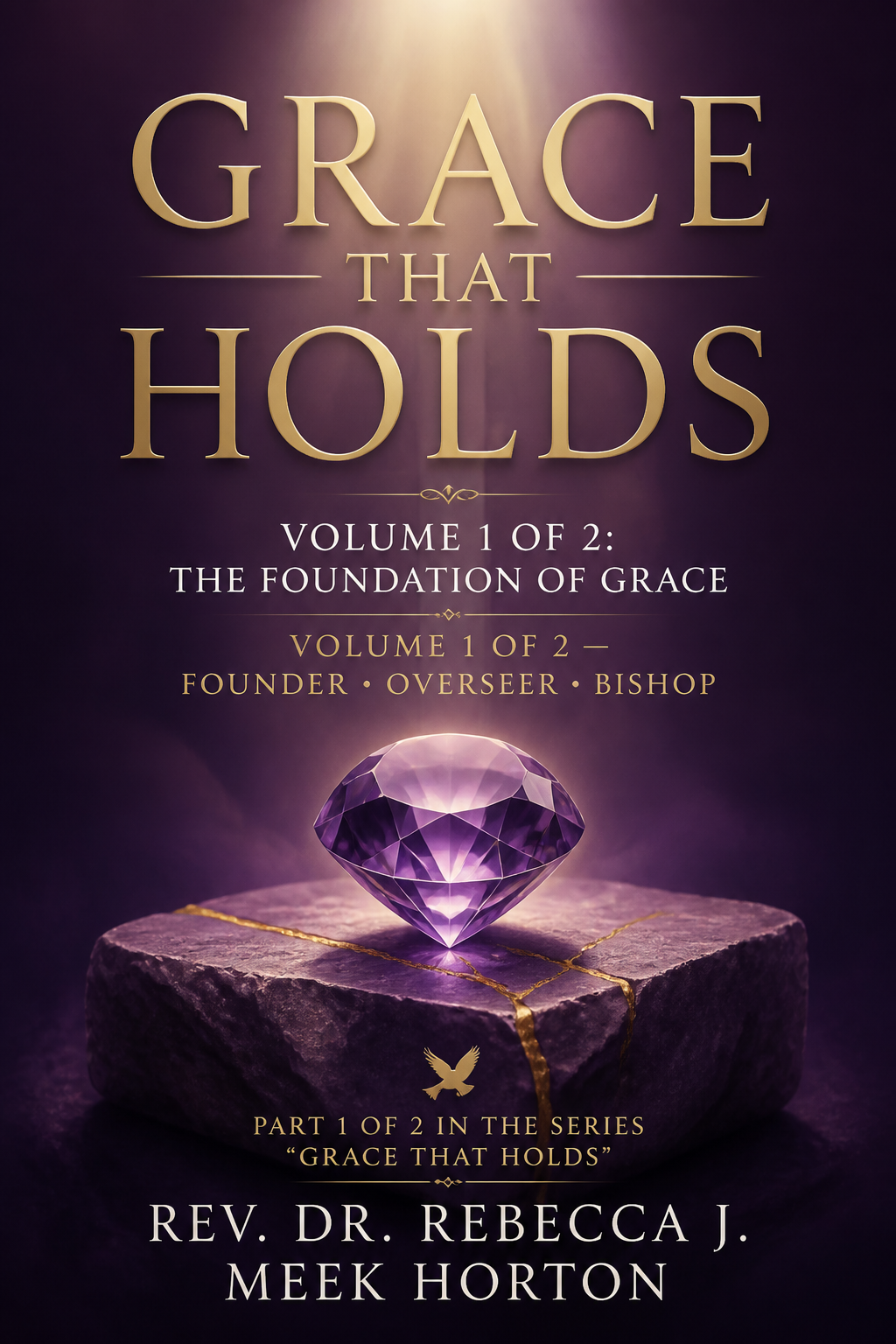
Grace That Holds · Volume 1
The Foundation of Grace
Part 1 of 2 in the series "Grace That Holds". Series theme: Grace flies through trust in GOD. Grace is our sufficiency. Grace empowers all we do in life. Series arc: This two-book series moves from foundation to formation. The first book establishes grace as God’s sufficient gift received through trust in Christ, not earned by striving or sustained by self-effort. The second book shows how that sa
Chapter 1 preview
NBCNGMI MASTER KNOWLEDGE LIBRARY Featuring the works of The Sage, Apostle Prophet. Rev. Dr. Rebecca J. Meek Horton, Apostolic Prophetic Architect, NewBeing Creation Network Global Ministries, Inc. Integrated Framework Modalities™
Purpose
I wrote this book for every weary believer who needs to remember that grace is not earned by striving or held together by self-effort. Grace is God’s sufficient gift in Christ, received through trust, and strong enough to hold us in weakness (Ephesians 2:8–10; 2 Corinthians 12:9). My prayer is that these pages help you rest again in the grace that saves, steadies, and brings you near to God with confidence (Romans 5:1–2; Hebrews 4:16).
Preface
I have carried this book in my heart for weary believers.
Not weary because they do not love GOD.
Weary because they have tried to keep themselves together by strength they were never meant to supply.
Some are tired from striving. Some are tired from guilt. Some are tired from serving while empty. Some are tired from believing that grace was enough to save them, but not enough to hold them.
This book begins there.
*The Foundation of Grace* was written to return us to the ground beneath our feet: “For by grace you have been saved through faith. And this is not your own doing; it is the gift of God” (Ephesians 2:8). Grace is not an accessory to the Christian life. Grace is the gift of GOD in Christ. Grace is the place we stand. Grace is our sufficiency.
The first movement of this series, *Grace That Holds*, is foundation. Before grace sends us, grace holds us. Before we serve, endure, obey, lead, or pour out, we must learn again how to receive. Romans 5:1–2 says that through Christ “we have also obtained access by faith into this grace in which we stand.” We do not stand in our record. We do not stand in our effort. We stand in grace.
I wrote these pages because many believers know how to work for GOD, but struggle to rest in Him. We know how to repent, rebuild, and press forward, but we often forget how to come boldly to the throne of grace to “receive mercy and find grace to help in time of need” (Hebrews 4:16).
This book is not written to add weight to your shoulders. It is written to help you recognize the weight Christ already carried.
Grace does not excuse sin. Grace does not remove obedience. Grace does not make us passive. But grace does remove the lie that we must become sufficient before we come to GOD.
The Lord told Paul, “My grace is sufficient for you, for my power is made perfect in weakness” (2 Corinthians 12:9). That is where we begin.
Not with performance.
Not with pretending.
Not with self-effort dressed in spiritual language.
We begin with trust.
Grace flies through trust in GOD. And when grace holds us, we can finally stop trying to hold ourselves.
Introduction
If you are weary, this book is not asking you to try harder before you rest.
Many believers are tired, not because they do not love God, but because they have been carrying what grace was meant to hold. They have tried to earn what Christ already gave. They have tried to sustain by self-effort what can only be sustained by God’s power. They have mistaken spiritual maturity for spiritual strain.
Grace does not begin with our strength.
Grace begins with God.
“For by grace you have been saved through faith. And this is not your own doing; it is the gift of God” (Ephesians 2:8). That sentence is the foundation beneath this book. Grace is not a reward for the strong. It is not a wage for the disciplined. It is not God’s approval after we finally become acceptable. Grace is God’s sufficient gift in Christ, received through faith, and trusted in daily.
This is the first book in the *Grace That Holds* series. The series moves from foundation to formation. This book lays the ground: grace holds us before grace sends us. The next book will show how grace becomes strength for obedience, endurance, service, and daily faithfulness. But we must not rush there too quickly. If we try to build formation without foundation, we will turn obedience into striving and service into exhaustion.
Grace flies through trust in GOD.
That means grace is received by faith, not controlled by effort. Romans 5:1–2 says, “Since we have been justified by faith, we have peace with God through our Lord Jesus Christ. Through him we have also obtained access by faith into this grace in which we stand.” We do not stand in grace because we are flawless. We stand in grace because Christ is faithful.
This book will ask simple but weighty questions.
What is grace?
What is grace not?
Why do weary believers struggle to rest in what God freely gives?
How do we come boldly to the throne of grace when we feel weak, ashamed, or unfinished? (Hebrews 4:16)
And what does it mean when the Lord says, “My grace is sufficient for you, for my power is made perfect in weakness”? (2 Corinthians 12:9)
Grace is not an excuse to remain unchanged. It is not permission to live carelessly. It is not a soft word that removes responsibility. True grace saves, steadies, teaches, and transforms. Ephesians 2 does not end at verse 9. Verse 10 says we are “created in Christ Jesus for good works, which God prepared beforehand, that we should walk in them.” But the order matters. Gift comes before good works. Belonging comes before becoming. Christ holds us before He leads us forward.
Read this book slowly.
Do not read it as a project to complete. Read it as ground to stand on. Keep your Bible near. Pause over the Scriptures. Let the Word correct the places where fear, shame, pride, or exhaustion have renamed grace. Some chapters may comfort you. Some may confront you. Both are mercy when they lead you back to Christ.
You may find places where you have been striving to prove you are loved. You may notice where you have confused discipline with earning. You may recognize that your weakness is not the end of your usefulness, but the place where God’s sufficiency becomes clear.
Nothing is random. Nothing is wasted.
Even your weariness can become a doorway into deeper trust, if you bring it honestly before the Lord.
So begin here: not with your performance, but with Christ. Not with what you must carry, but with what He has already carried. Not with fear that you are not enough, but with the truth that His grace is sufficient.
Before you turn the page, take one quiet moment and pray:
Lord, teach me to receive Your grace by faith. Show me where I have been striving. Ground me again in Christ. Amen.
Chapter 1 — When Striving Cannot Hold You
The coffee had gone cold beside her Bible.
She had opened it early, before the house woke up, hoping for peace. But the page blurred. Not because the words were unclear. Because her soul was tired.
She had served. She had prayed. She had shown up. She had tried to be patient, tried to be strong, tried to be consistent, tried to be grateful. She had said yes when she was empty. She had smiled when she was breaking. She had repented for the same fear more times than she could count.
And somewhere along the way, faith began to feel less like life with God and more like a long list of things she was failing to maintain.
Maybe you know that feeling.
You love God, but you are tired.
You believe the gospel, but you are worn down by the pressure to prove that you do. You know you were saved by grace, but you have been trying to stay acceptable by effort. You would never say it that way out loud, but your body knows. Your prayers know. Your exhaustion knows.
This chapter names the problem plainly: **we were not saved by grace so we could be sustained by self-effort.**
Paul asked the Galatians a searching question: “Are you so foolish? Having begun by the Spirit, are you now being perfected by the flesh?” (Galatians 3:3, ESV).
That question is not meant to shame the weary. It is meant to wake us up.
Grace does not begin our life with God and then leave us to carry the rest alone.
## The Quiet Drift from Grace to Performance
Most believers do not wake up one morning and decide to abandon grace.
The drift is usually quieter than that.
It begins with a holy desire. We want to please God. We want to grow. We want to obey. We want our lives to bear fruit. These desires are good. Scripture calls us to walk worthy of the Lord (Colossians 1:10). Jesus calls us to abide in Him and bear fruit (John 15:4–5). Grace never produces indifference toward obedience.
But something can shift inside us.
What began as love becomes pressure.
What began as gratitude becomes fear.
What began as obedience becomes self-measurement.
We start checking our spiritual condition by how well we performed that week. Did I pray enough? Did I feel strong enough? Did I overcome quickly enough? Did I serve cheerfully enough? Did I disappoint anyone? Did I disappoint God?
These questions can sound responsible, but when fear is underneath them, they become heavy.
A believer may still be doing all the right things outwardly while inwardly living under a crushing assumption: “God is pleased with me only when I am doing well.”
That is performance wearing religious clothing.
It can happen in a church pew. It can happen in ministry leadership. It can happen in a home where no one sees the pressure except the person carrying it.
A mother may feel she must never be overwhelmed if she is truly trusting God.
A pastor may feel he must never be weak if he is truly called.
A young believer may feel she must understand everything quickly if her faith is real.
A faithful servant may feel guilty for needing rest.
The drift from grace to performance often shows up as spiritual exhaustion. Not the normal tiredness that comes after faithful labor, but the deeper weariness that comes from trying to carry what only God can carry.
Paul’s question in Galatians 3:3 presses on this very place. The Galatians had received Christ by faith, but they were being tempted to continue by human effort and religious performance. They had begun by the Spirit, but now they were acting as if maturity depended on the flesh.
The word “flesh” here does not simply mean the body. It means human effort apart from dependence on God. It is the self trying to secure what only grace can give.
That old pattern still speaks today.
It tells us, “Try harder and God will be closer.”
It tells us, “Do more and you will finally be enough.”
It tells us, “Hide your weakness until you can present a better version of yourself.”
But the gospel says something better.
“By grace you have been saved through faith. And this is not your own doing; it is the gift of God” (Ephesians 2:8).
Grace begins with God.
And what begins with God must be sustained by God.
## Self-Effort Cannot Carry the Weight of Salvation
Self-effort is not the same as obedience.
This distinction matters.
Obedience is a response to God’s grace. Self-effort is an attempt to replace it.
Obedience says, “Lord, because You have loved me, I will follow.”
Self-effort says, “Lord, if I follow well enough, maybe You will love me.”
One produces humility. The other produces fear.
One leads to dependence. The other leads to exhaustion.
The problem is not that believers care too much about holiness. The problem is that we often try to become holy by carrying ourselves instead of trusting the One who saved us.
Paul told the Philippians, “He who began a good work in you will bring it to completion at the day of Jesus Christ” (Philippians 1:6). Notice who began the work. Notice who completes it.
God does not start the work of salvation and then hand the burden of completion to our anxious strength.
A builder would never pour a foundation and then ask the house to hold itself up. The strength of the building depends on what supports it beneath. If the foundation fails, the whole structure is at risk.
Grace is the foundation beneath the believer’s life.
When we forget this, we begin building on unstable ground. We build on approval. We build on consistency. We build on comparison. We build on emotional strength. We build on ministry output. We build on how we think God must feel about us today.
But none of those can hold the weight.
Your emotions cannot hold you.
Your discipline cannot hold you.
Your usefulness cannot hold you.
Your reputation cannot hold you.
Your ability to “do better next time” cannot hold you.
Only grace can hold what grace has saved.
This does not make effort meaningless. Scripture calls us to “work out” our salvation with fear and trembling, but the next verse tells us why we can: “for it is God who works in you, both to will and to work for his good pleasure” (Philippians 2:12–13).
We work because God is at work in us.
We do not work to make Him begin.
That is a very different life.
Imagine a child learning to walk while holding a parent’s hand. The child is truly walking. The steps are real. The effort is real. But the child is not alone. The strength, safety, and steadiness come from the one holding them.
Grace does not remove our steps. Grace holds us while we learn to walk.
## Weariness Can Reveal a False Burden
Weariness is not always a sign of failure.
Sometimes it is a signal.
It may be telling us that we have been carrying a burden Christ never gave us. It may be revealing that our soul has slipped from trust into strain. It may be showing us that we are trying to maintain our standing with God instead of receiving what Christ has already secured.
Jesus spoke tenderly to burdened people: “Come to me, all who labor and are heavy laden, and I will give you rest” (Matthew 11:28).
He did not say, “Come to me after you have become light.”
He did not say, “Come to me when you can explain why you are tired.”
He said, “Come to me.”
There is mercy in that invitation.
Many weary believers are not rebellious. They are burdened. They are carrying guilt that grace would teach them to lay down. They are carrying expectations God did not assign. They are carrying the fear that if they stop striving, everything will fall apart.
But if everything depends on our striving, then grace is no longer the foundation. Self becomes the foundation. And self is too small for that weight.
This is where RE-Language™ can help us tell the truth more clearly.
Instead of saying, “I am failing as a believer,” we can say, “I may be carrying my faith in my own strength.”
Instead of saying, “God must be tired of me,” we can say, “I need to return to the grace that first received me.”
Instead of saying, “I just need to try harder,” we can say, “I need to trust more deeply and obey from that place.”
This is not excuse-making. It is honest recalibration.
Nothing is random. Nothing is wasted. Even weariness can become a place where God shows us what has been out of order.
A man may discover that his constant need to serve is tied to fear of being unseen.
A woman may discover that her harsh self-talk is not conviction but condemnation.
A young leader may discover that his drive is not faithfulness but anxiety dressed as excellence.
A tired saint may discover that the Lord is not asking for more noise, more speed, or more proving. He is inviting them back to dependence.
The Spirit’s conviction leads us toward Christ. Condemnation drives us away from Him.
“There is therefore now no condemnation for those who are in Christ Jesus” (Romans 8:1).
This does not mean there is no correction. God corrects His children. But His correction is not rejection. His discipline is not abandonment. His voice does not crush the bruised reed (Isaiah 42:3).
Grace tells the truth without destroying the person.
## Beginning Again Where You Began
The way forward is not to despise effort. It is to restore order.
Grace first. Trust first. Dependence first.
Then obedience.
Then service.
Then endurance.
The Galatians did not need a new spiritual trick. They needed to return to the truth they had already received. They began by the Spirit. They needed to continue by the Spirit.
So do we.
This is the first movement of the book because weary believers often need permission to stop pretending they are stronger than they are. Not permission to quit following Jesus. Permission to stop trying to be their own source.
Grace is not fragile. It does not disappear when you are weak. It does not evaporate when you are tired. It does not stand at a distance until you improve.
The grace of God in Christ is not a doorway you passed through long ago and left behind. It is the ground beneath your feet now.
You may need to begin again where you began.
Not by earning.
Not by proving.
Not by performing.
By trusting.
Trust says, “Lord, I cannot hold myself together, but You can hold me.”
Trust says, “Lord, I will obey, but I will not make my obedience my Savior.”
Trust says, “Lord, I bring You the truth of where I am, not the image I wish I had.”
This will feel costly.
It may cost you the illusion of control. It may cost you the pride of being seen as always strong. It may cost you the habit of measuring your worth by your output. It may require you to admit that some of your spiritual activity has been driven by fear, not freedom.
That is not easy.
But it is mercy.
Grace does not humiliate us. It humbles us. Humiliation says, “You are nothing.” Humility says, “You are not God, and you were never meant to be.”
There is rest in that truth.
You are not the foundation.
Christ is.
And because Christ is the foundation, your life with God can be rebuilt from a steadier place.
## Key Takeaways
- You were not saved by grace to be sustained by self-effort.
- Weariness may reveal a burden Christ never asked you to carry.
- Grace restores the order: trust first, then obedience.
## Practice
Take ten quiet minutes today and write one honest sentence to God:
“Lord, I have been trying to carry __________ in my own strength.”
Do not fix it yet. Do not explain it away. Bring it into the light.
Then pray Galatians 3:3 slowly and ask the Lord to return you to dependence on the grace that first received you.
This is the opening chapter. The complete publication is available in the full edition.
Back to the library