Master Knowledge Library™
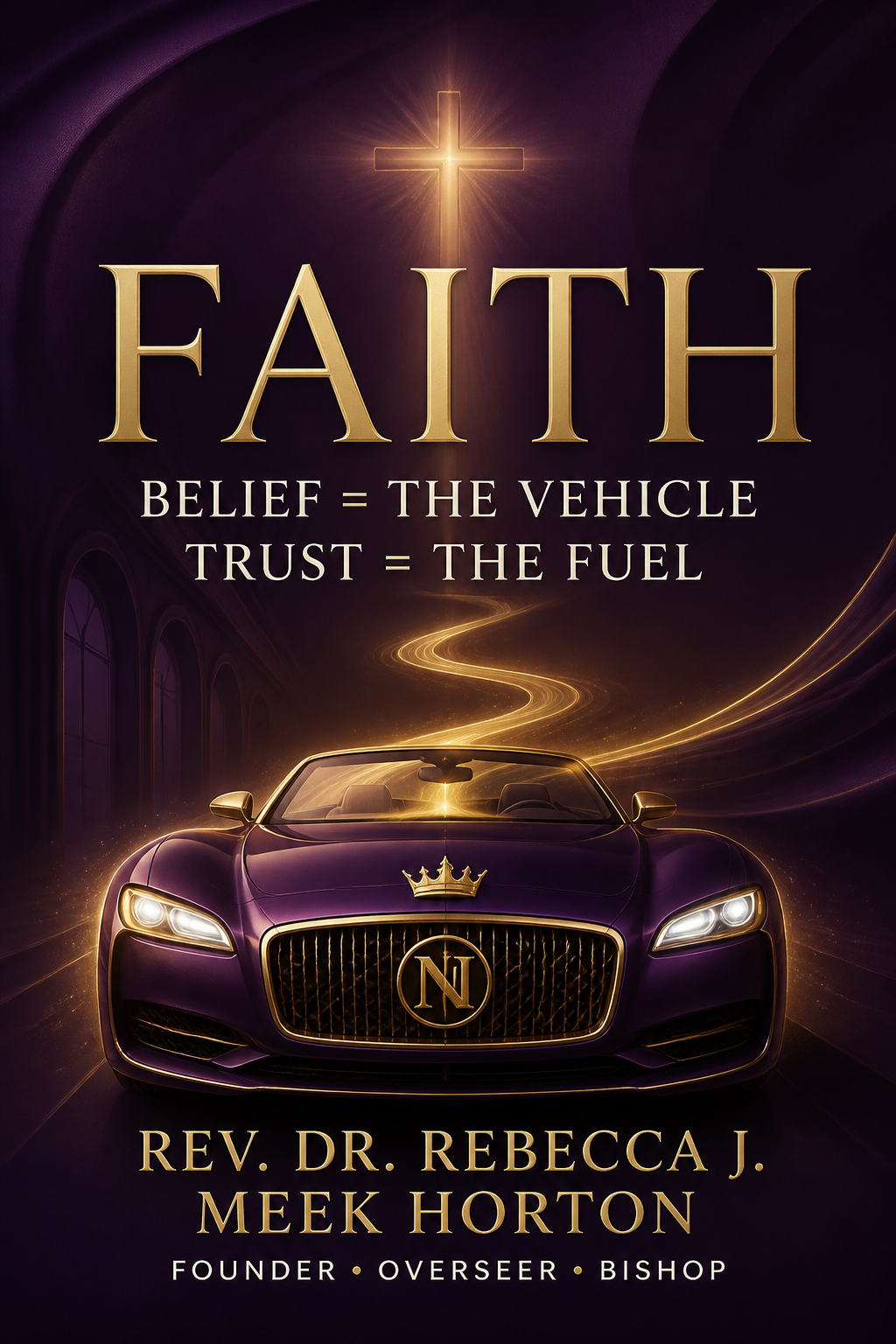
Faith: Belief = The Vehicle- Trust = The Fuel
I believe this should become one of the signature theological statements in the book because it also integrates seamlessly with your earlier work, The Architecture of Grace, where you described: * Belief as the “hardware”—the settled conviction that God is who He says He is. * Trust as the “software”—the living reliance that allows faith to operate daily. Those two concepts complement this chapt
Chapter 1 preview
NBCNGMI MASTER KNOWLEDGE LIBRARY Featuring the works of The Sage, Apostle Prophet. Rev. Dr. Rebecca J. Meek Horton, Apostolic Prophetic Architect, NewBeing Creation Network Global Ministries, Inc. Integrated Framework Modalities™
Purpose
I wrote this book to help make faith plain: belief is the vehicle that receives God’s truth, and trust is the fuel that keeps us moving with Him. My hope is that you will not only know what God has said, but learn to rely on His faithfulness in daily life, because “the righteous shall live by faith” (Romans 1:17). As you read, take the next honest step God gives you.
Preface
I wrote this book because I have seen many sincere believers carry a quiet frustration: *I believe God, but I do not know how to trust Him here.*
That sentence matters.
For years, I have watched people love the Lord, honor Scripture, pray earnestly, and still struggle to bring their belief into the daily places where fear, waiting, disappointment, and uncertainty live. They are not pretending. They are not careless. Many are simply trying to understand how faith works when life does not move quickly, when answers are delayed, and when obedience costs something.
This book was born from that holy tension.
In my earlier work, *The Architecture of Grace*, I described belief as the “hardware”—the settled conviction that God is who He says He is. I described trust as the “software”—the living reliance that allows faith to operate in real time. That picture stayed with me because it helped give language to something many of us experience but do not always know how to name.
Belief is the vehicle. Trust is the fuel.
Belief says, “God is true.” Trust says, “I will lean on Him today.”
Belief receives the truth of God. Trust rests in the faithfulness of God. Belief anchors the mind. Trust steadies the heart and moves the feet. Together, they form a living faith—not merely something we claim, but something we walk.
Scripture does not invite us into vague optimism. It calls us to a grounded confidence in the living God. “Without faith it is impossible to please Him” (Hebrews 11:6). Yet that faith is not passive. “Trust in the Lord with all your heart, and do not lean on your own understanding” (Proverbs 3:5). Abraham believed God, and his belief was counted as righteousness (Genesis 15:6; Romans 4:3). But that belief also had to walk, wait, surrender, and obey.
That is where many of us are being formed.
My hope is that this book will help you slow down, examine what you believe, and learn how to entrust more of your life to the God you confess. Not perfectly. Not theatrically. But honestly, steadily, and with grace.
As you read, bring your real questions. Bring the places where belief feels clear but trust feels costly. Then take the next faithful step before you. Faith grows as it is practiced. Trust deepens as it is lived.
Introduction
Faith is often spoken of as if it were only a belief to hold. Trust is often treated as if it were only a feeling to summon. But Scripture gives us something richer, stronger, and more livable.
Faith is not bare agreement. Trust is not blind optimism. Together, they form a life of covenant dependence on God.
This book is built around a simple image:
**Belief is the vehicle. Trust is the fuel.**
Belief gives faith its form. It receives what God has revealed. It says, “God is who He says He is. God has done what He says He has done. God will keep what He has promised.” Without belief, faith has no biblical shape. As Hebrews says, “whoever would draw near to God must believe that he exists and that he rewards those who seek him” (Hebrews 11:6).
But trust is what moves belief into lived reliance. Trust takes the truth we confess and places the weight of life upon God’s character. It prays when the answer has not come. It obeys when the path is costly. It waits when the promise feels delayed. “Trust in the LORD with all your heart, and do not lean on your own understanding” (Proverbs 3:5).
Belief may say, “God is faithful.” Trust says, “Because God is faithful, I will take the next step.”
This distinction is helpful, but it must be handled carefully. In Scripture, faith and trust are deeply joined. They are not enemies, and they are not truly separate lives. Biblical faith includes trust, reliance, allegiance, and obedience. Still, many people know the ache of believing true things about God while struggling to entrust their fear, future, grief, money, calling, or relationships to Him. This book is written for that honest place.
You may believe God can provide, yet still panic over provision. You may believe God forgives, yet still live under shame. You may believe God leads, yet still resist surrender. You may believe Christ is Lord, yet still guard certain rooms of your life.
That tension is not named to condemn you. It is named so grace can meet you truthfully.
In earlier language, we might say belief is like the hardware—the settled conviction that God is who He says He is. Trust is like the software—the living reliance that allows faith to operate in the ordinary pressures of daily life. Hardware without working software sits unused. Software without sound hardware has no stable place to run. In the same way, belief without trust remains incomplete, and trust without truth loses its foundation.
So this book will return often to one guiding conviction:
**Faith apprehends God’s truth; trust appropriates God’s faithfulness. Together they become the living conduit through which grace is received, experienced, and expressed.**
This is not a call to manufacture more spiritual energy. It is an invitation to bring your whole self—mind, heart, will, body, history, questions, and wounds—before the God who is already faithful. Faith does not begin with our strength. It begins with God’s revelation. “So faith comes from hearing, and hearing through the word of Christ” (Romans 10:17). Trust grows as we learn to walk with the One we have heard.
Read this book slowly. Do not rush to master the language. Let the language search you. When a sentence exposes fear, pause. When a Scripture steadies you, stay with it. When a question unsettles you, do not hurry past it. God often builds deep trust through honest wrestling, not quick slogans.
Each chapter is meant to help you see, name, and practice the difference between confessing truth and relying on the God of that truth. Some pages will clarify doctrine. Some will invite repentance. Some will comfort. Some will challenge. All of it is aimed at maturity—not dependency on a book, a system, or a voice, but deeper dependence on God Himself.
Begin here: ask the Lord to show you one area where your belief is present but your trust is not yet active. Name it plainly. Then pray, “Lord, I believe; help my unbelief” (Mark 9:24), and take the next faithful step with Him.
Chapter 1 — 1. Faith Begins with God
Faith does not begin with us reaching into the dark and hoping something is there.
Faith begins because God has spoken.
That one sentence changes the whole journey. If faith begins with us, then faith rises and falls with our mood, our discipline, our confidence, our pain, our questions, and our ability to hold everything together. But if faith begins with God, then faith rests on something far stronger than human emotion. It rests on His self-revelation.
God is not hiding behind the universe waiting for the most spiritual people to find Him. He has made Himself known. He has spoken through creation. He has spoken through the prophets. He has spoken finally and fully through His Son. He speaks through His Word by the power of His Spirit.
So faith is not a religious guess. It is not positive thinking with Bible language wrapped around it. It is not pretending we are certain when we are afraid. True faith is a response to the God who reveals Himself.
Hebrews says it plainly:
> “And without faith it is impossible to please him, for whoever would draw near to God must believe that he exists and that he rewards those who seek him.” > — Hebrews 11:6
And Paul gives us the pathway:
> “So faith comes from hearing, and hearing through the word of Christ.” > — Romans 10:17
Faith begins where God’s Word is heard and received.
Not merely heard as sound.
Not merely read as information.
Received.
Welcomed.
Taken seriously.
Allowed to become the ground beneath our feet.
## Faith Is Not Human Optimism
Many people confuse faith with optimism.
Optimism says, “Things will probably get better.”
Faith says, “God is faithful, whether the road gets easier or harder.”
Optimism depends on favorable outcomes. Faith depends on the character of God.
There is nothing wrong with hopefulness. It is a mercy to be able to look ahead and believe that tomorrow may hold good. But biblical faith is deeper than a bright outlook. It does not require us to deny grief, ignore danger, or force a smile when the soul is trembling.
Faith can weep.
Faith can wait.
Faith can ask questions.
Faith can say, “I do not understand,” and still turn toward God.
The Scriptures do not present faith as emotional cheerfulness. Abraham had to leave what was familiar. Moses had to confront Pharaoh. Hannah prayed out of deep anguish. David cried from caves and battlefields. Mary received a word from God that would change her life and cost her reputation. Paul followed Christ through prison, beatings, and weakness.
None of this was mere optimism.
Faith is not confidence that life will always go the way we want. Faith is confidence that God is who He says He is, and that His Word is true, even when life does not go the way we expected.
This matters because shallow definitions of faith cannot carry us through deep suffering. If we think faith means “I should always feel strong,” then weakness will feel like failure. If we think faith means “God will always remove the hard thing quickly,” then waiting will feel like abandonment. If we think faith means “I must never have questions,” then honest struggle will feel like rebellion.
But faith begins with God, not with our emotional condition.
The question is not, “Can I produce enough spiritual energy today?”
The better question is, “What has God said, and will I receive it?”
## God Makes the First Move
From the first pages of Scripture, God is the One who speaks first.
“Let there be light” (Genesis 1:3).
“Where are you?” (Genesis 3:9).
“Go from your country…” (Genesis 12:1).
“I have surely seen the affliction of my people…” (Exodus 3:7).
Again and again, God initiates. He calls. He reveals. He promises. He corrects. He comforts. He commands. He covenants.
Human faith is never the starting point. God’s revelation is.
We do not create God by believing in Him. We do not make His promises true by having enough confidence. We do not bring His kingdom into being by spiritual effort. God is already God. His Word is already true. His grace is already active. Faith is the open hand that receives what God has made known.
This protects us from pride.
If faith began with us, we could boast in the strength of our believing. We could divide people into the strong and the weak, the successful and the struggling, the ones who “have enough faith” and the ones who do not. But Scripture will not let us make faith into a trophy.
Paul writes:
> “For by grace you have been saved through faith. And this is not your own doing; it is the gift of God.” > — Ephesians 2:8
Faith receives grace. It does not manufacture grace.
This also protects us from despair.
If faith depended entirely on our ability to hold tightly to God, then every season of weakness would threaten our standing. But the gospel tells a better story. Before we ever reached for God, God came near to us in Christ.
Jesus is not the reward for impressive faith. He is the foundation of faith.
He is the Word made flesh (John 1:14). He is the image of the invisible God (Colossians 1:15). He is the radiance of God’s glory and the exact imprint of His nature (Hebrews 1:3).
So when we say faith begins with God, we are not speaking in vague spiritual terms. Faith begins because God has revealed Himself in Jesus Christ.
## Faith Comes by Hearing
Romans 10:17 is one of the clearest statements in Scripture about how faith is awakened:
> “So faith comes from hearing, and hearing through the word of Christ.” > — Romans 10:17
Paul is not describing faith as self-generated confidence. He is describing faith as a response to a message.
The gospel is announced.
Christ is proclaimed.
The Word is heard.
Faith comes.
This is humbling because it means we are dependent on revelation. We need God to speak. We need the Word of Christ. We need truth that comes from outside our own thoughts.
Our hearts are not neutral. They can be sincere and still be mistaken. They can desire spiritual things and still resist God. They can confuse comfort with truth, emotion with obedience, and personal preference with divine guidance.
That is why faith must be formed by the Word of God.
Romans 10 is especially concerned with the message of Christ: His lordship, His resurrection, His saving work, and the call to confess and believe. Paul writes:
> “If you confess with your mouth that Jesus is Lord and believe in your heart that God raised him from the dead, you will be saved.” > — Romans 10:9
Faith begins by hearing the good news of Jesus.
Not hearing that we should try harder to be acceptable.
Not hearing that we should become more religious to earn God’s attention.
Not hearing that our moral improvement is the center of the Christian life.
We hear Christ.
Crucified for sinners.
Raised in victory.
Exalted as Lord.
Near to all who call on Him.
The Word of Christ creates the ground on which faith stands.
This is why Scripture must remain central in the life of faith. Not as a decoration. Not as a quote collection. Not as a tool for winning arguments. Scripture is the living witness through which God reveals Himself, corrects us, nourishes us, and calls us forward.
Faith comes by hearing.
So the posture of faith begins with listening.
## Hearing Is More Than Sound
There is a kind of hearing that leaves us unchanged.
We can hear a sermon and only evaluate the preacher.
We can read a passage and only look for something familiar.
We can quote Scripture and still avoid its searching light.
We can keep the Bible near us but not let it speak over us.
Jesus often said, “He who has ears to hear, let him hear” (Matthew 11:15). He was not talking about physical hearing alone. He was calling for receptive hearing. Humble hearing. Obedient hearing.
In the parable of the sower, Jesus described different ways people receive the word (Mark 4:1–20). Some hear, but the word is quickly taken away. Some receive it with joy, but have no root. Some hear, but the cares of the world and the deceitfulness of riches choke the word. Others hear and bear fruit.
The difference is not that the seed changes.
The condition of the soil matters.
This is worth pondering honestly. We can be exposed to Scripture without being yielded to God. We can admire biblical truth without letting it govern our lives. We can agree with sound doctrine and still resist the Lord’s correction.
Faith begins when God’s Word is not merely noticed, but received.
Received means we allow God to tell the truth.
About Himself.
About us.
About sin.
About grace.
About judgment.
About mercy.
About the world.
About what matters.
This kind of hearing requires humility. It means we come to Scripture not merely asking, “Do I like this?” but “Lord, what are You saying?” It means we are willing to be comforted and confronted. It means we stop using the Word only to confirm what we already think, and begin letting it shape what we think.
James gives a sober instruction:
> “But be doers of the word, and not hearers only, deceiving yourselves.” > — James 1:22
Hearing that does not move toward obedience becomes self-deception. Not because obedience earns God’s love, but because true hearing opens the heart to God’s rule.
Faith begins with hearing, but biblical hearing always invites response.
## Faith Requires That We Come to God as He Is
Hebrews 11:6 says:
> “And without faith it is impossible to please him, for whoever would draw near to God must believe that he exists and that he rewards those who seek him.”
This verse is simple, but it is not shallow.
“Whoever would draw near to God must believe that he exists.”
Faith begins by receiving the reality of God. Not the idea of God as we would prefer Him to be. Not a distant force. Not a projection of our values. Not a spiritual symbol. The living God.
The God who creates.
The God who speaks.
The God who judges rightly.
The God who makes covenant.
The God who shows mercy.
The God and Father of our Lord Jesus Christ.
To draw near to God, we must come to Him as He has revealed Himself, not as we have imagined Him.
This is where many people stumble. We may want a God who affirms everything we desire, but the true God loves us too much to be ruled by our desires. We may want a God who explains everything immediately, but the true God calls us to walk with Him even when we see only part of the road. We may want a God who gives blessings without surrender, comfort without correction, salvation without lordship.
But faith does not reshape God into our image.
Faith receives God as He is.
Hebrews also says we must believe “that he rewards those who seek him.”
This does not mean God can be manipulated by religious activity. It does not mean if we perform the right actions, God owes us the life we planned. The reward is not always immediate relief, visible success, or earthly comfort.
The deepest reward of seeking God is God Himself.
His presence.
His mercy.
His wisdom.
His keeping grace.
His eternal promise.
Those who seek Him are not wasting their lives. Those who draw near to Him are not ignored. Those who call upon Him in truth are not abandoned.
Faith believes God is real, and that He is not indifferent to those who seek Him.
## Religious Effort Cannot Replace Faith
Because faith begins with God’s revelation, it cannot be reduced to religious effort.
This is important. Many people live exhausted spiritual lives because they are trying to produce by effort what can only be received by faith.
They attend. They serve. They give. They perform. They compare. They try to keep up appearances. But underneath all the activity, they are not resting in the God who has spoken. Their spiritual life becomes a long attempt to prove they are acceptable.
Religious effort asks, “Have I done enough for God to receive me?”
Faith hears the gospel and says, “Christ is enough, and I receive Him.”
Religious effort often produces either pride or despair. Pride when we think we are doing better than others. Despair when we know we are not doing well enough. But faith turns our attention away from self-measurement and back to God’s mercy.
This does not mean faith is passive or lazy. Scripture never teaches that. Faith obeys. Faith acts. Faith endures. Faith works through love (Galatians 5:6). But the order matters.
We do not obey to create God’s faithfulness.
We obey because God is faithful.
We do not serve to purchase grace.
We serve because grace has reached us.
We do not seek God so that He might become good.
We seek Him because He is good.
The Christian life is not built on human striving. It is built on divine revelation and grace.
When we get this order wrong, our souls suffer. We become anxious, harsh, performative, or secretly bitter. We may keep doing religious things, but joy dries up because we have slipped from response into self-reliance.
Faith begins again when we return to what God has said.
## God’s Word Creates the World Faith Lives In
Faith does not float in the air. It lives inside the world created by God’s Word.
When God speaks, He does not merely pass along information. His Word reveals reality.
If God says we are created in His image, then human life has sacred worth.
If God says sin separates, then sin is not a harmless preference.
If God says Christ died for the ungodly, then grace is not for the deserving but for the needy.
If God says Jesus is risen, then death does not have the final word.
If God says He will never leave nor forsake His people, then loneliness is not the same as abandonment.
Faith learns to inhabit the world as God defines it.
That does not happen all at once. Much of discipleship is the slow healing of our vision. We have learned to see through fear, pride, pain, culture, family history, disappointment, and desire. God’s Word patiently retrains us.
It tells us what is true when our feelings are loud.
It tells us who God is when circumstances are confusing.
It tells us who we are when shame is persuasive.
It tells us what matters when the world is demanding.
This is why the regular hearing of Scripture is not optional for mature faith. We do not live by impressions alone. We live by every word that comes from the mouth of God (Matthew 4:4).
Jesus Himself answered temptation with Scripture. In the wilderness, He did not treat the Word as secondary. He stood in what the Father had spoken.
If the Son of God honored the written Word in the hour of testing, we should not imagine that we can walk faithfully while neglecting it.
## The Word Reveals Before It Requires
Many people approach Scripture mainly as a list of demands.
Do this.
Do not do that.
Try harder.
Be better.
But Scripture first reveals God.
Before we are commanded, we are shown the One who commands. Before we are corrected, we are confronted with the holy and merciful God. Before we are sent, we are called to behold Him.
The Bible is not less than instruction, but it is far more. It is revelation.
God shows us His holiness in the law.
His patience in Israel’s story.
His compassion in the prophets.
His wisdom in the writings.
His heart in Christ.
His power in the resurrection.
His mission in the church.
His promise in the new creation.
Faith grows as God becomes less vague to us.
This is why hurried reading often leaves us thin. We may gather a phrase for the day, but miss the God who is speaking. We may look for quick inspiration, but avoid the deeper work of attention.
To read Scripture faithfully, we must slow down enough to ask:
What does this passage reveal about God?
What does it reveal about human need?
What promise, warning, command, or comfort is being given?
How does this point me toward Christ?
What faithful response is being invited?
These questions help us receive the Word with reverence. They keep us from using Scripture carelessly. They help us listen before we speak.
Faith begins with God’s self-revelation, so our first task is not to master the Word as an object. It is to be mastered by the God who speaks through it.
## Faith Is Personal, Not Private Invention
Faith is deeply personal. No one can believe for you in the fullest sense. You must respond to God yourself. You must hear. You must receive. You must come.
But personal faith is not private invention.
In our time, many people speak of faith as if it means choosing whatever gives personal meaning. “My faith” can become a phrase for private spirituality detached from the Word of God, the lordship of Christ, and the witness of the church.
Biblical faith is personal, but it is not self-authored.
Jude speaks of “the faith that was once for all delivered to the saints” (Jude 3). Paul reminds Timothy that the sacred writings are able to make one “wise for salvation through faith in Christ Jesus” (2 Timothy 3:15). The faith we receive has content. It is anchored in the gospel. It is entrusted to God’s people.
This is freeing.
We do not have to invent a faith strong enough to survive the world. We receive the faith grounded in God’s Word and centered on Jesus Christ.
The church does not create the truth, but it is called to guard, teach, confess, and live it. We need the gathered people of God because we are forgetful. We need preaching, prayer, fellowship, correction, and communion. We need older saints who have endured. We need brothers and sisters who can remind us of what is true when we are weary.
Faith is personal, but God never designed it to be isolated.
The Word comes to us, and often it comes through faithful witnesses.
## The Mercy of a Spoken Word
There is mercy in the fact that God speaks.
Silence would be terrifying. If God never revealed Himself, we would be left to speculation. We would search creation and conscience and still not know the fullness of His saving heart. We might sense glory, guilt, longing, and beauty, but we would not know the cross unless God made it known.
But God has spoken.
He has not left us to guess our way back to Him.
He has not hidden His mercy behind impossible riddles.
He has not required us to climb into heaven by our own strength.
Paul says in Romans 10:
> “The word is near you, in your mouth and in your heart.” > — Romans 10:8
Then he explains that this is the word of faith being proclaimed.
The nearness of the Word is a gift. God brings His truth near enough to be heard, believed, confessed, and lived.
This should soften us. Every open Bible is a mercy. Every faithful sermon is a mercy. Every remembered verse in a hospital room, every whispered promise at a graveside, every gospel word spoken to a guilty conscience, every correction that turns us from ruin—these are gifts.
God speaks because God is merciful.
Faith is born in that mercy.
## When Faith Feels Small
If faith begins with God, then small faith is not hopeless.
This is good news for tired people.
Some imagine that faith must always feel large, bold, and unshakable. But Scripture is honest about frail faith. The disciples were often afraid. Thomas struggled to believe the resurrection testimony until he saw the risen Christ. A desperate father once cried out to Jesus:
> “I believe; help my unbelief!” > — Mark 9:24
That prayer is not polished, but it is honest. And Jesus did not despise it.
There are seasons when faith feels less like a shout and more like a whisper. There are days when all you can do is turn your face toward God and say, “Lord, I am here. Speak to me again.”
That is not nothing.
Faith does not become real only when it feels heroic. Faith is real when it responds to God, however trembling the response may be.
A bruised reed He will not break (Isaiah 42:3). The Lord is patient with the weak. He knows our frame; He remembers that we are dust (Psalm 103:14).
This does not excuse unbelief as harmless. Unbelief can harden the heart. It can refuse God’s Word. It can call God untrustworthy. Scripture warns us seriously about that. But there is a difference between hardened refusal and humble weakness.
If your faith feels small, do not stare at your faith until it grows. Look again to the God who speaks. Return to the Word of Christ. Ask Him to help you receive what He has revealed.
The strength of faith is not found by measuring faith itself. It is found by beholding the Faithful One.
## Receiving the Word Requires Surrender
To receive God’s Word is not merely to collect truth. It is to yield to the One who speaks.
This is where faith becomes costly.
If God has spoken, then we are not free to remain lord over our own lives. We cannot treat His Word as one voice among many, equal to preference, culture, appetite, fear, or ambition. Faith receives God’s Word as authoritative because faith receives God as God.
There will be times when Scripture comforts us deeply.
There will be times when it confronts us directly.
Both are grace.
The same Word that says, “Come to me, all who labor and are heavy laden” (Matthew 11:28), also says, “If anyone would come after me, let him deny himself and take up his cross and follow me” (Matthew 16:24).
The same Lord who forgives sinners also calls sinners to repent.
The same Shepherd who restores our souls also leads us in paths of righteousness.
We should not pretend this is always easy. Receiving the Word may require us to release cherished sin, forgive an enemy, confess wrongdoing, change direction, wait when we want to run, or obey when obedience is misunderstood.
Faith is not human optimism, but neither is it casual agreement.
Faith says, “God has spoken, and I am no longer my own.”
That surrender is not slavery to a cruel master. It is life under the care of the Good Shepherd. But it is surrender all the same.
A faith that never bows has not yet understood the One who speaks.
## The First Movement of Faith: Attend to God
If faith comes by hearing, then one of the most faithful things we can do is make room to hear.
Not as a technique to control God.
Not as a performance to prove devotion.
But as a humble posture.
We cannot force faith to grow by anxiety. We cannot shame ourselves into maturity. But we can place ourselves before the Word. We can quiet the noise. We can ask for ears to hear. We can listen with a willingness to obey.
This is simple, but it is not always easy.
We live in a noisy age. Many of us reach for a screen before we reach for Scripture. We take in headlines, opinions, entertainment, outrage, and comparison before we have received the Word of Christ. Then we wonder why our souls feel scattered.
The issue is not merely technology. The deeper issue is attention.
What forms our hearing will shape our faith.
If fear is the loudest voice, faith will feel fragile.
If pride is the loudest voice, faith will become distorted.
If pain is the loudest voice, faith may become suspicious.
If culture is the loudest voice, faith may become confused.
But when God’s Word is given its proper place, our souls begin to recover order. Not instantly. Not mechanically. But truly.
The first movement of faith is attention to God.
“Speak, Lord, for your servant hears” (1 Samuel 3:9).
That is a prayer of beginning.
## Faith Begins, Then Keeps Beginning
There is an initial beginning of faith, when a person hears the gospel and turns to Christ. That beginning matters eternally.
But there are also many renewed beginnings.
Every morning, faith begins again as we return to God’s Word.
Every trial invites faith to begin again.
Every confession of sin is a beginning again.
Every act of obedience is a beginning again.
Every time we open Scripture after a season of distance, faith begins again.
This is not because God keeps changing. It is because we are continually being called back into living response.
The Christian life is not sustained by yesterday’s attentiveness alone. The manna of yesterday was not meant to replace today’s dependence. We need daily bread. We need present hearing. We need the Spirit to bring the Word home to us again and again.
Jesus taught us to pray:
> “Give us this day our daily bread.” > — Matthew 6:11
Daily bread is humble. It does not flatter our independence. It reminds us that we remain receivers.
Faith matures not by outgrowing dependence, but by deepening it.
## The Ground Beneath the Whole Journey
This chapter is the doorway for everything that follows.
Before we speak of belief as the vehicle of faith, we must know where belief comes from.
Before we speak of trust as the fuel of faith, we must know whom trust is responding to.
Before we speak of practice, testing, obedience, or grace expressed through our lives, we must settle this first truth:
Faith begins with God.
God reveals Himself.
God speaks His Word.
God gives the gospel of Christ.
God calls us to hear and receive.
We respond.
That response may be new and trembling. It may be renewed after years of walking with Him. It may come through tears. It may come after conviction. It may come quietly in the ordinary place where Scripture is opened and the heart finally stops running.
But true faith is always response.
Not invention.
Not optimism.
Not effort.
Response.
The living God has spoken. Faith hears and comes.
## A Simple Practice: Begin by Hearing
Before moving on, take one unhurried step.
Set aside ten quiet minutes today or tomorrow. Read Romans 10:8–17 slowly. If you can, read it aloud.
Then ask three simple questions:
1. **What does this passage reveal about God and His saving work in Christ?** 2. **What word, phrase, or truth do I need to receive rather than merely notice?** 3. **What is one faithful response God is inviting from me today?**
Do not rush to make the moment dramatic. Simply attend to God.
Wait in stillness.
Ask honestly.
Listen carefully.
Keep the next faithful step.
Faith begins where God’s Word is heard and received. So begin there.
This is the opening chapter. The complete publication is available in the full edition.
Back to the library