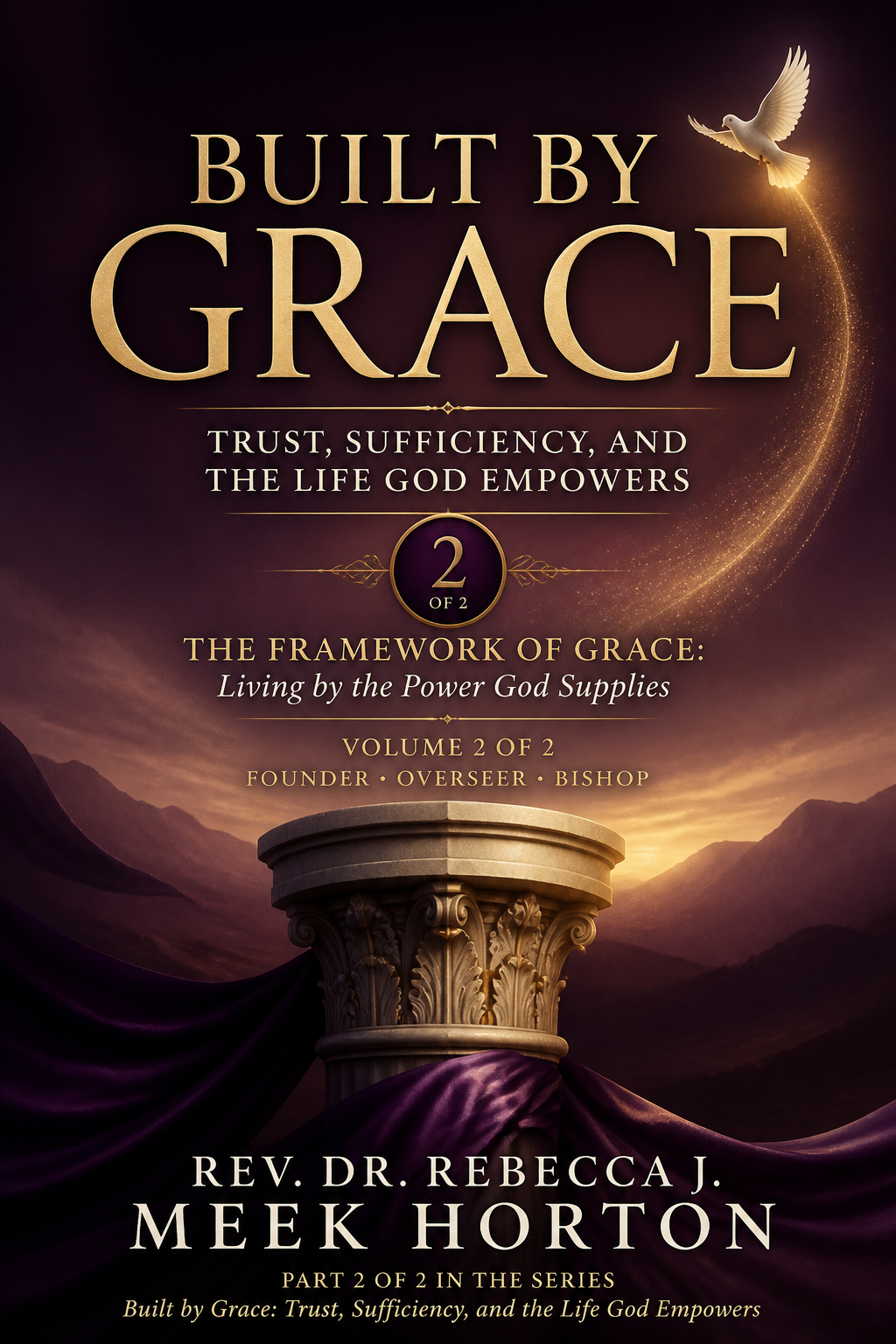
Grace That Holds · Volume 2
The Framework of Grace: Living by the Power God Supplies
Part 2 of 2 in the series "Built by Grace: Trust, Sufficiency, and the Life God Empowers". Series theme: Grace flies through trust in GOD. Grace is our sufficiency. Grace empowers all we do in life. Series arc: This two-book series moves from foundation to formation. The first book establishes grace as God’s sufficient gift received through trust, grounding the reader in the gospel rather than sel
Chapter 1 preview
NBCNGMI MASTER KNOWLEDGE LIBRARY Featuring the works of The Sage, Apostle Prophet. Rev. Dr. Rebecca J. Meek Horton, Apostolic Prophetic Architect, NewBeing Creation Network Global Ministries, Inc. Integrated Framework Modalities™
Purpose
I wrote this book to help you see grace not only as the gift that saves you, but as the power God supplies for the life He calls you to live. My prayer is that you will learn to steward grace in obedience, work, suffering, service, and witness without falling into passivity or performance. “By the grace of God I am what I am” (1 Corinthians 15:10), and I hope these pages help you live from that same sufficiency with courage, humility, and faith.
Preface
I wrote this book because I have seen how easily sincere believers can receive grace for salvation and then quietly return to self-effort for daily life.
We trust God to forgive us, but then we try to carry our obedience, our calling, our relationships, our suffering, and our growth in our own strength. We know grace is the door, but we do not always know grace is also the room we live in.
This is the burden behind *The Framework of Grace*.
The first book in this series focused on the foundation: grace received through trust in God. This second book turns toward formation. If grace is God’s sufficient gift, then grace is also God’s supplied power. It does not make us passive. It makes us dependent in the right way. It teaches us to move, obey, serve, endure, and give from what God provides.
Paul said it plainly: “By the grace of God I am what I am… I worked harder than any of them, though it was not I, but the grace of God that is with me” (1 Corinthians 15:10). That sentence has searched me often. Grace did not make Paul idle. Grace made him fruitful. Yet he knew the source of the fruit.
That is the life I want to learn. That is the life I want to help you walk in.
This book was born from ordinary places: prayers prayed when strength was thin, conversations with weary servants, moments of correction, and seasons where I had to learn again that God does not only call His people—He supplies them. Hebrews 4:16 invites us to “receive mercy and find grace to help in time of need.” Not grace in theory. Grace to help.
So these pages are not written to add weight to your shoulders. They are written to help you discern what God has already placed beneath them.
We will talk about obedience, work, relationships, suffering, generosity, calling, and maturity. We will also be honest about the cost. Grace does not remove every hardship. But it does keep us from living as if faithfulness depends on us alone.
As you read, bring your real life with you. Bring your weariness. Bring your desire to obey. Bring your questions about calling and capacity. And ask God for the grace not only to understand, but to practice.
The next faithful step may be simple: stop striving for a moment, come near to the throne of grace, and ask God for the help He has promised.
Introduction
Grace is not only the way we begin with God. Grace is the way we keep walking with God.
Many believers know they are saved by grace, yet they quietly try to live by pressure. They receive forgiveness as a gift, then carry obedience like a weight they must lift alone. They pray for strength, but still measure their lives by strain, comparison, fear, and performance. Others move the other way. They hear “grace” and assume it means passivity, as if God’s kindness removes the need for faithful effort.
Scripture gives us a better way.
Paul said, “By the grace of God I am what I am, and his grace toward me was not in vain.” Then he added, “I worked harder than any of them, though it was not I, but the grace of God that is with me” (1 Corinthians 15:10). That is the heart of this book. Grace does not cancel obedience. Grace empowers it. Grace does not make effort unnecessary. Grace makes faithful effort possible.
The first book in this series established the foundation: grace is God’s sufficient gift, received through trust in Him. We do not earn our standing with God. We do not save ourselves, complete ourselves, or make ourselves worthy by striving. Christ is enough.
This second book turns toward formation. If grace is our foundation, how does grace become our daily framework? How does it shape our work, relationships, suffering, generosity, calling, service, endurance, and maturity? How do we live what we have received?
The answer is not self-reliance with religious language. It is also not waiting for God to do what He has called us to practice. The life of grace is a life of dependent participation. God supplies the power, and we respond in trust. Philippians 2:12–13 holds these together: “Work out your own salvation with fear and trembling, for it is God who works in you, both to will and to work for his good pleasure.”
God works in us. Therefore, we work it out.
This book is for believers who are tired of swinging between performance and passivity. It is for those who want to obey God without pretending they are strong enough on their own. It is for the servant who feels weary, the disciple who feels inconsistent, the leader who feels stretched, the giver who feels depleted, and the quiet faithful person who wonders whether grace is strong enough for ordinary life.
It is.
But grace must be stewarded. Peter writes, “As each has received a gift, use it to serve one another, as good stewards of God’s varied grace” (1 Peter 4:10). Grace is not a private possession to admire. It is a holy supply to carry, practice, and pour out. We come to “the throne of grace” to “receive mercy and find grace to help in time of need” (Hebrews 4:16), and then we rise to live as people helped by God.
Read this book slowly. Do not rush to master the ideas. Let the Scriptures search you. Notice where you have been striving without dependence. Notice where you have been passive under the name of grace. Notice where God is inviting you into a next faithful step.
Each chapter will carry one teachable idea. The movement is simple: from grace as strength, to grace in obedience, to grace in suffering, service, generosity, calling, relationships, witness, and maturity. The goal is not to give you a heavier life. The goal is to help you receive the life God empowers.
You will be asked to practice. Not to prove yourself. Not to earn what Christ has already secured. Practice is how trust becomes visible. Practice is how grace takes shape in real time.
Paul told Timothy, “Be strengthened by the grace that is in Christ Jesus” (2 Timothy 2:1). That is the invitation before us.
Do not begin with your weakness alone. Begin with His supply.
Before you read further, pause and pray honestly: “Lord, show me where I have been trying to live by my own strength. Teach me to steward Your grace with trust, obedience, and joy.”
Chapter 1 — 1. When Grace Becomes Daily Strength
The alarm goes off before the room is ready for morning.
You reach for the phone, see the messages, remember the meeting, the bill, the child who needs patience, the relationship that still feels strained, the habit you meant to break, the prayer you meant to pray. Before your feet touch the floor, yesterday’s weakness is already speaking.
Many believers know what it means to receive grace from God. We can say, with gratitude, that we are forgiven in Christ. We know we did not save ourselves. We know the cross is our only hope.
But then Monday comes.
The question changes from, “Can God forgive me?” to, “Can God strengthen me for this day?”
This chapter’s controlling idea is simple: **grace is not only God’s pardon for the past; grace is God’s supplied power for faithful living today.**
Paul said it this way: “But by the grace of God I am what I am, and his grace toward me was not in vain. On the contrary, I worked harder than any of them, though it was not I, but the grace of God that is with me” (1 Corinthians 15:10).
That one verse holds the promise of this book. Grace receives us. Grace remakes us. Grace strengthens us. Grace works in us and with us so we can live before God with faithfulness, humility, and courage.
## The Gap Between Forgiven and Strengthened
There is a quiet gap many Christians carry.
On one side is the grace we celebrate in worship. We sing about mercy. We confess that salvation is a gift. We rest in the truth that “by grace you have been saved through faith” (Ephesians 2:8).
On the other side is the life we actually live. Decisions must be made. Temptations must be resisted. People must be loved. Work must be done. Suffering must be endured. Sin must be confessed. Responsibility must be carried.
And somewhere between Sunday truth and daily life, grace can begin to feel like a doctrine we believe more than a strength we depend on.
A man may believe he is forgiven and still feel alone when he has to lead his family with patience.
A woman may believe God loves her and still feel empty when she has to keep serving without recognition.
A young believer may rejoice in salvation and still wonder why obedience feels so hard.
The problem is not that grace is weak. The problem is often that we have treated grace as if it only works at the entrance of the Christian life.
But Scripture speaks differently.
Grace saves us, yes. But grace also teaches us, trains us, strengthens us, and sends us. Grace is not a soft word for God overlooking everything. Grace is the active kindness of God that brings us into Christ and then supplies what He calls us to live.
Paul did not say, “By grace I was forgiven, and then I took it from there.”
He said, “By the grace of God I am what I am” (1 Corinthians 15:10).
That is identity. Formation. Continuance.
Grace did not merely open the door. Grace was still with him in the work.
## Grace Does Not Cancel Effort
One reason believers struggle to live by grace is that we often confuse grace with ease.
If it is grace, we think, it should not feel costly.
If it is grace, it should come naturally.
If it is grace, I should not have to labor, repent, wait, obey, or endure.
But Paul’s testimony corrects that misunderstanding. He says, “I worked harder than any of them” (1 Corinthians 15:10). Grace did not make him passive. Grace made him fruitful.
Then he immediately adds, “though it was not I, but the grace of God that is with me.”
This is not contradiction. This is Christian life.
Grace does not erase effort. Grace changes the source and spirit of our effort.
Self-powered effort says, “I must prove myself.”
Grace-powered effort says, “God is at work in me, so I can respond faithfully.”
Self-powered effort becomes proud when it succeeds and crushed when it fails.
Grace-powered effort remains humble because it knows every good thing comes from God.
Imagine a branch on a vine. The branch bears fruit, but it does not generate life from itself. It receives life from the vine and bears what the vine supplies. Jesus said, “Whoever abides in me and I in him, he it is that bears much fruit, for apart from me you can do nothing” (John 15:5).
The branch is not inactive. It bears fruit.
But it is not independent. It abides.
That is the pattern of grace.
We act, but not as orphans. We obey, but not to earn a place at the table. We labor, but not as if the kingdom rests on our shoulders. We take the next step because God supplies strength for the step He gives.
## Grace Meets the Actual Day
It is easy to speak about grace in large, beautiful terms. It is harder, and more necessary, to receive grace for the actual day in front of us.
Grace for the email you do not want to answer.
Grace for the apology you need to make.
Grace for the child who interrupts your plan.
Grace for the diagnosis you did not expect.
Grace for the work that feels unseen.
Grace for the discipline of showing up again.
The grace of God is not vague spiritual encouragement. It is help from God for real need.
Hebrews says, “Let us then with confidence draw near to the throne of grace, that we may receive mercy and find grace to help in time of need” (Hebrews 4:16).
Notice the wording: “in time of need.”
Not in theory. Not only at conversion. Not only at the end of life. In the moment of need.
There is grace for the place where you are tempted to quit. There is grace for the moment when your patience is thin. There is grace when you do not know what to say. There is grace when obedience feels small and hidden.
This does not mean the day becomes easy. It means you are not left to live it by yourself.
A mother caring for a sick child through the night may not feel strong. But she asks God for mercy, takes the next faithful step, and finds enough grace for the next hour.
A pastor preparing to preach after a week of grief may not feel impressive. But he opens the Word, prays for help, and serves from what God supplies.
A worker entering a hard meeting may not feel confident. But she asks for wisdom, speaks truthfully, and refuses fear-driven words.
This is often how grace appears: not as a dramatic feeling, but as supplied faithfulness.
Enough light for the next step.
Enough strength for the next obedience.
Enough mercy to begin again.
## Grace Gives the Shape of a Supplied Life
If grace is God’s supplied power, then the Christian life is not built on pretending.
We do not have to pretend we are strong enough. We do not have to pretend we are wise enough. We do not have to pretend we are naturally patient, brave, generous, or holy.
Grace begins where pretending ends.
Paul’s words in 1 Corinthians 15:10 are honest. He does not deny his labor. He does not deny God’s grace. He holds both together.
“I worked.”
“Yet not I.”
“The grace of God was with me.”
This gives us a framework for daily living.
First, receive. Start with God, not yourself. The day does not begin with your sufficiency. It begins with His.
Second, respond. Grace is not an excuse to drift. It calls for obedience.
Third, remember. When fruit comes, give glory to God. When weakness appears, return to God. When failure happens, confess and rise by mercy.
This framework protects us from two errors.
It protects us from despair, because our weakness is not the end of the story.
It protects us from pride, because our strength is not our own.
A supplied life is not a lazy life. It is not a frantic life either. It is a dependent life. It keeps turning toward God for what God commands.
The mature believer is not the one who needs grace less. The mature believer has learned to depend on grace more honestly, more quickly, and more deeply.
## The Cost of Living by Supplied Strength
This sounds comforting, and it is. But it also costs us something.
To live by grace as daily strength, we must surrender the illusion of self-sufficiency.
That is not easy.
Many of us would rather be helped after we have proven we can handle most of it ourselves. We like grace for emergencies, but not for ordinary dependence. We want God’s rescue, but we still want the reputation of being strong.
Grace humbles us.
It teaches us to pray before we perform. To ask before we act. To confess before we collapse. To say, “Lord, I need You,” not only when life breaks, but when life is normal.
It also costs us our excuses.
If grace truly supplies strength, then we cannot use weakness as a permanent hiding place. We may be weak, but we are not abandoned. We may be tired, but we can come to the throne of grace. We may have failed, but we can repent and take the next faithful step.
Grace does not shame us for need.
Grace meets us in need and trains us to move with God.
So the question is not, “Do I have enough in myself for this life?”
You do not.
The better question is, “Will I learn to live by the power God supplies?”
That is the path this book will walk.
Not performance. Not passivity. Grace.
Grace for obedience. Grace for work. Grace for relationships. Grace under pressure. Grace for service. Grace for generosity. Grace that grows us up. Grace that sends us into the world as faithful stewards of what God gives.
The Christian life is not lived by admiring grace from a distance.
It is lived by receiving grace in real time.
## Key Takeaways
- Grace is God’s pardon for the past and power for today. - Grace does not cancel effort; it supplies faithful effort. - The daily Christian life begins with dependence, not self-sufficiency.
## Practice
Before you begin tomorrow, pause for two minutes and pray from 1 Corinthians 15:10:
“Lord, by Your grace I am what I am. Let Your grace toward me not be in vain today. Strengthen me to receive, respond, and obey by the power You supply.”
Then name one specific place you need grace that day, and take the next faithful step.
This is the opening chapter. The complete publication is available in the full edition.
Back to the library