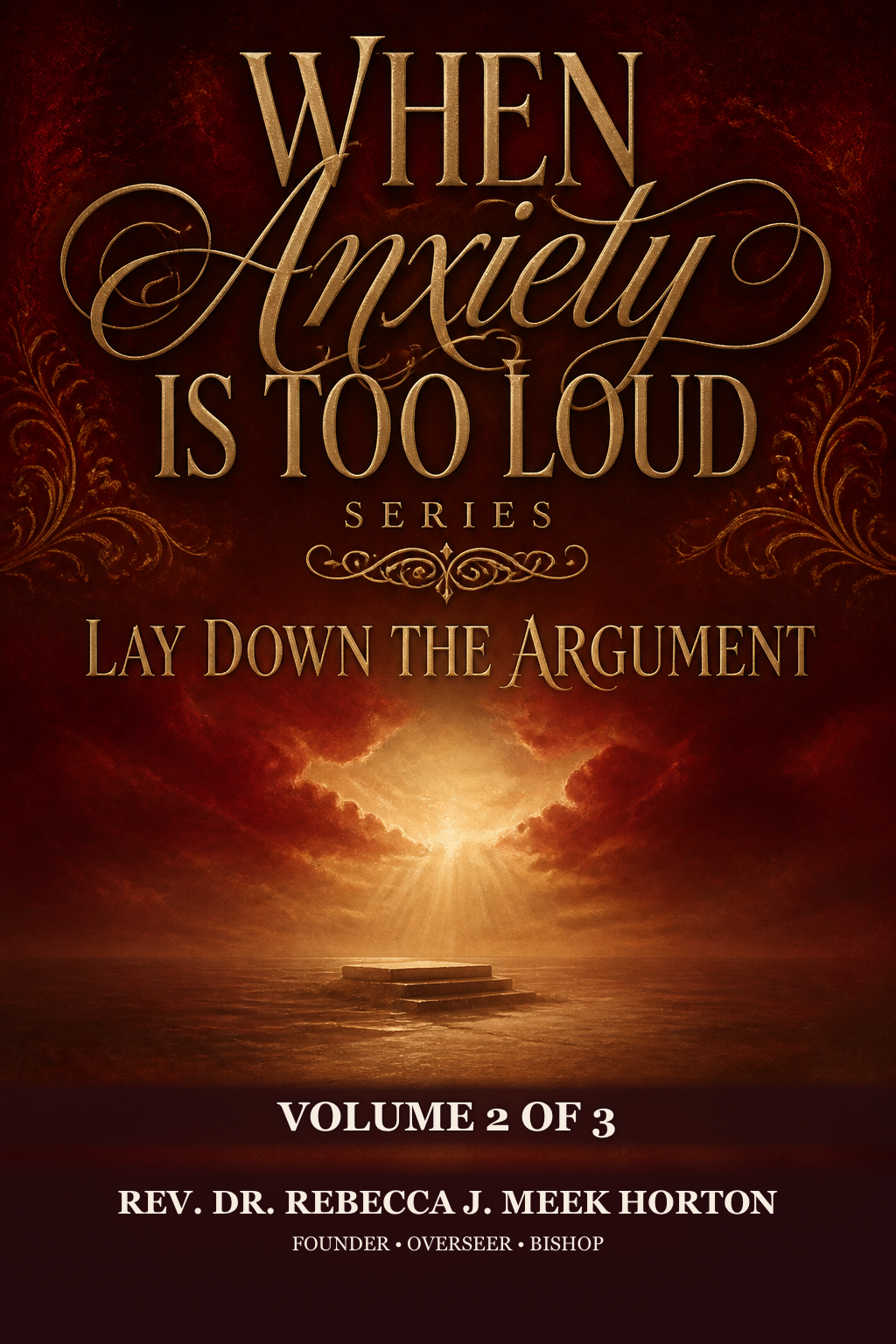
When Anxiety Is Too Loud · Volume 2
Lay Down the Argument
Part 2 of 3 in the series "When Anxiety Is Too Loud". Series theme: Do not try to fight anxiety or reason with it. Series arc: This three-book series moves from interruption to surrender to steady living. The first book teaches readers to stop arguing with anxiety and create enough quiet to see what is really happening. The second book helps them place fear, control, and uncertainty before God wit
Chapter 1 preview
NBCNGMI MASTER KNOWLEDGE LIBRARY Featuring the works of The Sage, Apostle Prophet. Rev. Dr. Rebecca J. Meek Horton, Apostolic Prophetic Architect, NewBeing Creation Network Global Ministries, Inc. Integrated Framework Modalities™
Dedication
To every soul tired from arguing with fear: I wrote these pages for you. May you find grace to lay the burden before God, courage to stop wrestling with what you cannot control, and quiet strength to take the next faithful step in His care.
Purpose
I wrote this book to help you stop carrying what fear keeps asking you to manage, explain, and control. My hope is that these pages will guide you to bring the real burden before God with honesty, trust, and surrender, without turning prayer into another form of striving. May this book help you lay down the argument, receive His care, and take the next faithful step in His peace.
Preface
I wrote this book for the person who is tired of negotiating with anxiety.
I know what it means to feel pulled into an inward argument that does not end. Fear asks for proof. Control asks for certainty. Regret asks for another hearing. Imagined outcomes demand attention before they ever become real. The mind keeps answering, explaining, defending, preparing, rehearsing, and revising. But anxiety is rarely satisfied by one more argument.
This book was born from a simple burden: after we learn not to answer the noise, we must learn where to place what the noise keeps demanding we carry.
Lay Down the Argument is the second part of the When Anxiety Is Too Loud series. The first book helped us interrupt the cycle long enough to see what is really happening. This book moves us toward surrender. Not surrender as defeat. Not surrender as denial. Not surrender as pretending we are no longer afraid. But surrender as the faithful act of placing fear, control, uncertainty, and heaviness before God.
Philippians 4:6-7 (KJV) Be careful for nothing; but in every thing by prayer and supplication with thanksgiving let your requests be made known unto God. And the peace of God, which passeth all understanding, shall keep your hearts and minds through Christ Jesus.
Prayer is not another way to wrestle harder. Prayer is not a spiritual performance where we try to say the perfect words so our feelings will obey immediately. Prayer is where we bring the real burden to the real God.
That may sound simple, but it will cost us something. It will cost us the illusion of control. It will ask us to stop treating worry like responsibility. It will ask us to tell the truth about what we fear, what we cannot fix, and what we have been carrying as if it belongs only to us.
This book is not a promise that anxiety will disappear all at once. It is an invitation to practice release with honesty, Scripture, confession, counsel, and trust. Again and again, we will learn to lay down the argument and return the burden to God.
Read slowly. Pray honestly. Do not rush the quiet work.
Begin with one burden you have been rehearsing in your mind. Name it before God today. Then ask Him to teach you how to carry only what He has actually given you to steward.
Introduction
Anxiety can sound like an argument you never agreed to enter.
It asks one more question. It raises one more possibility. It reminds you of what happened, warns you about what might happen, and pressures you to decide before wisdom has had time to speak. Even when you know the thoughts are wearing you down, you may still feel pulled to answer them.
What if this happens?
What if I missed something?
What if God does not come through the way I need Him to?
What if I cannot handle what comes next?
This book begins with a simple truth: you do not have to keep negotiating with fear. You can place the burden before God without turning prayer into another form of striving.
Lay Down the Argument is the second book in the When Anxiety Is Too Loud series. The first book helped you stop answering the noise long enough to see what was really happening. This book helps you bring what you see to God. Not polished. Not performed. Not explained perfectly. Brought honestly.
That matters because anxiety often disguises itself as responsibility. It tells you that if you keep thinking, keep rehearsing, keep predicting, keep controlling, you are being wise. But there is a difference between faithful stewardship and fearful striving. Stewardship takes the next obedient step. Striving tries to carry what only God can hold.
Philippians 4:6-7 (KJV)
Be careful for nothing; but in every thing by prayer and supplication with thanksgiving let your requests be made known unto God. And the peace of God, which passeth all understanding, shall keep your hearts and minds through Christ Jesus.
This passage does not tell us to pretend we have no concerns. It teaches us where to take them. Prayer is not denial. Prayer is placement. Supplication is not panic dressed in spiritual language. It is honest dependence. Thanksgiving is not forced cheerfulness. It is the act of remembering God while the burden is still present.
You may not feel instant quiet every time you pray. That is important to say plainly. Surrender is not always a sudden emotional release. Sometimes surrender is quiet obedience repeated many times in one day. Sometimes it sounds like, “Lord, I am bringing this back to You again.” Sometimes it means confessing that control has become a false refuge. Sometimes it means receiving counsel, telling the truth, resting the body, or choosing not to rehearse an imagined outcome.
1 Peter 5:7 (KJV)
Casting all your care upon him; for he careth for you.
God does not shame you for having care. He invites you to cast it upon Him. That casting may feel costly. It may cost you the illusion of control. It may cost you the habit of rehearsing pain until it feels prepared. It may cost you the pride of appearing unbothered. But what you lay before God is no longer something you have to carry alone.
Psalm 55:22 (KJV)
Cast thy burden upon the LORD, and he shall sustain thee: he shall never suffer the righteous to be moved.
Read this book slowly. Do not use it to pressure yourself into feeling calm. Use it to practice truthful surrender. Each chapter will help you recognize one form of argument anxiety often creates: fear, control, regret, uncertainty, isolation, and the demand for guarantees. Then you will be invited to bring that burden before God with honesty, Scripture, prayer, counsel, and one faithful step.
This book is not a replacement for Scripture, prayer, pastoral care, wise counsel, or professional support when needed. It is a companion for learning how to stop wrestling with what God is inviting you to release.
Before you continue, take one step. Name the burden you have been arguing with most. Write it in one plain sentence. Then pray simply: “Lord, I bring this to You. Teach me how to lay it down without picking it back up as control.”
Chapter 1 — The Argument Is Wearing You Out
You check the lock again.
You know you locked the door. You remember turning the key. You remember touching the handle before you walked away. But halfway down the hall, the thought comes back.
What if you did not lock it?
So you return. You check again. For a moment, relief comes. Then another thought arrives.
What if the stove is on?
Now the mind is no longer walking down the hall. It is in a courtroom, answering questions from an anxious prosecutor who never runs out of evidence.
This is how anxiety often works. It does not always begin with panic. Sometimes it begins with a demand: Answer me. Solve this. Prove you are safe. Prove you are prepared. Prove nothing bad will happen.
The controlling idea of this chapter is simple: anxiety wears us down when we treat every anxious demand as something that must be answered. The first step toward surrender is learning to recognize the argument without entering it.
You do not have to win every anxious debate.
Some debates are not meant to be won. They are meant to be laid down.
The Voice That Sounds Like Responsibility
Anxiety often borrows the language of wisdom.
It says, “You need to think this through.”
It says, “You cannot ignore this.”
It says, “If you were responsible, you would keep checking.”
That is what makes it difficult. Anxiety rarely introduces itself as anxiety. It often sounds like planning, protection, discernment, or care. And sometimes there is a real responsibility underneath it. Bills must be paid. Children must be watched. Health concerns should not be ignored. Hard conversations may need to happen.
The problem is not responsibility.
The problem is when responsibility becomes endless mental negotiation.
A mother lies awake at night replaying her child’s future. School. Friends. Safety. Character. College. Calling. She loves her child, and that love is real. But at two in the morning, love has been pulled into a courtroom. She is no longer praying, planning, or parenting. She is trying to guarantee outcomes she cannot control.
Anxiety tells her, “If you stop thinking, you stop caring.”
That is not true.
Care is not the same as constant mental labor. Stewardship is not the same as control. Wisdom prepares what can be prepared. Anxiety demands certainty where certainty has not been given.
Jesus asked a question that exposes the limit of anxious thought:
Matthew 6:27 (KJV) Which of you by taking thought can add one cubit unto his stature?
This does not shame the anxious person. It tells the truth. Some thoughts feel productive, but they do not add life. They only spend strength.
Negotiating With Fear
Fear does not usually ask one question and leave. It asks one question, then builds a hallway of more questions.
What if this happens?
What if I cannot handle it?
What if I fail?
What if they leave?
What if I missed God?
What if this never changes?
When we answer one question, another rises behind it. The argument keeps moving because fear is not really looking for an answer. Fear is looking for control.
Think of someone waiting for a medical result. They search symptoms online. Then search the meaning of the symptoms. Then search stories from strangers. Then search worst-case outcomes. Hours pass. Their body is still in the room, but their mind has traveled through ten imagined futures.
They may call it research. Sometimes research is needed. But there is a line where learning becomes feeding fear.
That line matters.
A wise question can lead to a responsible step. An anxious question often leads to another anxious question.
Wisdom asks, “What do I need to know, and what is the next faithful step?”
Fear asks, “How can I remove all uncertainty before I move?”
Those are not the same.
This is where RE-Language™ helps. We can begin to recognize language that binds us and reframe it toward truth.
Instead of saying, “I have to figure everything out tonight,” say, “I need one faithful step, not total control.”
Instead of saying, “If I feel afraid, something must be wrong,” say, “Fear is present, but fear is not my master.”
Instead of saying, “I cannot rest until I know,” say, “I can be honest about uncertainty without obeying panic.”
This is not pretending fear is small. It is refusing to let fear become lord over the moment.
The Trap of Regret and Imagined Outcomes
Anxiety does not only pull us forward into what might happen. It also pulls us backward into what already happened.
Regret can become one of anxiety’s favorite arguments.
Why did I say that?
Why did I trust them?
Why did I wait so long?
Why did I not see it sooner?
Honest reflection can bring wisdom. But anxious regret keeps reopening the same scene without leading to repentance, repair, learning, or peace. It does not teach. It punishes.
A man replays a conversation from three days ago. He remembers one sentence he wishes he had not said. He imagines how the other person must have heard it. Then he imagines what they must think of him. Then he imagines what may happen next. By the time he finishes, he is not responding to the real conversation anymore. He is responding to a story anxiety has built around it.
There may be a real next step. He may need to apologize. He may need to clarify. He may need to learn patience. But anxiety will not let him move cleanly. It keeps him circling.
Regret says, “Look honestly and learn.”
Anxious regret says, “Keep punishing yourself until you feel safe.”
The same happens with imagined outcomes. The mind creates a future scene, then reacts as if it has already happened. The body tightens. The heart races. The stomach turns. The person is grieving, defending, explaining, and bracing for something that is not yet real.
This is exhausting because the body pays for stories the soul has not been called to carry.
We must learn to ask, “Is this a real responsibility, or an imagined trial?”
That question does not solve everything. But it interrupts the loop.
The Cost of Answering Everything
There is a cost to arguing with anxiety.
It costs attention.
You cannot be fully present with the person in front of you while answering every anxious possibility inside you.
It costs rest.
The body may lie down, but the mind keeps working.
It costs discernment.
When every thought feels urgent, it becomes harder to recognize what truly matters.
It costs prayer.
Not because you stop using religious words, but because prayer can become another arena for striving. You may speak to God while still trying to control every outcome in your own strength.
It costs relationships.
People near you may feel managed instead of loved. They may become part of your system of reassurance. You ask again and again, “Are we okay? Are you sure? Did I do something wrong?” For a moment, their answer helps. Then anxiety demands another answer.
This is not a reason for shame. It is a reason for clarity.
Anxiety is loud, but loud does not mean truthful. Urgent does not mean obedient. Repeated does not mean wise.
The tension is real: laying down the argument may feel irresponsible at first. You may feel as if you are abandoning your post. You may fear that if you stop wrestling, something will fall apart.
But some of what you are carrying was never in your hands to hold.
This is the hard mercy of surrender. It asks you to stop confusing mental strain with faithfulness. It asks you to admit the limit of your control. It asks you to let God be God without demanding that your emotions settle instantly.
You are not being asked to ignore life.
You are being invited to stop letting anxiety run the meeting.
Key Takeaways
• Anxiety often sounds urgent, but urgency is not always wisdom.
• Stewardship takes the next faithful step; control tries to secure every outcome.
• The first movement toward surrender is recognizing the argument without entering it.
Practice
Today, notice one anxious demand without answering it immediately.
Write it down in one sentence: “Anxiety is asking me to argue about…”
Then pause for two minutes. Breathe slowly. Ask yourself:
Is this a real responsibility for today, or an imagined outcome I am trying to control?
Choose one faithful step you can take today. Leave the rest unnamed for now. This is not the full work of surrender yet. It is the beginning of no longer treating every anxious thought as a command.
This is the opening chapter. The complete publication is available in the full edition.
Back to the library