When Anxiety Is Too Loud · Volume 1
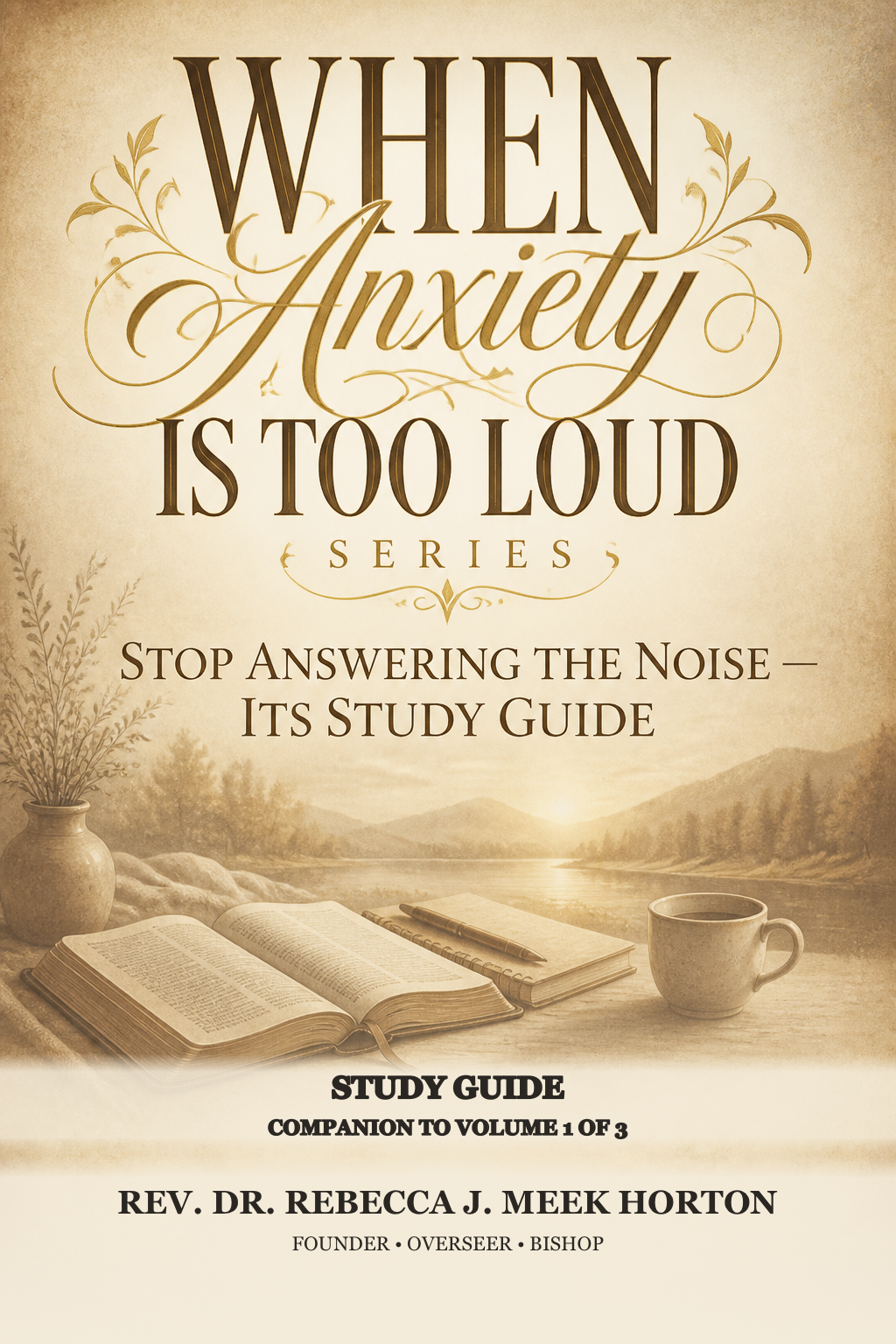
Stop Answering the Noise — Its Study Guide
A study guide for "Stop Answering the Noise". Every written chapter becomes a study session: chapter summary, key truths, the Scriptures in full, word study, ten study questions, personal application, and a memory verse.
Chapter 1 preview
NBCNGMI MASTER KNOWLEDGE LIBRARY Featuring the works of The Sage, Apostle Prophet. Rev. Dr. Rebecca J. Meek Horton, Apostolic Prophetic Architect, NewBeing Creation Network Global Ministries, Inc. Integrated Framework Modalities™
Dedication
I dedicate this study guide to every soul learning to stop answering the noise and return to the voice of Jesus. May these pages help you slow down, receive truth, and walk your next faithful step with courage, clarity, and obedience.
Purpose
I wrote this study guide to help you slow down, examine each chapter with Scripture, and stop giving your strength to the noise that keeps pulling for your attention. My hope is that you will move from reading to understanding, from understanding to obedience, and from obedience to steady spiritual maturity. May these sessions help you hear more clearly, discern more wisely, and take your next faithful step with God.
Preface
I wrote this study guide because I know how loud life can become.
Noise does not always sound like chaos. Sometimes it sounds like pressure. Sometimes it sounds like urgency, comparison, fear, accusation, distraction, or the constant need to explain yourself. Sometimes the loudest noise is not around us; it is within us.
Stop Answering the Noise was written as a call to return to clarity, obedience, and governed peace. This study guide was created to help you sit with that call, chapter by chapter, until it becomes more than something you read. I want you to study it, pray through it, question your own patterns, and practice the truth in real life.
Jesus said:
John 10:27 (KJV) My sheep hear my voice, and I know them, and they follow me:
That verse carries the heart of this work. The goal is not to answer every voice. The goal is to know the Voice that leads you rightly.
Every session in this guide is designed to help you slow down and listen with wisdom. You will find chapter summaries, key truths, Scriptures in full, word study, study questions, personal application, and a memory verse. Do not rush through them. The value is not in finishing quickly. The value is in allowing truth to search you, settle you, and strengthen your next step.
This may cost you something. It may cost you the habit of reacting. It may cost you the comfort of blaming the noise while refusing to guard your own heart. It may ask you to stop feeding what God is calling you to outgrow.
Proverbs 4:23 (KJV) Keep thy heart with all diligence; for out of it are the issues of life.
Nothing is random. Nothing is wasted. Even the noise can reveal what needs RE-Calibration™.
My prayer is that this guide helps you stop living pulled apart by every sound around you. May you learn to hear more clearly, respond more faithfully, and walk in obedience with steadiness.
Begin simply: read slowly, answer honestly, and choose one noise you will stop answering today.
Introduction
This study guide was created to help you do more than read Stop Answering the Noise. It is designed to help you sit with the message, test your attention, examine your responses, and practice a quieter obedience.
Noise is not only sound. Noise can be pressure, urgency, fear, comparison, accusation, distraction, overthinking, people-pleasing, spiritual confusion, and the constant demand to react. Some noise comes from the world around us. Some comes from within us. Some comes from old wounds, ungoverned habits, or voices we have allowed to become louder than wisdom.
The argument of this guide is simple: every voice does not deserve your answer. Every demand does not deserve your movement. Every emotion does not deserve your obedience. The believer must learn to discern the difference between noise that pulls, wisdom that instructs, and the voice of the Lord that leads.
John 10:27 (KJV) My sheep hear my voice, and I know them, and they follow me:
This is not a call to ignore responsibility. It is not an invitation to become passive, careless, or unreachable. It is a call to become governed. A governed life does not answer everything. A governed life learns to pause, weigh, listen, and obey.
That will cost something. It may cost the comfort of quick reaction. It may cost the approval of people who benefited from your immediate availability. It may cost the false peace of staying busy so you do not have to become still. But the fruit is worth it: clearer hearing, steadier obedience, wiser decisions, and deeper peace.
Psalm 46:10 (KJV) Be still, and know that I am God: I will be exalted among the heathen, I will be exalted in the earth.
Each session in this guide follows the written chapter it supports. You will find a chapter summary, key truths, Scriptures in full, a word study, ten study questions, personal application, and a memory verse. This order is intentional. You begin by understanding the message, then you return to Scripture, examine language, answer honestly, and practice one next faithful step.
Do not rush the questions. The goal is not to finish pages. The goal is to let truth become clearer and obedience become concrete. If a question searches you, stay with it. If a Scripture corrects you, receive it. If a word study exposes a pattern in your language, let RE-Language™ help you move from shame to responsibility and from vague intention to faithful action.
You may use this guide alone, with a small group, in a class, or in a discipleship setting. If you are using it with others, keep the space honest and safe. Do not use the questions to judge someone else’s process. Let the Word search you first. If you are using it privately, consider keeping a journal nearby. Write plainly. Pray honestly. Track what becomes clearer over time.
As you move through each session, practice this rhythm:
• Read the chapter slowly.
• Study the Scriptures carefully.
• Answer the questions truthfully, not performatively.
• Identify the noise you have been answering.
• Choose one obedient step you can practice that day.
Remember: WISDOM is not yours until YOU WALK IT. Understanding is a gift, but it must become stewardship. This guide will not do the work for you. It will help you notice the work that is already being required of you.
Before you begin, take one quiet moment. Name one noise you have been answering too quickly. Write it down. Then ask God for the courage to stop reacting to what is loud and start responding to what is true.
Chapter 1 — The Thought That Demands an Answer
Chapter Summary
This chapter establishes a clear starting place for learning how to stop answering the noise. Anxiety often enters through a small thought, message, feeling, or uncertainty that demands an immediate answer. The pressure can feel like authority, but the chapter teaches that urgency does not make a thought true, and pressure does not make it a command. The reader is invited to slow down, separate fact from fear, and notice what the body is signaling without surrendering to panic. The chapter also shows that not every thought deserves obedience. Some thoughts must be examined, submitted to Christ, corrected, or refused. A pause becomes an act of wisdom because it gives space for discernment before reaction. This is not denial, passivity, or avoidance of responsibility. It is stewardship. The chapter is honest about the cost: pausing may feel unsafe, irresponsible, or uncomfortable at first. Yet maturity begins when we stop treating every inner alarm as wisdom. The loudest thought in the room does not have to lead.
Key Truths
An anxious thought may feel urgent, but urgency does not make it true.
Pressure is a signal to notice, not a command to obey.
There is a difference between having a thought and obeying a thought.
The body may feel alarmed before the situation is actually clear.
A pause gives wisdom room to speak before reaction takes over.
Responsible language helps move anxiety from ruler to signal.
Maturity begins when we stop calling every inner alarm wisdom.
Scriptures for Study
2 Corinthians 10:5 (KJV) Casting down imaginations, and every high thing that exalteth itself against the knowledge of God, and bringing into captivity every thought to the obedience of Christ;
Proverbs 14:29 (KJV) He that is slow to wrath is of great understanding: but he that is hasty of spirit exalteth folly.
Word Study
Imaginations. Plain meaning: thoughts, reasonings, arguments, or inner conclusions that may rise up in the mind. Why it matters here: anxiety often builds a whole story from little information, and Scripture teaches that these inner conclusions must be brought under the authority of Christ.
Captivity. Plain meaning: being taken under control instead of being left free to rule. Why it matters here: anxious thoughts are not masters. They can be noticed, examined, corrected, and submitted to Christ.
Hasty of spirit. Plain meaning: inwardly rushed, reactive, or quick to move without understanding. Why it matters here: anxiety often pushes people to answer, explain, defend, accuse, or decide too quickly.
RE-Language™. Plain meaning: the practice of changing harmful or vague words into truthful, responsible, and actionable words. Why it matters here: saying “I have to fix this now” gives anxiety authority, but saying “I am feeling pressure to fix this now” names anxiety as a signal.
SAPP™ Discernment. Plain meaning: a wisdom practice that helps a person See the situation truthfully, Ask deeper questions, Ponder motives and costs, and Practice the next faithful step. Why it matters here: the chapter begins with seeing clearly before deciding what the anxious thought means.
Study Questions
1. What situation opens the chapter, and why does such a short message create so much inner noise?
2. What kinds of questions does the mind begin asking after the message appears?
3. How does the body respond before any clear facts are known?
4. According to the chapter, what is the difference between a concern that needs attention and anxiety that demands reaction?
5. How does 2 Corinthians 10:5 help us understand that thoughts are not final authorities?
6. Why is it important to separate fact, fear, assumption, and body signal?
7. What does Proverbs 14:29 teach about haste, understanding, and folly?
8. Where do you most often feel pressured to respond too quickly: messages, relationships, work, family, leadership, or personal fear?
9. What sentence of RE-Language™ could help you name an anxious thought this week without obeying it?
10. What is one situation where you need to practice a pause before answering the noise?
Personal Application
1. Practice the four line reflection once this week: Fact, Fear, Pressure, and Faithful response.
2. When an anxious thought rises, say out loud or write down: “I am having the thought that…” before deciding whether it is true.
3. Choose one pause practice before responding: take one slow breath, step away from the screen, pray “Lord, help me see clearly,” or wait before sending a reactive message.
Memory Verse
2 Corinthians 10:5 (KJV) Casting down imaginations, and every high thing that exalteth itself against the knowledge of God, and bringing into captivity every thought to the obedience of Christ;
Notes and Answers
[Answer Lines]
[Journal Page]
[Journal Page]
This is the opening chapter. The complete publication is available in the full edition.
Back to the library