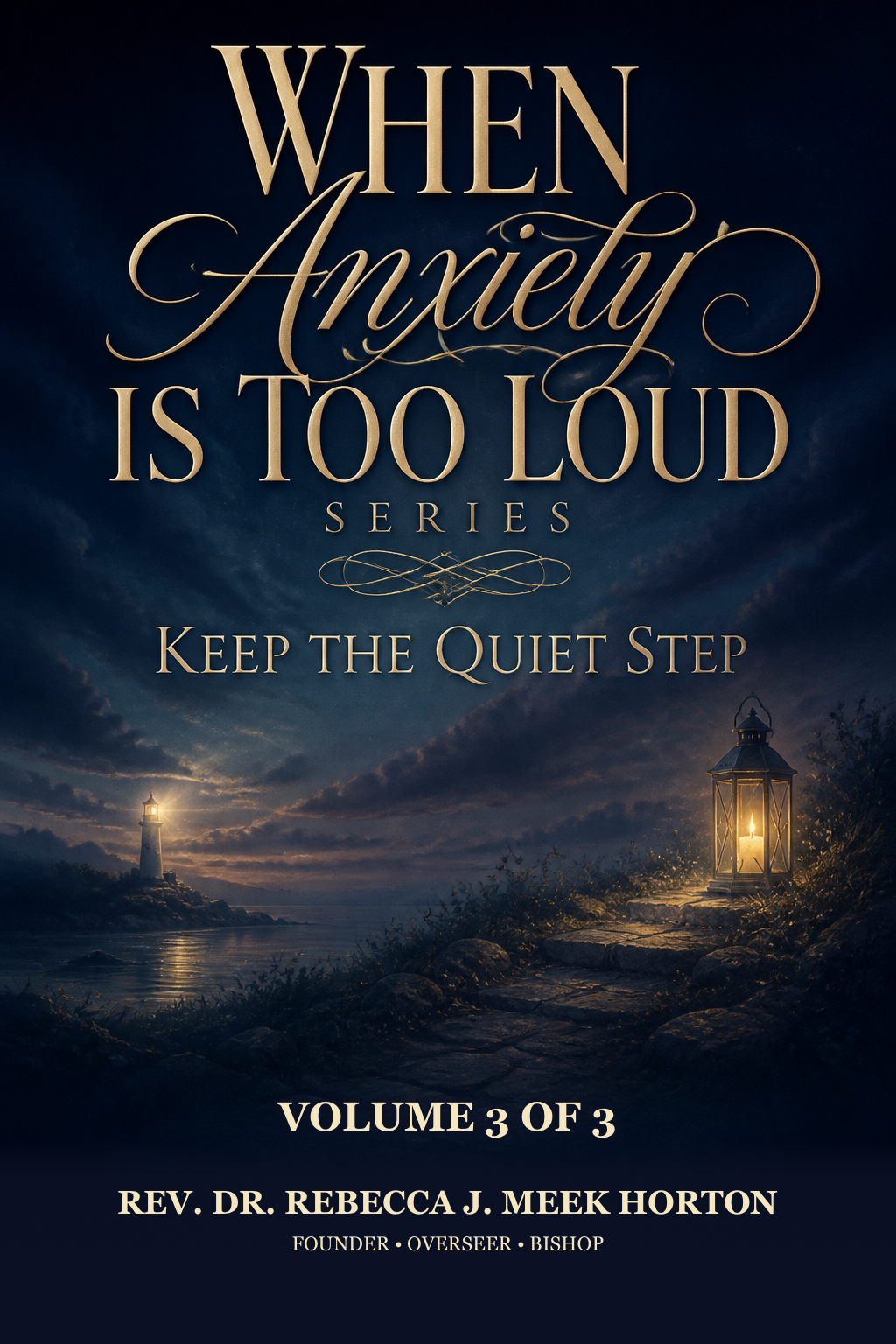
When Anxiety Is Too Loud · Volume 3
Keep the Quiet Step
Part 3 of 3 in the series "When Anxiety Is Too Loud". Series theme: Do not try to fight anxiety or reason with it. Series arc: This three-book series moves from interruption to surrender to steady living. The first book teaches readers to stop arguing with anxiety and create enough quiet to see what is really happening. The second book helps them place fear, control, and uncertainty before God wit
Chapter 1 preview
NBCNGMI MASTER KNOWLEDGE LIBRARY Featuring the works of The Sage, Apostle Prophet. Rev. Dr. Rebecca J. Meek Horton, Apostolic Prophetic Architect, NewBeing Creation Network Global Ministries, Inc. Integrated Framework Modalities™
Dedication
I dedicate this book to every soul learning to keep walking while anxiety is still loud. May you discover that peace is not proven by perfect feelings, but by one quiet, faithful step with God. May your daily obedience become a path of steady trust.
Purpose
I wrote this book to help you keep walking faithfully after the first surrender, even when anxiety has not fully disappeared. My hope is that these pages give you a quiet daily rhythm of waiting, asking, listening, and taking one obedient step at a time, anchored in God’s Word and His peace. May you learn to live with steadiness, wisdom, and courage, trusting that the Lord can guide your next step even when the whole path is not yet clear.
Preface
I wrote this book for the tender place after surrender.
That place is not always loud. Sometimes it is very quiet. You have prayed. You have stopped arguing with anxiety. You have placed fear, control, and uncertainty before God. You have meant it.
And still, anxiety may speak again.
That can feel discouraging. Many people think peace means the anxious voice disappears completely. But in real life, growth often looks more like this: anxiety is still present, but it no longer gets to govern the next step.
This book was born from that truth.
Keep the Quiet Step is not a book about pretending you are never afraid. It is not a book about forcing yourself into confidence. It is not a replacement for wise counsel, pastoral care, medical support, or professional help when those are needed. It is a companion for daily stewardship. It is for the morning decision, the hard conversation, the unfinished work, the needed boundary, the quiet return to God when your thoughts begin to race again.
The first surrender matters. But faithfulness is learned in the steps that follow.
Isaiah 26:3 (KJV)
Thou wilt keep him in perfect peace, whose mind is stayed on thee: because he trusteth in thee.
That verse does not describe a life with no pressure. It describes a mind being kept. A mind stayed on God. A heart learning trust in the middle of real life.
This is the movement of the book: wait, ask, listen, and keep the next faithful step. Not ten steps. Not the whole future. One obedient step at a time.
There is a cost here. Quiet steps require humility. They ask us to slow down when we want control, to seek wisdom when we want certainty, to rest when we feel guilty, and to keep doing good when results are not immediate.
But there is also grace here.
You do not have to wait until anxiety vanishes to live faithfully. You can begin where you are. You can let God steady your mind, order your day, guide your decisions, and teach your feet how to walk in peace.
My prayer is that these pages help you stop measuring your growth by the absence of anxiety and begin recognizing the presence of wisdom, obedience, and quiet courage.
WISDOM is not yours until YOU WALK IT.
So begin gently.
Keep the quiet step.
Introduction
Anxiety can become quieter without disappearing.
That sentence matters for this final book. Many people believe faithful living begins only after anxiety is gone. They wait to make decisions until fear is silent. They wait to rest until the mind stops racing. They wait to obey until they feel completely steady. But anxiety does not have to vanish before you can take a faithful step.
Keep the Quiet Step is about life after the first surrender.
The first book in this series helped you stop arguing with anxiety long enough to see what was really happening. The second book helped you bring fear, control, and uncertainty before God without turning prayer into another form of striving. This third book moves from surrender into practiced stewardship.
The question now is not, “How do I make anxiety disappear?”
The question is, “How do I live faithfully when anxiety is still speaking but no longer gets to lead?”
That is the work of this book.
Isaiah 26:3 (KJV) Thou wilt keep him in perfect peace, whose mind is stayed on thee: because he trusteth in thee.
Peace is not always the absence of pressure. Sometimes peace is the guarded place where your mind returns when pressure rises. It is the grace to pause before reacting, ask for wisdom before deciding, listen before assuming, and keep the next obedient step before trying to control the whole road.
This book will give you a simple daily rhythm:
Wait. Ask. Listen. Keep.
Wait before you rush. Ask honestly, without performing strength. Listen for what is true, wise, and faithful. Keep the next step you have been given.
Psalm 119:105 (KJV) Thy word is a lamp unto my feet, and a light unto my path.
A lamp does not show the whole journey at once. It gives enough light for the next step. That is often how God forms steadiness in anxious seasons. Not by giving us every answer at once, but by teaching us to walk with Him in the amount of light we have.
You will see this rhythm applied to ordinary places: decisions, relationships, work, rest, boundaries, disappointment, and the return of anxious thoughts. The goal is not to build a life where nothing ever shakes you. The goal is to become someone who knows how to return to God, receive wisdom, and move with obedience instead of panic.
James 1:5 (KJV) If any of you lack wisdom, let him ask of God, that giveth to all men liberally, and upbraideth not; and it shall be given him.
Read this book slowly. Do not use it as another project to master. Use it as a practice guide. Each chapter will ask you to notice what is happening, name what anxiety is trying to lead, and choose one faithful response. Small steps matter. Repeated obedience matters. Returning matters.
There will be tension. Keeping the quiet step may cost you the comfort of overexplaining, overplanning, overchecking, and overcontrolling. It may ask you to stop rehearsing every possible outcome. It may require an honest boundary, a delayed answer, a humble apology, a simpler schedule, or a quieter way of making decisions.
But maturity is often built there.
Galatians 6:9 (KJV) And let us not be weary in well doing: for in due season we shall reap, if we faint not.
This book is not asking you to pretend you are never anxious. It is inviting you to stop giving anxiety governing authority. Anxiety may speak. It may rise again. It may knock loudly at familiar doors. But through God’s Word, prayer, wisdom, and practiced obedience, you can learn to answer differently.
Begin here: choose one area of your life where anxiety has been trying to lead. Do not solve the whole thing today. Simply write it down, bring it before God, and ask, “What is the next quiet step of obedience?” Then take that step.
Chapter 1 — When Anxiety Still Speaks
The room is quiet now.
The prayer has been prayed. The tears have slowed. The decision has been made: I will not let anxiety rule me.
Then morning comes.
The body wakes before the mind is ready. The chest tightens. The old questions return. What if this happens? What if I cannot handle it? What if I made the wrong choice? Nothing dramatic has occurred, but anxiety is speaking again.
Maybe the phone has not even rung yet. Maybe no one has said anything unkind. Maybe the calendar looks ordinary. Still, the body remembers old alarms. The mind reaches for old patterns. Before your feet touch the floor, anxiety is already offering instructions.
Check everything.
Rehearse everything.
Prepare for the worst.
Do not trust peace.
This is where many people feel confused. They thought surrender would make anxiety disappear. They thought peace would arrive like a permanent silence. They thought giving the fear to God meant they would never feel it again.
But life after surrender is often quieter than that.
The controlling idea of this chapter is simple: anxiety may still speak, but it does not have to lead. Steady faithfulness is possible when you learn to keep the next step with God, even before every feeling is calm.
Isaiah gives us a promise strong enough for ordinary days.
Isaiah 26:3 (KJV)
Thou wilt keep him in perfect peace, whose mind is stayed on thee: because he trusteth in thee.
Perfect peace does not mean a life without pressure. It means a kept life. A guarded life. A mind brought back, again and again, to the One who is faithful.
That word kept matters. It does not sound dramatic. It sounds steady. Held. Watched. Guarded. Preserved.
This is the promise we need after the first surrender. Not a promise that anxiety will never make noise again. Not a promise that every question will be answered before noon. A promise that God is able to keep the one whose mind returns to Him in trust.
You may still feel something.
You may still notice the old tremor.
You may still need to pause.
But anxiety is not the shepherd of your day.
You are not starting over every time anxiety speaks. You are learning a new order. You are learning that a feeling can be present without being in charge. You are learning that peace is not proven by the absence of pressure, but by the presence of God keeping you in the middle of it.
This is where the quiet step begins.
Not in a perfect morning.
Not in a fearless body.
Not in a future where nothing can go wrong.
The quiet step begins in the honest place where anxiety is still talking, but you choose not to hand it the lead.
Surrender Is Not the End of Practice
Surrender is real. But surrender is not the end of your formation.
When you place fear before God, you are not signing a contract that says you will never tremble again. You are changing leadership. You are saying, “Anxiety may be present, but it is no longer my authority.”
That distinction matters.
A person can feel anxiety and still obey God.
A person can feel uncertain and still choose wisdom.
A person can feel unsettled and still speak gently, work faithfully, rest honestly, and make a responsible decision.
This truth may feel small at first, but it is deeply freeing. Many people wait for a completely calm inner life before they take the next step. They think, When I feel peaceful, I will obey. When I feel settled, I will decide. When I feel brave, I will have the conversation. When I feel certain, I will move.
But obedience often begins before the feeling catches up.
This does not mean you ignore what is happening in your body. It does not mean you shame yourself for being anxious. It does not mean you pretend. It means you stop treating anxiety as the final authority over what faithfulness is possible today.
Surrender opens the door. Practice teaches you how to walk through it.
Think of a person learning to walk after an injury. The first standing moment matters. It is a victory. But strength is rebuilt through repeated steps. Small steps. Slow steps. Steps that do not look impressive to anyone watching.
The person may still feel weakness in the leg. They may still need support. They may still move with care. But every faithful step retrains the body to carry weight again.
The same is true here.
You may have had a moment of release in prayer. You may have finally stopped arguing with the fear. You may have named control for what it was and handed it to God. That was not fake because anxiety returned the next day.
It means the work is becoming daily.
Jesus spoke of daily discipleship, not one dramatic moment that removes all need for walking.
Luke 9:23 (KJV)
And he said to them all, If any man will come after me, let him deny himself, and take up his cross daily, and follow me.
Daily does not diminish surrender. Daily proves it.
There is grace for the moment at the altar, at the bedside, in the car, or at the kitchen sink when you finally say, “Lord, I give this to You.” There is also grace for the Tuesday morning when you must live that surrender in a crowded inbox, a hard decision, a tired body, or a conversation you would rather avoid.
This book is about that daily work. Not striving. Not panic management as a lifestyle. Not pretending. It is about practiced stewardship: learning to live faithfully without waiting for anxiety to vanish.
Practice is not punishment. Practice is how surrender becomes a way of life.
A surrendered life still needs rhythms.
A surrendered life still needs wisdom.
A surrendered life still needs boundaries, rest, counsel, patience, confession, and correction.
We sometimes treat surrender as if it should erase the need for training. But Scripture teaches us that following Jesus is lived out in daily obedience. The first yes matters. The next yes matters too.
A person may forgive someone sincerely and still need to practice new boundaries.
A person may trust God with provision and still need to make a budget.
A person may surrender a relationship and still need to stop checking for signs of control.
A person may release fear and still need to learn how to begin the morning without letting anxious thoughts organize the day.
That is not failure. That is formation.
Anxiety often argues, “If you were really free, you would not feel this anymore.”
That is not the voice of wisdom. Freedom is not always the immediate absence of feeling. Sometimes freedom is the new ability to refuse an old master. Sometimes freedom is the grace to pause where you used to panic. Sometimes freedom is the strength to take one obedient step while your emotions are still catching up.
Paul teaches believers to cast care on God, not because care is imaginary, but because God is faithful with what we cannot carry rightly.
1 Peter 5:7 (KJV)
Casting all your care upon him; for he careth for you.
Casting is not pretending the care does not exist. It is transferring the weight. It is refusing to carry as lord what belongs before the Lord.
There may be days when you must cast the same care again. Not because God failed to receive it, but because your hands reached back for it. Be honest about that. Then return without shame.
The daily work is not to perform peace. The daily work is to practice trust.
You may need to say, “Lord, I gave this to You last night, and I feel it again this morning. I am bringing it back. Teach me the next faithful step.”
That prayer is not weakness. It is stewardship.
It names the truth.
It refuses shame.
It returns leadership to God.
Peace Can Keep You While You Are Still Learning
Isaiah 26:3 does not say you keep yourself in perfect peace. It says, “Thou wilt keep him.”
That is mercy.
Anxiety often makes peace feel like something you must manufacture. If you can think correctly enough, pray perfectly enough, plan carefully enough, or control enough variables, then maybe you can feel safe.
But biblical peace begins with God’s keeping power.
Your part is not to become your own keeper. Your part is to stay your mind on Him. To return your attention. To trust again. To refuse the anxious invitation to build your whole day around imagined danger.
A stayed mind is not a mind that never wanders. It is a mind that knows where to return.
That matters because anxious thoughts often move quickly. One thought becomes ten. One possibility becomes a prediction. One message becomes a whole story. One unknown becomes evidence that something is wrong.
A stayed mind does not always stop the first thought from arriving. It learns not to host every thought as truth.
For example, you may begin the day steady, then receive a message that unsettles you. Anxiety rushes in with a full report. It gives you conclusions without evidence. It urges you to respond quickly, defend yourself, cancel everything, or rehearse the worst outcome.
A stayed mind pauses.
It may say, “This is anxiety speaking. I do not need to answer from this place.”
It may return to Scripture.
It may breathe, pray, and wait before replying.
It may ask for counsel instead of spiraling alone.
It may do the next faithful thing already in front of it.
This is not weakness. This is Governed Movement™. You are not being dragged by urgency. You are allowing peace to govern attention before action.
Paul gives a similar invitation when he teaches believers to bring care to God rather than be ruled by it.
Philippians 4:6-7 (KJV)
Be careful for nothing; but in every thing by prayer and supplication with thanksgiving let your requests be made known unto God. And the peace of God, which passeth all understanding, shall keep your hearts and minds through Christ Jesus.
Notice again the word keep.
Peace is not presented as something you force into existence by mental effort. The peace of God keeps the heart and mind through Christ Jesus. It stands guard where anxiety wants to take over. It does not always explain everything. It passes understanding. It may steady you before you can fully describe how.
That is why the quiet step matters. You are learning to live under the keeping of God in real moments, not only in spiritual moments that feel calm.
At the office, peace may keep you from sending the harsh reply.
In the family conversation, peace may keep you from withdrawing into silence as punishment.
At night, peace may keep you from checking the same thing again and again.
In uncertainty, peace may keep you from forcing a decision that wisdom has not confirmed.
Peace can keep you while you are still learning.
Nothing is random. Nothing is wasted. Even the moment anxiety rises can become a place of RE-Calibration™ if you let it teach you where your mind needs to return.
You do not have to despise the moment of return. Returning is part of maturity. The child learning to walk is not mocked for reaching for the steady hand. The believer learning peace is not condemned for needing to come back again.
A stayed mind may look very ordinary.
It may look like closing your eyes for thirty seconds before you answer the question.
It may look like saying, “I need a little time to think before I respond.”
It may look like reading one verse before checking the news.
It may look like turning your attention from the imagined disaster back to the actual responsibility in front of you.
It may look like telling yourself the truth slowly: “God is here. This is today. I do not have to live tomorrow yet.”
Peace often begins with a return of attention.
Anxiety pulls attention forward, backward, outward, and inward all at once. It drags you into what might happen, what already happened, what someone may think, what you may lose, what you did wrong, what you must fix, what you cannot know.
The kept mind is not careless. It is gathered.
It comes back to God.
It comes back to truth.
It comes back to the present assignment.
It comes back to the next faithful step.
Jesus gives peace differently than the world gives it. The world often offers peace by promising favorable conditions. Jesus gives peace in Himself.
John 14:27 (KJV)
Peace I leave with you, my peace I give unto you: not as the world giveth, give I unto you. Let not your heart be troubled, neither let it be afraid.
This is not a command meant to shame a trembling heart. It is an invitation to receive a peace that does not depend on everything around you becoming manageable.
The world says, “When everything is settled, then you can be at peace.”
Jesus says, “My peace is given to you.”
That peace may not remove every problem at once. But it can keep you from being ruled by the problem. It can steady your heart enough to speak wisely, wait honestly, work faithfully, rest humbly, and refuse the anxious command to become your own savior.
You are still learning.
Peace can keep you there too.
Anxiety Can Speak Without Leading
One of the most important shifts in this final part of the journey is learning to hear anxiety without obeying it.
Anxiety is loud because it wants authority.
It does not usually present itself as a suggestion. It sounds like command. Check again. Ask again. Hide now. Fix it now. Decide now. Escape now. Prove it now.
But volume is not lordship.
Just because anxiety speaks first does not mean it speaks truth. Just because it feels urgent does not mean it is wise. Just because your body reacts does not mean your next step must be ruled by fear.
This is where RE-Language™ becomes important.
Instead of saying, “I cannot function because I am anxious,” you may learn to say, “Anxiety is present, and I can take one faithful step.”
Instead of saying, “I have no peace, so I must not move,” you may say, “I do not feel fully calm, but I can move with wisdom.”
Instead of saying, “This feeling means something bad is coming,” you may say, “This feeling is asking for attention, but God will help me discern what is true.”
That shift is not denial. It is responsibility.
You are not shaming yourself for feeling anxious. You are also not handing anxiety the keys.
Picture a child shouting from the back seat while a parent is driving. The child may be afraid. The fear may be real to them. A wise parent does not mock the child. But the parent also does not let the child grab the steering wheel.
The parent may speak calmly. “I hear you. We are not turning the wheel from the back seat. I am driving.”
That is a picture of wise inner leadership.
Anxiety can be acknowledged without being obeyed.
You can say, “I hear the fear.” Then you can keep your hands on the wheel of obedience.
This is not the same as suppressing. Suppression says, “Nothing is happening.” Stewardship says, “Something is happening, and I will respond wisely.”
There is a difference.
If anxiety is alerting you to a real responsibility, you can take the responsible step. Pay the bill. Make the appointment. Ask the clarifying question. Apologize where needed. Prepare with integrity. Seek help where help is wise.
But if anxiety is demanding control beyond your responsibility, you can refuse the demand. You do not have to rehearse every outcome. You do not have to solve everyone’s response. You do not have to know the whole future to obey God in the next ten minutes.
Jesus gave a clear boundary for anxious attention.
Matthew 6:34 (KJV)
Take therefore no thought for the morrow: for the morrow shall take thought for the things of itself. Sufficient unto the day is the evil thereof.
This does not mean planning is wrong. Scripture honors wisdom, diligence, and preparation. But Jesus confronts the anxious reach that tries to live tomorrow before tomorrow arrives.
Anxiety says, “You must carry tomorrow now.”
Wisdom says, “Receive today’s light. Keep today’s step.”
There is a simple test that can help when anxiety starts giving orders.
Ask, “Is this a responsibility, or is this a demand for control?”
A responsibility has a faithful next step. It may be hard, but it is clear enough to begin.
A demand for control usually multiplies without end. It asks you to manage what belongs to God, predict what has not happened, and secure what cannot be secured by human effort.
Responsibility says, “Prepare the document.”
Control says, “Make sure no one ever misunderstands you.”
Responsibility says, “Ask the honest question.”
Control says, “Keep asking until you feel completely safe.”
Responsibility says, “Care for your body today.”
Control says, “Monitor every sensation until you are certain nothing is wrong.”
Responsibility says, “Tell the truth in love.”
Control says, “Make sure the other person responds exactly as you hope.”
Anxiety often disguises control as responsibility. That is why discernment matters.
SAPP™ Discernment can slow the moment down.
See what is really happening.
Ask what anxiety is demanding and what wisdom is requiring.
Ponder motive, timing, counsel, and Scripture.
Practice the next faithful step.
This is not complicated, but it is not always easy. Anxious urgency does not like being slowed. It wants immediate obedience. It wants you to move before wisdom has spoken.
But you can learn a different rhythm.
You can say, “I will not Force-The-FiT™. I will not turn pressure into proof. I will not make urgency my shepherd.”
Sometimes the faithful step will be action.
Sometimes it will be waiting.
Sometimes it will be asking for help.
Sometimes it will be choosing silence until your words can be governed by peace.
Sometimes it will be doing the ordinary thing anxiety says is too small to matter.
That may mean folding laundry instead of spiraling.
It may mean attending the meeting instead of hiding.
It may mean eating breakfast instead of beginning the day on dread alone.
It may mean answering the one email you can answer, not the whole future of your career.
It may mean saying, “I cannot solve this tonight. I will write down what is mine to do tomorrow, and I will rest.”
Anxiety can speak without leading.
This sentence will need to be practiced.
Not once.
Often.
The goal is not to silence every anxious thought by force. The goal is to stop giving anxious thoughts governing authority over your obedience.
The Cost of a Kept Mind
This will cost you something.
It will cost you the false relief of reacting quickly.
It will cost you the familiar comfort of rehearsing every possible outcome.
It will cost you the old belief that you must feel certain before you can be faithful.
It may also cost you the identity anxiety helped you build. Some people have lived so long in emergency mode that peace feels irresponsible. Slowness feels unsafe. Trust feels like losing control.
That is an honest tension.
When urgency has been your normal, quiet can feel strange. When overthinking has felt like protection, simplicity can feel careless. When you have been rewarded for overfunctioning, rest can feel like failure. When you have survived by scanning for danger, peace may feel unfamiliar before it feels safe.
So the kept mind must be trained gently but firmly.
It must learn, “I can be responsible without being ruled by fear.”
It must learn, “I can care deeply without controlling everything.”
It must learn, “I can prepare without worshiping certainty.”
It must learn, “I can move slowly and still be obedient.”
This is part of RE-Calibration™. Not a quick emotional adjustment, but a steady returning of your attention, language, decisions, and habits under the care of God.
But anxiety is a costly leader.
It spends tomorrow’s strength today. It turns relationships into places of suspicion. It makes ordinary decisions feel like trials. It confuses preparation with control. It can make rest feel like danger and obedience feel too small to matter.
Anxiety may promise protection, but it often produces exhaustion.
It may promise readiness, but it often produces paralysis.
It may promise control, but it often produces bondage.
The kept mind learns another way.
It does not demand a full map before taking the next step. It receives enough light for today. It learns to ask, “What is mine to do now?” and “What must I leave with God?”
Those two questions are simple, but they can interrupt many anxious cycles.
What is mine to do now?
Maybe the answer is to tell the truth kindly.
Maybe it is to wash the dishes.
Maybe it is to stop scrolling.
Maybe it is to go to sleep.
Maybe it is to ask for wisdom.
Maybe it is to wait before deciding.
What must I leave with God?
The other person’s reaction.
The outcome you cannot force.
The timing you cannot control.
The future you cannot see.
The approval you cannot secure.
The burden you were never assigned to carry.
This is where steady faithfulness begins.
Not with a dramatic vow.
Not with a perfect emotional state.
Not with a life where nothing presses you.
Steady faithfulness begins when you stop waiting for anxiety to be silent before you obey what is clear.
You answer one email without panic.
You have one honest conversation without rehearsing it twenty times.
You take one rest period without apologizing for being human.
You pray one simple prayer without turning it into mental labor.
You do the next right thing, and then the next.
This is not glamorous. It may not feel like breakthrough. But it is the kind of obedience that rebuilds a life.
Galatians 6:9 (KJV)
And let us not be weary in well doing: for in due season we shall reap, if we faint not.
Weariness is real. The verse does not deny it. It teaches endurance in the middle of it. Well doing still matters when you are tired. The quiet step still matters when you cannot see fruit yet. The kept mind is not formed by one moment of courage, but by repeated returns to what is true.
WISDOM is not yours until YOU WALK IT.
This cost is not meant to discourage you. It is meant to tell the truth.
There may be a cost in your relationships. If anxiety has trained you to overexplain, people may be surprised when you speak more simply. If anxiety has trained you to rescue everyone, people may be uncomfortable when you begin to practice healthy boundaries. If anxiety has trained you to say yes quickly so no one is disappointed, faithfulness may require you to pause before answering.
There may be a cost in your work. If anxiety has driven you to overfunction, you may need to learn the difference between diligence and self-punishment. If anxiety has kept you avoiding responsibilities, you may need to take small honest steps back into stewardship. Either way, anxiety does not get to define faithfulness.
There may be a cost in your inner life. You may have to let go of the belief that constant mental labor equals care. You may have to stop calling worry love. You may have to admit that rehearsing every outcome has not made you safer; it has made you tired.
That honesty is part of healing.
Not everything anxiety taught you was wisdom.
Some of it was survival.
Some of it was habit.
Some of it was control wearing the clothes of concern.
The quiet step asks you to let God retrain what anxiety trained. That takes time. Be patient, but be honest. Be gentle, but do not hand the wheel back to fear.
If anxiety is severe, persistent, or interfering with your ability to function, seeking support from wise pastoral care, trusted counsel, or a qualified professional can be a faithful step. Help is not failure. Stewardship sometimes includes receiving care instead of trying to carry everything alone.
The goal is not isolation.
The goal is governed, faithful movement.
A kept mind is not a mind that refuses help. It is a mind learning where to return, what to release, and how to obey with the light it has.
The Promise of Kept Steps
This book will not ask you to fight anxiety as if your mind is a battlefield you must win by force. It will not ask you to reason with every fear until you are exhausted. It will not teach you to chase a feeling of perfect calm before you live.
It will invite you into kept steps.
A kept step is a small act of obedience held under God’s peace.
It may look unimpressive. It may not remove every symptom. It may not answer every question. But it returns leadership to God.
You wait before moving.
You ask for wisdom.
You listen for the next right thing.
You keep the step in work, rest, relationships, and responsibility.
And when anxiety rises again, you return to peace without shame.
This is not a lesser life. This is maturity.
Maturity is not proven by never feeling fear. Maturity is seen when fear is no longer allowed to rule the house. It is seen when you can notice the anxious thought, bring your mind back to God, ask for wisdom, and keep the step that belongs to you.
Some days the step will be outward. Make the call. Finish the task. Set the boundary. Keep the commitment.
Some days the step will be inward. Release the outcome. Confess the control. Stop rehearsing the accusation. Receive mercy.
Some days the step will be relational. Speak honestly. Listen without defending. Apologize without overexplaining. Let someone help.
Some days the step will be rest. Close the laptop. Put the phone down. Eat the meal. Take the walk. Sleep without solving everything.
None of these are small when they are done in obedience.
Psalm 119:105 (KJV)
Thy word is a lamp unto my feet, and a light unto my path.
A lamp does not show the whole road at once. It gives enough light for the next step. Anxiety wants a floodlight over the entire future. God often gives a lamp for your feet.
That is not abandonment. That is training in trust.
The promise of Isaiah 26:3 is not that you will keep yourself by constant control. The promise is that God keeps the one whose mind is stayed on Him. Your daily practice is to return. His faithful work is to keep.
So when anxiety still speaks, do not be surprised. Do not call the whole surrender false. Do not begin arguing again. Do not hand fear the authority Jesus has not given it.
Pause.
Return.
Ask, “What is the next faithful step?”
Then keep it.
Not because you feel perfectly calm.
Because God is faithful, His Word gives light, and peace can govern one step at a time.
This is the promise of kept steps: your life can become steady without becoming easy. Your obedience can become clear without every uncertainty being removed. Your peace can become deeper without every anxious sensation disappearing first.
You can live today.
Not the whole year.
Not every possible version of tomorrow.
Today.
You can receive enough light for the step in front of you. You can ask God for wisdom. You can wait before moving. You can listen for what is true. You can keep one faithful action. And if anxiety rises again before the day is over, you can return again.
Returning is not defeat.
Returning is discipleship.
Every return says, “My mind belongs back with God.”
Every kept step says, “Anxiety may speak, but it is not leading.”
Every small obedience says, “Peace is not a mood I must manufacture. Peace is a gift of God that can govern this moment.”
This is how a life is rebuilt after surrender.
Not by arguing with anxiety.
Not by waiting for perfect calm.
Not by forcing a future you cannot see.
But by walking with God in the light He gives.
One quiet step at a time.
Key Takeaways
• Anxiety may still speak, but it does not have to lead.
• Peace begins with God’s keeping power, not your perfect control.
• Steady faithfulness grows through one kept step at a time.
Practice
Today, when anxiety speaks, do not argue with it. Pause and write one sentence:
“Anxiety is present, but it is not leading this next step.”
Then name one faithful action you can take in the next ten minutes. Keep it small, clear, and obedient.
Closing Prayer
Father, teach me how to live after surrender. When anxiety speaks again, help me not to panic, argue, or return to old control. Keep my mind stayed on You. Train my attention to come back to Your truth, my body to slow down under Your peace, and my steps to follow Your wisdom.
Show me what is mine to do today, and help me release what belongs in Your hands. Give me courage for one faithful step, humility to ask for help when needed, and grace to return without shame when I drift. Let Your Word be a lamp unto my feet and a light unto my path.
In Jesus’ name, Amen.
This is the opening chapter. The complete publication is available in the full edition.
Back to the library