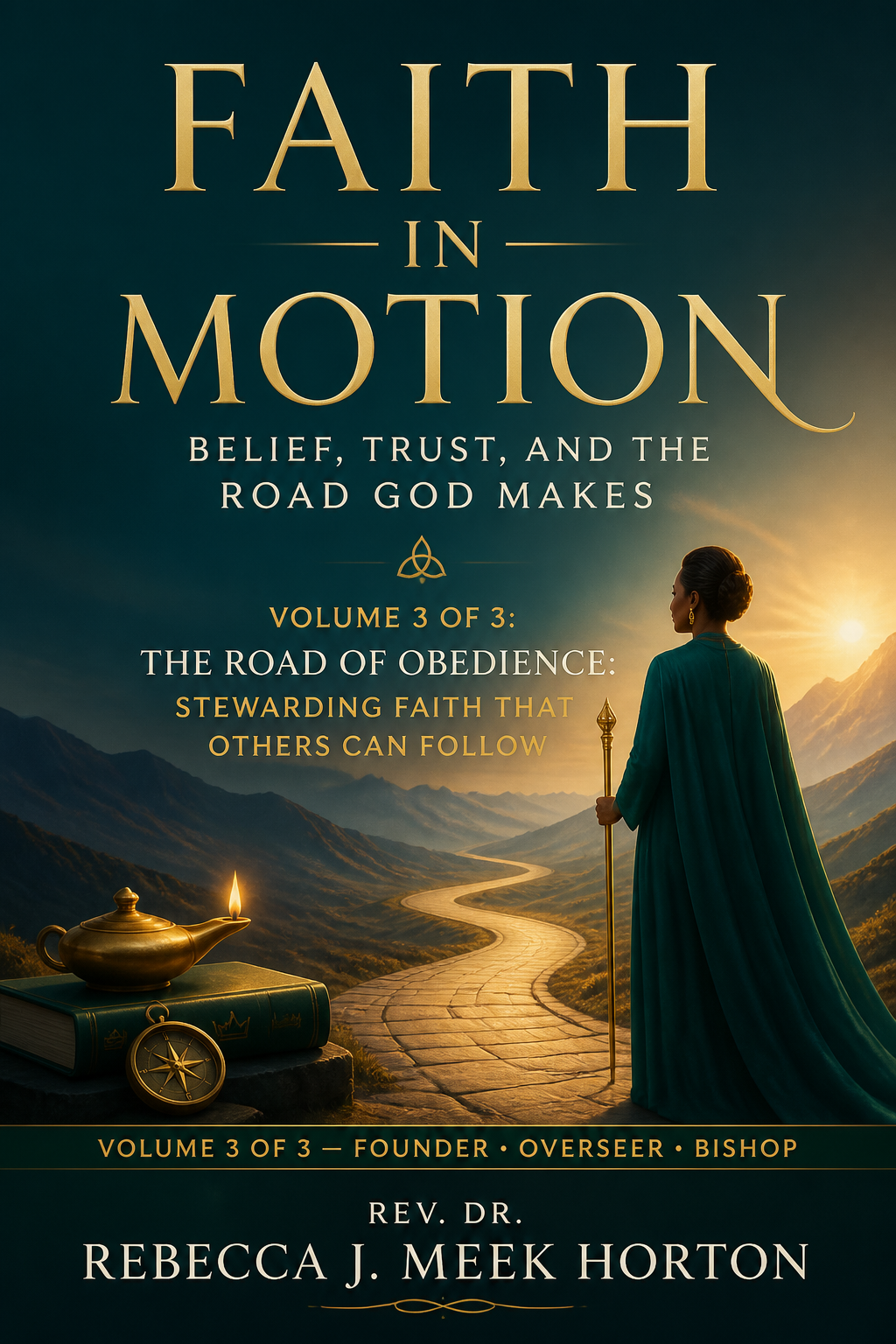
Faith in Motion: Belief, Trust, and the Road God Makes · Volume 3
The Road of Obedience: Stewarding Faith That Others Can Follow
Part 3 of 3 in the series "Faith in Motion: Belief, Trust, and the Road God Makes". Series theme: Series arc: True faith is a response to the God who speaks: belief gives faith its vehicle, trust gives faith its fuel, and obedience carries faith into faithful witness. The series begins with the foundation—faith begins with God, not human optimism or religious effort. It then moves into the cost a
Chapter 1 preview
NBCNGMI MASTER KNOWLEDGE LIBRARY Featuring the works of The Sage, Apostle Prophet. Rev. Dr. Rebecca J. Meek Horton, Apostolic Prophetic Architect, NewBeing Creation Network Global Ministries, Inc. Integrated Framework Modalities™
Purpose
I wrote this book to help leaders steward faith beyond belief and trust into daily obedience that others can safely follow. My hope is that you will learn to keep the next faithful step with humility, endurance, and courage, even when the road is costly or unclear. May your leadership become a living witness that faith without works is dead, and that obedience still reveals the Faithful One (James 2:17; John 14:15).
Preface
I have learned that obedience is where faith becomes visible.
Belief may be sincere. Trust may be deeply felt. But at some point, the Lord asks for a step. Not a performance. Not a platform. Not a public announcement. A step.
This book was born from the burden I carry for leaders who love God, serve people, and still feel the weight of daily obedience. Leadership is not only what we teach. It is what we steward when no one is clapping, when correction is needed, when conflict must be faced, when motives must be searched, and when the next faithful step costs more than we expected.
Jesus said, “If you love me, keep my commandments” (John 14:15). That word is simple, but it is not light. Obedience asks for surrender. It asks us to trust God with outcomes we cannot control. It asks us to keep walking when the road is not fully shown.
This is why *The Road of Obedience* belongs at the close of this series. Faith begins with the God who speaks. Belief receives what He has said. Trust leans into who He is. Obedience carries that faith into witness.
Leaders do not obey for appearance. We obey because God is worthy. We obey because people are watching more than our words; they are learning from our pace, our posture, our repentance, our endurance, and our decisions.
I wrote these pages for leaders who want their lives to help others follow Christ without becoming dependent on them. That is holy stewardship. We are not the road. We are not the source. We are servants who point, walk, and keep yielding.
Hebrews 12:1 calls us to “run with endurance the race that is set before us.” Endurance is not accidental. It is formed through daily obedience, quiet surrender, honest correction, and steady trust.
My prayer is that this book will help you slow down enough to hear God clearly, obey Him faithfully, and lead with a life that carries weight without carrying what only God can bear.
Begin here: ask the Lord, “What is the next faithful step You are requiring of me?” Then do not rush past it.
Nothing is random. Nothing is wasted.
Introduction
There is a kind of faith that sounds strong in a room but becomes unclear on the road.
It can preach belief, speak the language of trust, and still hesitate when obedience becomes costly. Leaders know this tension well. We can teach what is true and still have to decide, in private, whether we will obey it when it costs comfort, approval, control, pace, or reputation.
This book is written for that road.
*The Road of Obedience* is the third movement in the series *Faith in Motion: Belief, Trust, and the Road God Makes*. The first book established that faith begins with God, not human optimism. The second book pressed into trust: the quiet strength of relying on the Faithful One when the way is not yet visible. This final book asks what must come next.
If belief gives faith its vehicle, and trust gives faith its fuel, obedience carries faith into faithful witness.
Faith is not meant to remain parked. James says, “faith by itself, if it does not have works, is dead” (James 2:17). Obedience is not how we earn God’s love. It is how we respond to it. Jesus said, “If you love me, you will keep my commandments” (John 14:15). That sentence is not manipulation. It is formation. Love becomes visible through obedience.
For leaders, this matters deeply because our obedience is never private in its impact. Others are learning from the road we choose. They watch how we handle correction, conflict, pressure, delay, disappointment, success, and hidden sacrifice. They learn what we really believe about God by how we move when obedience is inconvenient.
This book will not call you to performance. Performative obedience tries to be seen. Faithful obedience is willing to be formed. Jesus warned against practicing righteousness “in order to be seen” (Matthew 6:1), yet He also told His people to let their light shine so others may glorify the Father (Matthew 5:16). The difference is motive. One points to self. The other bears witness to God.
That is the heart of this book: leaders must steward faith through daily obedience so their lives help others trust the God who speaks.
We will walk this road in three movements.
First, we will name the problem and the promise. Many leaders are carrying visible responsibility without a settled rhythm of obedience underneath it. The promise is not ease. The promise is formation: God can make a leader’s life steady enough to be followed without making that leader the center.
Then we will move from foundation to practice. Obedience will be examined in decisions, endurance, correction, conflict, service, community, mission, and spiritual formation. Each chapter will carry one teachable idea, because leaders do not need more noise. We need order, weight, and wisdom. Nothing is random. Nothing is wasted.
Finally, we will gather the whole road into a durable practice: keeping the next faithful step. Not the dramatic step. Not the impressive step. The next faithful one.
Read this book slowly. Do not read it only for leadership language. Read it for surrender. Let Scripture search you before you use it to instruct others. Hebrews 12:1–2 calls us to run with endurance, “looking to Jesus, the founder and perfecter of our faith.” That is the posture of this book. We are not looking at obedience as a technique. We are looking to Jesus, who obeyed the Father fully and formed a people who could follow Him.
As you read, keep a simple question before the Lord:
**What obedience is being asked of me now?**
Do not rush past that question. Write it down. Pray over it. Name the cost honestly. Then take the next faithful step.
WISDOM is not yours until YOU WALK IT.
Chapter 1 — When Faith Stays Parked
The car looked ready.
It sat in the driveway washed, fueled, and pointed toward the street. The tires were full. The keys were on the table. The destination had been discussed more than once.
But morning after morning, it did not move.
From the window, nothing looked wrong. Anyone passing by could have said, “That car is prepared.” But a parked car does not become faithful by being prepared. It becomes useful when it is driven.
Leadership can look like that.
We can confess the right things, preach the right words, gather the right people, and still leave faith parked in the driveway of daily obedience. The language of faith may be present, but the movement of faith may be missing.
This chapter’s controlling idea is simple: **faith that is confessed but not carried into obedience weakens a leader’s witness.**
James says it plainly: “So also faith by itself, if it does not have works, is dead” (James 2:17). Jesus asks the piercing question: “Why do you call me ‘Lord, Lord,’ and not do what I tell you?” (Luke 6:46).
These are not verses meant to crush sincere believers. They are verses meant to awaken us. They call leaders to examine whether our faith has remained a statement, or whether it has become a surrendered life.
## Confession Is Not the Same as Movement
Leaders know how to speak the language of faith.
We can say, “God is faithful.” We can say, “The Lord will provide.” We can say, “We trust His timing.” We can say, “Jesus is Lord.”
Those words matter. Confession matters. Romans 10:9 teaches that confessing Jesus as Lord is central to salvation. But confession is not meant to remain isolated from obedience. The mouth and the life must come into agreement.
A leader may confess dependence on God while making decisions from fear. A leader may preach humility while refusing correction. A leader may teach forgiveness while quietly feeding resentment. A leader may speak of trust while manipulating outcomes behind the scenes.
This is where faith stays parked.
Not because the leader has no belief. Not because the leader is false in every way. But because belief has not been carried into the ordinary places where obedience is tested.
Jesus’ question in Luke 6:46 is not complicated: “Why do you call me ‘Lord, Lord,’ and not do what I tell you?” The issue is not vocabulary. The issue is lordship.
A leader can have accurate language and still resist surrendered movement.
Consider a boardroom conversation where everyone agrees prayer is important. They open the meeting in prayer. They ask God for wisdom. Then they ignore every concern raised by mature counsel because the launch date is already printed.
The prayer was real. But was the obedience?
This is the leadership problem we must name gently and truthfully: faith can be confessed clearly while remaining unmoved in practice.
## Parked Faith Weakens Witness
People do not only listen to a leader’s words. They learn from a leader’s patterns.
A congregation, team, family, or organization can hear a leader teach faith for years. But if that leader consistently avoids obedience when obedience is inconvenient, the people learn something deeper than the sermon.
They learn that faith is language without surrender. They learn that conviction can be adjusted under pressure. They learn that obedience is optional when outcomes are at stake.
That kind of witness may still look active. Meetings continue. Programs run. Messages are delivered. Plans are executed. But beneath the activity, something loses strength.
James 2:17 says faith without works is dead. James is not teaching that works save us. Scripture is clear that salvation is by grace through faith, not by works (Ephesians 2:8–9). But James is teaching that living faith bears visible fruit. Real faith moves. It responds. It obeys.
A seed that never breaks the ground may be present, but it is not bearing fruit.
For leaders, this matters because leadership multiplies what it models. If our faith remains parked, we may unintentionally give others permission to keep theirs parked too.
Imagine a young leader watching how a senior leader handles conflict. The senior leader teaches reconciliation, but avoids every hard conversation. The young leader learns avoidance. Not from the teaching, but from the pattern.
Imagine a ministry team hearing sermons about generosity, while decisions are driven by scarcity and self-protection. The team learns fear. Not from the doctrine, but from the culture.
Witness is not only what we declare. Witness is what our obedience makes visible.
Nothing is random. Nothing is wasted. Even our delays teach something. Even our avoidance forms someone. Even our private compromises send roots into the community we lead.
## Obedience Begins Before the Public Moment
Many leaders think of obedience in large terms.
A major calling. A public sacrifice. A visible assignment. A defining decision.
Those moments matter, but they are rarely where obedience begins. Obedience usually begins in smaller rooms.
It begins in the email we do not send in anger. It begins in the apology we stop postponing. It begins in the budget we refuse to manipulate. It begins in the rest we accept because we are not God. It begins in the truth we tell before the story becomes useful to us.
Parked faith often hides in ordinary resistance.
We are not always resisting the great commission. Sometimes we are resisting the next clear instruction.
Jesus said, “If you love me, you will keep my commandments” (John 14:15). Love moves toward obedience. Not perfect performance. Not anxious striving. Not religious image management. But a real willingness to respond when the Lord speaks.
This is where leaders must slow down enough to notice the gap.
Where am I speaking faith but practicing control? Where am I teaching surrender but protecting comfort? Where am I asking others to obey what I keep delaying?
These questions are not for shame. They are for RE-Calibration™. They help us bring the confessed life and the lived life back into alignment.
A pastor once told his team, “We are going to become a praying church.” It was a strong statement. But the calendar stayed crowded with everything except prayer. Staff meetings remained rushed. Decisions were made quickly. Prayer was mentioned often and practiced rarely.
Eventually, one team member asked, gently, “Where does prayer actually live in our week?”
That question became a mercy.
The issue was not whether the leader believed in prayer. He did. The issue was whether that belief had been given ordered movement. Faith had language, but not yet structure.
When the team changed the calendar, they were not becoming more spiritual for appearance’s sake. They were letting obedience take the wheel.
## The Cost of Starting the Engine
It is safer to keep faith parked.
Parked faith can be admired without being tested. Parked faith can be polished without being surrendered. Parked faith can maintain an image without requiring movement.
Obedience changes that.
Obedience costs comfort. It interrupts control. It exposes motives. It may slow down plans. It may require confession, repentance, repair, or waiting. It may make a leader look less impressive for a season.
This is why leaders sometimes prefer discussion over obedience. Discussion keeps us near the truth without requiring us to walk in it.
But Jesus did not call leaders to manage the appearance of faith. He called His people to hear His words and do them. At the end of Luke 6, Jesus compares the obedient person to one who builds a house on rock (Luke 6:47–48). The storm reveals the foundation.
Leadership storms do the same.
Pressure reveals whether faith has been practiced or only presented.
This does not mean leaders obey perfectly. No faithful leader does. We stumble. We misread moments. We delay. We need mercy. We need correction. We need the Spirit’s help.
But there is a difference between imperfect obedience and parked faith.
Imperfect obedience keeps returning to the Lord. Parked faith keeps explaining why movement can wait.
The cost of starting the engine is real. But the cost of staying parked is greater. A leader whose faith does not move will eventually train others to admire truth without obeying it.
And that is not faithful witness.
## Key Takeaways
- Faith that does not move into obedience weakens witness.
- Leaders teach by patterns, not words alone.
- The gap between confession and obedience is a place for RE-Calibration™.
## Practice
Choose one area where your confessed faith and daily obedience are not aligned.
Write one sentence naming it honestly:
“I confess ________, but I have been resisting obedience in ________.”
Then take one concrete step within the next twenty-four hours.
Make the apology. Adjust the calendar. Tell the truth. Stop the hidden compromise. Ask for counsel. Pray before deciding.
Do not make it dramatic.
Start the engine.
This is the opening chapter. The complete publication is available in the full edition.
Back to the library