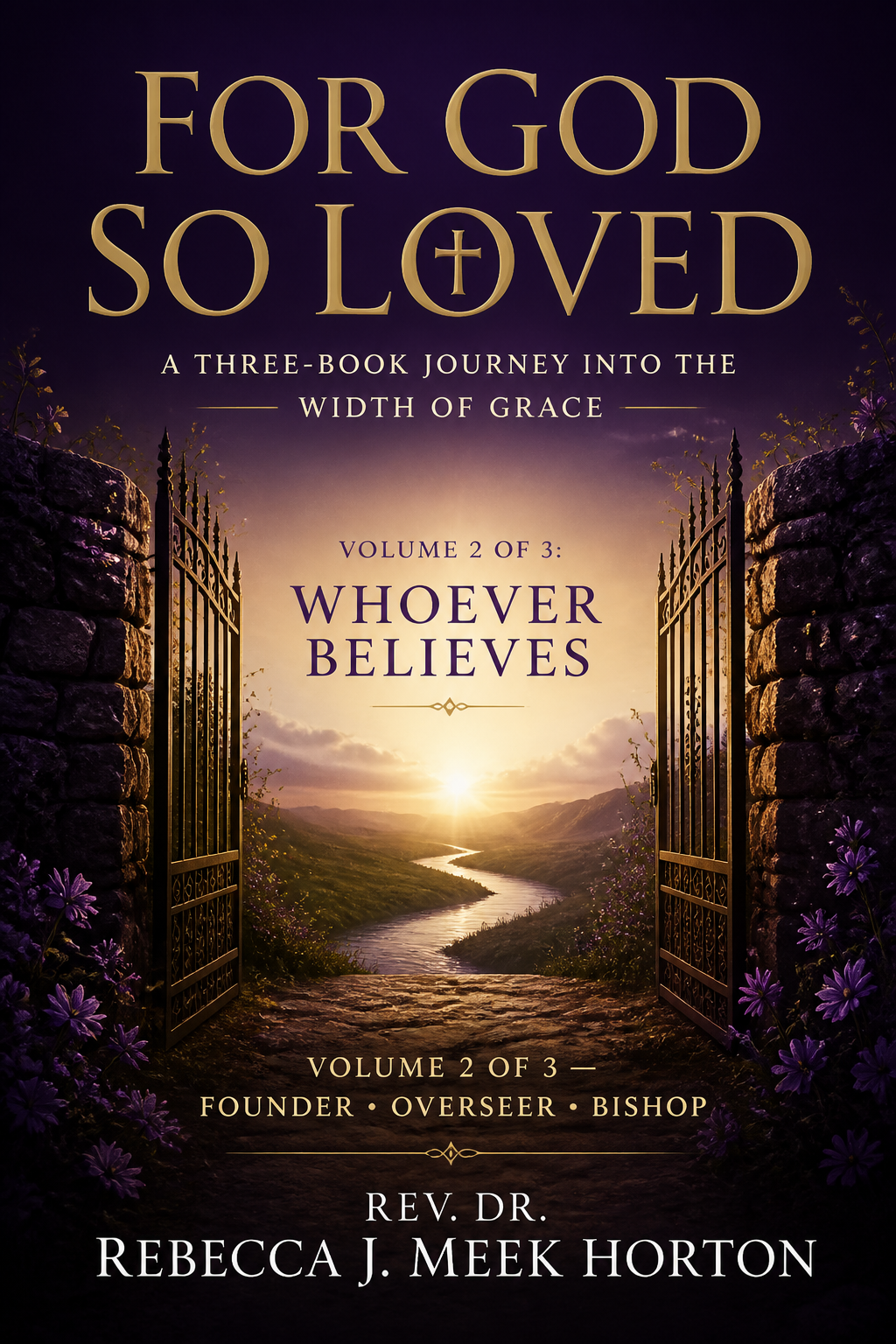
For God So Loved: A Three-Book Journey into the Width of Grace · Volume 2
Whoever Believes
Part 2 of 3 in the series "For God So Loved: A Three-Book Journey into the Width of Grace". Series theme: John 3:16 Series arc: This series follows the movement of John 3:16 from revelation to reception to witness. Book One opens the heart of God, showing that His love begins with His own character and reaches the whole world. Book Two walks through the barriers that keep people from receiving tha
Chapter 1 preview
NBCNGMI MASTER KNOWLEDGE LIBRARY Featuring the works of The Sage, Apostle Prophet. Rev. Dr. Rebecca J. Meek Horton, Apostolic Prophetic Architect, NewBeing Creation Network Global Ministries, Inc. Integrated Framework Modalities™
Purpose
I wrote this book for every person who has heard “whoever believes” and still wondered, “Does that include me?”
My hope is to walk gently through the barriers that keep us from receiving the love of God—shame, sin, fear, pride, exclusion, and misunderstanding—while keeping the invitation of John 3:16 clear and open.
May these pages help you see that the welcome is wide, the response is real, and “everyone who calls on the name of the Lord will be saved” (Romans 10:13).
Preface
I have returned to John 3:16 many times, and each time I am met by the same holy wonder: “For God so loved the world…” That love is wider than our fear, deeper than our failure, and steadier than our questions. But the verse does not stop with the love of God revealed. It moves toward a response: “that whoever believes in Him should not perish but have everlasting life.”
This book was born in that word: **whoever**.
I have sat with people who wondered if they were included. I have listened to the quiet ache behind questions like, “After what I’ve done, can God still receive me?” “Do I have to fix myself first?” “What if I do not understand everything yet?” I have also seen another barrier rise in the heart: pride that resists surrender, fear that avoids trust, and pain that mistakes God’s invitation for another door that may close.
So I wrote this book for the person standing near the doorway of grace, unsure whether to enter.
The gospel is not narrow in welcome. Jesus tells of a father running toward a returning son in Luke 15. Peter declares that “God shows no partiality” in Acts 10:34–35. Paul writes, “Everyone who believes in Him will not be put to shame” and “everyone who calls on the name of the Lord will be saved” in Romans 10:11–13. The invitation is wide.
But the response is real.
Believing is not pretending. It is not religious performance. It is not merely agreeing with an idea about God while holding the heart back from Him. To believe is to trust Christ, to come into the light, to receive mercy, and to begin walking in new life. Grace welcomes us as we are, but it does not leave us unchanged.
My prayer is that this book will help remove false barriers without removing the truth. Shame must not keep you away. Sin must not be renamed as harmless. Fear must not be allowed to lead. Pride must bow. Misunderstanding must be gently corrected. And exclusion must be confronted by the wideness of Christ’s call.
If you have ever wondered whether “whoever” includes you, come slowly, honestly, and with an open heart.
The invitation of Jesus is still alive.
Whoever believes may come.
Introduction
“Whoever believes.”
Those two words are easy to pass over until you realize how much weight they carry.
In John 3:16, Jesus does not say, “For God so loved the qualified,” or “the clean,” or “the confident,” or “the people who already know how to belong.” He says, “whoever believes in him should not perish but have eternal life” (John 3:16). The invitation is wide enough to reach the whole world, and personal enough to reach one wounded, weary, resistant heart.
This book is about receiving the love of God.
Book One opened the heart of God. It reminded us that the gospel begins in Him, not in us. God loved first. God gave first. Grace begins in the character of God before it ever becomes the hope of the world.
But love revealed must still be received.
That is where many of us struggle.
Some cannot receive because shame has taught them to hide. Some cannot receive because sin has become familiar. Some fear that if they come near to God, He will expose them only to reject them. Some are kept back by pride, not because they feel strong, but because surrender feels unsafe. Some have been told, directly or quietly, that the word “whoever” does not really include them.
This book will walk carefully through those barriers.
We will not pretend that believing is shallow or simple in the way slogans sometimes make it sound. Faith is not merely agreeing with an idea about God. It is trust. It is turning. It is receiving Christ as Savior and Lord. It includes grace, and it includes repentance. It welcomes the broken, and it also calls the broken into new life.
Jesus’ parables in Luke 15 show us a God who seeks the lost, rejoices over the found, and welcomes the returning child. Acts 10:34–35 reminds us that “God shows no partiality.” Romans 10:11–13 declares that “everyone who calls on the name of the Lord will be saved.” Galatians 3:26–28 shows us that in Christ, old dividing walls lose their power to define who may belong.
The gospel is wide in welcome.
It is also clear in response.
That tension matters. If we speak only of welcome and never of repentance, we may comfort people without leading them into life. If we speak only of repentance and lose the sound of welcome, we may make the doorway seem narrower than Jesus made it. The call of Christ holds both together: “Come to me” (Matthew 11:28), and “Follow me” (Matthew 4:19).
As you read, move slowly. Do not rush past the places that name your own resistance. This is not a book for judging who is in or out. It is a book for hearing the invitation again with honesty. Let the word “whoever” search you. Let it comfort you. Let it correct what fear, pride, shame, or misunderstanding have taught you about God.
Each chapter will carry one central truth and one practice. The goal is not to collect religious information. The goal is to make room for a faithful response. Read with Scripture open. Pray honestly. If something unsettles you, do not run from it too quickly. Sometimes the place that feels tender is the place where grace is doing careful work.
God’s love is not vague affection from a distance.
It is a holy love that comes near, tells the truth, gives the Son, opens the door, and calls us by faith into life.
Whoever believes means the invitation is real.
It also means the response is yours.
Chapter 1 — 1. The Word That Opens the Door
A door can be open and still feel hard to enter.
You may have stood at one like that before. A hospital room after bad news. A home after an argument. A church sanctuary after years away. The handle is there. The welcome may even be real. But something inside you hesitates.
John 3:16 has that kind of doorway in it.
“For God so loved the world, that he gave his only Son, that whoever believes in him should not perish but have eternal life.”
The first movement is God’s: He loved. He gave.
The next movement is ours: whoever believes.
This chapter begins the path of this book with one clear truth: grace is wide enough to welcome anyone, and clear enough to call for a real response. The word “whoever” opens the door. The word “believes” tells us how we enter.
## The Gift Comes Before the Response
John 3:16 does not begin with human effort.
It does not say, “For the world finally became worthy.” It does not say, “For the religious improved themselves.” It does not say, “For the ashamed cleaned up enough to be considered.”
It says, “For God so loved the world, that he gave…”
The giving love of God comes first.
This matters because many people hear the gospel backward. They assume God is waiting at the end of a long moral staircase. If they climb high enough, pray well enough, stop enough habits, fix enough damage, and prove enough sincerity, maybe God will receive them.
But John 3:16 begins on God’s side of the distance.
God loved. God gave. God moved toward us in His Son.
Jesus spoke these words to Nicodemus, a religious leader who came to Him at night (John 3:1–2). Nicodemus had knowledge, position, and discipline. Still, Jesus did not tell him he needed a little more polish. He told him he needed new birth (John 3:3).
That is humbling. It is also mercy.
The gospel does not flatter the strong or shame the weak. It tells the truth about everyone. We do not save ourselves. We receive the One God has given.
Think of a child who has fallen into deep water. The rescuer does not stand on the shore and shout instructions on swimming technique. He enters the water. He reaches. The child still must stop fighting the rescue, but the rescue begins with the rescuer.
So it is with grace.
The door is open because God opened it.
## “Whoever” Is Wider Than We Expect
The word “whoever” is small, but it carries a holy wideness.
It means the invitation is not limited to one kind of person. Not one nation. Not one background. Not one temperament. Not one story. Not one level of religious experience.
Whoever believes.
That word reaches the careful and the careless. The near and the far. The person raised with Scripture and the person who has only begun to wonder if God is real. The person with a clean public reputation and the person carrying a private history they can barely name.
Romans 10:11 says, “Everyone who believes in him will not be put to shame.” Romans 10:13 adds, “For everyone who calls on the name of the Lord will be saved.”
Everyone.
This does not make faith vague. It makes grace available.
We often narrow what God has made wide. Sometimes we do it with obvious prejudice. Sometimes we do it quietly. We imagine certain people are too far gone, too complicated, too resistant, too different, too late. At times, we even place ourselves outside the word “whoever.”
But “whoever” belongs to God.
We are not permitted to make it smaller.
A church may have a front door everyone can see, but still carry invisible doors people feel they cannot pass through. A single mother wonders if she will be judged. A man with a prison record wonders if his past will be louder than his presence. A young adult with questions wonders if doubt disqualifies them. An older person wonders if they waited too long.
John 3:16 speaks before those fears finish their sentence.
Whoever believes.
Not whoever understands everything.
Not whoever has no wounds.
Not whoever has never failed.
Whoever believes in Him.
## “Believes” Is More Than Agreement
The door is wide, but entering still matters.
John 3:16 does not say, “whoever admires him.” It does not say, “whoever knows about him.” It does not say, “whoever respects Christian values.” It says, “whoever believes in him.”
Biblical belief is not bare agreement. It is trust. It is reliance. It is receiving Christ as the One God has given.
A person can agree that a chair is sturdy and still refuse to sit down. Agreement stays at a distance. Trust puts weight on what it claims is true.
Believing in Christ means we put the weight of our life on Him.
This includes the mind, but it does not stop with the mind. It includes the heart, but it is not ruled by feeling. It includes a decision, but it is deeper than a moment of emotion. Faith is surrendered reception.
John says those who believe “have eternal life” (John 3:16). Eternal life is not merely a future destination. It is life from God, through Christ, beginning now and continuing forever. Jesus later prayed, “And this is eternal life, that they know you, the only true God, and Jesus Christ whom you have sent” (John 17:3).
So belief is not just agreeing to an idea about Jesus. It is coming to Jesus.
It is the difference between reading a menu and eating the meal. The menu may be accurate. It may describe nourishment beautifully. But it cannot feed you unless you receive what is offered.
Many people live near the language of faith without receiving Christ Himself. They know verses. They respect church. They believe God exists. They believe Jesus matters. Yet they remain guarded, self-led, and distant.
John 3:16 invites more than religious familiarity.
It invites trust.
## The Welcome Is Wide, and the Response Is Real
We must hold both truths together.
If we only say the welcome is wide, people may think response does not matter. If we only stress the response, people may think grace must be earned. John 3:16 will not let us choose one half of the truth.
God so loved the world.
Whoever believes.
The love is wide. The call is clear.
This is where the tension begins. Receiving love sounds gentle, but it can feel costly. To believe in Christ is to stop standing outside the door explaining why we cannot come in. It is to stop hiding behind shame, performance, pride, fear, or delay. It is to let God name both our need and His mercy.
That is not always easy.
Some would rather remain in control than be rescued. Some would rather keep their defenses than be known. Some would rather manage guilt than bring it into the light. Some would rather keep God as an idea than trust Him as Lord.
Jesus does not coerce. But He does call.
In John 3, Jesus speaks of light and darkness. “Whoever does what is true comes to the light” (John 3:21). Coming to the light can feel exposing. But the light of Christ does not expose in order to destroy. It reveals in order to heal, cleanse, and make new.
This book will walk slowly through some of the barriers that make receiving grace hard. Shame. Sin. Fear. Pride. Exclusion. Misunderstanding. We will not rush past them, and we will not let them have the final word.
The first word is still God’s love.
The open door is still Christ.
The invitation is still whoever believes.
Nothing is random. Nothing is wasted. Even the hesitation at the threshold can become a place where grace meets us truthfully.
The question is not whether God’s love is wide enough.
The question is whether we will receive the Son He has given.
## Key Takeaways
- God’s gift comes before our response. - “Whoever” is God’s wide invitation. - Belief means trusting Christ with your life.
## Practice
Read John 3:16 slowly three times today.
The first time, notice what God does: “loved” and “gave.”
The second time, notice the invitation: “whoever believes.”
The third time, pray honestly:
“Lord Jesus, show me where I am standing at the door but not yet trusting You. Help me receive Your grace with a surrendered heart. Amen.”
This is the opening chapter. The complete publication is available in the full edition.
Back to the library