When Anxiety Is Too Loud · Volume 1
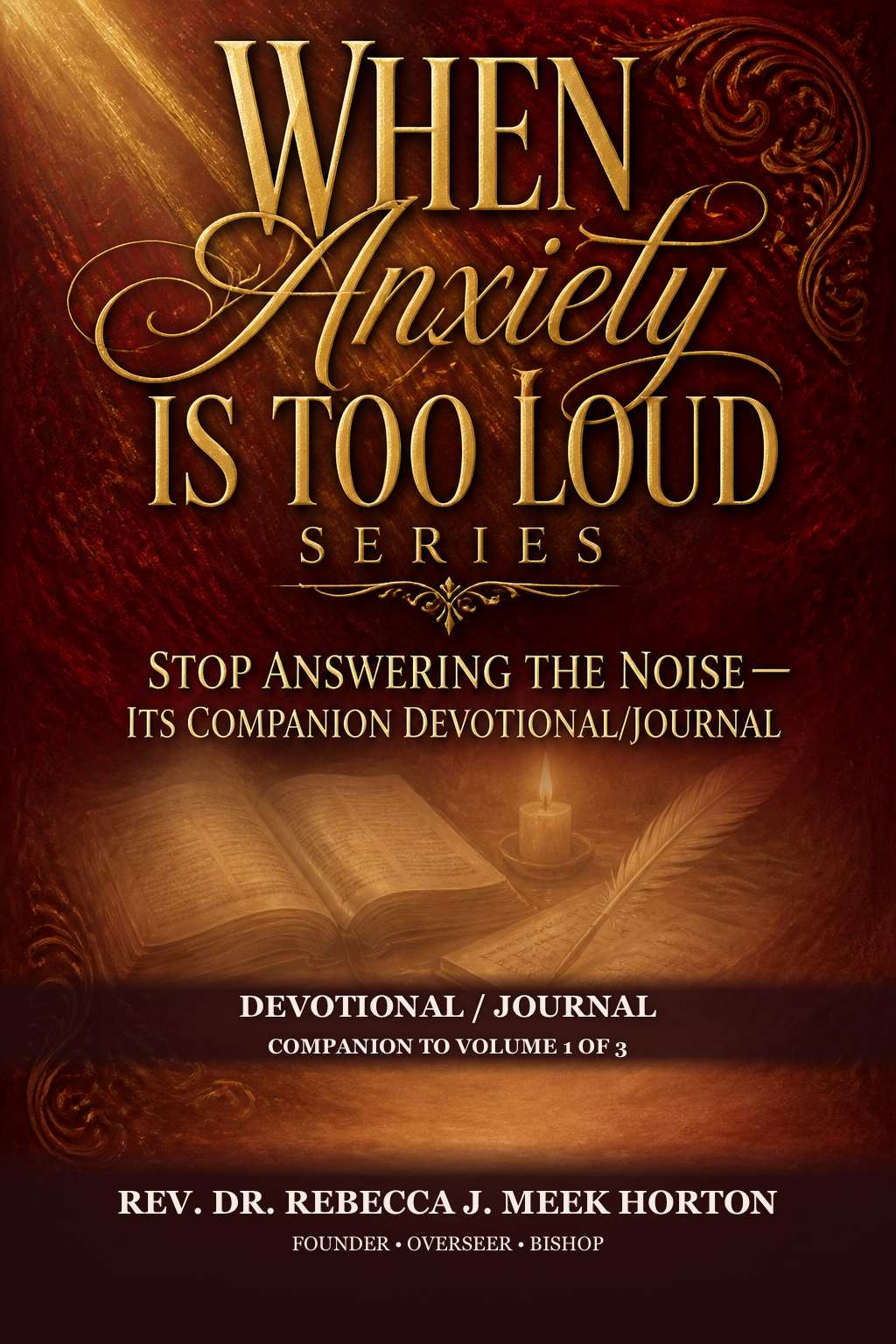
Stop Answering the Noise — Its Companion Devotional/Journal
A companion devotional and journal for "Stop Answering the Noise". Each chapter becomes five entries — a KJV Scripture reading, a devotional, a prayer, a journal prompt, and space to write — closing with An Apostolic Prophetic Architect Message and lined journal pages.
Chapter 1 preview
NBCNGMI MASTER KNOWLEDGE LIBRARY Featuring the works of The Sage, Apostle Prophet. Rev. Dr. Rebecca J. Meek Horton, Apostolic Prophetic Architect, NewBeing Creation Network Global Ministries, Inc. Integrated Framework Modalities™
Dedication
I dedicate this devotional journal to every soul learning to stop answering the noise and return to the voice of GOD with a quiet, obedient heart. May these pages help you hear clearly, pray honestly, write truthfully, and take the next faithful step with wisdom, courage, and peace.
Purpose
I wrote this companion devotional and journal to help you stop giving your attention, agreement, and strength to the noise that keeps pulling you away from GOD’s voice, wisdom, and peace. Each entry is designed to slow you down with KJV Scripture, honest reflection, prayer, and written response so the truth can move from reading into daily practice. My hope is that these pages help you become quieter within, stronger in discernment, and more faithful in your next step of obedience.
Preface
I wrote this companion devotional and journal because I know how tiring it can be to live surrounded by constant noise.
Noise does not always come loudly. Sometimes it comes as pressure, opinion, urgency, comparison, fear, memory, offense, distraction, or the need to explain yourself to people who were never assigned to understand your obedience. If we are not careful, we can spend our strength answering what GOD never told us to answer.
This book was created as a slower place.
Stop Answering the Noise teaches the principle. This companion devotional and journal helps you practice it day by day. Each entry invites you to sit with the Word of GOD, receive a clear devotional thought, pray honestly, reflect deeply, and write what is being revealed in your own life. The goal is not to fill pages. The goal is to become quiet enough to hear rightly, respond faithfully, and walk in governed obedience.
John 10:27 (KJV) My sheep hear my voice, and I know them, and they follow me:
That verse carries the heart of this journal. GOD’s voice must become weightier than the noise around us. His instruction must become stronger than our reactions. His timing must become more trusted than our urgency.
I have learned that silence is not weakness when GOD is governing it. Restraint is not fear when wisdom is leading it. Stillness is not inactivity when obedience is being formed inside of it.
This devotional and journal is for anyone who is tired of being pulled in every direction. It is for the believer who needs RE-Calibration™. It is for the leader who must stop carrying every voice. It is for the wounded heart learning not to answer from pain. It is for the seeker who needs sacred space to listen, write, pray, and begin again.
Move through these pages slowly. Let each Scripture search you. Let each prayer steady you. Let each prompt help you name what needs to be surrendered, strengthened, corrected, or obeyed.
Nothing is random. Nothing is wasted.
May this companion help you stop answering the noise and begin keeping the next faithful step with clarity, courage, and peace.
Introduction
Noise is not only sound. Noise is anything that pulls your attention away from truth, peace, obedience, and godly order.
Some noise comes from the outside: opinions, pressure, urgency, conflict, comparison, fear, and constant information. Some noise comes from the inside: old wounds, anxious thoughts, pride, shame, impatience, and the need to prove something. Not every voice deserves your answer. Not every demand is your assignment. Not every open door is your next step.
This devotional and journal was created as a companion to Stop Answering the Noise. The main book teaches the call to stop reacting, stop striving, and stop letting noise govern your movement. This companion helps you practice that truth day by day. It turns the message into a rhythm of Scripture, devotion, prayer, reflection, and written response.
Psalm 46:10 (KJV) Be still, and know that I am God: I will be exalted among the heathen, I will be exalted in the earth.
Stillness is not weakness. Stillness is disciplined trust. It is the place where your soul stops running long enough to hear clearly, see honestly, and respond faithfully.
Each chapter theme from Stop Answering the Noise becomes five devotional entries in this journal. Each entry includes a KJV Scripture reading, a short devotional, a prayer, a journal prompt, and space to write. The goal is not to rush through pages. The goal is to let truth settle, expose what needs RE-Calibration™, and guide you into one faithful step.
Read this book slowly. Bring your real life to the page. Do not write what sounds spiritual if it is not honest. Write what is true. Name the noise. Name the pressure. Name the places where you have answered what GOD never assigned you to carry. Then ask for grace to return to order.
John 10:27 (KJV) My sheep hear my voice, and I know them, and they follow me:
This is the heart of the journal: hearing and following. Discernment is not only recognizing what is wrong. Discernment is learning what to stop answering so you can obey what is right.
Some entries may comfort you. Others may confront you. Let both be part of the work. GOD’s correction is not rejection. His instruction is mercy. If a prompt slows you down, let it. If a prayer touches something tender, pause. If a Scripture reveals a pattern you have excused, do not turn away. Wisdom instructs before expansion is released.
This journal is not meant to create dependency. It is meant to strengthen maturity. You are not being asked to perform for the page. You are being invited to listen, reflect, and walk. WISDOM is not yours until YOU WALK IT.
At the end of the devotional entries, you will find An Apostolic Prophetic Architect Message and additional lined journal pages. Use them for deeper prayer, notes, decisions, patterns you are noticing, and next steps you must steward. Nothing is random. Nothing is wasted. Even what you write in weakness can become part of your growth when brought honestly before GOD.
Begin with one clear decision: you will not answer every noise.
Before you continue, take a quiet moment. Ask GOD to show you one voice, pressure, habit, or reaction that has been governing your attention. Write it down. Then pray simply: Lord, teach me what to stop answering, and help me keep the next faithful step.
Chapter 1 — The Thought That Demands an Answer
Entry 1
Scripture Reading
2 Corinthians 10:5 (KJV) Casting down imaginations, and every high thing that exalteth itself against the knowledge of God, and bringing into captivity every thought to the obedience of Christ;
Devotional
Some thoughts enter quietly. Others enter like they own the room.
An anxious thought often comes with pressure attached to it. It does not simply say, Consider this. It says, Answer me now. Fix this now. Explain yourself now. Prepare for the worst now. That demand can feel so strong that the thought begins to sound like truth.
But Scripture gives us another way to live with our thoughts. We are not told to obey every imagination. We are not told to treat every inner alarm as wisdom. We are told to cast down imaginations and bring every thought into captivity to the obedience of Christ.
That means your thoughts can be governed.
This is not shame. This is stewardship. You are not wrong because a fearful thought came. You are not faithless because your body reacted before the facts were clear. But you are invited to slow down and notice what has taken the throne in your inner room.
The thought may say, Something is wrong. Wisdom asks, What do I actually know?
The thought may say, They are upset with me. Wisdom asks, Is that fact, fear, or assumption?
The thought may say, I must respond immediately. Wisdom asks, Is this urgency from responsibility, or is it pressure trying to rule me?
There is a holy difference between having a thought and surrendering to a thought. A thought can knock. It does not have to govern. A feeling can rise. It does not have to command. A body signal can alert you. It does not have to define reality.
Today, the practice is simple but not easy: do not let the loudest thought become the leader. Bring it before Christ. Name it plainly. Weigh it honestly. Refuse the parts that exalt themselves above God’s truth.
RE-Language™ may help you begin. Instead of saying, I have to fix this now, say, I am feeling pressure to fix this now. That one shift takes anxiety off the throne and puts responsibility back in its proper place.
Nothing is random. Nothing is wasted. Even this moment of pressure can become a place of formation. The anxious thought may be loud, but Christ is still Lord over the mind.
Prayer
Father, I bring my thoughts before You. I confess that I have often treated anxious pressure like authority. I have answered fear too quickly, reacted before I could see clearly, and allowed assumptions to shape my peace. Help me cast down imaginations that rise against Your truth. Teach me to bring my thoughts into obedience to Christ without shame and without panic. Give me the courage to pause, name what is happening, and refuse what is not true. Let my mind be governed by Your Word, not by noise. I receive Your help for this day, one thought at a time. Amen.
Journal Prompt
From 2 Corinthians 10:5, what anxious thought has been demanding an answer from you, and how can you bring it into obedience to Christ today?
Space to Write [Answer Lines]
Entry 2
Scripture Reading
Philippians 4:6-7 (KJV) 6 Be careful for nothing; but in every thing by prayer and supplication with thanksgiving let your requests be made known unto God. 7 And the peace of God, which passeth all understanding, shall keep your hearts and minds through Christ Jesus.
Devotional
Anxiety often tells you that prayer is too slow.
It says the message needs an answer now. The conversation needs to be repaired now. The uncertainty needs to be solved now. The outcome needs to be controlled now. Anxiety does not like the space between not knowing and understanding. It wants to close that space with action, explanation, defense, or control.
But Scripture does not tell us to be careless. It tells us to be careful for nothing. That means we do not have to carry care as if we are the only ones responsible for holding life together.
There is a difference between responsibility and anxious ownership. Responsibility asks, What is mine to steward? Anxious ownership says, Everything depends on me right now. Responsibility can pray, wait, listen, and act with wisdom. Anxiety rushes ahead and calls the rush obedience.
Paul gives a different rhythm. In every thing, bring the matter to God. Not after you have rehearsed every fear. Not after you have already reacted. Not after you have exhausted your strength trying to settle your own soul. Bring it first.
Prayer is not avoidance. Prayer is ordered dependence. Supplication is not weakness. It is honest need brought before the Father. Thanksgiving is not denial of difficulty. It is a decision to remember that God is present before the outcome is clear.
Then comes a promise: the peace of God shall keep your hearts and minds through Christ Jesus. Notice what peace does. It keeps. It guards. It stands watch over the places anxiety tries to invade.
This peace may not answer every question immediately. It may not remove every consequence. It may not make every person respond the way you hoped. But it can keep your heart and mind from being ruled by the demand beneath the thought.
Today, when anxiety presses you to answer the noise, let prayer answer first. Before the extra text. Before the long explanation. Before the imagined argument. Before the panic decision. Stop and say, Father, here is what I know. Here is what I fear. Here is what I need. Govern me in this moment.
You do not have to solve your whole life today. You can make your request known unto God and let His peace keep what anxiety tried to seize.
Prayer
Father, I come to You with the cares I have been carrying. I admit that I have tried to answer anxiety with control instead of bringing my requests to You. Teach me to pray before I react. Teach me to ask honestly without pretending I am not afraid. Help me receive the peace that keeps my heart and mind through Christ Jesus. I do not want to be careless, but I also do not want to be ruled by care. Show me what is mine to steward and what I must release to You. Govern my response today. Amen.
Journal Prompt
From Philippians 4:6-7, what care do you need to bring to God before you answer it with reaction, and what request will you make known to Him?
Space to Write [Answer Lines]
Entry 3
Scripture Reading
Proverbs 14:29 (KJV) He that is slow to wrath is of great understanding: but he that is hasty of spirit exalteth folly.
Devotional
Anxiety can make the spirit hasty.
It may not look like anger at first. Sometimes it looks like overexplaining. Sometimes it looks like checking the phone again and again. Sometimes it looks like sending one more message, replaying one more conversation, preparing one more defense, or deciding what someone meant before you have asked.
Haste is not always loud. Sometimes haste happens quietly inside the mind.
The Scripture says that the one who is slow to wrath is of great understanding, but the hasty of spirit exalts folly. This speaks to more than temper. It speaks to movement. A hasty spirit moves before wisdom has room to speak.
An anxious thought often says, If you pause, something will get worse. If you wait, you are being irresponsible. If you do not act now, you do not care. But wisdom teaches us that a pause is not neglect. A pause can be obedience. A pause can protect the words you cannot take back. A pause can keep you from building a whole story out of one sentence.
The text message says, Call me when you can. Anxiety hears, Something is wrong. A hasty spirit starts preparing for trouble. Wisdom pauses and says, All I know is that I received a request.
That pause is not small. It is spiritual maturity in motion.
There are moments when immediate action is necessary. Wisdom does not teach passivity. But many anxious reactions are not true emergencies. They are inner alarms demanding outer movement. If we move every time fear demands it, we train the soul to obey pressure instead of truth.
SAPP™ Discernment begins with seeing. See what is actually happening. Ask what is being assumed. Ponder the motive, timing, and cost. Practice one faithful step. This protects you from hasty movement that feels relieving for a moment but creates confusion later.
Today, do not rush to answer everything that stirs you. Let understanding have time to form. Let prayer have time to settle you. Let facts have time to arrive. Let your spirit slow down enough to become teachable.
A hasty spirit exalts folly, but a governed spirit makes room for wisdom.
Prayer
Father, I acknowledge the places where I become hasty in spirit. I have moved too quickly under pressure, spoken before listening, assumed before asking, and tried to settle fear by reacting. Teach me to slow down without becoming passive. Help me recognize when urgency is wisdom and when urgency is anxiety trying to lead. Give me great understanding. Govern my mouth, my messages, my decisions, and my inner pace. I do not want to exalt folly through rushed reactions. I want to walk in obedience with a steady heart and a teachable spirit. Amen.
Journal Prompt
From Proverbs 14:29, where has anxiety made your spirit hasty, and what pause would help you move with greater understanding today?
Space to Write [Answer Lines]
Entry 4
Scripture Reading
Isaiah 26:3 (KJV) Thou wilt keep him in perfect peace, whose mind is stayed on thee: because he trusteth in thee.
Devotional
The mind needs a place to stay.
When anxiety enters, the mind often runs from one imagined outcome to another. It searches faces, messages, silence, delays, tone, timing, and memory. It gathers fragments and tries to build certainty. But anxiety’s certainty is usually expensive. It costs peace, rest, clarity, and sometimes relationships.
Isaiah gives us a different picture. Perfect peace belongs to the one whose mind is stayed on God, because trust has become the foundation.
To stay the mind is not to pretend nothing is wrong. It is not spiritual performance. It is not forcing yourself to feel calm. It is returning the mind to the One who remains steady when the situation is unclear.
The anxious thought demands, Look at me until you solve me. Faith says, I can notice the thought, but I will not make it my dwelling place.
This is important because attention feeds authority. What you keep staring at begins to feel larger. What you rehearse begins to feel final. What you imagine repeatedly begins to feel true. Anxiety knows this. It pulls your attention toward the possible threat and tries to keep it there.
But trust redirects attention.
Trust says, I do not have all the facts, but God is still present. Trust says, My body may be alarmed, but God is not confused. Trust says, I can wait for truth without surrendering to dread. Trust says, I can take the next faithful step without panic.
Perfect peace does not mean life becomes painless. It means the mind is kept while life is unfinished. It means you are not left alone with the noise. It means there is a guarding grace available when you choose to stay your mind on God.
Today, when a thought demands your full attention, gently redirect. Not once, but as often as needed. You may need to say, Father, my mind is running again. I return my attention to You. You may need to step away from the screen, breathe slowly, read the Scripture again, or write down the difference between fact and fear.
This is WALK™ in daily practice. Wait in stillness. Ask honestly. Listen carefully. Keep the next faithful step.
Your mind does not have to live inside the demand. It can be stayed on God.
Prayer
Father, I bring my restless mind to You. I admit that I have stayed too long with anxious thoughts, rehearsed fearful outcomes, and allowed uncertainty to occupy my attention. Teach me to trust You in the space where I do not yet know. Keep me in Your peace. Help me return my mind to You without condemning myself when it wanders. I choose to notice the noise without dwelling in it. I choose to remember that You are steady, present, and faithful. Let my thoughts be stayed on You today, and let my next step come from trust. Amen.
Journal Prompt
From Isaiah 26:3, what has your mind been staying on, and what practice will help you return your attention to God today?
Space to Write [Answer Lines]
Entry 5
Scripture Reading
1 Peter 5:7 (KJV) Casting all your care upon him; for he careth for you.
Devotional
Care becomes heavy when we carry it alone.
There are real concerns in life. People do send unclear messages. Children do withdraw. Leaders do face hard conversations. Friends do misunderstand. Bodies do react before facts arrive. The invitation is not to become numb or careless. The invitation is to stop carrying care as if care belongs only to you.
Peter says to cast all your care upon Him. Not some care. Not only the care that looks spiritual. Not only the care you have already cleaned up and made presentable. All your care.
That includes the small anxious thought that embarrassed you because it seemed too dramatic. It includes the pressure to fix what is not yours to fix. It includes the fear behind the repeated checking. It includes the need to be understood immediately. It includes the dread that rose from one sentence on a screen.
The reason is tender and strong: for He careth for you.
God does not tell you to cast your care because your care does not matter. He tells you to cast it because you matter to Him. This is not rejection of your concern. It is rescue from being ruled by it.
Some people hold care tightly because they believe letting go means losing control. But many times, what we call control is only exhaustion with a plan. Casting care is not abandoning responsibility. It is placing the weight where it belongs so you can respond with wisdom instead of panic.
You may still need to make the call. You may still need to have the conversation. You may still need counsel, rest, repentance, repair, or help from a trusted pastor, counselor, physician, or qualified professional. Casting care does not erase responsibility. It restores order.
First, cast the care. Then, take the next faithful step.
This is the difference between being driven and being led. Anxiety drives with pressure. Wisdom leads with clarity. Fear says, Carry it now or everything will fall apart. The Father says, Cast it upon Me, because I care for you.
Today, name one care plainly. Do not dress it up. Do not argue with it for an hour. Say what it is. Then give it to God in prayer. After that, choose one steady step that does not come from panic.
WISDOM is not yours until YOU WALK IT. Walk this truth today.
Prayer
Father, I cast my care upon You. I confess that I have carried worry as if carrying it proved my love, responsibility, or faithfulness. I have held pressure in my body and allowed anxious thoughts to direct my movement. Thank You for caring for me. Thank You that I do not have to pretend my concerns are small in order to bring them to You. Help me release what belongs in Your hands and steward what belongs in mine. Teach me to act from peace, not panic. Today, I give You this care and receive Your help for the next faithful step. Amen.
Journal Prompt
From 1 Peter 5:7, what care are you still carrying as if it belongs only to you, and what would it look like to cast it upon God today?
Space to Write [Answer Lines]
An Apostolic Prophetic Architect Message
Beloved, the work of these five entries has not been to silence every thought. It has been to restore order.
A thought may knock, but it does not have to rule. A feeling may rise, but it does not have to lead. A body alarm may sound, but it does not have to write the story. This is where maturity begins: when you stop treating urgency as authority and start bringing your inner life under the government of God.
There is a holy strength in the pause. The pause is not weakness. The pause is not avoidance. The pause is the place where wisdom can interrupt reaction. It is where you learn to see the difference between fact and fear, pressure and responsibility, discernment and anxiety in a hurry.
Psalm 46:10 (KJV) Be still, and know that I am God: I will be exalted among the heathen, I will be exalted in the earth.
Be still does not mean be careless. It means stop bowing to the noise as if it has the final word. Stillness gives the soul room to remember who God is. When God is restored to the center, thoughts can be examined without panic. Decisions can be made without haste. Conversations can be entered without fear demanding control.
This is confirmation for the one who has felt ashamed of anxious thoughts: shame is not your teacher. Wisdom is. The presence of anxiety does not disqualify you from growth. It reveals a place where God is inviting RE-Calibration™, RE-Alignment™, and deeper trust.
Nothing is random. Nothing is wasted. Even the thought that demanded an answer can become a training ground for peace, order, and obedience.
So today, do not try to master your whole mind in one moment. Practice one faithful interruption. Name the fact. Name the fear. Name the pressure. Then choose the faithful response. That is Governed Movement™. That is Walking in Obedience™.
The loudest thought in the room does not have to lead. Let God govern the room. Let truth take its place. Let wisdom rise before reaction. And when the noise knocks again, remember: you are not required to answer everything that demands you. You are called to answer God with trust.
[Journal Page]
[Journal Page]
This is the opening chapter. The complete publication is available in the full edition.
Back to the library