 NBCNGMI™
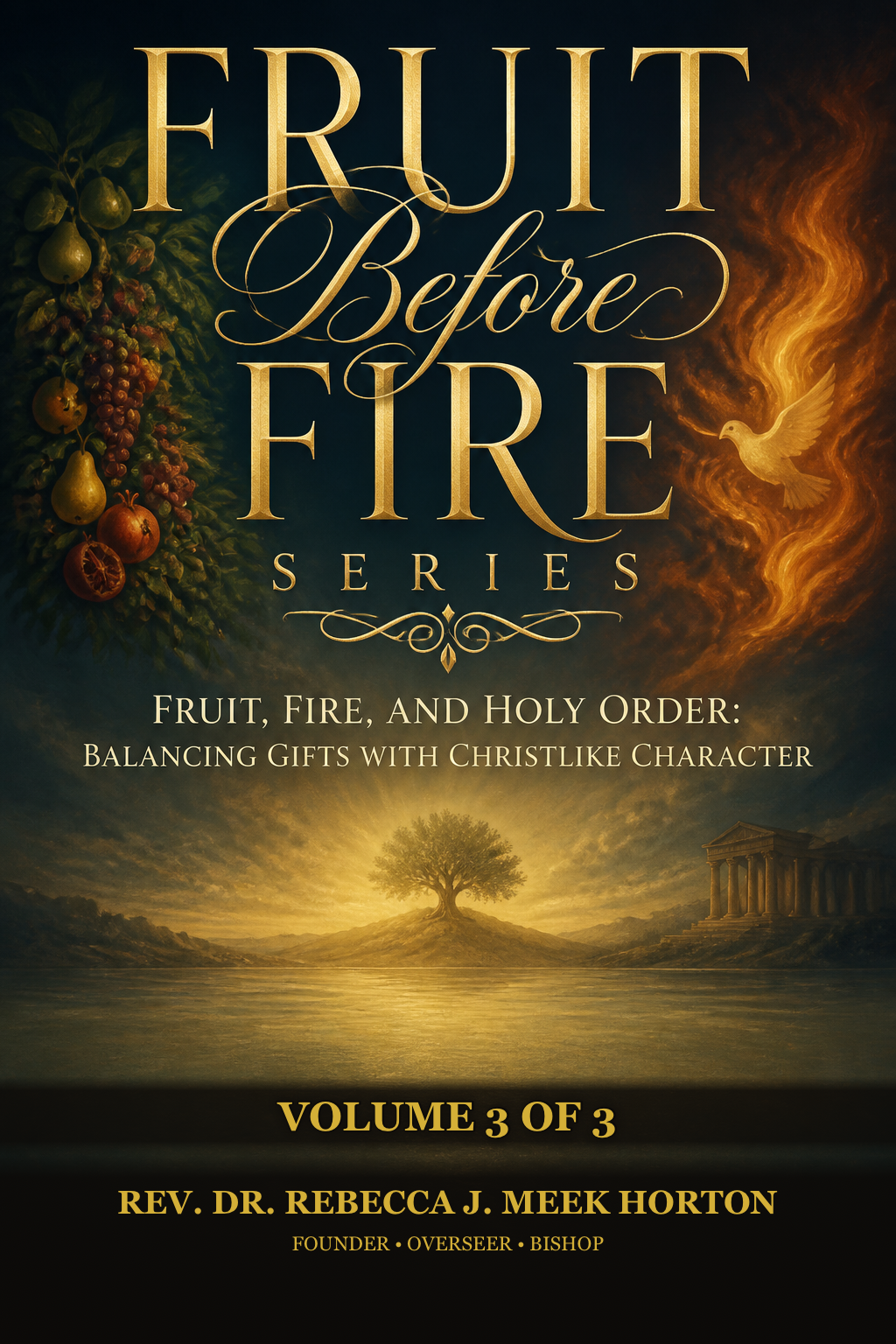
Fruit Before Fire · Volume 3
Fruit, Fire, and Holy Order: Balancing Gifts with Christlike Character
Part 3 of 3 in the series "Fruit Before Fire". Series theme: These are divine attributes not human chat Necessary for ministry Necessary to balance the gifts Necessary to engender works of faith Necessary to live by faith not by sigy Series arc: This three-book series moves from formation to ministry to Spirit-empowered service. Book 1 establishes the Fruit of the Holy Spirit as divine character formed in believers, not natural personality or religious language. Book 2 shows why that fruit is necessary for faithful ministry, daily obedience, and works of faith. Book 3 brings the Fruit and Gifts of the Holy Spirit together so fire remains holy, love governs power, and the Church is built up. How this book advances the series: This final book completes the series by showing how Spirit-formed character carries Spirit-given power without performance, pride, or harm. This book brings the Fruit of the Spirit and the Gifts of the Spirit into proper biblical relationship. It teaches that gifts are holy tools for service, witness, edification, and Kingdom advancement, but they must be governed by love, humility, surrender, and order. The source material on character and charisma, along with the draft chapter on spiritual fire, forms the core; this book must expand into practical discernment for churches, leaders, and believers using 1 Corinthians 12:4-11, 1 Corinthians 13:1-13, 1 Corinthians 14:1-5 and 14:12, Acts 1:8, Luke 24:49, and Romans 12:3-8.
Chapter 1 preview
NBCNGMI MASTER KNOWLEDGE LIBRARY Featuring the works of The Sage, Apostle Prophet. Rev. Dr. Rebecca J. Meek Horton, Apostolic Prophetic Architect, NewBeing Creation Network Global Ministries, Inc. Integrated Framework Modalities™
Dedication
I dedicate this book to every believer who longs to serve with clean hands, a surrendered heart, and holy fire. May the Fruit of the Spirit govern every gift, may love remain the more excellent way, and may the Church be built up in Christlike order.
Purpose
I wrote this book to bring the Fruit of the Spirit and the Gifts of the Spirit back into holy order, so that power is governed by love, humility, surrender, and biblical truth. Gifts are necessary for ministry, but without Christlike character they can become noise, performance, or harm, as 1 Corinthians 12–14 teaches us. My prayer is that this book helps every believer serve by the Spirit with clean motives, steady faith, and love that builds up the Church.
Preface
I wrote this book with a deep burden for holy balance.
I have seen people hunger for the power of the Holy Spirit, and that hunger is not wrong. The Church needs the gifts of the Spirit. We need wisdom, discernment, prophecy, faith, healing, tongues, interpretation, teaching, exhortation, mercy, and every holy supply God gives for the building up of His people. But I have also learned that fire without fruit can wound what it was meant to serve.
That is why this final book in the Fruit Before Fire series matters.
Book 1 began with formation. The Fruit of the Holy Spirit is not natural personality, religious language, or human charm. It is divine character produced in yielded believers. Book 2 moved that fruit into ministry, obedience, and works of faith. Now Book 3 brings fruit and gifts together in holy order, because Spirit-given power must be carried by Spirit-formed character.
1 Corinthians 13:2 (KJV) And though I have the gift of prophecy, and understand all mysteries, and all knowledge; and though I have all faith so that I could remove mountains, and have not charity, I am nothing.
That verse searches me every time.
It reminds me that God is not impressed by gift activity that is disconnected from love. He is not calling us to perform power. He is calling us to steward what is holy. Gifts are not stages for pride. They are tools for service, witness, edification, and Kingdom advancement. They must be governed by love, humility, surrender, discernment, and order.
This book is for believers, leaders, churches, intercessors, teachers, and servants who want the Holy Spirit’s fire without confusion, harm, or performance. It is for those who know there is more, but also know that “more” must remain submitted to Christ.
My prayer is simple: that we would not choose between fruit and fire. We need both. Fruit keeps the vessel clean. Fire empowers the work. Holy order protects the Body.
As you read, do not rush to measure someone else. Let the Word examine you first. Ask the Holy Spirit where your character needs deepening, where your gifts need surrender, and where your service needs holy order.
Begin there. Then take the next faithful step.
Introduction
A flame can warm a house, light a path, and prepare a meal. The same flame, mishandled, can burn what it was meant to serve.
Spiritual gifts are holy. They are not toys for attention, badges for status, or proof that a person is mature. They are given by the Holy Spirit for service, witness, edification, and Kingdom advancement. But gifts must be carried by Christlike character. Fire must remain holy. Power must remain submitted. Ministry must remain governed by love.
This is the burden of this final book in the Fruit Before Fire series.
Book 1 established that the Fruit of the Holy Spirit is not natural personality, religious language, or polished behavior. It is divine character formed in believers as they yield to the Spirit. Book 2 showed why that fruit is necessary for ministry, daily obedience, and works of faith. This book brings the Fruit and Gifts of the Holy Spirit into proper biblical relationship.
The promise is simple: when fruit governs fire, the Church is strengthened, people are served, and God is glorified.
The danger is also simple: when gifts operate without love, humility, surrender, and order, people may be impressed, but they may not be built.
1 Corinthians 12:4-7 (KJV)
Now there are diversities of gifts, but the same Spirit. And there are differences of administrations, but the same Lord. And there are diversities of operations, but it is the same God which worketh all in all. But the manifestation of the Spirit is given to every man to profit withal.
The gifts are not self-made. They are not self-owned. They are manifestations of the Spirit, given “to profit withal.” That means they are given for the good of others, not the elevation of self.
This book will not ask you to despise spiritual gifts. Scripture does not do that. It will also not allow gifts to be separated from holy order. The same Spirit who gives power also forms love, joy, peace, longsuffering, gentleness, goodness, faith, meekness, and temperance. The Spirit does not produce contradiction in the life of a yielded believer.
1 Corinthians 13:1-3 (KJV)
Though I speak with the tongues of men and of angels, and have not charity, I am become as sounding brass, or a tinkling cymbal. And though I have the gift of prophecy, and understand all mysteries, and all knowledge; and though I have all faith so that I could remove mountains, and have not charity, I am nothing. And though I bestow all my goods to feed the poor, and though I give my body to be burned and have not charity, it profiteth me nothing.
That passage is not against tongues, prophecy, knowledge, faith, sacrifice, or service. It is against loveless power. It is against ministry that moves without the nature of Christ.
Read this book slowly. Do not read it first for someone else. Read it first before God. Let the Word examine your motives, your pace, your hunger for visible results, and your understanding of spiritual maturity. If you are a leader, read with responsibility. If you are a believer learning your place in the Body, read with humility and courage. If you have been wounded by disorder, read with discernment, not bitterness. If you have been used in gifts, read with surrender, not fear.
This book will move from biblical foundation to practical discernment. We will look at gifts, love, order, humility, witness, service, and the building up of the Church. We will name the tension honestly: it costs something to submit power to love. It costs something to slow down when attention is available. It costs something to choose edification over display.
But holy order is not restriction. It is protection.
Begin here: ask the Lord to show you where your desire for fire needs deeper fruit, and where your fear of fire needs biblical correction. Then keep reading with one prayer in your heart: Holy Spirit, form Christ in me, and use me without harming what You love.
Chapter 1 — When Fire Outruns Fruit
The room was full.
The songs were strong. The prayers were loud. People were moved. Hands were lifted. Words were spoken with confidence. Someone said they felt the fire of God in the room.
And yet, when the gathering ended, the same people who shouted together could not speak kindly to one another in the hallway.
A leader corrected a volunteer with sharpness. A gifted person left offended because no one recognized them publicly. Someone who had been deeply touched during prayer was ignored when they needed care. The sound was spiritual, but the spirit of love was missing.
That is one of the quiet dangers of ministry: fire can be visible while fruit is neglected.
The controlling truth of this chapter is simple: the Gifts of the Holy Spirit are holy, but love must govern their use.
Gifts are not wrong. Power is not wrong. Spiritual manifestation is not wrong. The Holy Spirit gives gifts to the Church for the glory of God and the building up of the Body. But when gifts operate without Christlike character, what was meant to serve can begin to wound. What was meant to edify can begin to entertain. What was meant to point to Christ can begin to point back to the person carrying the gift.
This is why fruit must come before fire, and fire must remain under holy order.
The Gift Is Holy, but the Vessel Must Yield
Paul did not treat spiritual gifts as human talent. He did not describe them as personality strengths, religious style, or personal branding. He placed them in the work of the Holy Spirit.
1 Corinthians 12:4-11 (KJV) Now there are diversities of gifts, but the same Spirit. And there are differences of administrations, but the same Lord. And there are diversities of operations, but it is the same God which worketh all in all. But the manifestation of the Spirit is given to every man to profit withal. For to one is given by the Spirit the word of wisdom; to another the word of knowledge by the same Spirit; To another faith by the same Spirit; to another the gifts of healing by the same Spirit; To another the working of miracles; to another prophecy; to another discerning of spirits; to another divers kinds of tongues; to another the interpretation of tongues: But all these worketh that one and the selfsame Spirit, dividing to every man severally as he will.
The source is clear: the same Spirit.
The purpose is clear: to profit withal.
That means the manifestation of the Spirit is not given for self-display. It is given for the good of others. A gift is not a platform for ego. It is stewardship. It is holy trust.
A person may carry a real gift and still need formation. A person may speak accurately and still need humility. A person may pray with power and still need patience. A person may discern deeply and still need gentleness.
This is not contradiction. It is the difference between receiving a gift and being matured in character.
Think of a sharp knife in a kitchen. In the hand of a trained cook, it prepares food that nourishes a family. In the hand of a careless child, it can harm. The knife is not evil. The issue is stewardship.
So it is with spiritual gifts. The gift may be holy, but the vessel must yield.
This is where many believers become confused. They assume that because God uses someone, God approves of everything in that person. But Scripture does not teach that. God can work through imperfect vessels, and He also calls those vessels into obedience, humility, and love.
Gifting is not the same as maturity.
Visibility is not the same as holiness.
Accuracy is not the same as love.
Fire without fruit can make a person loud, but not safe. Impressive, but not faithful. Active, but not surrendered.
The Holy Spirit does not give gifts so we can build spiritual identities around them. He gives gifts so Christ may be glorified, the Church may be strengthened, and the work of the Kingdom may advance.
When we forget that, the gift becomes too heavy for the unformed heart.
Love Gives Weight to the Work
Paul moves from the gifts in 1 Corinthians 12 into the way of love in 1 Corinthians 13. This is not an interruption. It is divine order.
After naming spiritual gifts, Paul shows what must govern them.
1 Corinthians 13:1-3 (KJV) Though I speak with the tongues of men and of angels, and have not charity, I am become as sounding brass, or a tinkling cymbal. And though I have the gift of prophecy, and understand all mysteries, and all knowledge; and though I have all faith so that I could remove mountains, and have not charity, I am nothing. And though I bestow all my goods to feed the poor, and though I give my body to be burned, and have not charity, it profiteth me nothing.
These words are sobering.
Paul does not say the activity is small. He names powerful things: tongues, prophecy, mysteries, knowledge, mountain-moving faith, radical generosity, even sacrifice. These are not weak expressions. They are serious spiritual and religious actions.
But without charity, without love, the result is empty.
Sounding brass.
Tinkling cymbal.
Nothing.
No profit.
This should make every believer pause.
The question is not only, “What gift do I have?”
The deeper question is, “What spirit is governing how I use it?”
Love gives holy weight to the work. Love makes the gift safe for service. Love keeps power from becoming performance. Love keeps knowledge from becoming arrogance. Love keeps discernment from becoming suspicion. Love keeps correction from becoming cruelty. Love keeps sacrifice from becoming self-glory.
A gifted person without love may still draw attention. They may still gather a crowd. They may still sound impressive. But Paul says heaven weighs the matter differently.
Without love, spiritual sound can become noise.
Imagine a musician tuning an instrument before a service. One note struck alone can be clear. But if every instrument plays loudly without listening to the others, the room fills with sound but not music. Volume does not equal harmony.
In the same way, spiritual gifts must be governed by love so the Body can hear Christ clearly.
Love does not weaken the gift. Love purifies its use.
Love does not silence fire. Love keeps fire holy.
Love does not deny power. Love directs power toward service.
This matters because gifts can attract attention faster than fruit. Fruit grows quietly. Gifts may be noticed publicly. Fruit is formed in hidden places, in obedience, forgiveness, self-control, patience, and surrender. Gifts may appear in a moment, but fruit is proven over time.
A person can be celebrated for fire while still resisting the slow work of fruit.
That is dangerous.
The Fruit of the Holy Spirit is divine character formed in believers as they yield to the Spirit’s work. It is not natural personality. It is not religious politeness. It is not human charm. It is the life of Christ being formed in us by the Spirit.
Galatians 5:22-23 (KJV) But the fruit of the Spirit is love, joy, peace, longsuffering, gentleness, goodness, faith, Meekness, temperance: against such there is no law.
Notice that love is first named in the fruit, and love is the governing necessity in 1 Corinthians 13. The Spirit who gives gifts also forms fruit. He is not divided against Himself.
If our fire makes us less loving, less gentle, less patient, less self-controlled, then we must pause and return to formation.
Nothing is random. Nothing is wasted.
Even the discomfort we feel when Scripture corrects us is part of mercy. God is not trying to embarrass His people. He is protecting His Church.
When Fire Outruns Fruit
Fire outruns fruit when spiritual activity moves faster than spiritual maturity.
It happens when a person wants to be used more than they want to be formed. It happens when a church celebrates manifestation but neglects discipleship. It happens when leaders make room for giftedness but do not require accountability. It happens when believers mistake intensity for intimacy with God.
Fire outruns fruit when the question becomes, “Did something happen?” instead of, “Was Christ honored?”
Fire outruns fruit when people leave impressed but not edified.
Fire outruns fruit when someone can minister publicly but refuses correction privately.
Fire outruns fruit when the gift becomes a source of identity rather than a tool of service.
This is not only a problem in large ministries or public platforms. It can happen in small groups, family prayer, online spaces, church meetings, and everyday relationships.
A person may say, “I am just speaking truth,” but speak without kindness.
Another may say, “I discerned something,” but use discernment to label people instead of intercede wisely.
Another may say, “God gave me a word,” but deliver it without humility, timing, or care.
Another may serve faithfully in public, but live harshly at home.
These are not small matters. They reveal a gap between gift and fruit.
The answer is not to reject gifts. Scripture does not tell us to become suspicious of the Holy Spirit’s work. The answer is to bring gifts back under the government of love.
This requires honest RE-Flection™. Not shame. Not denial. Not comparison. Honest examination before God.
A believer might ask:
Is this gift helping others see Christ, or helping others see me?
Am I willing to be corrected in how I serve?
Do I care more about being accurate or being loving?
Do people experience safety, clarity, and edification when I minister?
Am I using spiritual language to avoid repentance?
These questions are not meant to crush anyone. They are meant to bring RE-Alignment™.
In NBCNGMI language, RE-Alignment™ is the intentional movement toward greater agreement with truth, wisdom, stewardship, purpose, proper order, and divine instruction. That is what this chapter is calling for: not the rejection of fire, but the RE-Alignment™ of fire under fruit.
Here is a simple example.
A young believer senses that God has given them words of encouragement for others. At first, they are excited and sincere. People are blessed. Over time, they begin to expect recognition. If they are not invited to speak, they feel rejected. If someone else is used, they feel threatened. Their gift has not disappeared, but their heart has drifted.
The solution is not humiliation. The solution is discipleship.
They need to be taught that the gift belongs to the Holy Spirit. They need to learn that hidden obedience matters as much as public ministry. They need to practice love when unseen, joy when not chosen, peace when delayed, patience when corrected, gentleness when misunderstood, and self-control when eager.
That is fruit before fire.
And when fruit begins to govern the gift, the gift becomes safer, cleaner, and more useful in the hand of God.
Holy Gifts Require Holy Stewardship
A gift is not ownership. It is stewardship.
That one sentence can correct many abuses.
If the manifestation of the Spirit is given as He wills, then no believer can boast as if the gift originated in them. We receive. We do not possess as owners. We serve. We do not perform as spiritual celebrities.
Paul’s language in 1 Corinthians 12 keeps bringing us back to God: the same Spirit, the same Lord, the same God. The work is God’s. The distribution is God’s. The purpose is God’s.
That means holy gifts require holy stewardship.
Stewardship asks different questions than pride asks.
Pride asks, “How gifted am I?”
Stewardship asks, “How faithfully am I serving?”
Pride asks, “Who noticed?”
Stewardship asks, “Who was strengthened?”
Pride asks, “Why did they not make room for me?”
Stewardship asks, “Am I submitted to God’s timing and order?”
Pride asks, “How can I increase my influence?”
Stewardship asks, “Can my character carry what I am asking God to release?”
This is where spiritual maturity begins to show.
A mature believer does not despise gifts. A mature believer honors gifts without worshiping them. A mature believer desires the Spirit’s work while remaining teachable, accountable, and governed by love.
This is needed in churches.
It is needed in leaders.
It is needed in every believer who wants to live by faith and not by sight.
Because visible fire can tempt us to measure spiritual health by what we see. But God also looks at the unseen places: motive, love, obedience, surrender, patience, humility, and truth.
1 Samuel 16:7 reminds us that the Lord looks on the heart. We do not need to quote that verse fully here to receive its warning. God’s measure is deeper than appearance.
A church may have strong gifts and weak love.
A leader may have spiritual insight and poor self-control.
A believer may have passion and little patience.
A ministry may have activity and little peace.
When that happens, we do not need panic. We need RE-Calibration™.
RE-Calibration™ is the intentional process of examining, adjusting, correcting, and RE-Aligning™ thoughts, behaviors, perceptions, priorities, stewardship practices, and responses with truth, wisdom, purpose, and proper order.
In practice, this may look very simple.
A leader slows down a meeting to ask whether people are being built up or overwhelmed.
A believer apologizes for delivering a true word with a harsh spirit.
A prayer team chooses accountability instead of private spiritual freelancing.
A church teaches both 1 Corinthians 12 and 1 Corinthians 13, refusing to separate power from love.
A gifted person steps back for a season, not as punishment, but to be strengthened in character.
That kind of pause may feel costly. But it is mercy.
Better to slow down and become safe than to move fast and cause harm.
Better to be corrected early than exposed later.
Better to let love govern the fire than to let fire outrun love.
The Cost of Letting Love Govern
The cost of this chapter is humility.
If we receive it honestly, we cannot hide behind our gifts. We cannot say, “But God uses me,” as an excuse to avoid growth. We cannot treat spiritual activity as proof that our motives are pure. We cannot measure ministry only by response, attendance, emotion, or visibility.
Love asks for surrender.
Love asks the gifted person to become teachable.
Love asks the leader to value formation as much as function.
Love asks the church to stop confusing charisma with character.
Love asks every believer to examine not only what they do, but how and why they do it.
That is not easy.
Some people have been praised for their fire while their fruit has been ignored. Some have learned to perform because performance was rewarded. Some have used gifting to feel significant because they were never deeply discipled in identity. Some churches have created cultures where giftedness opens doors faster than maturity.
To change that will cost us.
It may cost applause.
It may cost speed.
It may cost certain platforms.
It may cost the comfort of being unquestioned.
But it will protect the people of God.
It will strengthen the Church.
It will honor the Holy Spirit.
And it will keep the fire holy.
This is not a call to fear spiritual gifts. It is a call to steward them. The Church does not need cold order that resists the Spirit. The Church also does not need wild fire that ignores love. The Church needs Spirit-given gifts carried by Spirit-formed people under the lordship of Jesus Christ.
The same Spirit who gives gifts forms fruit.
We must not divide what God holds together.
Key Takeaways
• Gifts are holy, but love must govern their use.
• Gifting is not the same as maturity.
• Fire becomes safe when fruit carries it.
Practice
Take ten quiet minutes today for honest RE-Flection™ before God.
Write one spiritual gift, ministry role, or area of service you believe God has entrusted to you. Then answer these three questions plainly:
• Where is love visible in how I use this?
• Where might pride, impatience, comparison, or performance be trying to lead?
• What is one fruit of the Spirit I need to practice this week so the gift is carried with greater care?
Choose one action from your answer and do it within the next seven days. Not a vague intention. One faithful step.
This is the opening chapter. The complete publication is available in the full edition.
Back to the library