Grace That Holds · Volume 1
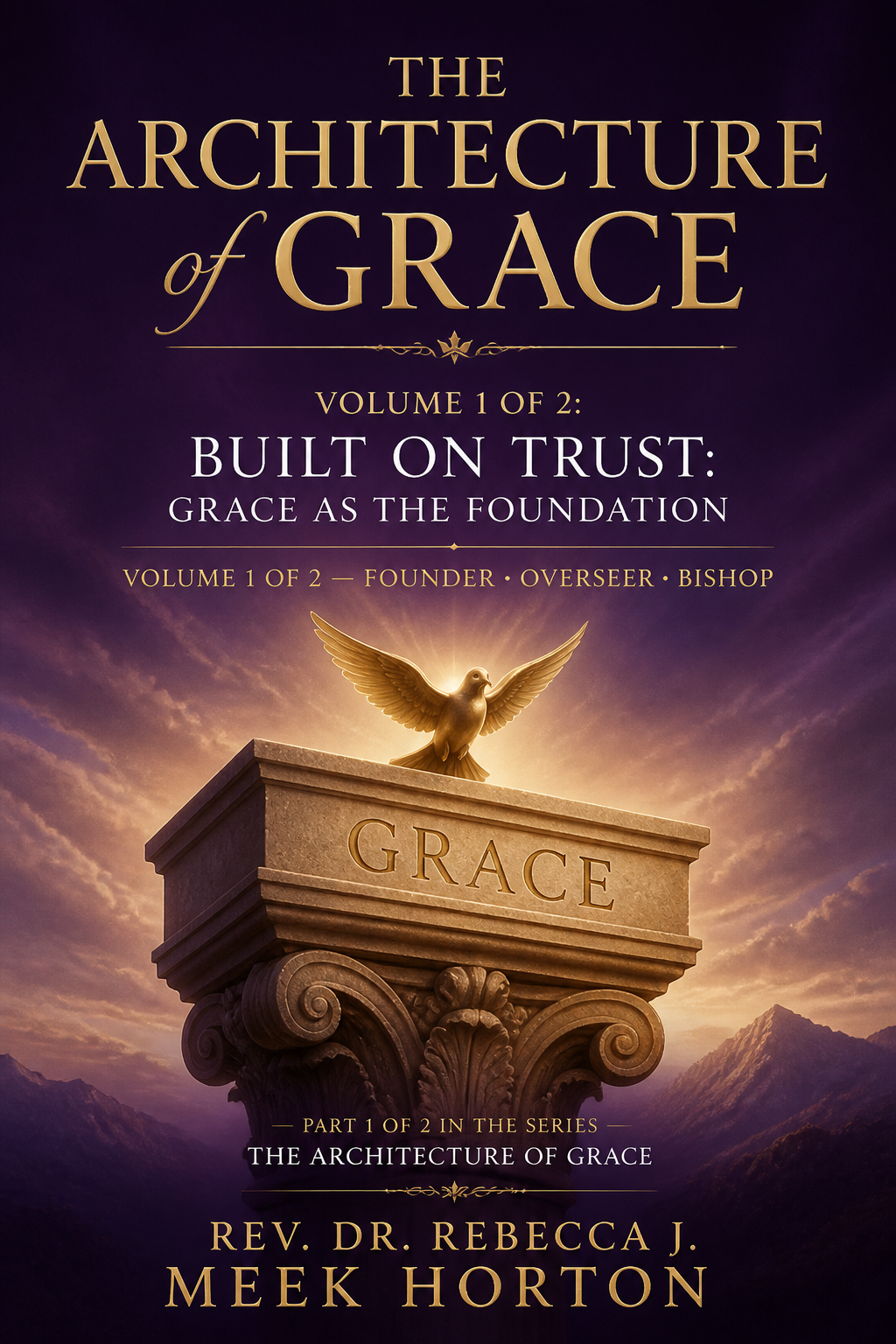
Built on Trust: Grace as the Foundation
Part 1 of 2 in the series "The Architecture of Grace". Series theme: Grace flies through trust in GOD. Grace is our sufficiency. Grace empowers all we do in life. Series arc: This two-book series moves from foundation to formation. The first book establishes grace as God’s sufficient gift received through trust, not earned through striving. The second book shows how that grace becomes strength for
Chapter 1 preview
NBCNGMI MASTER KNOWLEDGE LIBRARY Featuring the works of The Sage, Apostle Prophet. Rev. Dr. Rebecca J. Meek Horton, Apostolic Prophetic Architect, NewBeing Creation Network Global Ministries, Inc. Integrated Framework Modalities™
Purpose
I wrote this book to help us come back to the foundation: grace is God’s gift, received through trust, not earned through striving (Ephesians 2:8–10). My hope is that you will lay down the weight of performance, shame, and self-sufficiency, and stand more securely in Christ. May you learn to receive His grace as sufficient, even in weakness, and walk forward with quiet confidence in Him (2 Corinthians 12:9; Romans 5:1–2).
Preface
I wrote this book because I have seen how quietly striving can dress itself in spiritual language.
We can serve God, speak of faith, attend church, pray, give, and still live as though everything depends on our performance. We may believe grace is true, but still carry shame like a second skin. We may confess that Jesus is enough, while privately trying to prove that we are enough too.
I know that place.
There have been seasons when I treated grace like a doctrine to defend more than a gift to receive. I knew the words, but my heart still leaned toward earning, managing, and measuring. The Lord has been patient with me. Again and again, He has brought me back to the foundation: “For by grace you have been saved through faith. And this is not your own doing; it is the gift of God” (**Ephesians 2:8**).
That is where this book begins.
*Built on Trust* is the first part of *The Architecture of Grace*. Before we speak of grace as strength for obedience, endurance, service, and fruitfulness, we must first stand on grace as God’s sufficient gift. Grace is not a wage for the disciplined. It is not a reward for the impressive. It is not God helping us finish what we started in our own strength.
Grace is God giving what only God can give.
And trust is how we receive it.
This book is for the weary believer who is tired of pretending. It is for the faithful servant who has forgotten how to rest. It is for the wounded heart that wonders if God is still near. It is for anyone who needs to hear again that peace with God comes through our Lord Jesus Christ, and through Him “we have also obtained access by faith into this grace in which we stand” (**Romans 5:1–2**).
My prayer is simple: that these pages would help you stop building your life on fear, shame, self-effort, or religious performance, and begin again on trust in God.
Not shallow trust. Not passive trust. Not trust without cost.
But the kind of trust that says, “Lord, if Your grace is sufficient, then I do not have to be.”
As you read, go slowly. Bring your real questions. Let Scripture search you. When the Lord shows you where you have been striving, do not run from Him. Turn toward Him.
Grace is not fragile.
It can hold you.
Introduction
Grace is not God’s reward for the impressive.
Grace is God’s gift for the needy.
That truth sounds simple, but many of us spend years resisting it. We believe in grace with our mouths while carrying the weight of our lives as if everything still depends on us. We try to prove we are sincere enough, strong enough, sorry enough, useful enough, disciplined enough, or spiritual enough. We call it responsibility, but often it is fear wearing good clothes.
The gospel tells a better truth.
“For by grace you have been saved through faith. And this is not your own doing; it is the gift of God, not a result of works, so that no one may boast” (Ephesians 2:8–9). Grace begins where boasting ends. It is received through faith, not earned through striving. It is God’s sufficiency given to people who cannot save, secure, or sanctify themselves apart from Him.
This book is the first part of *The Architecture of Grace*. The series moves from foundation to formation. This first book, *Built on Trust: Grace as the Foundation*, lays the groundwork. Before we talk about grace as strength for daily obedience, endurance, service, and fruitfulness, we must first settle this: grace is received before it is expressed. We stand in grace before we walk in strength.
Romans 5:1–2 says, “Since we have been justified by faith, we have peace with God through our Lord Jesus Christ. Through him we have also obtained access by faith into this grace in which we stand.” That is the foundation. Peace with God does not come from our performance. Access into grace does not come through self-improvement. We stand because Christ has made a way.
This matters because the heart easily builds on unstable ground.
Some build on performance. If they do well, they feel close to God. If they fail, they hide.
Some build on shame. They know the right words about forgiveness, but deep down they still believe they are disqualified.
Some build on self-sufficiency. They trust God for salvation but quietly trust themselves for everything else.
This book speaks to those foundations with care and honesty. It does not dismiss obedience. Ephesians 2:10 reminds us that we are “created in Christ Jesus for good works.” But order matters. Works are not the root of grace. They are the fruit of grace. We do not obey to become accepted. We learn to obey because, in Christ, we have been received.
The central argument of this book is plain: grace flies through trust in God. Where the heart trusts Him, grace is received, rested in, and lived from. Where the heart mistrusts Him, even good effort can become anxious striving.
Each chapter will take one step in that foundation. We will look at the gift of grace, the call to trust, the burden of performance, the healing of shame, the weakness that makes room for Christ’s strength, and the security of standing in Him. We will return often to Scripture, not as decoration, but as ground. God’s Word must carry the weight.
You do not need to rush through these pages. Read slowly. Pause where a sentence finds you. Let the Lord search the places where you have been trying to earn what He gives freely. Bring your real questions. Grace is not fragile. It can meet you in honest places.
This book will ask something of you. It will ask you to lay down the pride of self-sufficiency and the false comfort of self-condemnation. It will ask you to stop measuring God’s heart by your latest success or failure. It will ask you to trust Christ more than your record.
That may feel costly. But it is also freedom.
The Lord said to Paul, “My grace is sufficient for you, for my power is made perfect in weakness” (2 Corinthians 12:9). That is not only a verse for crisis. It is a foundation for life.
As you begin, take one simple step: name the place where you most often strive to prove yourself to God, and pray honestly, “Lord, teach me to receive Your grace here.”
Chapter 1 — The Weight We Were Not Built to Carry
The backpack looked normal from the outside.
A man stood at the edge of a trailhead, ready for a short hike. He had water, snacks, a jacket, and good shoes. Nothing dramatic. But when he bent down to lift his pack, his knees shook. He pulled once, then again. The bag barely moved.
Someone had filled it with bricks.
That is how many people try to follow God.
They look fine from the outside. They keep moving. They smile, serve, provide, show up, answer messages, attend church, and try to do better. But inside, they are carrying weight God never placed on them: the need to prove they are enough, the fear that one failure will disqualify them, the pressure to earn what God calls a gift.
This chapter’s controlling idea is simple: we cannot build a life of grace on the foundation of earning.
Striving cannot secure what only God can give. Shame cannot produce the life of God. Self-sufficiency cannot carry the soul into peace. If grace is the foundation, then the first work is not to perform harder, but to tell the truth about the weight we were not built to carry.
## The Invisible Load
Not every burden looks heavy at first.
Some burdens sound responsible.
“I just need to get my life together.”
“I have to prove I’ve changed.”
“I can’t let anyone see me struggle.”
“I need to do more so God will be pleased with me.”
There is a kind of effort that is holy. Scripture does not call us to laziness. We are called to obedience, diligence, faithfulness, endurance, and love. Paul says, “By the grace of God I am what I am, and his grace toward me was not in vain” (1 Corinthians 15:10). Grace did not make him passive. Grace made him fruitful.
But there is another kind of effort that is not faithfulness. It is fear wearing work clothes.
It is the effort to become acceptable before God by doing enough. It is the effort to outrun shame. It is the effort to keep control because trusting God feels too risky. This kind of striving does not make the soul strong. It makes the soul tired.
Jesus spoke directly to burdened people: “Come to me, all who labor and are heavy laden, and I will give you rest” (Matthew 11:28). He did not say, “Come to me once you are impressive.” He did not say, “Come to me after you have carried everything well.” He called the weary while they were still weary.
Think of someone who cleans the house before the housekeeper arrives. Not basic tidying, but frantic cleaning, scrubbing, hiding, pretending there is no mess. Many people approach God that way. They know they need Him, but they keep trying to make themselves presentable before receiving His help.
The result is exhaustion with a religious vocabulary.
The invisible load is not always sin itself. Sometimes it is the belief that we must fix ourselves before we can be loved, forgiven, or helped by God.
That belief is heavier than we think.
## Striving Cannot Hold the Foundation
A foundation carries the weight of everything built on it.
If the foundation is cracked, the house may stand for a while, but pressure will reveal the problem. Rain, wind, time, and weight will tell the truth.
A life built on earning has a cracked foundation.
At first, earning can feel motivating. It gives us a task. It creates a ladder. It says, “Climb, and you will be safe.” So we climb. We compare. We measure. We look for signs that we are doing better than before, or at least better than someone else.
But ladders are poor foundations.
You cannot rest on a ladder. You can only keep holding on.
This is why performance-based faith produces such deep anxiety. If my peace depends on my performance, then peace will rise and fall with my latest success or failure. If my confidence before God depends on my consistency, then one weak day can shake the whole structure.
Scripture is clear that human effort cannot secure salvation. “For by grace you have been saved through faith. And this is not your own doing; it is the gift of God” (Ephesians 2:8). This book will return to that promise, but here we must first face the problem: if grace is a gift, earning is the wrong way to receive it.
Imagine a child at a birthday party trying to pay for every present handed to him. He reaches into his pockets, finds nothing, and panics. The giver smiles and says, “This is for you.” But the child keeps asking, “How much do I owe?”
That is not humility. It is mistrust.
Many believers would never say they are trying to buy grace. But inwardly, they negotiate for it.
“If I pray more, maybe God will accept me.”
“If I serve more, maybe I can make up for what I did.”
“If I suffer quietly, maybe that will count for something.”
Good things become distorted when we use them to purchase what God gives freely. Prayer becomes payment. Service becomes proof. Suffering becomes a bargaining chip. Even obedience becomes a way to manage God instead of respond to Him.
This does not lead to love. It leads to bondage.
The foundation of earning cannot hold a life of grace because earning keeps the focus on the self: my record, my effort, my improvement, my failure, my control. Grace turns the heart toward God: His mercy, His sufficiency, His promise, His Son.
## Shame and Self-Sufficiency Often Travel Together
Shame says, “You are not enough.”
Self-sufficiency answers, “Then I will become enough by myself.”
Together, they form a hard and lonely way to live.
Shame drives people into hiding. Self-sufficiency builds the hiding place. Shame whispers, “Don’t let anyone know.” Self-sufficiency says, “You don’t need help anyway.” Shame remembers every failure. Self-sufficiency promises a plan to make sure it never happens again.
But the soul cannot be healed by hiding.
In Genesis 3, after Adam and Eve sinned, they hid from the presence of the Lord among the trees (Genesis 3:8). Their hiding did not remove their guilt. It only placed distance between them and the One who called to them. God’s question, “Where are you?” was not because He lacked information. It was mercy drawing them out of concealment.
We still hide among trees.
Some hide in busyness. If they stay productive, they do not have to be honest.
Some hide in religious activity. If they keep doing visible good, no one will ask about the hidden ache.
Some hide in competence. They become the dependable one, the strong one, the one who never needs anything.
Some hide in isolation. They would rather be alone than risk being known.
A woman may sit in church every week convinced that God is disappointed in her, even while she sings about His mercy. A man may lead his family, pay the bills, and help others, yet feel unable to bring his own fear to God. A young adult may try to rebuild life after failure, but secretly believe one mistake has become their name.
This is the weight we were not built to carry: the burden of being our own savior.
We cannot atone for ourselves. We cannot cleanse our own conscience. We cannot create the grace we need by becoming impressive enough to deserve it.
Only God can give what the soul most deeply needs.
## The Cost of Laying It Down
Letting go of earning sounds peaceful, but it can feel threatening.
There is a cost.
If we stop trying to earn grace, we must surrender the illusion of control. We must admit that our best effort cannot make God owe us. We must stop using performance to protect ourselves from need. We must let God be generous without trying to manage the terms.
That is harder than it sounds.
Many of us would rather be tired than dependent. Tired still feels in control. Dependent feels exposed.
But faith begins where control ends. Not because God despises effort, but because effort was never meant to replace trust. “Unless the Lord builds the house, those who build it labor in vain” (Psalm 127:1). The builders may be skilled. The work may be sincere. But if the Lord is not the foundation, the labor cannot carry eternal weight.
To lay down the burden of earning does not mean we stop obeying. It means we stop obeying in order to become loved and begin obeying because God has first loved us.
It does not mean we ignore sin. It means we bring sin into the light instead of trying to bury it under achievement.
It does not mean we become passive. It means we become rightly dependent.
The cost is pride. The gift is rest.
The cost is control. The gift is trust.
The cost is pretending. The gift is truth before God.
Jesus does not invite the weary to drop their burdens into emptiness. He invites them to Himself. “Take my yoke upon you, and learn from me,” He says, “for I am gentle and lowly in heart, and you will find rest for your souls” (Matthew 11:29).
Rest for your souls.
Not just a break from activity. Not just a quiet weekend. Rest at the foundation. Rest where the soul stops arguing for its worth and begins receiving mercy from the Lord.
This is where the architecture of grace begins.
Not with a better performance.
Not with a stronger image.
Not with a private vow to never struggle again.
It begins with trust in God.
The first honest prayer may be simple: “Lord, I have been trying to carry what only You can give.”
That prayer is not weakness. It is the beginning of freedom.
## Key Takeaways
- Grace cannot be built on earning. - Striving may look strong, but it cannot save. - God invites the weary to come to Him, not prove themselves first.
## Practice
Take ten quiet minutes today.
Write down one burden you have been carrying to prove yourself to God, to others, or to yourself. Name it plainly.
Then pray:
“Father, I release the burden of earning what You give by grace. Teach me to trust You where I have been striving. Help me receive what only You can give. Amen.”
After you pray, take one small step of trust: stop one unnecessary act of proving, and do the next faithful thing from peace instead of pressure.
This is the opening chapter. The complete publication is available in the full edition.
Back to the library