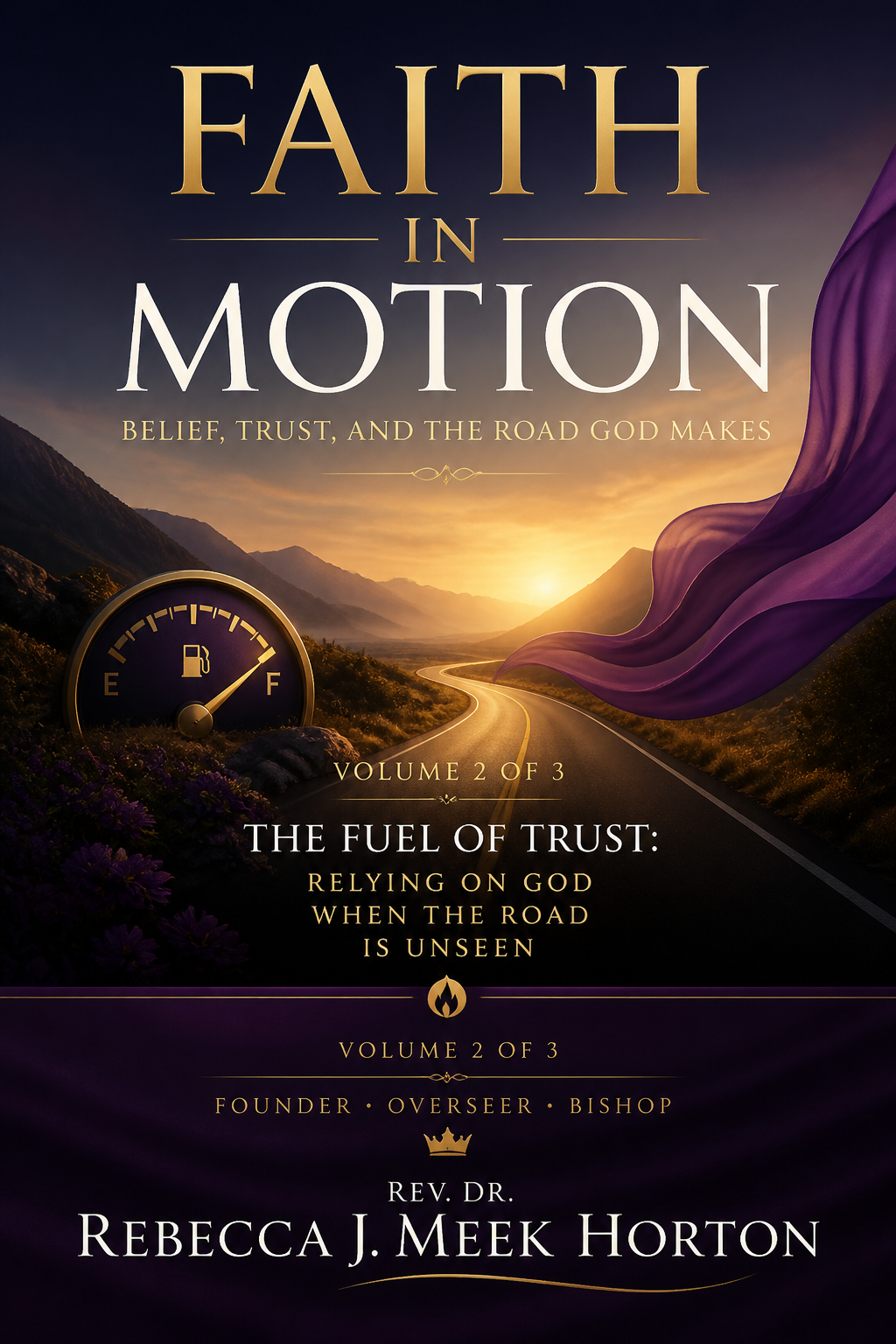
Faith in Motion: Belief, Trust, and the Road God Makes · Volume 2
The Fuel of Trust: Relying on God When the Road Is Unseen
Part 2 of 3 in the series "Faith in Motion: Belief, Trust, and the Road God Makes". Series theme: Series arc: True faith is a response to the God who speaks: belief gives faith its vehicle, trust gives faith its fuel, and obedience carries faith into faithful witness. The series begins with the foundation—faith begins with God, not human optimism or religious effort. It then moves into the cost a
Chapter 1 preview
NBCNGMI MASTER KNOWLEDGE LIBRARY Featuring the works of The Sage, Apostle Prophet. Rev. Dr. Rebecca J. Meek Horton, Apostolic Prophetic Architect, NewBeing Creation Network Global Ministries, Inc. Integrated Framework Modalities™
Purpose
I wrote this book for leaders who believe God, yet still have to walk roads they cannot see. My prayer is that these pages help you trust His character when waiting, suffering, silence, uncertainty, and cost test your confession of faith. May you learn to say with steady surrender, “God is faithful, whether the road gets easier or harder” (Proverbs 3:5–6).
Preface
I wrote this book for the leader who still believes God, but no longer has a clear view of the road.
There is a kind of faith that sounds strong in public and trembles in private. It can preach, teach, build, organize, and encourage others, yet still whisper in the night, “Lord, how long?” Leaders know this tension well. We are often expected to carry clarity for others while we are still learning how to trust God in places we cannot explain.
This book was born from that place.
In the first part of this series, we considered belief as the vehicle of faith. But every vehicle needs fuel. Belief may begin the journey, but trust keeps faith moving when waiting stretches long, when obedience costs more than expected, when silence feels heavy, and when the next step is the only light we have.
Trust is not pretending the road is easy. It is not denying grief, fear, fatigue, or disappointment. Trust is active reliance on the character of God when we cannot control the outcome. It is the quiet surrender that says, “God is faithful, whether the road gets easier or harder.”
Abraham “went out, not knowing where he was going” (Hebrews 11:8). Israel followed a pillar through wilderness they could not manage (Exodus 13:21–22). The disciples crossed waters that frightened them while Jesus taught them who He was (Mark 4:35–41). Again and again, Scripture shows us that God does not always reveal the whole road. But He reveals Himself.
That is the comfort and the cost of trust.
I have written these pages slowly, with leaders in mind—pastors, servants, builders, parents, mentors, and those carrying responsibility that cannot be laid down lightly. My prayer is that this book will not give you quick answers where God is forming deep endurance. I pray it will strengthen your dependence, steady your soul, and help you recognize the faithfulness of God even before circumstances change.
Nothing is random. Nothing is wasted.
As you read, do not rush to master trust as a concept. Let trust search you. Let the Word anchor you. Let prayer become honest again. Let surrender become practical.
Begin with this simple step: name the road you cannot see, then place it before the Faithful One.
He is still worthy of your trust.
Introduction
There comes a point in every leader’s journey when belief is no longer clean on the page.
It has to travel.
The road bends. The map runs out. The prayer is not answered the way you hoped. The people you carry still need courage from you, while your own heart is asking quiet questions. You still believe God is able. But now you must learn whether you trust Him when the outcome is not visible.
That is the ground of this book.
*The Fuel of Trust* is the second movement in *Faith in Motion: Belief, Trust, and the Road God Makes*. The first book established that faith begins with God, not with human optimism, personality strength, or religious effort. Belief gives faith its vehicle. But belief will be tested. It will face waiting, suffering, silence, uncertainty, disappointment, and cost.
When that happens, trust becomes the fuel that keeps faith moving.
Trust is not pretending the road is easy. It is not denial. It is not a spiritual way of controlling outcomes. Trust is active reliance on the character of God when you cannot yet trace the hand of God.
Scripture does not present trust as sentimental. It presents trust as surrendered dependence.
“Trust in the LORD with all your heart, and do not lean on your own understanding” (Proverbs 3:5). That command does not remove the mystery. It names where the weight belongs. We do not lean on our understanding because our understanding cannot carry what only God can carry.
Abraham “went out, not knowing where he was going” (Hebrews 11:8). Israel followed God through wilderness, not because the wilderness was clear, but because the Lord was present. David could walk “through the valley of the shadow of death” because the Shepherd was with him (Psalm 23:4). Paul could say, “We walk by faith, not by sight” (2 Corinthians 5:7), not because sight was evil, but because sight was limited.
Leaders need this truth.
Leadership often tempts us to confuse trust with certainty. We want to know enough to feel safe before we obey. We want God to explain the whole road before we take the next step. We want faith to feel strong before the assignment feels costly.
But God forms leaders differently.
He teaches us to trust Him in hidden places before He entrusts us with visible influence. He strengthens dependence before He expands responsibility. He lets the road expose what confidence has been resting on.
This book will ask honest questions.
What do we do when God is faithful but the road is still hard? How do we lead when answers are delayed? How do we keep moving without forcing outcomes? How do we comfort others when we ourselves are still learning to trust?
We will not rush those questions. We will bring them to Scripture. We will read slowly, interpret carefully, ponder honestly, and steward what we receive responsibly. Trust must be formed, not performed.
Read this book with a Bible near you and with your leadership role in view. Do not read only for language to teach others. Let the Word search you first. Let each chapter examine what you are leaning on, what you are trying to control, what you are afraid to release, and where God is inviting you into deeper reliance.
The chapters ahead move from the foundation of trust in God’s character, into the testing places of waiting, silence, suffering, uncertainty, and cost, and finally into the daily practice of surrendered leadership. Each chapter carries one central idea and one practice. Do not hurry past the practice. Wisdom is not yours until you walk it.
The promise of this book is not that trusting God will make the road easier.
The promise is better than that.
God is faithful whether the road gets easier or harder.
And because He is faithful, faith can keep moving.
Begin here: name one place where you are asking God for sight, but He may be inviting you into trust. Write it plainly. Then pray Proverbs 3:5–6 over that place before you read on.
Chapter 1 — 1. When Belief Meets the Unseen Road
The room gets quiet after the meeting ends.
The reports are still on the table. The budget is not settled. The team is tired. A door that seemed open last month now looks uncertain. People are looking to you for steadiness, but inside you are carrying questions you cannot say too loudly.
You believe God.
That is not the problem.
The problem is that you believe God and still cannot see the road.
This is where many leaders discover the difference between belief and trust. Belief says, “God is real. God is able. God has spoken.” Trust says, “I will rely on Him here, while the way is still hidden.”
The single idea of this chapter is simple: trust is active reliance on God’s character when visible outcomes are not enough to steady you.
Faith does not begin with our ability to see. Hebrews 11:1 says, “Now faith is the assurance of things hoped for, the conviction of things not seen.” Faith has never required full visibility. It requires a faithful God.
## The Unseen Road Is Not an Unfaithful Road
Leaders often feel pressure to interpret uncertainty as failure.
If the plan is unclear, we assume we missed something. If the provision has not arrived, we wonder if we moved too soon. If the people are unsettled, we question whether God is still leading.
But Scripture does not treat the unseen road as strange.
Abraham went out “not knowing where he was going” (Hebrews 11:8). Israel followed a cloud and fire through wilderness, not a printed map. The disciples stepped into storms with Jesus in the boat and still did not understand what He was doing.
The unseen road is not automatically an unfaithful road.
There are seasons when God gives enough light for obedience, but not enough detail for control.
A pastor may know it is time to strengthen the church’s foundation, but not know how the finances will respond. A ministry leader may know a hard conversation must happen, but not know whether the relationship will survive it. A founder may know the assignment is real, but not know how long the hidden work will take.
In those moments, trust is not pretending the road is clear.
Trust is saying, “God is faithful, and I will not make visibility my source of peace.”
Proverbs 3:5–6 gives the leader a grounded path: “Trust in the Lord with all your heart, and do not lean on your own understanding. In all your ways acknowledge Him, and He will make straight your paths.”
Notice the order.
Trust the Lord.
Do not lean on your own understanding.
Acknowledge Him in all your ways.
Then He makes the path straight.
The straight path is God’s work. Trusting, yielding, and acknowledging are ours.
## Belief Confesses; Trust Relies
Belief matters. Without belief, faith has no vehicle.
But belief can remain stated while the heart still leans on control. A leader can preach God’s faithfulness and still be ruled by panic. A leader can quote promises and still grasp for outcomes. A leader can believe correct doctrine while carrying the weight as if everything depends on human management.
This is why trust must become more than agreement.
Trust is reliance.
It is the difference between saying a chair can hold you and actually sitting down. It is the difference between knowing a bridge was built to carry weight and placing your feet on it when the river below is loud.
Many leaders live in the strain between confession and reliance.
We confess, “God will provide,” but we cannot sleep unless every number is already solved.
We confess, “God is leading,” but we rush decisions because silence feels unsafe.
We confess, “God owns the work,” but we carry criticism as if our identity depends on the approval of people.
This is not hypocrisy. Often, it is immaturity under pressure. It is the place where God kindly exposes what our words believe but our nervous system has not yet learned to entrust.
Trust grows when belief is tested.
A leader once described a season when every visible sign seemed mixed. Attendance was inconsistent. Giving was unpredictable. The staff needed clarity. She kept asking God for the full plan. What she received instead was one step: gather the team, tell the truth, pray, and strengthen what remained.
It felt too small.
But that was the next faithful step.
Months later, she could see that God had not abandoned the work. He had been removing hurry from the leader before rebuilding strength in the ministry.
Nothing is random. Nothing is wasted.
Trust often begins where our demand for full understanding ends.
## God’s Character Must Carry What Outcomes Cannot
Outcomes are not strong enough to carry a leader’s soul.
Good outcomes can encourage us, but they cannot become the foundation of our trust. If they do, peace will rise and fall with the report, the offering, the attendance, the response, the opportunity, or the approval.
That is not trust. That is emotional dependence on visible conditions.
Biblical trust anchors in God Himself.
Hebrews 11 does not celebrate people who controlled outcomes. It remembers people who acted because they trusted the God who called, promised, warned, and led. Some saw deliverance. Some endured suffering. Some received what was promised. Some died still waiting in faith.
The common thread was not ease.
The common thread was God.
This matters for leaders because leadership exposes what we have been using as fuel.
If praise fuels us, criticism will empty us.
If certainty fuels us, ambiguity will paralyze us.
If visible success fuels us, hidden obedience will feel like failure.
But if trust in God’s character fuels us, we can keep moving without demanding that every mile explain itself.
God is wise when the process feels confusing.
God is faithful when the timing feels slow.
God is present when the road feels lonely.
God is good when the outcome is not yet visible.
This does not make leadership painless. It makes leadership anchored.
A leader may still grieve. Still ask questions. Still seek counsel. Still revise plans. Still admit weakness. Trust does not remove honest stewardship. It purifies it.
Stewardship asks, “What responsibility has God placed in my hands?”
Control asks, “How can I force the outcome I fear losing?”
Trust helps us know the difference.
## The First Work of Trust Is Surrendered Attention
When the road is unseen, leaders often reach for motion.
Send another message. Schedule another meeting. Make another announcement. Rework the plan again. Search for a sign. Push for a door. Study everyone else’s success.
Some action is faithful. Some action is fear wearing leadership clothes.
The first work of trust is surrendered attention.
Before the leader moves, the leader must become present to God.
This does not mean passivity. It means we refuse to let anxiety become our strategist.
Proverbs 3:6 says, “In all your ways acknowledge Him.” That word “all” is mercy. God does not ask to be acknowledged only in spiritual language, prayer meetings, and worship services. He is to be acknowledged in budgets, hiring, timing, conflict, planning, correction, and rest.
Acknowledge Him in the email you want to send too quickly.
Acknowledge Him in the decision that feels urgent.
Acknowledge Him in the pressure to look stronger than you are.
Acknowledge Him before you explain yourself.
Acknowledge Him before you build what your soul cannot carry.
This is where trust becomes practical. It slows the leader down enough to ask, “Am I relying on God, or am I leaning on my own understanding?”
The answer may not condemn you. It may recalibrate you.
A leader can pause for five minutes before a hard meeting and pray, “Lord, I trust Your character more than my ability to manage this room. Give me wisdom. Keep me truthful. Keep me from fear.”
That small prayer is not small.
It is a transfer of weight.
## The Cost: Trust Will Challenge Your Need to See
Trust sounds beautiful until it asks for surrender.
The cost of this chapter is that you may have to release your demand for certainty before obedience. You may have to stop treating clarity as proof that God is with you. You may have to admit that some of your leadership exhaustion is not from responsibility alone, but from carrying what belongs to God.
This is tender work.
Leaders are often rewarded for knowing, deciding, fixing, and producing. People come to leaders for answers. But the leader who follows God must learn to say, “I do not see the whole road, but I know the One who leads.”
That sentence may feel costly.
It may humble your image.
It may slow your pace.
It may disappoint people who prefer confidence without dependence.
But it will also protect your soul.
Trust does not make you less responsible. It makes you rightly responsible. You carry obedience. God carries outcomes.
You steward the next step. God governs the road.
## Key Takeaways
- Trust is active reliance on God’s character when the road is unseen. - Uncertainty is not proof that God is absent or unfaithful. - Leaders carry obedience; God carries outcomes.
## Practice
Before your next major decision, take ten quiet minutes with Proverbs 3:5–6.
Write two columns:
**What I know God has asked me to steward.** **What I am trying to control because I cannot yet see.**
Pray honestly over both columns.
Then choose one next faithful step you can take without forcing the outcome.
This is the opening chapter. The complete publication is available in the full edition.
Back to the library