When Anxiety Is Too Loud · Volume 1
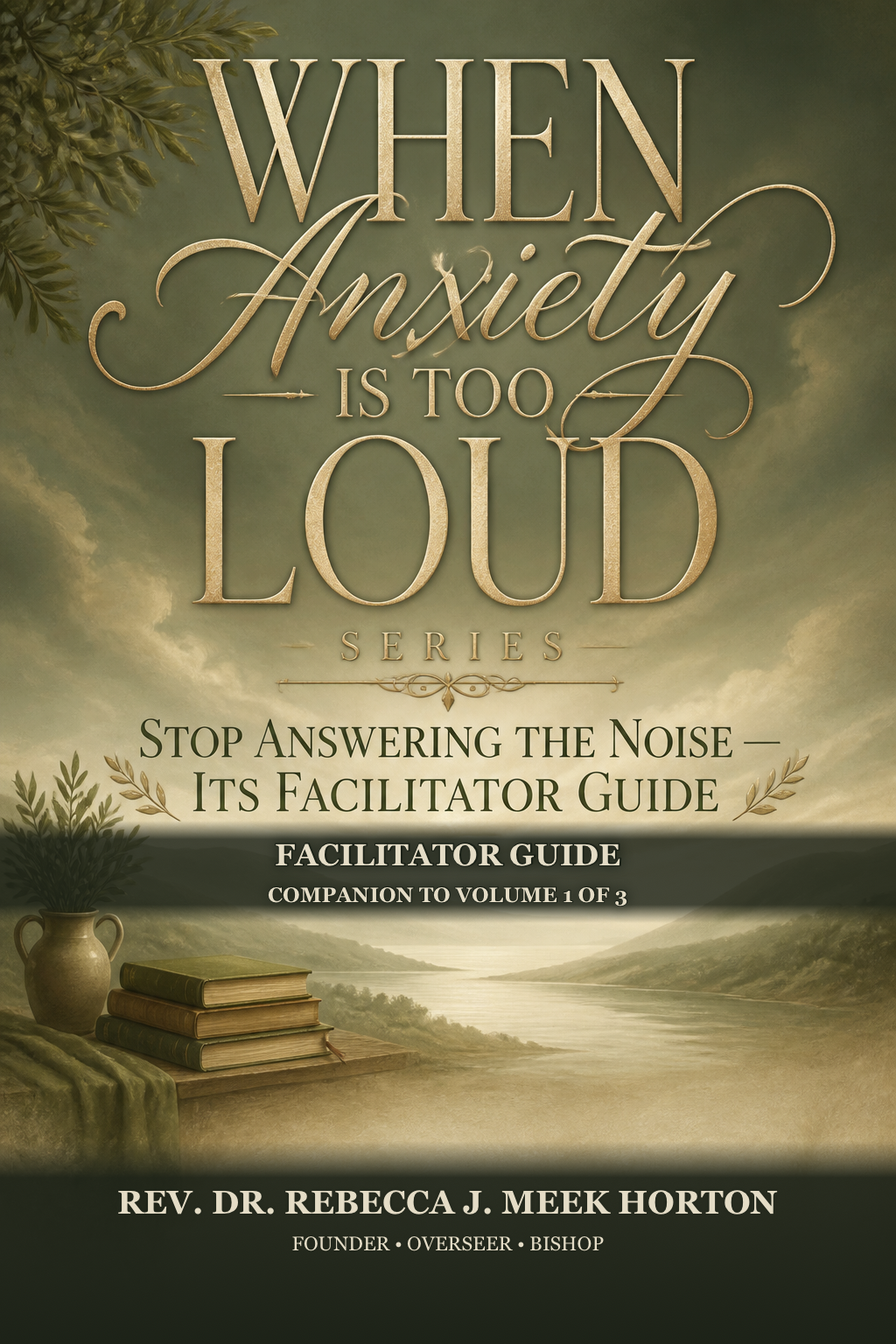
Stop Answering the Noise — Its Facilitator Guide
A facilitator's guide for "Stop Answering the Noise". Every written chapter becomes a 60-minute session: objectives, preparation, timing, teaching outline, discussion questions with suggested answers, an activity, a closing commission, a written closing prayer, and leader's notes.
Chapter 1 preview
NBCNGMI MASTER KNOWLEDGE LIBRARY Featuring the works of The Sage, Apostle Prophet. Rev. Dr. Rebecca J. Meek Horton, Apostolic Prophetic Architect, NewBeing Creation Network Global Ministries, Inc. Integrated Framework Modalities™
Chapter 1 — The Thought That Demands an Answer
Session Overview
This session helps the group recognize how anxiety can enter through a single thought that feels urgent, demanding, and authoritative. The leader will guide participants to see the difference between a thought, a feeling, a body signal, an assumption, and a faithful response. The goal is not to shame anxious thoughts or pretend concerns are never real. The goal is to teach stewardship: not every loud thought deserves immediate obedience. Participants will learn that urgency does not make a thought true, pressure does not make it a command, and a pause can give wisdom room to speak. This session introduces simple RE-Language™ shifts, SAPP™ Discernment, and the beginning rhythm of WALK™: Wait, Ask, Listen, Keep. By the end, participants should be able to slow down, separate fact from fear, and choose one steady next step instead of reacting to the noise.
Session Objectives
Recognize how anxious thoughts can feel urgent without being accurate.
Separate facts, fears, assumptions, body signals, and faithful responses.
Practice RE-Language™ that names pressure without surrendering to it.
Understand that Scripture calls believers to bring thoughts into captivity.
Use a simple pause to interrupt haste and create space for wisdom.
Identify one practical step for responding to anxiety with stewardship instead of panic.
Preparation
Read the full chapter slowly, paying attention to the opening text message example and the four-line practice at the end.
Read 2 Corinthians 10:5, Proverbs 14:29, James 1:19, and Philippians 4:6-7 in the King James Version.
Prepare a whiteboard, paper, or shared screen for the four categories: Fact, Fear, Pressure, Faithful response.
Pray over the group, especially for those who may carry chronic anxiety, trauma, pressure, or fear of conflict.
Be ready to remind the group that this session is not medical or clinical treatment. If anxiety is severely disrupting someone’s life, sleep, health, relationships, or safety, seeking qualified help is wise stewardship.
Timing
Welcome and Session Framing, 5 minutes
Opening Prayer, 3 minutes
Chapter Recap, 7 minutes
Teaching Outline, 20 minutes
Discussion Questions, 15 minutes
Group Activity, 7 minutes
Closing and Commission, 2 minutes
Closing Prayer, 1 minute
Opening Prayer
Father, quiet our hearts and help us listen with wisdom. Teach us to notice the thoughts that demand our obedience, and give us grace not to answer anxiety as if it is our ruler. Help us see clearly, respond faithfully, and bring our thoughts under the obedience of Christ. Amen.
Teaching Outline
Movement 1: The loudest thought is not always the truest thought.
Point: Anxiety often arrives as a thought that demands an answer, but urgency does not make it true.
2 Corinthians 10:5 (KJV) Casting down imaginations, and every high thing that exalteth itself against the knowledge of God, and bringing into captivity every thought to the obedience of Christ;
Leader sentence: This verse teaches us that thoughts can be examined and brought under Christ’s rule; they do not have the right to rule us simply because they are loud.
Movement 2: Haste can make fear feel like wisdom.
Point: Anxiety pushes us to react before we have seen clearly, but wisdom slows us down.
Proverbs 14:29 (KJV) He that is slow to wrath is of great understanding: but he that is hasty of spirit exalteth folly.
Leader sentence: A hasty spirit can speak, assume, defend, accuse, or withdraw too quickly; the pause gives understanding room to grow.
Movement 3: Listening begins with careful seeing.
Point: SAPP™ Discernment begins by seeing what is actually happening before deciding what it means.
James 1:19 (KJV) Wherefore, my beloved brethren, let every man be swift to hear, slow to speak, slow to wrath:
Leader sentence: Being slow to speak is not avoidance; it is a faithful interruption of reaction so that we can listen before we answer.
Movement 4: Prayer makes space for peace to guard us.
Point: Anxiety may still be present, but prayer helps us bring concern to God instead of letting fear command the next step.
Philippians 4:6-7 (KJV) 6 Be careful for nothing; but in every thing by prayer and supplication with thanksgiving let your requests be made known unto God. 7 And the peace of God, which passeth all understanding, shall keep your hearts and minds through Christ Jesus.
Leader sentence: God does not shame us for bringing real concerns to Him; He invites us to bring them prayerfully so our hearts and minds can be guarded through Christ.
Discussion Questions with Suggested Answers
1. What happened in the opening example with the message, Call me when you can?
Suggested answer: A short message created a large inner reaction. The facts were limited, but the mind and body began filling in the unknown with fear.
2. Why can anxious thoughts feel so convincing?
Suggested answer: Because they often come with strong feelings and body sensations. The intensity can make the thought feel factual, even when it is only an assumption.
3. What is the difference between having a thought and obeying a thought?
Suggested answer: Having a thought means it appeared in the mind. Obeying it means letting it direct our words, choices, timing, and behavior without discernment.
4. How does 2 Corinthians 10:5 help us understand anxious thoughts?
Suggested answer: It reminds us that thoughts can be brought into captivity. We do not have to treat every thought as truth or authority.
5. What does the chapter mean when it says pressure is a signal, not a command?
Suggested answer: Pressure may show that something needs attention, but it does not automatically mean immediate reaction is required.
6. Why is RE-Language™ important in this chapter?
Suggested answer: It helps us move from shame or panic into responsibility. Instead of saying, I have to fix this now, we can say, I am feeling pressure to fix this now.
7. What can the body tell us when anxiety rises?
Suggested answer: The body may show alarm through tightness, shallow breathing, restlessness, or heaviness. These signals should be noticed, but they should not be worshiped or treated as final truth.
8. What is one faithful response someone could take when anxiety demands an immediate answer?
Suggested answer: Pause, breathe, pray, name the facts, separate fear from reality, ask for counsel if needed, or wait before responding.
Group Activity
Practice: Fact, Fear, Pressure, Faithful Response
Instructions: Ask each participant to think of one recent anxious thought that demanded an immediate answer. It should be real but not so personal that they feel unsafe sharing. Give them three minutes to write four lines:
Fact: What actually happened?
Fear: What am I afraid this means?
Pressure: What is anxiety demanding I do right now?
Faithful response: What is one steady step I can take without panic?
After writing, invite volunteers to share only what they feel comfortable sharing. Remind the group not to correct, diagnose, or advise one another unless invited. The purpose is to practice separating the noise from the next faithful step.
Purpose: This exercise helps participants slow the anxious demand, see more clearly, and choose stewardship instead of reaction.
Closing and Commission
Close by reminding the group that maturity does not mean never having anxious thoughts. Maturity means we stop treating every anxious thought as ruler. Send the group out with one assignment: for the next twenty-four hours, notice one thought that demands an immediate answer and write the four lines from the practice. Encourage them to take one steady step, not solve their whole life in one day.
Closing Prayer
Father, thank You for meeting us in the places where our thoughts feel loud, urgent, and overwhelming. Teach us to bring every thought into captivity to the obedience of Christ. Help us separate fact from fear, pressure from responsibility, and body alarm from true direction. Give us courage to pause when anxiety demands reaction. Give us humility to seek counsel and support when we need it. Let Your peace guard our hearts and minds through Christ Jesus. This week, help us stop answering the noise as if it is in charge, and teach us to take the next faithful step with wisdom, steadiness, and obedience. Amen.
Leader's Notes
Some participants may hear this teaching as, Just stop being anxious. Clarify that the chapter does not shame anxiety. It teaches stewardship of anxious thoughts.
Some may ask, What if the concern is real? Answer simply: if it is real, wisdom will still help you respond better than panic will.
Watch for participants who disclose severe anxiety, panic attacks, trauma responses, self-harm, or inability to function. Receive them gently and encourage support from a trusted pastor, counselor, physician, crisis resource, or qualified professional.
Do not let the discussion become a space where people diagnose one another. Keep the focus on noticing, naming, pausing, praying, and taking the next faithful step.
Emphasize that a pause is not passivity. A pause is Governed Movement™. It creates room for wisdom before action.
Likely question: Does bringing thoughts into captivity mean I failed if anxious thoughts keep coming? Suggested response: No. The practice is not about never having thoughts. It is about learning not to obey every thought as truth.
Likely question: How long should I pause? Suggested response: Long enough to see more clearly. Sometimes it is one breath. Sometimes it is overnight. Sometimes it requires counsel.
Pastoral care reminder: Some anxiety is connected to medical, neurological, emotional, or trauma-related realities. Spiritual practice and professional care do not have to compete. Seeking help can be stewardship.
Notes
[Answer Lines]
[Journal Page]
[Journal Page]
This is the opening chapter. The complete publication is available in the full edition.
Back to the library