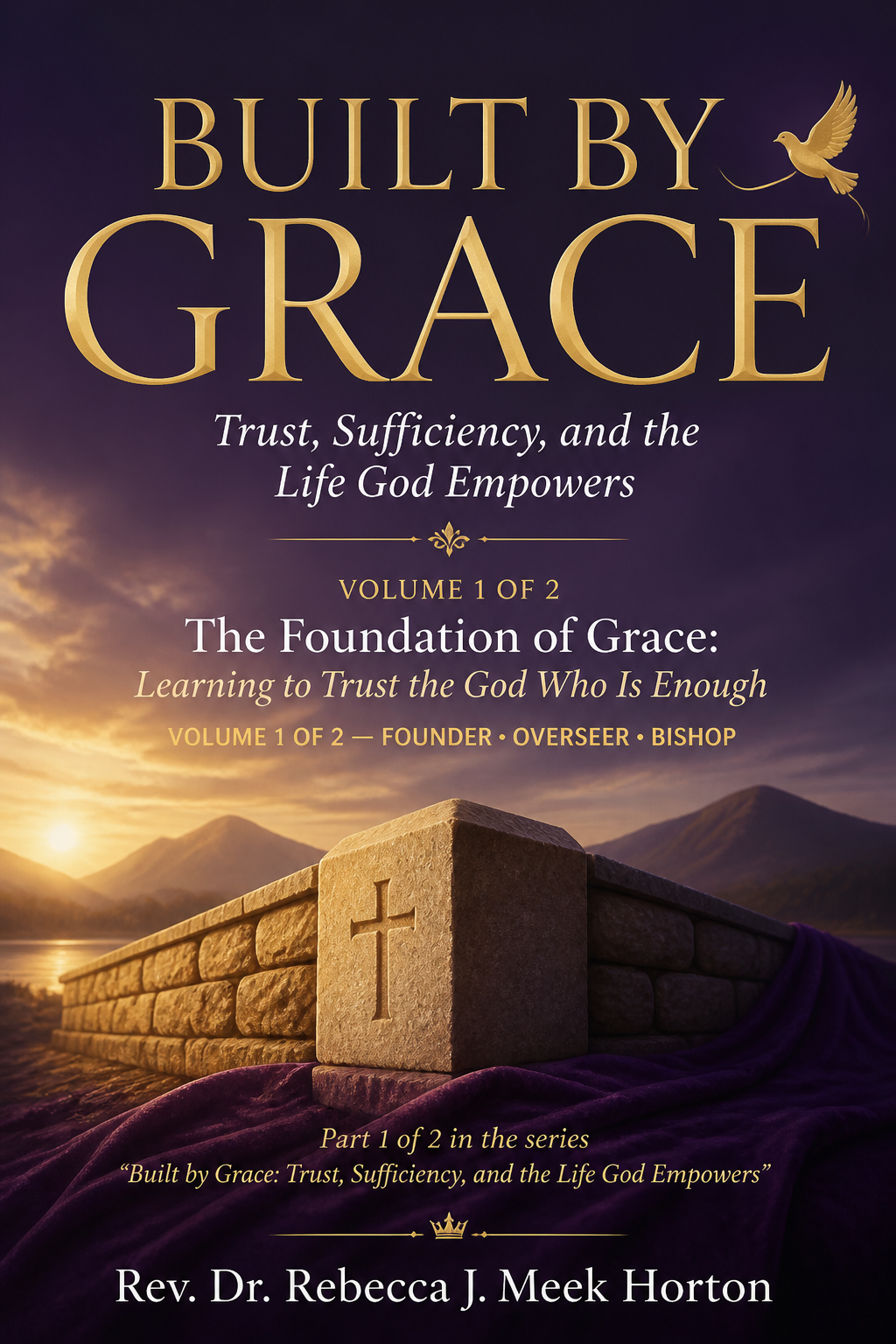
Grace That Holds · Volume 1
The Foundation of Grace: Learning to Trust the God Who Is Enough
Part 1 of 2 in the series "Built by Grace: Trust, Sufficiency, and the Life God Empowers". Series theme: Grace flies through trust in GOD. Grace is our sufficiency. Grace empowers all we do in life. Series arc: This two-book series moves from foundation to formation. The first book establishes grace as God’s sufficient gift received through trust, grounding the reader in the gospel rather than sel
Chapter 1 preview
NBCNGMI MASTER KNOWLEDGE LIBRARY Featuring the works of The Sage, Apostle Prophet. Rev. Dr. Rebecca J. Meek Horton, Apostolic Prophetic Architect, NewBeing Creation Network Global Ministries, Inc. Integrated Framework Modalities™
Purpose
I wrote this book to help you rest your life on the grace of God, not on your own striving. My prayer is that you will see grace as God’s sufficient gift, received through trust in Christ, and learn to stand with confidence in what He has already done for you (Ephesians 2:8–10). May these pages lead you into deeper assurance, honest dependence, and the freedom of knowing that God is enough.
Preface
I have met many sincere believers who love God and yet live as if His love must still be earned.
I understand that struggle. There is a kind of striving that can wear church clothes. It prays, serves, gives, studies, and shows up—but underneath it all is a quiet fear: *Am I doing enough? Am I enough? Has God really accepted me?*
This book was written for that place.
*The Foundation of Grace* began as a burden to return to what is first and keep it clear: we are saved by grace, we stand by grace, and we live because God is enough. Grace is not God’s reward for the strong. It is His gift to the needy. “For by grace you have been saved through faith” (Ephesians 2:8). That is not only where the Christian life begins. It is where we must learn to remain.
The heart of this book is simple: grace flies through trust in God. Not trust in our record. Not trust in our effort. Not trust in our ability to hold everything together. Trust in the God who has made peace with us through Jesus Christ and brought us into “this grace in which we stand” (Romans 5:1–2).
This is the first book in the *Built by Grace* series. It lays the foundation before we move into formation. Before we talk about serving, enduring, obeying, and bearing witness, we must first settle what God has already given. If we try to build life for God without resting in the grace of God, we will turn even holy things into heavy things.
Grace does not make us passive. It makes us dependent. It teaches us to say no to what destroys us and yes to the life God is forming in us (Titus 2:11–12). It meets us in weakness, where Christ says, “My grace is sufficient for you” (2 Corinthians 12:9).
My prayer is that these pages help you breathe again. Not because life is easy. Not because obedience is costless. But because God is faithful, Christ is enough, and grace is not fragile.
As you read, go slowly. Bring your questions honestly. Let Scripture do its steady work. And when you feel the old urge to prove yourself, pause and practice this first step:
Trust the God who is enough.
Introduction
You may know what it is to be tired in a way sleep does not fix.
Tired from trying to be enough. Tired from measuring your faith by your performance. Tired from promising God you will do better, then quietly fearing He is disappointed when you do not. Some believers carry the word *grace* like a doctrine they agree with, but not like a home they live in.
This book begins there.
*The Foundation of Grace* is about learning to trust the God who is enough. Not the God who helps you prove you are enough. Not the God who waits for you to become worthy. The God who gives, saves, keeps, corrects, and forms His people by grace.
The central argument of this book is simple: **grace is God’s sufficient gift, received through trust, and it becomes the foundation for a life no longer driven by striving.**
Scripture says it plainly: “For by grace you have been saved through faith. And this is not your own doing; it is the gift of God” (Ephesians 2:8). Grace begins with God, not with us. Faith does not purchase grace. Faith receives it. Trust is the open runway where grace takes flight.
This matters because many of us know how to work, but not how to receive. We know how to repent from obvious sin, but not always from self-reliance. We know how to ask God for help, but still live as though everything depends on our strength, our consistency, our understanding, or our ability to hold everything together.
The gospel tells a better truth.
Through Jesus Christ, we are brought into peace with God: “Therefore, since we have been justified by faith, we have peace with God through our Lord Jesus Christ” (Romans 5:1). We do not stand in grace because we finally became strong. We stand because Christ is faithful. We do not approach God on the basis of our record. We come through the finished work of His Son.
This first book in the *Built by Grace* series lays the foundation. Before we talk about grace as power for daily obedience, endurance, service, and witness, we must first learn grace as sufficiency. Before formation, there must be foundation. Before we ask, “What can I do for God?” we must receive what God has done for us.
That does not make grace passive. Titus tells us, “The grace of God has appeared, bringing salvation for all people, training us…” (Titus 2:11–12). Grace saves, and grace teaches. But it teaches as grace, not as fear. It trains us from acceptance, not toward acceptance. It frees us from both rebellion and religious striving.
As you read, move slowly. Do not rush to master the ideas. Let the truth examine the places where you are still trying to earn what God gives. Pay attention to the words you use with yourself: *I should be further. I have to prove it. God must be tired of me.* Bring those sentences into the light of Scripture.
Each chapter is meant to build one stone at a time: what grace is, why it cannot be earned, how faith receives it, how weakness becomes a place of meeting God, and how assurance grows when our confidence moves from ourselves to Christ.
Read with a Bible nearby. Read with honesty. Read with prayer. If something exposes you, do not hide. If something comforts you, do not brush it aside. Grace is not fragile. It can tell the truth about your need and still hold you steady in God’s love.
Begin with this simple prayer:
> Father, teach me to receive Your grace without pretending, striving, or fear. Ground me in Christ. Train my trust. Show me the next faithful step. Amen.
Chapter 1 — When Trying Harder Is Not Enough
The sink was full again.
Not with anything dramatic. Just the ordinary evidence of a life being lived faster than it could be tended: breakfast bowls, coffee mugs, a pan with something hardened along the edge, one fork balanced strangely across the drain. The phone buzzed on the counter. A child called from another room. An email waited unanswered. A bill needed attention. A body needed rest.
And somewhere beneath all of it was the quiet sentence many people carry but rarely say out loud:
“I should be doing better than this.”
Not just with dishes.
With prayer. With patience. With parenting. With marriage. With money. With discipline. With emotions. With God.
So we try harder.
We make a new plan. We buy a new notebook. We promise ourselves that tomorrow will be different. We tighten our grip, raise our standards, push down our weariness, and keep going.
For a while, it seems to work.
Then the pressure returns.
The old fear rises. The same weakness appears. The same sin crouches near the door. The same exhaustion meets us in the morning. The same disappointment whispers, “You are still not enough.”
This chapter begins there.
Not because effort is evil. Not because discipline has no place. Not because responsibility does not matter.
But because there is a kind of trying that cannot carry the weight of the soul.
The single controlling idea of this chapter is simple: **God does not ask us to build life on our strength, but on His grace.**
That is the foundation of this book.
Before we talk about works, growth, weakness, identity, freedom, or daily obedience, we have to face the first mercy: Jesus does not stand at the door of the weary and say, “Try harder.” He says, “Come to Me.”
In Matthew 11:28–30, Jesus gives one of the most tender invitations in Scripture:
> “Come to me, all who labor and are heavy laden, and I will give you rest. Take my yoke upon you, and learn from me, for I am gentle and lowly in heart, and you will find rest for your souls. For my yoke is easy, and my burden is light.” > — Matthew 11:28–30
This is not an invitation to laziness. It is not permission to escape responsibility. It is the voice of the Son of God calling tired people away from self-salvation and into life with Him.
The foundation of grace begins when we stop pretending we can carry what only God can carry.
## The Weariness Beneath the Work
There is tired, and then there is weary.
Tired is what happens after a long day. Weariness goes deeper. It settles into the soul. It is the heaviness that remains even after sleep. It is the feeling that no matter how much you do, it is not enough.
Jesus speaks to “all who labor and are heavy laden” (Matthew 11:28). The words carry weight. They describe people worn down by effort and burdened by loads they cannot lay down.
Some burdens are visible.
A demanding job. A strained relationship. A sick parent. A child in trouble. Debt. Grief. A calendar with no margin.
Other burdens are hidden.
The need to be approved. The fear of disappointing God. The pressure to appear strong. The guilt of past failure. The private shame of not being as faithful, joyful, disciplined, or spiritually alive as you think you should be.
Many believers know this burden well.
We love God, but we are tired. We believe the gospel, but we still live as if everything depends on us. We confess that salvation is by grace, but we carry discipleship like a debt repayment plan. We know the right words, but underneath them sits a restless question: “Have I done enough for God to be pleased with me?”
This is a crushing way to live.
It can even wear religious clothing.
A person can read Scripture from fear instead of hunger. Serve from anxiety instead of love. Pray from pressure instead of trust. Apologize not because repentance has softened the heart, but because panic wants relief. Say yes to everything because no feels like failure.
The outside may look devoted.
The inside may be exhausted.
Picture someone carrying grocery bags from the car. There are too many bags, but they do not want to make two trips. So they hook plastic handles across every finger. They tuck something under one arm. They hold their keys in their teeth. They shuffle toward the door, half determined and half miserable.
That is how many souls move through life.
Loaded down, trying to prove they can make it in one trip.
Jesus sees this.
He does not mock it. He does not ignore it. He does not add one more bag.
He says, “Come to Me.”
That matters. The first word is not “do.” It is “come.”
Before instruction, there is invitation. Before correction, there is nearness. Before the yoke, there is the Person.
This is where grace begins to unsettle our self-effort. Grace does not first give us a better system. Grace gives us Christ Himself.
The weary soul does not need a harsher inner coach. It needs a Savior.
This does not mean our responsibilities disappear. The dishes may still need washing. The apology may still need making. The assignment may still need finishing. The child may still need care. The habit may still need attention.
But the foundation changes.
We stop approaching life as people who must prove our worth by carrying everything well. We begin to come to Jesus as people who receive life from Him before we live for Him.
That order is not small. It is everything.
When the order is wrong, even good things become heavy.
Prayer becomes proof. Service becomes identity. Obedience becomes bargaining. Bible reading becomes a scoreboard. Growth becomes a mirror for shame.
But when the order is right, the same practices become places of communion. We pray because we are invited. We serve because we are loved. We obey because we belong. We read Scripture not to earn God’s voice, but to hear the God who has already spoken.
Trying harder cannot heal a soul built on fear.
Grace must go beneath the work.
Jesus does not deny that the people are laboring. He does not tell them their burdens are imaginary. He names the reality: they are weary and heavy laden.
Some of us need to let Him name that without arguing.
You may be tired not because you are faithless, but because you are human.
You may be weary not because you do not love God, but because you have been carrying your life as if grace were a concept instead of a foundation.
You may have confused responsibility with self-reliance.
The Lord is not ashamed to meet you there.
Isaiah gives a similar mercy:
> “He gives power to the faint, and to him who has no might he increases strength.” > — Isaiah 40:29
Notice who receives strength: the faint, the one with no might.
Not the impressive. Not the self-sufficient. Not the person who has it all together.
The faint.
That is not failure. That is the honest place where grace can be received.
## Trying Harder Cannot Become a Savior
Effort has a rightful place in the Christian life.
We should not pretend otherwise. Scripture calls us to obedience, endurance, repentance, faithfulness, love, discipline, and good works. The problem is not effort. The problem is making effort carry what only grace can carry.
A hammer is useful when you need to drive a nail. It is not useful when you need to heal a wound.
Trying harder can help you wake up earlier, finish a task, make a call, clean a room, or practice a skill. But trying harder cannot cleanse guilt. It cannot make you new. It cannot give you peace with God. It cannot secure your identity. It cannot raise the dead places of the heart.
Trying harder makes a poor savior.
Many people learn this slowly.
At first, effort feels noble. We are going to change. We are going to become better. We are going to stop failing. We are going to fix the thing.
Then effort meets the deeper problem.
We can restrain behavior for a season and still remain ruled by fear. We can look disciplined while being driven by shame. We can serve others while quietly needing them to validate us. We can avoid visible sin while pride grows in secret. We can improve our image and still not know rest.
This is why Jesus’ invitation matters so much.
He does not say, “Come to Me, all who have finally mastered their lives.”
He says, “Come to Me, all who labor and are heavy laden.”
He speaks to people who have already been trying.
In the context of Matthew’s Gospel, Jesus is speaking into a world where religious burdens had become heavy. The law of God was good, but human traditions and prideful religion had added weight that crushed people instead of leading them to God. Later, Jesus rebukes the scribes and Pharisees because “they tie up heavy burdens, hard to bear, and lay them on people’s shoulders” (Matthew 23:4).
That kind of religion still exists.
It may not always sound like ancient Pharisees. Sometimes it sounds like the voice in your own mind:
“Real Christians don’t struggle like this.”
“God must be tired of you.”
“You need to make up for what you did.”
“If you were stronger, you would be further along.”
“You cannot rest until you are fixed.”
These sentences may sound serious, but they do not sound like Jesus.
Jesus is serious about sin. He is serious about obedience. He is serious about truth. But His seriousness is not cruel. He is “gentle and lowly in heart” (Matthew 11:29).
Gentle does not mean weak. Lowly does not mean small. It means He is not harsh with the needy who come to Him. He is not proud toward the broken. He does not crush the bruised reed (Isaiah 42:3; Matthew 12:20).
This is hard for weary people to believe.
We often assume God relates to us the way we relate to ourselves. If we are harsh with ourselves, we imagine He is harsher. If we are disappointed in ourselves, we assume He is disgusted. If we are impatient with our slow growth, we imagine He is ready to walk away.
But Jesus reveals the Father truly.
He says, “Whoever has seen me has seen the Father” (John 14:9).
So when Jesus invites the weary, He is not acting against the heart of God. He is showing it.
This does not remove the call to change. It places change on the right foundation.
Imagine a child learning to walk. The child falls again and again. A good father does not stand across the room with folded arms and say, “Earn your place in this family by walking perfectly.” He calls the child forward because the child already belongs.
The effort is real.
But it grows inside security.
That is the difference grace makes.
Self-effort says, “If I perform well enough, I can belong.”
Grace says, “Because Christ has brought me near, I can learn to walk.”
This book will spend time in the chapters ahead unfolding that truth more carefully. We will look at grace as gift, grace rooted in God’s character, grace received through faith, grace in weakness, grace for identity, and grace that teaches us to live.
But here at the beginning, we simply need to see the false foundation.
If my peace depends on my performance, I will never have stable peace.
If my standing with God rises and falls with my emotions, I will never have stable assurance.
If my identity depends on how useful, disciplined, admired, or successful I am, I will never have stable rest.
Life cannot be built on the unstable ground of self.
The storm will come.
Jesus says this clearly at the end of the Sermon on the Mount. The wise person builds on the rock by hearing and doing His words. The foolish person builds on sand. Both houses face rain, floods, and wind. The difference is the foundation (Matthew 7:24–27).
The question is not whether we are building.
Everyone is building.
The question is what foundation is carrying the weight.
Many of us have built sincere lives on anxious ground. We did not mean to. We wanted to honor God. We wanted to be faithful. We wanted to become better. But somewhere along the way, we began to trust our trying more than His grace.
And when trying became our foundation, exhaustion became our companion.
Jesus offers something better.
He offers Himself.
## Jesus Offers Rest, Not Escape
When Jesus says, “I will give you rest,” we may hear something smaller than He means.
We may think rest means a nap, a day off, a quiet house, a vacation, or a season with fewer problems. Those are good gifts. Bodies need sleep. Minds need quiet. People need rhythms of work and Sabbath. God made us with limits, and pretending otherwise is not spiritual maturity.
But Matthew 11 is speaking of a deeper rest.
Jesus says, “You will find rest for your souls” (Matthew 11:29).
Soul rest is not the absence of all responsibility. It is the presence of a settled trust beneath responsibility. It is the deep relief of no longer trying to be your own savior.
This kind of rest can exist even when life is still demanding.
A mother may still wake in the night with a child. A worker may still face pressure. A pastor may still carry concern for people. A student may still need to study. A grieving person may still weep. A believer may still fight temptation.
Grace does not erase life.
Grace gives us a new way to stand inside it.
Jesus says, “Take my yoke upon you, and learn from me” (Matthew 11:29).
A yoke was a wooden frame placed on animals for work. It connected them to the task and, often, to one another. At first, that image may surprise us. We might expect Jesus to say, “Come to Me, and I will remove every yoke.”
But He says, “Take my yoke.”
There is still a way to walk. There is still learning. There is still obedience. There is still surrender. Grace is not aimless.
But the yoke of Jesus is different from the yoke of self-salvation. It is different from the yoke of religious pride. It is different from the yoke of shame. It is different from the yoke of proving.
His yoke is easy, and His burden is light (Matthew 11:30).
Easy does not mean effortless. The word carries the sense of kind, good, fitting. His yoke does not crush the neck. It fits the life He is redeeming. His burden does not destroy the soul. It teaches us to walk with Him.
This is important because some of us have only known two modes: striving or quitting.
If we are not pushing ourselves hard, we assume we are being lazy. If we are not anxious, we assume we are not taking things seriously. If we are not carrying guilt, we assume we are not humble.
So when Jesus offers rest, we may mistake it for passivity.
But biblical rest is not passivity. It is trust.
It is not refusing to act. It is refusing to act as if God is absent.
It is not doing nothing. It is doing the next faithful thing from a received life rather than a desperate one.
Think of two people doing the same act of obedience.
Both apologize after speaking harshly.
One apologizes from panic: “If I do not fix this perfectly, I am worthless. God is angry. This person may reject me. I have to regain control.”
The other apologizes from grace: “I sinned. I need to tell the truth. Christ has mercy for me, and because I am secure in Him, I can humble myself and seek repair.”
The action may look similar.
The foundation is different.
One is driven by fear. The other is led by grace.
Jesus’ rest reaches the foundation.
He does not merely lighten the schedule. He relocates the soul.
The rest He gives begins with coming to Him. The rest we find continues as we take His yoke and learn from Him. There is gift, and there is formation. There is receiving, and there is walking.
But receiving comes first.
This order protects us.
If we begin with our work, we will make rest a reward for productivity. “Once I have done enough, then I can rest.” But the finish line keeps moving. There is always more to do. More to fix. More to improve. More to prove.
Jesus does not say, “Finish everything, then come.”
He says, “Come.”
This is the mercy we resist because it feels too good and too humbling at the same time.
Too good, because we are used to earning.
Too humbling, because receiving means admitting need.
Grace always humbles before it heals. Not by shaming us, but by telling the truth: we are not enough without God.
That truth may offend our pride, but it comforts our souls.
You do not have to be enough.
God is enough.
That does not make you meaningless. It makes you free.
A foundation does not resent the house for needing support. It was made to carry the weight. In the same way, grace is not offended by your dependence. God does not sigh because you need Him again today.
The Christian life is not a one-time admission of need followed by years of pretending we have outgrown dependence.
We begin by grace. We continue by grace. We will finish by grace.
As Paul asked the Galatians:
> “Are you so foolish? Having begun by the Spirit, are you now being perfected by the flesh?” > — Galatians 3:3
That question searches us.
Many of us would never say we are perfected by the flesh. But we live as if Christian maturity means needing less mercy, less help, less nearness, less grace.
It does not.
Maturity means we learn to depend more honestly, obey more deeply, repent more quickly, love more freely, and trust more steadily.
Jesus’ yoke teaches us that kind of life.
Not the life of frantic proving.
The life of grace-shaped trust.
## The Better Foundation Is Grace
A foundation is usually hidden.
People notice paint, windows, furniture, and landscaping before they notice concrete and stone. But when pressure comes, the foundation matters most.
A house with a weak foundation may look fine for a while. Then cracks appear. Doors stop closing cleanly. Floors shift. Walls reveal what was wrong underneath.
The same is true in the soul.
For a while, self-effort can look strong. It can produce activity, achievement, and even admiration. But under pressure, cracks show.
Irritability may reveal that we are carrying too much in our own strength.
Comparison may reveal that our identity is tied to being ahead of someone else.
Despair may reveal that our hope was resting on circumstances.
Defensiveness may reveal that we are terrified of being seen as weak.
Spiritual exhaustion may reveal that we have turned life with God into life for God without life from God.
These cracks are painful, but they can become mercy. They tell us something about the foundation.
Jesus does not expose weakness to humiliate us. He exposes what cannot hold us so that we will come to what can.
The promise of this book is not that grace will make life easy.
It will not.
The promise is better: **God’s grace is sufficient foundation for the life He calls you to live.**
This first book in the *Built by Grace* series is about that foundation. We are not yet moving into every detail of daily practice, service, endurance, and witness. That will come later. First, we must be grounded.
A building rises safely only when the foundation is sound.
So we begin with grace.
Not grace as a vague religious word.
Not grace as a soft excuse.
Not grace as God lowering His standards because we tried our best.
Grace is God’s generous, undeserved provision for people who cannot save, sustain, or secure themselves. Grace is not earned. Grace is received. Grace does not flatter us. Grace frees us. Grace does not make God less holy. Grace brings us near to the holy God through Christ.
We will unfold this carefully in the chapters ahead.
For now, Matthew 11 gives us the doorway: come to Jesus.
This coming is not merely physical. It is the movement of trust. It is turning from self-reliance to Christ. It is bringing the real burden, not the polished version. It is letting Him be Savior, Teacher, Lord, and Rest.
Some people come to Jesus for the first time after years of trying to be good enough.
Others have followed Him for decades and still need to come again—not to be saved again, but to return to the foundation they drifted from.
The gospel is not the entry hallway into the Christian life while self-effort becomes the rest of the house. The gospel is the foundation under every room.
Grace carries repentance.
Grace carries obedience.
Grace carries growth.
Grace carries weakness.
Grace carries calling.
Grace carries the ordinary Tuesday when nothing feels spiritual and everything feels heavy.
When you know this, your language begins to change.
Instead of saying, “I have to hold everything together,” you learn to say, “I am responsible for the next faithful step, but God is the One who holds me.”
Instead of saying, “I should be stronger by now,” you learn to say, “I am still dependent, and dependence is not disgrace.”
Instead of saying, “God will love me if I do better,” you learn to say, “Because God has loved me in Christ, I can come into the light and learn to walk.”
That shift matters.
Words can deepen bondage or open the way toward truth. Shame says, “Hide.” Grace says, “Come.” Pride says, “Prove.” Grace says, “Receive.” Fear says, “Carry it alone.” Grace says, “Take My yoke.”
The better foundation does not remove responsibility. It restores it to its proper size.
You are not called to be the source of your own life.
You are called to trust the God who is.
Psalm 127:1 says:
> “Unless the LORD builds the house, those who build it labor in vain.” > — Psalm 127:1
The verse does not say the builders do nothing. It says their labor is vain unless the Lord builds.
That is the difference.
Grace does not make us inactive. Grace makes our labor no longer vain, because it is rooted in God rather than in self-sufficiency.
When God is the builder, we can work without pretending to be the foundation.
When Christ is our rest, we can obey without trying to purchase acceptance.
When grace is our sufficiency, we can admit weakness without collapsing into despair.
This is not learned all at once.
Most of us have old instincts. We return to striving quickly. We measure ourselves constantly. We compare without noticing. We trust God in one area while clenching our fists in another.
So we need a simple beginning.
Come to Jesus with the burden you are actually carrying.
Not the burden you think sounds spiritual.
Not the burden you think you should have.
The real one.
“I am tired of trying to prove I am enough.”
“I am afraid You are disappointed in me.”
“I do not know how to rest without feeling guilty.”
“I keep serving, but I am empty.”
“I believe in grace, but I do not know how to receive it.”
“I am carrying responsibility that belongs to You.”
This kind of honesty is not a lack of faith. It may be the first faithful step.
Jesus already knows the weight.
He invites you to bring it into His presence.
## What This Will Cost Us
Grace is free, but receiving it will cost us our illusions.
It will cost us the illusion of control.
Many of us prefer exhaustion over surrender because exhaustion still lets us feel in charge. If everything depends on us, then at least we can keep our hands on the wheel. Grace asks us to loosen our grip. It teaches us to act faithfully without claiming final control.
That is not easy.
It will cost us the illusion of earning.
There is something in the human heart that wants to contribute to its own rescue. We want to be able to say, “God helped me because I did my part well enough.” Grace silences that boasting. It teaches us to receive before we achieve.
That can feel uncomfortable, especially for capable people.
It will cost us the illusion of image.
Self-effort often depends on appearances. We need others to see us as strong, consistent, useful, or mature. Grace brings us into truth. It allows us to confess weakness, repent of sin, and ask for help without treating honesty as humiliation.
That may feel risky.
It will cost us the illusion of hurry.
Trying harder often moves fast. It reacts, pushes, fixes, and performs. Grace teaches a different pace. We learn to wait, ask, listen, and take the next faithful step. Not every problem is solved today. Not every wound heals immediately. Not every pattern breaks in an instant.
That can feel slow.
Jesus’ yoke is easy, but it is still a yoke. His rest is real, but it is not escape. Coming to Him means we stop negotiating with the old masters of fear, pride, shame, and control. We begin learning a new way.
That learning will touch real life.
It may mean saying no when you used to say yes to prove yourself.
It may mean apologizing without defending yourself.
It may mean receiving help without explaining why you should not need it.
It may mean praying honestly instead of performing polished words.
It may mean opening Scripture not as a task to complete, but as a place to meet the God who speaks.
It may mean doing less for a season so that your doing can be healed.
It may mean doing the same responsibilities with a different heart.
There is no need to pretend this is easy.
For some, striving has been a survival strategy. It helped you endure unstable homes, demanding environments, critical voices, or seasons where failure felt unsafe. The Lord is gentle with that history. He does not shame you for having learned to brace yourself.
But He does invite you into freedom.
Not all at once by force.
Step by step by trust.
Jesus says, “Learn from me” (Matthew 11:29).
That means we are allowed to be learners.
A learner does not have to be finished to be faithful. A learner listens, practices, stumbles, returns, and keeps walking with the Teacher.
This is good news for tired believers.
You are not being invited to master grace by next week.
You are being invited to come.
## Key Takeaways
- Trying harder cannot carry what only grace can carry. - Jesus invites the weary to come before He teaches them to walk. - Grace is not escape from life, but the foundation for life with God.
## Practice
Set aside ten quiet minutes today.
Read Matthew 11:28–30 slowly. Then write one honest sentence completing this phrase:
**“Jesus, the burden I have been trying to carry in my own strength is…”**
Do not edit it to sound spiritual.
Name the real burden. Pray it simply. Then take one next faithful step today from trust, not from proving.
This is the opening chapter. The complete publication is available in the full edition.
Back to the library