Master Knowledge Library™
Come to Me …
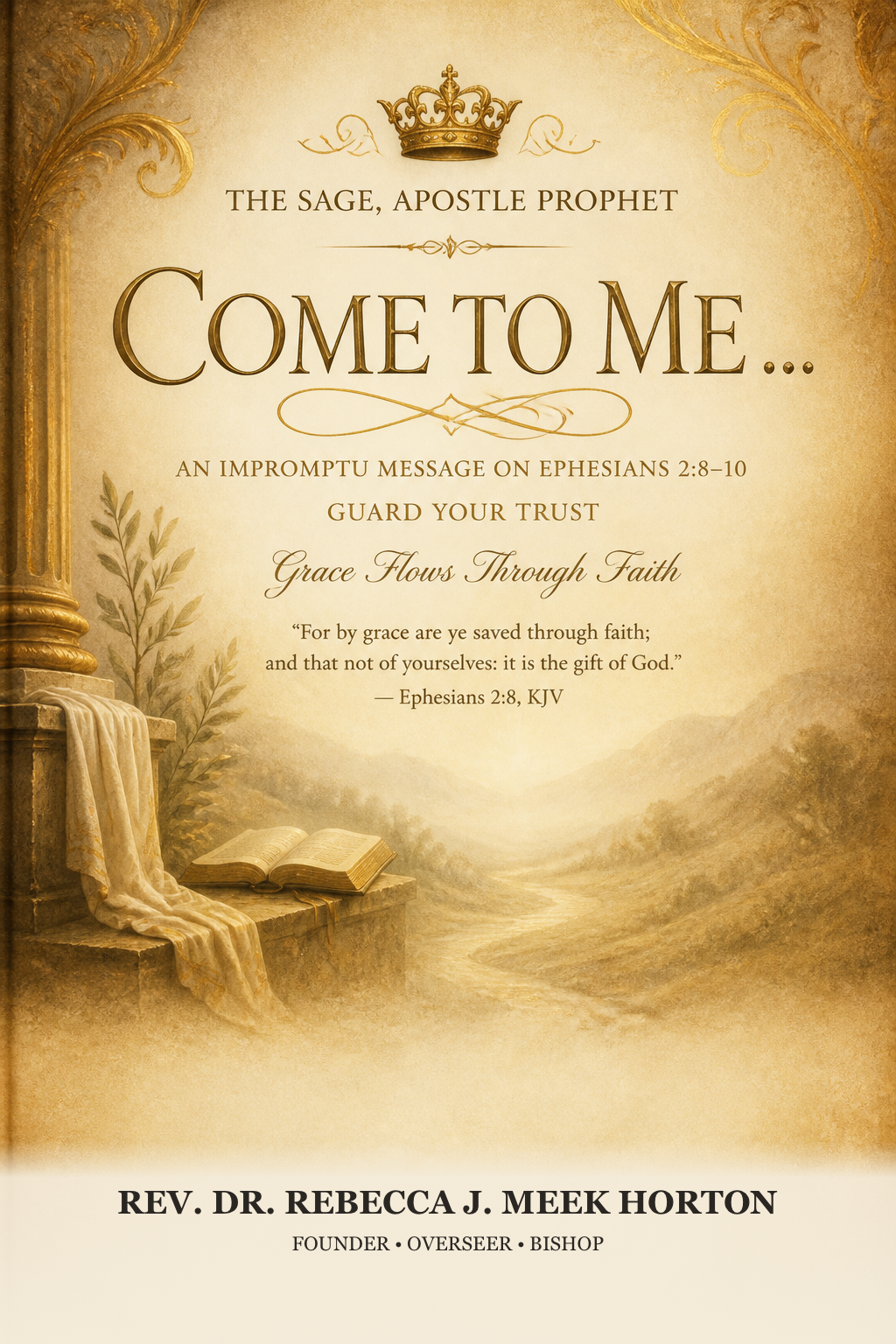
AN IMPROMPTU MESSAGE ON EPHESIANS 2:8–10 GUARD YOUR TRUST Grace Flows Through Faith “For by grace are ye saved through faith; and that not of yourselves: it is the gift of God.” — Ephesians 2:8, KJV The Sage, Apostle Prophet REV. DR. REBECCA J. MEEK HORTON Founder • Overseer • Bishop NewBeing Creation Network Global Ministries, Inc. (NBCNGMI™) Apostolic Prophetic Architect, NBCNGMI Integrated Fram
Chapter 1 preview
NBCNGMI MASTER KNOWLEDGE LIBRARY Featuring the works of The Sage, Apostle Prophet. Rev. Dr. Rebecca J. Meek Horton, Apostolic Prophetic Architect, NewBeing Creation Network Global Ministries, Inc. Integrated Framework Modalities™
Dedication
I dedicate this book to every weary soul still trying to stand while carrying what no one sees. May you hear the voice of Jesus saying, “Come unto me, all ye that labour and are heavy laden, and I will give you rest” (Matthew 11:28, KJV). Guard your trust; grace has not run out.
Purpose
I offer this book for every tired and weary soul who needs to remember that God is trustworthy, grace is still sufficient, and faith can keep standing when the road is hard. Jesus said, “Come unto me, all ye that labour and are heavy laden, and I will give you rest” Matthew 11:28 (KJV), and my prayer is that these pages help you come to Him again with honest need and guarded trust. I hope this message strengthens your faith, quiets the lies, and gives you a simple next step: receive the grace of God through faith, and keep walking in His truth.
Preface
This book began in the quiet hours of the morning.
On August 25, 2026, at 1:35 a.m., I recorded an impromptu message from Ephesians 2:8–10. I did not sit down to build a book. I was following the weight of a Word that had pressed upon my spirit: guard your trust.
The Scripture before me was simple and holy:
“For by grace are ye saved through faith; and that not of yourselves: it is the gift of God.” Ephesians 2:8, KJV
That verse brought me again to a truth I have carried, taught, and lived through many seasons: grace flows through faith. Faith is not the source of grace. God is the Source. Grace is His gift. Faith receives what God freely gives.
But faith must be guarded.
This book is for the tired one. The weary one. The one who still believes, but feels worn down by delay, grief, disappointment, unanswered questions, or battles in the mind. It is for the person who has wondered whether hardship means God has stepped away. It is for the believer who needs to remember that difficulty is not always evidence of abandonment.
Jesus said:
“Come unto me, all ye that labour and are heavy laden, and I will give you rest.” Matthew 11:28, KJV
That invitation is the heart of these pages.
This is not a polished argument written from a distance. It is a message born from Scripture, prayer, testimony, and the mercy of God. Some of what you will read came through my own lived trust: through injury, uncertainty, weakness, and the long work of learning that God’s character does not change when my circumstances do.
You will hear much about grace, faith, trust, the mind, Joseph’s process, lies that must be answered with truth, and the equal ground we all stand on at the Cross. No one is saved by boasting. No one is sustained by performance. We are held by grace.
My prayer is that this book will not merely comfort you for a moment, but strengthen you for the next faithful step.
Come to Him.
Bring the weariness.
Bring the questions.
Bring the places where trust has been bruised.
And by His grace, guard your trust.
Introduction
“Come unto me, all ye that labour and are heavy laden, and I will give you rest.” Matthew 11:28 (KJV)
This book is for the tired place in you.
Not only the tired body, but the tired trust. The part of you that has prayed, waited, tried again, forgiven again, stood again, and still wondered whether God is near. The part that has heard too many voices, carried too many conclusions, and fought too many thoughts in the dark.
The message at the center of this book is simple: God’s grace is received through faith, and mature faith must guard its trust in the trustworthiness of God.
Ephesians 2:8 says, “For by grace are ye saved through faith; and that not of yourselves: it is the gift of God” (KJV). Grace is the gift. Faith receives. Trust leans. Obedience walks.
This book began as an impromptu early-morning message on Ephesians 2:8–10. It has been edited and expanded, but its burden remains pastoral: to help weary people return to the truth of God’s character when circumstances, accusations, grief, delay, or fear try to speak louder than Scripture.
You will not be asked to pretend that pain is easy. You will not be told that difficulty means you failed. You will not be pushed into shallow answers for deep wounds. Joseph’s prison was real. Job’s grief was real. The Cross was real. Faith does not deny the wound; faith refuses to let the wound become the final authority over God’s goodness.
This book will ask something of you. It will ask you to examine what you have been believing about God, yourself, suffering, grace, and trust. It will ask you to stop giving every thought unrestricted access to your mind. It will ask you to answer lies with truth. It will ask you to receive grace without boasting and to walk in good works without performing for worth.
Read it slowly.
Do not read only to finish. Read to return. Return to Scripture. Return to prayer. Return to the God whose character does not change when your situation does. If a sentence arrests you, pause there. If a Scripture confronts a fear, write it down. If a lie is exposed, do not be ashamed. Exposure is not condemnation; it is mercy making room for freedom.
This book also invites practice. You will be encouraged to build a Scripture Tactical Attack Kit, not to attack people, but to confront lies with the Word of God. You will learn to name recurring thoughts, test them by Scripture, and take the next faithful step. This is not magic. This is stewardship of the mind before God.
If your weariness includes trauma, mental illness, medical concerns, or deep emotional distress, receive help without shame. Prayer, Scripture, pastoral care, wise counsel, and appropriate professional support do not have to compete with one another. Hurting does not make you less loved. Needing help does not make you less spiritual.
As you read, hold a simple rhythm: wait, ask, listen, keep.
Wait before God without rushing to explain everything.
Ask honestly, without hiding the real question.
Listen through Scripture, prayer, and wise counsel.
Keep the next faithful step, even if it is small.
The promise of this book is not that every circumstance will become easy. The promise is steadier than that: God is trustworthy, grace is sufficient, and truth can govern the tired places again.
Begin here.
Before you turn the page, pray this simple prayer: Lord Jesus, I come to You weary. Teach me to receive Your grace, guard my trust, and walk in Your truth. Amen.
Chapter 1 — Come to Me When Trust Is Tired
At the end of a long day, a person can still believe in God and feel too tired to lean on Him.
The room may be quiet, but the mind is not. Bills are stacked on the table. A diagnosis is still unanswered. A child is still wandering. A grief still rises at inconvenient times. The phone is face down because one more message may be too much.
And somewhere inside, faith is still there.
Not loud. Not bright. Not polished.
But there.
The weary soul is not always asking, “Does God exist?” Sometimes the deeper question is, “Can I trust Him here?”
This is the beginning place of this book: circumstances often try to reinterpret God’s character, but Jesus still invites the burdened to come to Him. The pressure may be real, the pain may be deep, and the questions may not be quickly resolved. Yet God’s trustworthiness is not rewritten by the weight we are carrying.
Jesus says:
Matthew 11:28–30 (KJV)
Come unto me, all ye that labour and are heavy laden, and I will give you rest. Take my yoke upon you, and learn of me; for I am meek and lowly in heart: and ye shall find rest unto your souls. For my yoke is easy, and my burden is light.
That invitation is not for people who have already figured everything out. It is for those who labour. It is for the heavy laden. It is for those who are carrying more than they know how to name.
When Belief Is Still There
There is a kind of weariness that does not look like rebellion.
It looks like continuing to pray, but with fewer words. It looks like opening the Bible and reading the same sentence three times because the heart is distracted. It looks like showing up for worship while secretly wondering why God feels far away. It looks like saying, “Lord, I believe,” while also needing help in the place where trust feels strained.
That is not a strange place to be. It is a human place.
Many believers have been taught to feel ashamed of struggle. They think that if their trust is tired, their faith must be false. But Scripture is honest about human weakness. God does not invite weary people by pretending they are not weary. He names the burden and calls them near.
Psalm 62:8 (KJV)
Trust in him at all times; ye people, pour out your heart before him: God is a refuge for us. Selah.
Notice the tenderness of that verse. It does not say, “Trust in him at all times, and hide your heart.” It says, “pour out your heart before him.” Trust is not proven by silence. Trust can bring the ache into the presence of God.
A child who runs to a parent crying is not demonstrating distance. The child is demonstrating where safety is expected. In the same way, coming to God with a tired heart is not failure. It may be the next faithful act of trust.
This is where we begin to RE-Language™ the inner accusation.
Not, “I am a bad believer because I am tired.”
But, “I am a weary believer being invited to bring my burden to Christ.”
That shift does not excuse unbelief. It removes shame so responsibility can be received. Shame drives people into hiding. Grace calls people into honest return.
Circumstances Are Not Good Interpreters
Pain has a loud voice.
Delay has a loud voice.
Disappointment has a loud voice.
When life hurts, circumstances often try to preach. They say, “God has forgotten you.” They say, “If He loved you, this would not be happening.” They say, “You must not matter.” They say, “You are on your own.”
But circumstances are not always truthful interpreters.
They can report what is happening, but they cannot define who God is.
A storm can tell you the wind is strong. It cannot tell you God is absent. A closed door can tell you one path is not opening. It cannot tell you God has no path. A painful season can tell you the burden is heavy. It cannot tell you grace is gone.
This matters because many people do not lose trust all at once. They lose it by repeatedly allowing pain to explain God to them.
One disappointment becomes a definition.
One unanswered prayer becomes a theology.
One betrayal becomes a lens.
One season of silence becomes a verdict.
Before long, the soul is not only carrying the trouble. It is carrying an interpretation of the trouble that may not be true.
This is why the Word of God must have governing authority over our conclusions. Not because our feelings are meaningless, but because our feelings are not sovereign. They are real, but they are not always reliable judges.
Ephesians 2 gives us a foundation that does not change with the weather of life.
Ephesians 2:8–10 (KJV)
For by grace are ye saved through faith; and that not of yourselves: it is the gift of God: Not of works, lest any man should boast. For we are his workmanship, created in Christ Jesus unto good works, which God hath before ordained that we should walk in them.
Before this passage tells us what we do, it tells us what God gives.
Grace is gift.
Salvation is gift.
Life in Christ begins by gift, not performance.
This means the weary believer does not have to earn the right to come near. Christ has already opened the way. The burdened do not come because they have carried well enough. They come because He invited them.
That does not make obedience unimportant. It puts obedience in the right order. We do not obey in order to purchase grace. We obey because grace has reached us and begins to form us.
The Invitation Is to a Person
Jesus did not say, “Come to an explanation.”
He said, “Come unto me.”
There is a difference.
Explanations matter. Understanding can bring relief. Wisdom gives structure to pain. But there are moments when the soul needs more than an answer. It needs a Person.
A grieving person may receive correct doctrine and still need comfort. A frightened person may know the right verse and still need to be held steady. A weary person may understand the principle and still need the presence of Christ.
Jesus invites the burdened to Himself before He teaches them the yoke. He gives rest, then He teaches. He receives, then He forms.
That order is mercy.
Think of someone carrying grocery bags in both arms, keys between fingers, phone slipping, shoulders tight, trying to open the door without dropping everything. Help does not begin with a lecture on better carrying techniques. Help begins when someone says, “Give me some of that.”
Many souls are standing at the door like that.
Still trying to hold everything.
Still trying to keep it from falling.
Still trying to look composed.
Still trying to prove they are strong enough.
Christ’s invitation cuts through the performance: bring the burden here.
Not every burden disappears immediately when we pray. Some burdens must be walked through with God, with Scripture, with wise counsel, with pastoral care, with appropriate professional help, and with faithful community. Mental illness, trauma, grief, and medical conditions are not proof of weak faith. Receiving help is not betrayal of trust. Sometimes stewardship means letting God use many forms of care while He continues to sustain the soul.
The invitation of Christ is not an invitation to pretend. It is an invitation to come truthfully.
Heavy laden means heavy laden.
Labour means labour.
Rest means rest.
The Cost of Coming Honestly
There is a cost to receiving this invitation.
Not the cost of earning grace. Grace cannot be purchased.
The cost is surrendering the false control we have been using to survive.
Sometimes we would rather keep carrying a burden we understand than release it into hands we cannot control. We say we want rest, but we also want to manage every outcome, predict every turn, and approve every method God uses. We want trust, but we want trust without vulnerability.
Coming to Christ requires honesty.
We may have to admit, “Lord, I believe You are real, but I have been interpreting You through my disappointment.”
We may have to admit, “I have called my fear wisdom.”
We may have to admit, “I have been trying to obey You while secretly accusing You.”
We may have to admit, “I am tired, and I need grace.”
That kind of honesty can feel costly because it removes the mask. But the mask was never giving rest. It was only making exhaustion look acceptable.
Hebrews 4:16 (KJV)
Let us therefore come boldly unto the throne of grace, that we may obtain mercy, and find grace to help in time of need.
The throne is a throne of grace. The help is for the time of need. The invitation is not delayed until we are impressive. Mercy meets us where need is telling the truth.
This is not passive living. Coming to Christ does not mean refusing responsibility. It means responsibility is carried in fellowship with Him, not in isolation from Him.
There may still be apologies to make.
There may still be decisions to face.
There may still be counseling to seek.
There may still be habits to change.
There may still be hard conversations ahead.
But we do not begin with panic. We begin with coming. We begin with the truthful movement of the soul toward Christ.
The First Order of the Weary Soul
When trust is tired, the first order is not to solve the whole life.
The first order is to return the burden to the right place.
This is where WOW™ reminds us that nothing is random, nothing is wasted. A weary moment is not meaningless. It can reveal what we have been carrying, what we have been believing, and where trust needs to be guarded.
Word: What is the true message God is giving us here?
Christ is still inviting the weary to come.
Order: What must be put in its proper place?
Circumstances must not sit above the character of God.
Wisdom: What is the next faithful response?
Bring the burden honestly to Christ, and refuse to let pain become the final interpreter.
This is simple, but it is not shallow.
A weary believer may want a complete map. God may give a lamp for the next step. A tired heart may want every answer tonight. Christ may give enough grace to come near, breathe, pray, and stay.
That is not small.
For some, the next faithful step is not dramatic. It is turning off the noise and praying one honest sentence. It is opening Scripture before opening another argument in the mind. It is calling someone trustworthy and saying, “I need prayer.” It is making an appointment for help. It is going to sleep instead of rehearsing fear until morning.
Grace does not always arrive as a feeling. Sometimes it arrives as strength to do the next obedient thing.
The promise of Ephesians 2:8–10 is not only that we are saved by grace through faith. It is also that we are His workmanship. God does not discard weary workmanship. He continues to work with what belongs to Him.
So if your trust is tired, do not confuse tired with dead.
Bring it to Christ.
Bring the questions.
Bring the disappointment.
Bring the fear.
Bring the part of you that still believes but does not know how to stand under the weight.
The invitation still stands.
Key Takeaways
• Circumstances can describe your pressure, but they must not define God’s character.
• Weariness is not proof that faith is false; it is a place where Christ invites honesty.
• Grace begins with gift, not performance, and it calls the burdened soul near.
Practice
Take ten quiet minutes today.
Sit without rushing. Place one hand open on your lap as a simple sign of release. Read Matthew 11:28–30 aloud from the KJV.
Then write one sentence in each line:
• The burden I am carrying is:
• The interpretation I need to surrender is:
• The truth Jesus is inviting me to receive is:
Close with this prayer:
Lord Jesus, I come to You with the burden I have been carrying. I do not want my circumstances to define Your character. Help me receive Your grace, trust Your heart, and take the next faithful step. Amen.
This is the opening chapter. The complete publication is available in the full edition.
Back to the library