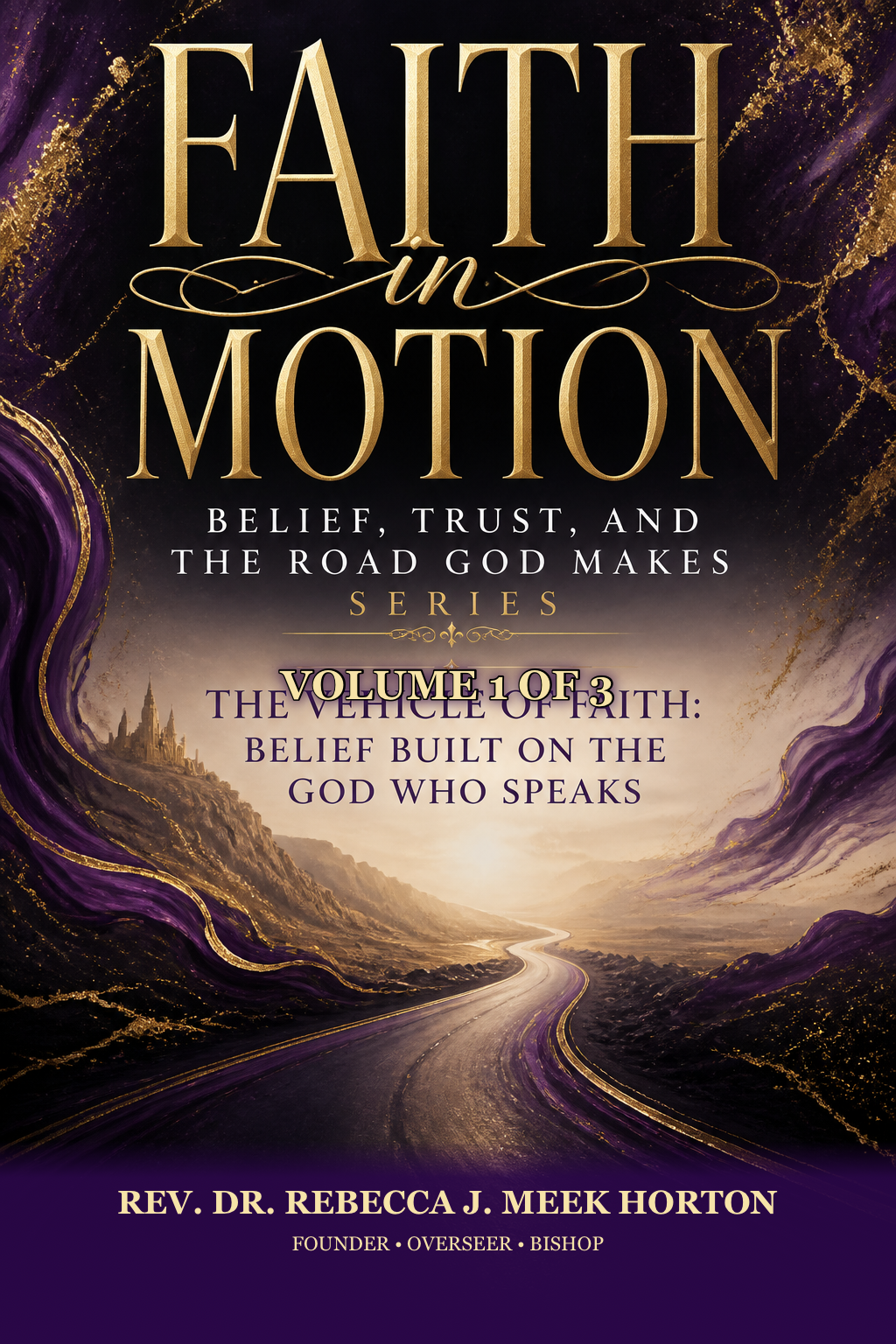
Faith in Motion: Belief, Trust, and the Road God Makes · Volume 1
The Vehicle of Faith: Belief Built on the God Who Speaks
Part 1 of 3 in the series "Faith in Motion: Belief, Trust, and the Road God Makes". Series theme: Series arc: True faith is a response to the God who speaks: belief gives faith its vehicle, trust gives faith its fuel, and obedience carries faith into faithful witness. The series begins with the foundation—faith begins with God, not human optimism or religious effort. It then moves into the cost a
Chapter 1 preview
NBCNGMI MASTER KNOWLEDGE LIBRARY Featuring the works of The Sage, Apostle Prophet. Rev. Dr. Rebecca J. Meek Horton, Apostolic Prophetic Architect, NewBeing Creation Network Global Ministries, Inc. Integrated Framework Modalities™
Purpose
I wrote this book to bring faith back to its beginning: the God who speaks. Faith is not human optimism, religious effort, or reaching into the dark; “faith comes from hearing, and hearing through the word of Christ” (Romans 10:17). My prayer is that this book helps you believe God with a steadier heart, receive His Word with humility, and walk forward with faith built on who He is.
Preface
I did not write this book to make faith sound complicated.
I wrote it because many of us have used the word *faith* for years while quietly carrying confusion about what faith actually is. We have called it confidence. We have called it hope. Sometimes we have called it effort, language, church culture, or the ability to keep moving when we are tired.
But biblical faith begins somewhere deeper.
Faith begins because God speaks.
“So faith comes from hearing, and hearing through the word of Christ” (Romans 10:17). That verse has searched me. It has steadied me. It has reminded me that faith is not human optimism dressed in spiritual language. Faith is our response to the God who reveals Himself, tells the truth, keeps covenant, and calls His people to believe Him.
This book was born from a simple conviction: belief is the vehicle of faith. Before faith can move rightly, it must be carried by a settled conviction that God is who He says He is and that His Word is true. Without that foundation, we may move, but we will not be stable. We may speak, but we will not be rooted. We may try hard, but effort cannot replace revelation.
This is the first book in the *Faith in Motion* series. It begins where faith must begin—not with our strength, but with God’s voice. Not with our performance, but with His mercy. Not with vague spirituality, but with the living God who has spoken fully in His Son (Hebrews 1:1–2).
I am writing to leaders, believers, and anyone who knows there is more to faith than repeating phrases. I am writing to those who want their belief examined, strengthened, and brought back under the authority of Scripture. That kind of work is not always comfortable. It may require us to lay down inherited assumptions, religious striving, and the pressure to sound strong when our foundations need repair.
But the mercy of God is that He does not leave us guessing in the dark.
He speaks.
And when God speaks, faith has ground to stand on.
As you read, move slowly. Bring your questions. Open the Scriptures. Let the Lord strengthen what is true and correct what is unstable.
The next faithful step is simple: listen for the Word of the God who speaks—and believe Him.
Introduction
Faith is often spoken of as if it begins with human effort.
We say, “I just need more faith,” as though faith were something we manufacture by pressure, emotion, or positive thinking. We try to believe harder. We repeat spiritual language. We borrow the confidence of others. Sometimes we mistake movement for maturity and religious activity for rooted conviction.
But biblical faith does not begin with us reaching into the dark.
Faith begins because God has spoken.
“Faith comes from hearing, and hearing through the word of Christ” (Romans 10:17). That means faith is not wishful thinking. It is not denial. It is not personality strength. Faith is a response to the God who reveals Himself, names what is true, makes covenant, keeps promise, and calls His people forward by His Word.
This book is built on a simple conviction: **belief is the vehicle of faith**.
Belief gives faith its structure. It carries faith in a certain direction. If belief is unclear, faith becomes unstable. If belief is built on fear, pride, tradition, pressure, or emotion, faith may still move—but it will not move with holy stability. Nothing is random. Nothing is wasted. What we believe about God, Scripture, Christ, ourselves, suffering, timing, obedience, and promise will shape how we walk.
Hebrews tells us, “Without faith it is impossible to please him, for whoever would draw near to God must believe that he exists and that he rewards those who seek him” (Hebrews 11:6). Notice the order. Before faith walks, belief receives. Before faith endures, belief settles. Before faith obeys, belief knows something true about God.
This is the first book in the series *Faith in Motion: Belief, Trust, and the Road God Makes*. The whole series follows a simple movement: belief gives faith its vehicle, trust gives faith its fuel, and obedience carries faith into faithful witness. This first book stays with the foundation. We are not yet rushing to the road. We are asking whether the vehicle is sound.
That question matters for leaders.
It matters for believers who have inherited phrases but need rooted understanding.
It matters for anyone who has confused faith with optimism, performance, spiritual pressure, or public confidence.
There is a mercy in returning to the beginning. God does not ask us to build faith on our own emotional strength. He gives us His Word. He gives us Christ. He gives us testimony, covenant, command, warning, promise, and presence. “Long ago, at many times and in many ways, God spoke to our fathers by the prophets, but in these last days he has spoken to us by his Son” (Hebrews 1:1–2).
So this book will ask careful questions.
What is biblical belief?
What does it mean to believe God, not merely believe in religious ideas?
How does Scripture correct unstable faith?
How does Christ become the center of faith rather than an accessory to our plans?
Where have we called something faith that may actually be anxiety, ambition, pressure, or presumption?
These questions are not meant to condemn. They are meant to bring clarity. Truth heals what confusion keeps repeating. The Lord is patient with trembling faith, but He is also faithful to correct false foundations. Jesus did not shame the father who cried, “I believe; help my unbelief!” (Mark 9:24). He met him there.
Read this book slowly.
Do not read it only for sentences to underline. Read it for places where the Word searches you. Let Scripture have the first voice. Let the chapters name what may need RE-Calibration™. If you are a leader, resist the urge to prepare this only for someone else. Let it work in you before you teach it. If you are weary, do not rush past the comfort that faith begins with God’s initiative, not your striving.
Each chapter will carry one main idea and one practice. The aim is not to make faith complicated. The aim is to make it sound. Faith does not need hype to be holy. It needs truth, order, and obedience.
Before you begin, take one quiet step.
Open your Bible to Romans 10:17 and Hebrews 11:6. Read them aloud. Then pray simply:
“Lord, help me believe You as You have spoken. Search what I have called faith. Strengthen what is true. Correct what is unstable. Build in me belief that can carry obedience.”
This is where the journey begins.
Not with noise.
Not with pressure.
With the God who speaks.
Chapter 1 — When Faith Starts in the Wrong Place
The leader sat across the table with tired eyes and a full calendar.
“I know I’m supposed to have faith,” he said. “So I keep telling the team we are believing for breakthrough. I keep preaching hope. I keep pushing. But if I’m honest, I don’t know if I’m living by faith or just trying to stay positive in public.”
That question is not weakness. It is mercy.
Many leaders inherit a version of faith that starts in the wrong place. It begins with our energy, our language, our emotion, our effort, or our ability to keep going. But biblical faith does not begin with us. Faith begins with God.
The controlling idea of this chapter is simple: faith is not self-generated confidence; it is a response to the God who is, the God who speaks, and the God who rewards those who seek Him.
Hebrews 11:1 says, “Now faith is the assurance of things hoped for, the conviction of things not seen.” But Hebrews does not leave faith floating in the air. Verse 6 brings it to the ground: “Without faith it is impossible to please him, for whoever would draw near to God must believe that he exists and that he rewards those who seek him.”
Faith has an object. Faith has a direction. Faith begins with God.
## Faith Is Not Optimism with Religious Words
Optimism can be a gift. It can help a team breathe. It can keep a room from surrendering too soon. Leaders often need courage in their tone and steadiness in their faces.
But optimism is not faith.
Optimism says, “This will probably work out.” Faith says, “God is worthy of trust whether I can see the outcome or not.”
Optimism often depends on favorable conditions. Faith depends on the character of God. Optimism can rise when the numbers improve and fall when the report turns hard. Faith may tremble, but it has somewhere to stand.
Hebrews 11 does not celebrate people who had easy circumstances. Abel was killed. Noah built before he saw rain. Abraham left without knowing where he was going. Sarah received strength beyond natural possibility. These were not people who mastered positive thinking. They responded to God.
A leader can fill a room with hopeful language and still avoid faith. We can say, “God’s got this,” because silence feels too exposed. We can call people to believe, while inside we are mainly afraid of discouraging them.
There is a difference between speaking courage and manufacturing certainty.
Consider a ministry facing financial pressure. Optimism says, “Don’t worry. The money will come.” Faith says, “God is our provider. We will pray, tell the truth, make wise decisions, and obey Him with what we have.” The first may sound stronger. The second is stronger.
Faith does not need to pretend the numbers are different. Faith brings the real numbers before the real God.
## Faith Is Not Effort Dressed as Devotion
Leaders are often trained to keep moving.
There is always another call to make, another person to encourage, another sermon to prepare, another problem to solve. In that environment, effort can begin to feel like faithfulness. We may assume that if we are exhausted enough, we must be trusting God.
But activity is not the same as faith.
Hebrews 11:6 says, “Whoever would draw near to God must believe that he exists.” That is not a call to frantic motion. It is a call to Godward dependence. Before faith works, faith draws near. Before faith builds, speaks, sacrifices, or leads, faith acknowledges God.
This matters because leaders can use work to avoid trust.
We can plan because planning is wise. But we can also plan because stillness feels unbearable. We can serve because love compels us. But we can also serve because being needed quiets our insecurity. We can build because God has assigned us to build. But we can also build because stopping would force us to face the question: Do I believe God is God without my constant control?
Effort becomes dangerous when it becomes our source of confidence.
Noah built the ark by faith, but the ark was not the source of his faith. God’s warning and instruction came first. Abraham obeyed and went, but movement was not the source of his faith. God’s call came first.
Faith works because God has spoken. Effort becomes faithfulness only when it answers Him.
A pastor may prepare carefully for Sunday. That preparation matters. It honors God and serves people. But the leader’s confidence cannot finally rest in the strength of the outline, the polish of the delivery, or the emotional response in the room. The leader prepares as an act of stewardship, then entrusts the Word and the people to God.
That is faith.
Not laziness. Not passivity. Not carelessness.
Faith is not doing less. It is depending rightly.
## Faith Is Not Emotion, Even When Emotion Is Present
Faith often has feeling in it. There may be joy, peace, grief, courage, longing, or holy fear. Scripture does not ask leaders to become stone-hearted. The life of faith is deeply human.
But faith is not the same as feeling.
This is important because leaders can begin to measure faith by emotional intensity. If the room is moved, we say faith was present. If we feel bold, we assume we are believing. If tears come easily, we think God must be near. If we feel dry, we fear faith has failed.
Hebrews gives us a better measure.
Faith is “assurance” and “conviction” concerning what is not seen (Hebrews 11:1). That does not mean faith always feels strong. It means faith is anchored beyond what is visible and beyond what is felt. The ground of faith is not the emotional weather of the leader. The ground of faith is God Himself.
Some days a leader will pray with warmth and clarity. Other days prayer will feel like speaking into fog. Some days worship will rise naturally. Other days the song will feel costly. Some days Scripture will burn in the heart. Other days it will read slowly, like bread eaten in weakness.
The question is not, “Did I feel enough?”
The question is, “Am I drawing near to God as He has revealed Himself?”
A mother in the church dies after many prayers for healing. The leader stands before the congregation with grief in his own body. Shallow faith may require him to sound untouched. Biblical faith allows him to weep and still say, “God is faithful.” Not because the loss is small. Not because the questions are gone. But because God is still God.
Faith does not deny sorrow. Faith brings sorrow to the One who is.
## Faith Is Not Religious Language Without Living Belief
Leaders learn words.
We learn how to pray in public. We learn how to encourage people at hospital bedsides. We learn how to speak about vision, calling, surrender, and breakthrough. These words can be true and useful. But over time, ministry language can outrun personal conviction.
That is a quiet danger.
We may repeat phrases we have not recently carried before God. We may speak truth faster than we have pondered it. We may tell others to trust while our own souls are living on borrowed phrases.
Hebrews 11:6 presses beneath language: “Whoever would draw near to God must believe that he exists and that he rewards those who seek him.”
Not merely say it.
Believe it.
This belief is not vague spirituality. It is not a general sense that things are sacred. It is not admiration for faith as a concept. Hebrews calls us to believe that God is real, present, and worthy of being sought. He is not an idea we manage. He is the living God before whom we stand.
Religious language can hide unbelief because it sounds faithful. But true faith is not proven by familiar phrases. It is revealed in the direction of the life.
When pressure comes, where do we turn first?
When we are afraid, what do we protect?
When obedience is costly, whose approval matters most?
When no one is watching, do we still seek God?
A leader may say, “We trust the Lord,” while manipulating outcomes behind the scenes. Another may say fewer words, pray honestly, tell the truth, and take the next obedient step. The second leader may look less impressive. But faith is not measured by volume. It is measured by response to God.
This is where Hebrews helps us. The chapter does not define faith as spiritual talk. It shows faith as Godward response. Abel offers. Noah builds. Abraham goes. Sarah receives. Each life answers God.
Faith hears and responds.
## The Cost of Starting in the Right Place
Starting faith with God sounds simple. It is not easy.
It asks leaders to lay down the illusion that we can generate faith by force. It asks us to stop confusing public confidence with private communion. It asks us to admit when our language is ahead of our belief. It asks us to let Scripture examine the ways we have used optimism, effort, emotion, or ministry speech to keep ourselves from honest dependence.
That can feel like losing control.
But it is actually a return to mercy.
If faith began with us, then we would always have to produce enough of it. Enough certainty. Enough passion. Enough strength. Enough spiritual language. That is a heavy burden for any leader to carry.
But faith begins with God.
He is. He speaks. He calls. He reveals. He rewards those who seek Him.
This does not make leaders passive. It makes them honest. It frees them from performing faith and invites them into receiving, believing, and responding. The leader does not have to create a road out of darkness. The leader must draw near to the God who is already there.
Hebrews 11:6 does not say God rewards those who impress Him. It says He rewards those who seek Him.
So the first movement of faith is not striving. It is turning.
Not pretending.
Not performing.
Turning.
## Key Takeaways
- Faith begins with God, not with the leader’s confidence. - Optimism, effort, emotion, and religious language cannot replace belief. - Biblical faith draws near to God and responds to what He has revealed.
## Practice
Set aside fifteen quiet minutes today with Hebrews 11:1–6.
Read it slowly. Then write one honest sentence for each question:
1. Where have I been confusing faith with optimism, effort, emotion, or religious language? 2. What does this passage ask me to believe about God? 3. What is one faithful response I need to take today?
Do not rush to fix everything. Begin where faith begins.
Draw near to God.
This is the opening chapter. The complete publication is available in the full edition.
Back to the library