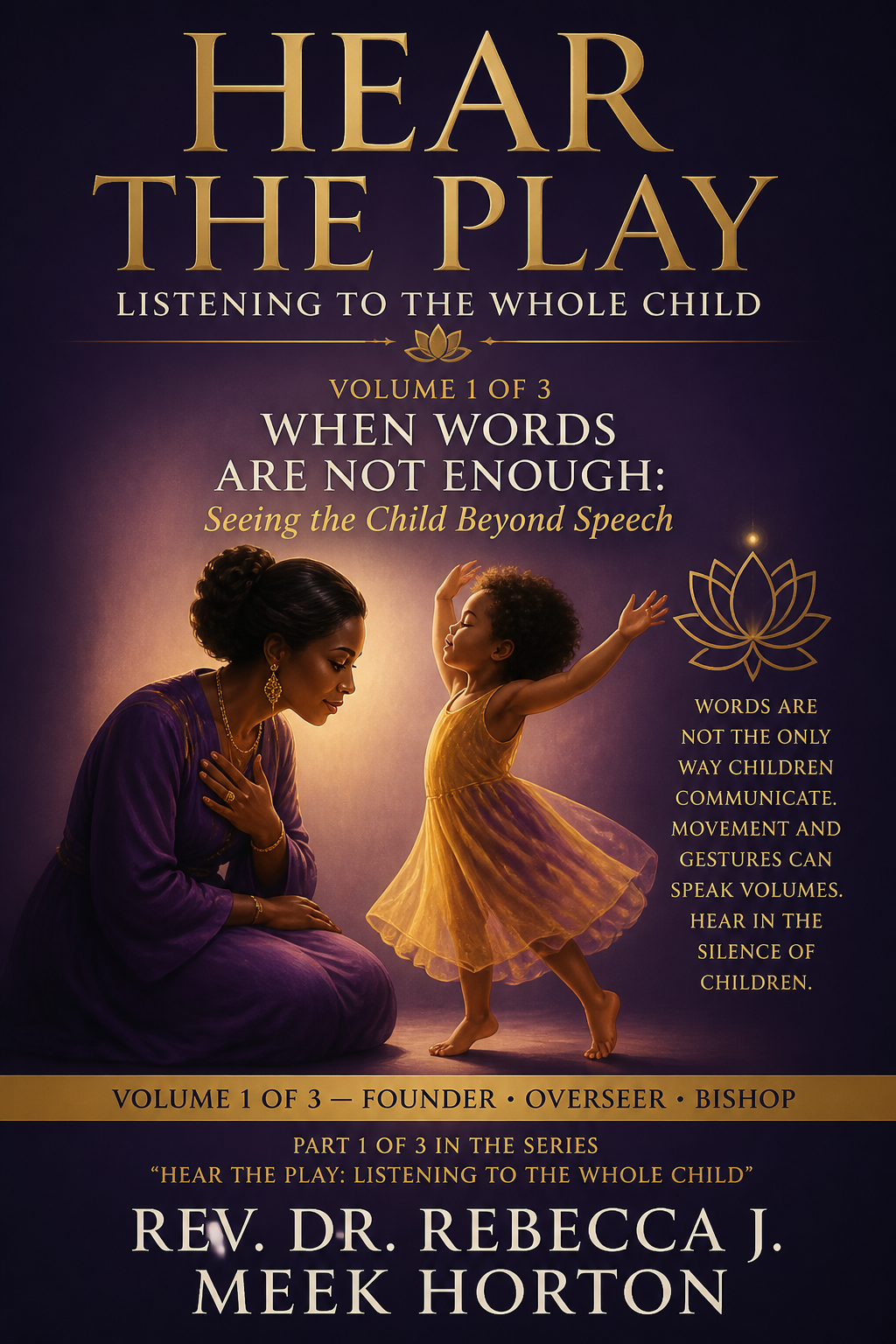
Hear the Play: Listening to the Whole Child · Volume 1
When Words Are Not Enough: Seeing the Child Beyond Speech
Part 1 of 3 in the series "Hear the Play: Listening to the Whole Child". Series theme: Word are not the only way children communicate. Movement and Gestures can speak volumes. Hear in the Silence of Children.. How this book advances the series: This opening book establishes the series theme by shifting the adult’s attention from verbal explanation to whole-child communication. This book introduce
Chapter 1 preview
NBCNGMI MASTER KNOWLEDGE LIBRARY Featuring the works of The Sage, Apostle Prophet. Rev. Dr. Rebecca J. Meek Horton, Apostolic Prophetic Architect, NewBeing Creation Network Global Ministries, Inc. Integrated Framework Modalities™
Chapter 1 — The Child Is Speaking Before the Words Arrive
The little boy stood in the doorway with one shoe on.
His mother had called him three times. The car was running. The backpack was packed. Everyone was late.
“Use your words,” she said, trying to stay calm. “Tell me what is wrong.”
He looked at the floor.
His fingers pulled at the hem of his shirt. His shoulders were tight. The one bare foot curled against the tile. He did not cry. He did not explain. He simply stood there, unmoving.
To an adult in a hurry, it looked like defiance.
But something was being spoken.
The child was speaking before the words arrived.
This is the first shift of the whole book: children do not communicate through words alone. Before a child can explain, defend, describe, or confess, the child may already be telling the truth through posture, play, silence, movement, repetition, refusal, nearness, distance, or need.
Adults often listen hardest for explanations. We want the child to make sense quickly. We ask, “What happened?” “Why did you do that?” “What are you feeling?” “What do you need?”
Those are not wrong questions. But sometimes they arrive too soon.
James gives a wisdom that belongs not only in conflict, but in care: “Let every person be quick to hear, slow to speak, slow to anger” (James 1:19). With children, this means we learn to receive before we rush to respond. We become quick to listen with more than our ears.
## Words Are Not the Whole Conversation
Words matter. Children need language. Adults should help them name feelings, needs, limits, and truth.
But words are not the beginning of communication.
A baby turns toward a familiar voice. A toddler hides behind a parent’s leg. A preschooler throws the same toy every time a new adult enters the room. An older child says, “I don’t care,” while watching carefully to see if anyone stays.
In each case, the adult may be tempted to respond only to the surface.
“Don’t hide.”
“Stop throwing.”
“Don’t be rude.”
“Tell me what you mean.”
There may be a time for correction. Boundaries matter. But if we only correct what we see, we may miss what is being carried underneath.
A child’s body and behavior can become a kind of early vocabulary. Not a perfect vocabulary. Not a code to crack with pride. But a real signal that something inside is trying to come out.
A child who cannot say, “I am overwhelmed,” may cover their ears.
A child who cannot say, “I am unsure if you are safe,” may refuse eye contact.
A child who cannot say, “I need help leaving this moment,” may run, freeze, cling, joke, interrupt, or shut down.
The point is not to excuse every action. The point is to listen more truthfully before we decide what the action means.
In Scripture, God often attends to more than spoken words. When Hannah prayed in deep distress, “only her lips moved, and her voice was not heard” (1 Samuel 1:13). Eli misread her at first. He assumed disorder where there was sorrow. But Hannah was not empty. Her silence had weight.
Children, too, may carry weight before they can speak it plainly.
## The Adult Problem: We Want Explanations Too Soon
Many adults have been trained to value verbal clarity above all else.
We trust the child who can explain. We grow impatient with the child who cannot. We reward the child who says, “I felt angry because…” and we become frustrated with the child who kicks the chair, hides under the table, or refuses to answer.
This creates a hidden pressure: speak clearly, or be misunderstood.
But childhood is not adulthood in smaller clothing. Children are still growing in language, memory, regulation, and self-understanding. Even when they have many words, they may not yet have the right words. Even when they sound mature, they may not be able to explain what their nervous system, conscience, fear, or imagination is trying to process.
Think of a teacher who sees a student put his head down during reading time.
One interpretation is laziness.
Another is embarrassment.
Another is exhaustion.
Another is fear of being called on.
Another is the weight of something that happened before school.
If the teacher moves too quickly from observation to conclusion, the response may be technically efficient and relationally wrong.
“Sit up and participate” may address the posture but miss the child.
A slower response might begin differently: “I notice your head is down. I’m going to give you a moment. Then I’ll check in.”
That kind of response does not abandon structure. It simply refuses to treat the first visible behavior as the whole truth.
This is where humility matters.
Humility says, “I may not yet understand what I am seeing.”
Humility says, “The child’s behavior is real, but my first interpretation may be incomplete.”
Humility says, “Before I label this child, I will listen.”
Proverbs 18:13 warns, “If one gives an answer before he hears, it is his folly and shame.” Adults can answer children before we have heard them. We can discipline before we have discerned. We can explain before we have received. We can fill the room with our words and never notice the child’s message.
## The Quieter Languages of Need
Children often communicate need indirectly.
This does not mean they are manipulative in every moment. It means they are human, immature, learning, and dependent. Their inner life may be larger than their language.
A child may ask for water every night after being put to bed. The adult hears delay. That may be part of it. But the request may also carry a quieter message: “Will you come back?” “Am I safe alone?” “Does connection end when the light goes off?”
A child may interrupt every conversation. The adult hears disrespect. That may need correction. But the interruption may also carry a question: “Do I still matter when your attention is elsewhere?”
A child may refuse help with a task they clearly cannot do alone. The adult hears stubbornness. But underneath may be the ache of growing independence: “Can I be capable and still be loved when I struggle?”
These are not excuses. They are invitations to listen with wisdom.
Listening to the quieter language of need helps adults respond more fully. We may still say, “It is bedtime.” We may still say, “You may not interrupt.” We may still say, “I will not let you throw that.” But we say it with a different spirit when we have considered the child beneath the behavior.
The goal is not to become permissive.
The goal is to become perceptive.
Jesus showed this kind of attentiveness. When children were brought to Him, the disciples saw an interruption. Jesus saw persons worthy of welcome. “Let the little children come to me and do not hinder them” (Mark 10:14). The adults near Jesus misread the moment. They treated children as a distraction from important work. Jesus corrected the adults, not the children.
Sometimes the first repentance belongs to the grown-up who was too busy to see.
## Receiving Before Repairing
Many caring adults rush to repair.
We see tears, and we want to stop them.
We see anger, and we want to correct it.
We see silence, and we want to fill it.
We see confusion, and we want to explain it away.
The impulse may come from love. But love must learn patience. First Corinthians 13:4 says, “Love is patient and kind.” Patience is not passive. It is strong enough to remain present without forcing a quick resolution.
To receive a child before repairing them means we make space for what is being communicated.
This may sound like:
“I see you are having a hard time coming in.”
“I notice your hands are tight.”
“You do not have to explain everything right now.”
“I am here. We will take one step at a time.”
“I will help you, and I will not let you hurt yourself or others.”
Receiving does not mean the child gets to lead the whole room. Adults are still responsible to guide, protect, and set limits. But the order matters.
Receive first.
Then respond.
A parent at the doorway may still need to leave for school. The morning cannot become endless. But the parent can kneel, look at the child’s one shoe, and say, “Something about leaving feels hard right now. I am going to help you with your shoe, and we will go together.”
That sentence may not solve everything. It does something better. It tells the child, “You are not invisible inside your struggle.”
This is the promise of the book: adults can learn to hear the whole child. Not perfectly. Not instantly. But more faithfully.
We can become slower to label and quicker to listen.
We can notice without panic.
We can guide without crushing.
We can correct without contempt.
We can help children find words by first honoring the ways they are already speaking.
## The Cost of Listening This Way
This kind of listening asks something of us.
It asks us to slow down when we feel rushed.
It asks us to stay regulated when the child is not.
It asks us to give up the pride of instant certainty.
It asks us to admit that behavior may be simple to see but not always simple to understand.
It also asks us to face our own discomfort. A child’s silence may make us anxious. A child’s tears may make us feel like failures. A child’s resistance may trigger our need for control. A child’s need may expose how tired we are.
Honest listening is costly because it requires presence.
And presence cannot be faked for long.
This does not mean every moment must become a deep emotional conversation. Families still need schedules. Classrooms still need order. Leaders still need decisions. Caregivers still need rest.
But even in ordinary life, we can practice a different first move.
Instead of beginning with, “What is wrong with this child?”
We begin with, “What might this child be communicating?”
That one shift changes the room.
It does not remove boundaries. It purifies them.
It does not remove correction. It humanizes it.
It does not make adults weak. It makes adults wise.
James 1:19 is simple, but not easy: quick to hear, slow to speak, slow to anger. For the adult who cares for children, this becomes a daily discipline. Listen first. Speak with care. Let anger wait outside until wisdom has had time to work.
The child may not have the words yet.
But the child may already be speaking.
## Key Takeaways
- Children communicate before they can fully explain.
- Adult interpretation should be humble, patient, and slow.
- Listening first helps correction become wiser and kinder.
## Practice
Today, choose one moment with a child and pause before interpreting.
Notice three things without labeling them: body, movement, and need.
Then ask yourself quietly: “What might this child be communicating before the words arrive?”
This is the opening chapter. The complete publication is available in the full edition.
Back to the library