 NBCNGMI™
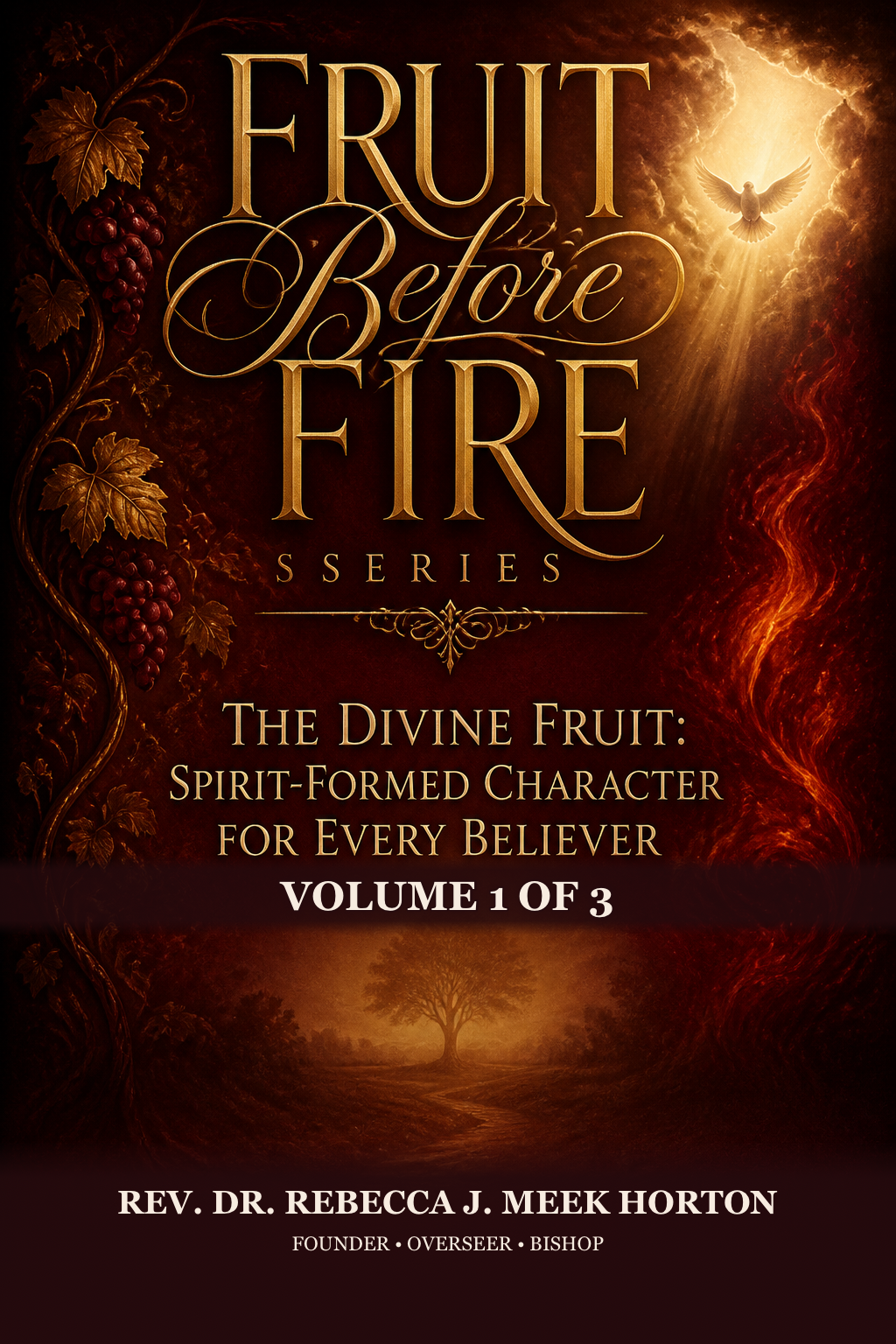
Fruit Before Fire · Volume 1
The Divine Fruit: Spirit-Formed Character for Every Believer
Part 1 of 3 in the series "Fruit Before Fire". Series theme: These are divine attributes not human chat Necessary for ministry Necessary to balance the gifts Necessary to engender works of faith Necessary to live by faith not by sigy Series arc: This three-book series moves from formation to ministry to Spirit-empowered service. Book 1 establishes the Fruit of the Holy Spirit as divine character formed in believers, not natural personality or religious language. Book 2 shows why that fruit is necessary for faithful ministry, daily obedience, and works of faith. Book 3 brings the Fruit and Gifts of the Holy Spirit together so fire remains holy, love governs power, and the Church is built up. How this book advances the series: This opening book grounds the whole series in spiritual formation before moving into ministry practice. This book teaches the Fruit of the Holy Spirit from Galatians 5:22-23 as one unified fruit with multiple holy attributes: love, joy, peace, longsuffering, gentleness, goodness, faith, meekness, and temperance. It makes clear that these are divine attributes produced by the Holy Spirit, not human charm, personality, or spiritual talk. The source material provides the 12-week course foundation; this book must expand it into a deeper teaching on abiding in Christ from John 15:1-8, walking in the Spirit, and living by faith rather than by sight according to 2 Corinthians 5:7.
Chapter 1 preview
NBCNGMI MASTER KNOWLEDGE LIBRARY Featuring the works of The Sage, Apostle Prophet. Rev. Dr. Rebecca J. Meek Horton, Apostolic Prophetic Architect, NewBeing Creation Network Global Ministries, Inc. Integrated Framework Modalities™
Dedication
I dedicate this book to every believer who longs to bear what only the Holy Spirit can produce. May your life be rooted in Christ, formed in His character, and strengthened to walk by faith when sight cannot lead you.
Purpose
I wrote this book to help every believer understand that the Fruit of the Holy Spirit is divine character formed by the Spirit, not human charm, personality, or religious talk. My prayer is that Galatians 5:22-23, John 15:1-8, and 2 Corinthians 5:7 will call you deeper into abiding in Christ, walking in the Spirit, and living by faith rather than by sight. Before there is fire for ministry, there must be fruit in the life.
Preface
I wrote this book with a burden for formation.
Before fire is displayed, fruit must be formed. Before gifts are exercised, character must be surrendered. Before ministry becomes visible, the inner life must be yielded to the Holy Spirit.
The Divine Fruit was born from years of teaching, watching, praying, correcting, and being corrected by the Word of God. I have seen how easily we can mistake personality for fruit, charisma for maturity, and religious language for spiritual formation. But the Fruit of the Holy Spirit is not human charm. It is not temperament. It is not performance. It is divine character produced in a yielded believer.
Galatians 5:22-23 (KJV) But the fruit of the Spirit is love, joy, peace, longsuffering, gentleness, goodness, faith, Meekness, temperance: against such there is no law.
Notice that Scripture says “fruit,” not “fruits.” The Holy Spirit forms one unified fruit with holy attributes. Love is not separated from temperance. Joy is not separated from longsuffering. Faith is not separated from meekness. The Spirit does not develop us in fragments. He forms Christlike character in us as we abide in Christ.
This book is the first movement in the Fruit Before Fire series. It does not begin with ministry platforms, spiritual gifts, or public works. It begins with the life hidden in Christ. John 15:1-8 teaches us that fruit comes from abiding, not striving. We do not produce divine fruit by pressure, image, or self-effort. We bear fruit as we remain connected to the true Vine.
This matters for every believer. The Fruit of the Holy Spirit is necessary for ministry, necessary to balance the gifts, necessary to engender works of faith, and necessary to live by faith, not by sight.
2 Corinthians 5:7 (KJV) For we walk by faith, not by sight:
My prayer is that this book will slow you down in the best way. Not to delay your calling, but to deepen your roots. Not to quench fire, but to make sure the fire remains holy.
Read prayerfully. Let the Word search you. Let the Spirit form what only He can produce.
Nothing is random. Nothing is wasted.
Introduction
Before the Church needs louder gifts, it needs deeper fruit. Before ministry carries fire, character must be formed. Before works of faith can be trusted in public, the life of faith must be cultivated in private.
This is the burden of The Divine Fruit. The Fruit of the Holy Spirit is not human charm, a pleasant temperament, religious language, or a polished personality. It is divine character produced by the Holy Spirit in the life of a believer who yields, abides, obeys, and walks by faith.
Galatians 5:22-23 (KJV) But the fruit of the Spirit is love, joy, peace, longsuffering, gentleness, goodness, faith, Meekness, temperance: against such there is no law.
Notice the word fruit. Not fruits, as though the Spirit gives one believer love, another joy, and another self-control. The Fruit of the Holy Spirit is one unified fruit with multiple holy attributes. Love, joy, peace, longsuffering, gentleness, goodness, faith, meekness, and temperance belong together. They grow together because they come from the same Source.
That Source is not self-improvement. It is not emotional discipline alone. It is not moral ambition. The Source is the Holy Spirit working in a surrendered life.
This matters because spiritual language can sometimes move faster than spiritual formation. A person can talk about love and still refuse sacrifice. A person can speak of peace and still create confusion. A person can claim faith and still be governed by sight, fear, and pressure. The Fruit of the Spirit brings truth to our inner life. It does not only decorate our testimony; it governs our responses.
Jesus made the matter plain.
John 15:4-5 (KJV) Abide in me, and I in you. As the branch cannot bear fruit of itself, except it abide in the vine; no more can ye, except ye abide in me. I am the vine, ye are the branches: He that abideth in me, and I in him, the same bringeth forth much fruit: for without me ye can do nothing.
Fruit is not forced from the branch. Fruit comes from abiding in the Vine.
This book is the first movement in the Fruit Before Fire series. Book 1 grounds us in formation. Book 2 will show why this fruit is necessary for ministry, daily obedience, and works of faith. Book 3 will bring the Fruit and Gifts of the Holy Spirit together so that fire remains holy, love governs power, and the Church is built up.
But we must begin here. Formation comes before ministry. Character must carry calling. Fruit must govern fire.
As you read, do not rush through these attributes as familiar words. Let each one search you. Love is not sentiment. Joy is not denial. Peace is not passivity. Longsuffering is not weakness. Gentleness is not softness without strength. Goodness is not image management. Faith is not performance. Meekness is not insecurity. Temperance is not repression. Each attribute reveals something of the life of Christ being formed in the believer.
This book will ask something of you. It will ask you to stop excusing what the Spirit is trying to transform. It will ask you to distinguish personality from fruit, gifting from maturity, and religious talk from Spirit-formed character. That cost is real. But it is also mercy. God does not form fruit in us to shame us. He forms fruit in us so we can live, love, serve, and endure as people who belong to Him.
2 Corinthians 5:7 (KJV) For we walk by faith, not by sight:
Read this book slowly. Bring your real life to the page: your home, your words, your decisions, your private reactions, your ministry, your wounds, your habits, your hopes. Do not read only to learn terms. Read to be formed.
Begin with one prayer:
Holy Spirit, form in me what I cannot produce without You. Teach me to abide in Christ, walk in the Spirit, and bear fruit that honors God.
Chapter 1 — Not Human Charm
A man can stand in a pulpit with confidence, shake every hand with warmth, remember every name, and still be unformed in the places only God can see.
A woman can pray beautifully in public, serve faithfully in the church, speak the right words in the right tone, and still be carrying impatience, pride, envy, or hidden anger at home.
This is one of the quiet dangers of spiritual life: we can learn the language of fruit before we yield to the formation of fruit.
The controlling idea of this chapter is simple: the Fruit of the Holy Spirit is divine life produced by God in the believer, not polished behavior, religious vocabulary, public gifting, or natural personality.
Galatians gives us the starting place.
Galatians 5:22-23 (KJV) But the fruit of the Spirit is love, joy, peace, longsuffering, gentleness, goodness, faith, Meekness, temperance: against such there is no law.
Notice the words: the fruit of the Spirit.
Not the fruit of pressure. Not the fruit of image. Not the fruit of talent. Not the fruit of church culture. Not the fruit of being raised around spiritual language.
The fruit belongs to the Spirit because the source is the Spirit. This matters because what we misname, we mishandle.
The Mistake We Learn to Make
Many believers learn how to look spiritually mature before they learn how to be spiritually governed.
This is not always hypocrisy. Sometimes it is imitation. We hear spiritual language, so we repeat it. We see certain church behaviors, so we adopt them. We watch confident people lead, pray, sing, preach, or serve, and we assume visible confidence equals inward formation.
But confidence is not the same as character.
Some people are naturally warm. Some are naturally quiet. Some are disciplined by temperament. Some avoid conflict because they fear it, not because they are meek. Some are generous because they enjoy being needed, not because love is governing them.
Natural personality may be pleasant, useful, and even beautiful. But it is not the same as Spirit-formed character.
A naturally calm person may still lack the peace of God. A naturally cheerful person may still lack holy joy. A naturally assertive person may still lack faith. A naturally gentle person may still avoid truth.
Fruit is not personality with Scripture added to it. Fruit is the evidence of the Holy Spirit forming the life of Christ in us.
This is why we must be careful about judging spiritual maturity by the surface. Scripture warns us that God does not see as man sees.
1 Samuel 16:7 (KJV) But the LORD said unto Samuel, Look not on his countenance, or on the height of his stature; because I have refused him: for the LORD seeth not as man seeth; for man looketh on the outward appearance, but the LORD looketh on the heart.
The outward appearance can impress people. The heart is where fruit is proved.
That does not mean outward behavior does not matter. It does. Words matter. Actions matter. Tone matters. Service matters. But outward behavior must be connected to inward surrender. Otherwise, we become trained performers instead of transformed disciples.
Fruit Has a Source
The Fruit of the Holy Spirit is not self-improvement with religious language.
Self-improvement can help a person become more organized, more aware, more disciplined, and more productive. Those things can be useful. But the Fruit of the Spirit is deeper than improvement. It is formation.
Formation means the Holy Spirit is shaping what we love, how we respond, what we desire, how we endure, how we speak, and how we treat people when there is no applause.
A person can improve habits without yielding the heart. But Spirit-formed fruit comes through surrender.
This is why the phrase “of the Spirit” must stay central. Love, joy, peace, longsuffering, gentleness, goodness, faith, meekness, and temperance are divine attributes expressed through human vessels. They do not begin with us. They are produced in us as we yield to God.
Think of a tree. A healthy tree does not tape fruit to its branches. It bears fruit because life is moving through it. If someone ties apples to a dead branch, it may look fruitful for a moment, but nothing living is happening.
Religious performance works like taped fruit. It can look convincing from a distance. But when pressure comes, the branch tells the truth.
Someone can sound loving until they are corrected. Someone can seem joyful until they are overlooked. Someone can appear peaceful until plans change. Someone can speak of faith until obedience becomes costly. Someone can look self-controlled until desire is denied.
Pressure does not create what is in us. Pressure reveals what is governing us.
That revelation is not meant to shame us. It is meant to invite RE-Calibration™. When we see what is really happening, we can stop pretending and start yielding.
Gifts Can Be Visible Before Character Is Mature
One reason believers confuse gifting with fruit is that gifts are often visible.
A person may teach well, sing powerfully, pray boldly, lead skillfully, or discern sharply. These things can bless others. But public usefulness does not automatically prove private formation.
God can use a person while still forming that person.
This is a sober truth. It should make us humble, not suspicious. The goal is not to distrust every gifted believer. The goal is to stop calling giftedness the same thing as fruitfulness.
A gift may open a door. Fruit helps govern what happens after the door opens.
A gifted person without love may wound while trying to help. A gifted person without peace may spread anxiety while leading. A gifted person without longsuffering may quit when people grow slowly. A gifted person without meekness may confuse authority with control. A gifted person without temperance may be ruled by appetite, emotion, attention, or ambition.
This is why fruit is necessary before fire. Power without character can damage what it was meant to serve.
Jesus taught that fruit matters.
Matthew 7:20 (KJV) Wherefore by their fruits ye shall know them.
Fruit is evidence. Not noise. Not image. Not speed. Not platform. Evidence.
This kind of evidence is not measured only in public moments. It is seen in ordinary places: the kitchen, the car, the meeting, the text message, the delayed answer, the private disappointment, the hidden temptation, the unresolved conflict.
Spiritual formation is often proved where no one is clapping.
Let Fruit Tell the Truth
If the Fruit of the Spirit is divine life produced by God, then we must let fruit tell the truth about our formation.
This is where the cost appears.
It costs us the comfort of hiding behind personality. We can no longer say, “That is just how I am,” when “how I am” resists the Spirit’s work.
It costs us the habit of hiding behind religious language. We can no longer use spiritual words to cover unspiritual reactions.
It costs us the pride of hiding behind gifting. We can no longer assume that being used by God means every part of us is yielded to God.
This is not condemnation. It is invitation.
The Holy Spirit does not expose immaturity to destroy us. He reveals what needs to be surrendered so Christ can be formed in us more deeply.
A simple way to begin is to ask honest questions without shame:
Where do I sound spiritual but resist obedience?
Where do I appear patient but carry bitterness?
Where do I serve others but secretly need control?
Where do I speak of faith but live by what I can see?
Where do I manage my image instead of yielding my heart?
These questions are not meant to trap us. They help us see. And seeing truthfully is often the first mercy.
The Lord is not asking us to manufacture fruit. He is calling us to yield to the One who produces it. That means we stop confusing polish with formation. We stop confusing charisma with holiness. We stop confusing spiritual talk with spiritual maturity.
The Fruit of the Holy Spirit is not decoration for a religious life. It is evidence of divine life within the believer.
Key Takeaways
• The Fruit of the Spirit is produced by God, not manufactured by personality.
• Public gifting is not the same as Spirit-formed character.
• Honest examination is an invitation to growth, not shame.
Practice
Choose one attribute from Galatians 5:22-23 that feels least formed in your current life.
Write one sentence of honest RE-Flection™:
“Lord, I need Your Spirit to form greater __________ in me, especially when __________.”
Then take one clear step today that agrees with that prayer. If you chose peace, pause before responding. If you chose longsuffering, endure without bitterness. If you chose temperance, deny one ungodly impulse. If you chose love, serve without needing attention.
Do not perform fruit.
Yield, obey, and let the Spirit form what only He can produce.
This is the opening chapter. The complete publication is available in the full edition.
Back to the library