When Anxiety Is Too Loud · Volume 2
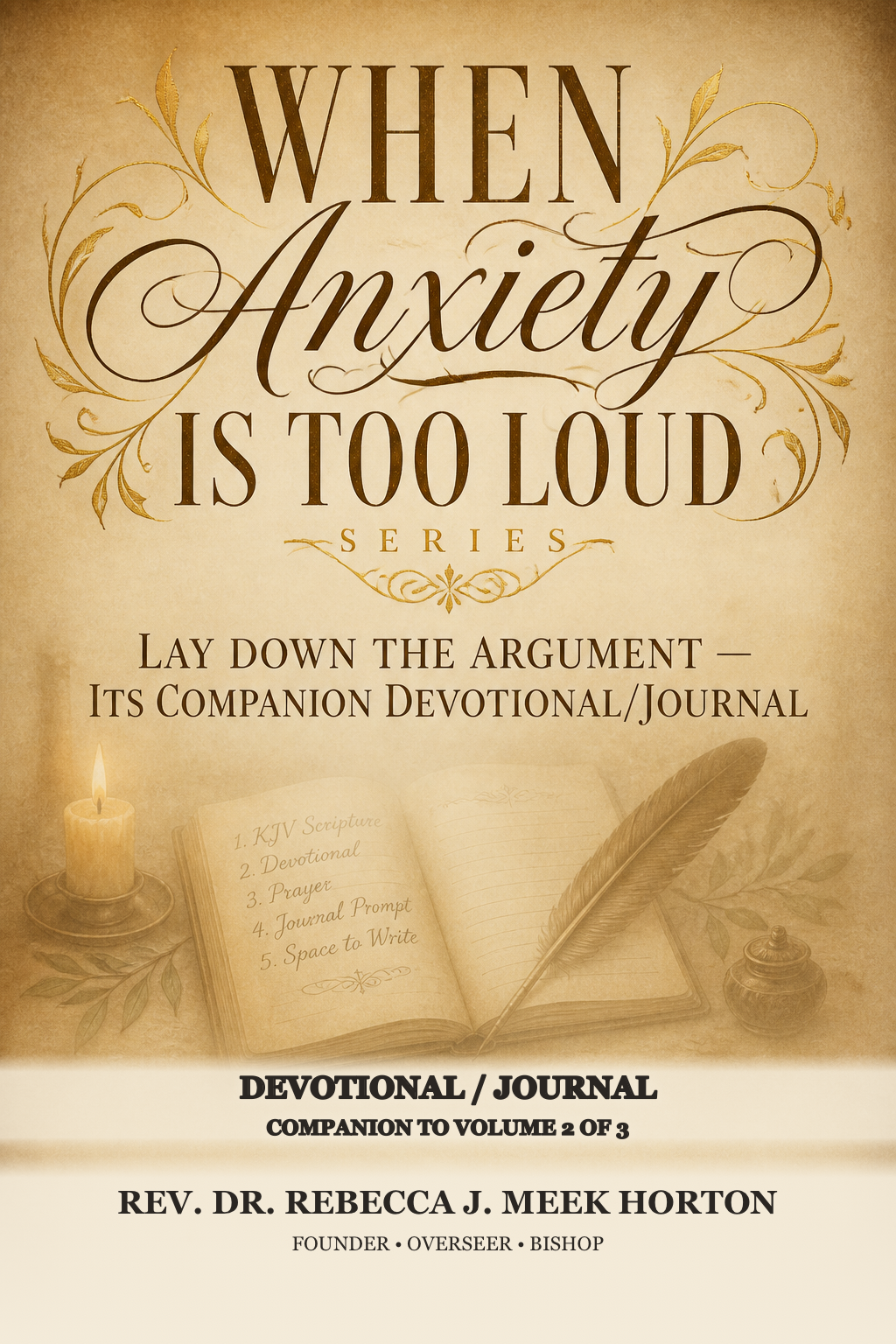
Lay Down the Argument — Its Companion Devotional/Journal
A companion devotional and journal for "Lay Down the Argument". Each chapter becomes five entries — a KJV Scripture reading, a devotional, a prayer, a journal prompt, and space to write — closing with An Apostolic Prophetic Architect Message and lined journal pages.
Chapter 1 preview
NBCNGMI MASTER KNOWLEDGE LIBRARY Featuring the works of The Sage, Apostle Prophet. Rev. Dr. Rebecca J. Meek Horton, Apostolic Prophetic Architect, NewBeing Creation Network Global Ministries, Inc. Integrated Framework Modalities™
Dedication
I dedicate this companion devotional and journal to every heart learning to lay down the argument and make room for God’s peace. May these pages help you listen honestly, pray faithfully, and take the next obedient step with wisdom, humility, and grace.
Purpose
I wrote this companion devotional and journal to help you move from reading about laying down the argument to practicing it before God, one day at a time. My prayer is that Scripture, reflection, prayer, and honest writing will help you surrender the need to win, defend, explain, or rehearse what God is asking you to release. May this book guide you into peace, obedience, and the next faithful step, as James 1:22 calls us to be doers of the word, and not hearers only.
Preface
I wrote this companion devotional and journal for the moments after the teaching has been heard, when the real work begins in the heart.
Lay Down the Argument was not born from a desire to make people quiet. It was born from a burden to help us become whole. Many of us have learned how to defend ourselves, explain ourselves, correct others, and rehearse our side of the story. But fewer of us have been taught how to pause before God, listen without preparing a comeback, and let the Holy Spirit reveal what is really happening within us.
James 1:19-20 (KJV) Wherefore, my beloved brethren, let every man be swift to hear, slow to speak, slow to wrath: For the wrath of man worketh not the righteousness of God.
This companion was created as a slower walk through the message. Each chapter becomes five entries: a KJV Scripture reading, a devotional reflection, a prayer, a journal prompt, and space to write. The goal is not to rush through pages, but to let truth meet you where you are.
Argument is not always loud. Sometimes it is internal. Sometimes it is the speech we never say out loud but keep repeating inside. Sometimes it is the need to be right, the fear of being misunderstood, or the pain of feeling unseen. Laying down the argument does not mean denying truth. It means surrendering the need to carry truth in a wounded, defensive, or uncontrolled way.
This work asks something of us. It asks humility. It asks stillness. It asks the courage to stop blaming long enough to examine our own heart. That is not easy. But it is holy work.
My prayer is that this devotional and journal becomes a quiet place of RE-Flection™, RE-Alignment™, and RE-Sponsibility™. Not shame. Not performance. Not religious pressure. Just honest surrender before God.
Take your time with these pages. Read the Scripture slowly. Pray honestly. Write what is true. Let the Lord meet you beneath the argument.
Begin with one entry. Bring one real situation before God. Ask Him what needs to be laid down today.
Introduction
Most arguments do not begin in the mouth. They begin in the heart.
Before words rise, something inside us has already taken a position. We want to be understood. We want to be right. We want someone to see what they missed, repair what they broke, or admit what they denied. Sometimes the argument is with another person. Sometimes it is with God. Sometimes it is with ourselves.
Lay Down the Argument was written to call us out of the exhausting cycle of proving, defending, replaying, and resisting. This companion devotional and journal was created to help that message become practice.
The central invitation is simple: lay down the argument so you can pick up obedience, peace, humility, truth, and the next faithful step.
That does not mean pretending pain did not happen. It does not mean becoming silent when truth must be spoken. It does not mean accepting abuse, avoiding accountability, or calling confusion “peace.” Laying down the argument means surrendering the inner war that keeps you bound to reaction instead of governed by wisdom.
James 1:19-20 (KJV)
Wherefore, my beloved brethren, let every man be swift to hear, slow to speak, slow to wrath: For the wrath of man worketh not the righteousness of God.
This devotional/journal is not designed to rush you. Each chapter from Lay Down the Argument becomes five entries. Each entry gives you space to slow down, listen, respond honestly, and practice what you are learning.
The rhythm is intentional:
• A KJV Scripture reading to anchor you in the Word
• A devotional to help you understand the heart of the lesson
• A prayer to bring the matter before God
• A journal prompt to help you tell the truth without hiding
• Space to write, process, repent, release, and RE-Focus™
Do not treat this as a task to complete quickly. Let it become a place of honest RE-Flection™. Some entries may feel gentle. Others may press on places you have protected for a long time. That is part of the work. Growth often costs us the comfort of our favorite explanation.
You may discover that the argument you thought was about someone else is also revealing something in you: a wound, a fear, a need for control, a habit of rehearsing offense, or a refusal to trust God with timing and justice. Do not condemn yourself when you see it. Seeing clearly is not shame. It is stewardship.
Proverbs 3:5-6 (KJV)
Trust in the LORD with all thine heart; and lean not unto thine own understanding. In all thy ways acknowledge him, and he shall direct thy paths.
Read this book with your Bible open and your heart honest. If an entry exposes something difficult, pause. Pray. Write plainly. Ask the Lord what obedience looks like today. If you are working through a painful relationship, use wisdom and seek godly counsel where needed. This journal is a spiritual formation tool, not a replacement for pastoral care, wise accountability, or appropriate professional support.
You will get the most from this companion if you move slowly and consistently. One entry a day is enough. If a prompt requires more time, stay with it. The goal is not volume. The goal is transformation.
At the end of the devotional entries, you will find An Apostolic Prophetic Architect Message and additional lined journal pages. Use those pages to gather what God has been showing you. Write the patterns you are noticing. Name what you are laying down. Record the next faithful steps you are willing to keep.
Begin here: before reading the first entry, write one sentence in your journal answering this question:
What argument am I ready to lay down before God?
Chapter 1 — The Argument Is Wearing You Out
Entry 1
Scripture Reading
Matthew 6:25-27 (KJV) 25 Therefore I say unto you, Take no thought for your life, what ye shall eat, or what ye shall drink; nor yet for your body, what ye shall put on. Is not the life more than meat, and the body than raiment? 26 Behold the fowls of the air: for they sow not, neither do they reap, nor gather into barns; yet your heavenly Father feedeth them. Are ye not much better than they? 27 Which of you by taking thought can add one cubit unto his stature?
Devotional
Anxiety often feels like responsibility because it keeps us busy. It gives us something to check, something to replay, something to solve, something to fear before it happens. It can sound careful. It can sound mature. It can even sound spiritual. But Jesus asks a question that cuts through the noise without shaming the weary soul: Which of you by taking thought can add one cubit unto his stature?
There is a kind of thinking that helps us walk wisely. We plan. We prepare. We pay attention. We respond to what is ours to steward. That is not the problem. The problem begins when thought becomes a courtroom and every anxious possibility demands testimony. We keep answering. We keep proving. We keep returning to the same mental door to see if it is locked.
Jesus does not invite us into carelessness. He invites us out of captivity. He points to the birds, not because birds have no need, but because their need is held under the care of the Father. They do what is given to them. They live within the order assigned to them. They do not carry tomorrow as if tomorrow has already been placed in their hands.
This is where surrender begins. Not with pretending there is no concern. Not with denying that life has real responsibilities. Surrender begins when we recognize the difference between stewardship and control. Stewardship asks, What is mine to do today? Control asks, How can I guarantee nothing painful will happen?
That second question will wear you out.
The anxious argument says, Keep thinking until you feel safe. Jesus says that anxious thought cannot add what only God can give. It cannot add height. It cannot add life. It cannot add certainty. It can only spend strength.
Today, you are invited to stop treating every anxious demand as a command. You can notice the thought without entering the debate. You can say, This is anxiety asking me to prove safety again. Then you can return to the Father’s care and take one faithful step.
You do not have to win the argument. Some arguments are not assignments. Some must be laid down.
Prayer
Father, I come to You with the thoughts that keep pulling on me. I confess that I have often treated anxious questions like commands I must obey. I have confused constant mental labor with care, and I have tried to add by worrying what only You can hold by Your power. Teach me the difference between wisdom and fear. Help me prepare what is mine to prepare and release what is not mine to control. I receive Your care over my life today. I choose not to enter every argument anxiety presents. Give me grace to notice, pause, breathe, and return my trust to You. Amen.
Journal Prompt
In Matthew 6:25-27, Jesus shows the limit of anxious thought. What thought have you been treating as productive, even though it is only spending your strength?
Space to Write [Answer Lines]
Entry 2
Scripture Reading
Philippians 4:6-7 (KJV) 6 Be careful for nothing; but in every thing by prayer and supplication with thanksgiving let your requests be made known unto God. 7 And the peace of God, which passeth all understanding, shall keep your hearts and minds through Christ Jesus.
Devotional
There is a holy exchange in this passage. We bring the care. God gives peace. We bring the request. God keeps the heart and mind. We bring what is real without pretending, hiding, or performing. God meets us with a peace that does not require us to understand everything first.
Anxiety says, You cannot rest until you know. Scripture teaches us to bring the unknown to God. That is not the same thing. Anxiety demands certainty before surrender. Prayer makes room for surrender in the presence of uncertainty.
This matters because anxiety can turn even prayer into another form of striving. We may say the words, but inside we are still arguing. We are still trying to control the outcome, rehearse the conversation, predict the response, and secure the future. We pray, but we do not release. We speak to God, but we keep holding court in our own mind.
The instruction is gentle and direct: in every thing let your requests be made known unto God. Not polished things only. Not religious things only. Not concerns that seem important enough. Every thing. The small check. The repeated fear. The imagined outcome. The regret from yesterday. The child you cannot control. The result you cannot force. The conversation you keep replaying.
Bring it honestly.
But notice what follows. The promise is not that every answer will arrive immediately. The promise is that the peace of God shall keep your hearts and minds through Christ Jesus. Peace becomes a guard. The heart that was exposed to fear is kept. The mind that was running through anxious hallways is kept. The soul that felt responsible for securing every outcome is kept.
Peace that passeth all understanding does not mean life becomes simple. It means God can guard you before the situation is fully solved. That is a mercy. You do not have to wait for perfect circumstances to stop obeying panic.
RE-Language™ helps us here. Instead of saying, I cannot rest until I know, we can say, I can bring what I do not know to God. Instead of saying, I have to figure everything out tonight, we can say, I need one faithful step, not total control.
Prayer is not avoidance. Prayer is proper placement. It places the burden before the One who can actually carry it.
Prayer
Father, I bring You the concerns I have been carrying in my mind and body. I do not want to turn prayer into another place of striving. I want to make my requests known to You and receive the peace You give through Christ Jesus. Teach me to pray honestly without grabbing the burden back as soon as I say amen. Guard my heart where fear has pressed hard. Guard my mind where anxious thoughts have multiplied. I thank You that Your peace is not limited by my understanding. Help me walk today as one who is kept by You, not driven by panic. Amen.
Journal Prompt
Philippians 4:6-7 invites you to make your requests known to God. What is one request you need to bring honestly, and what would it look like to stop carrying it after you pray?
Space to Write [Answer Lines]
Entry 3
Scripture Reading
2 Corinthians 10:4-5 (KJV) 4 (For the weapons of our warfare are not carnal, but mighty through God to the pulling down of strong holds;) 5 Casting down imaginations, and every high thing that exalteth itself against the knowledge of God, and bringing into captivity every thought to the obedience of Christ;
Devotional
Not every thought deserves a conversation.
That truth may feel strange at first, especially when anxiety has trained you to answer every question it asks. What if this happens? What if I fail? What if they leave? What if I missed God? What if this never changes? The anxious mind can build a full courtroom from one question, then call it discernment because the matter feels urgent.
But Scripture gives us a different responsibility. We are not told to entertain every imagination. We are told to cast down imaginations and bring every thought into captivity to the obedience of Christ.
This is not harshness toward yourself. This is protection. Some thoughts are not harmless visitors. They exalt themselves. They rise up against the knowledge of God. They challenge His care, His faithfulness, His timing, His presence, and His authority. They may sound reasonable, but their fruit is bondage.
The work is not to become afraid of your thoughts. The work is to become more discerning with them. A thought can be present without becoming your master. Fear can speak without being enthroned. Anxiety can make a demand without receiving your obedience.
This is where the first movement toward surrender becomes practical. You recognize the argument without entering it. You name it clearly: Anxiety is asking me to argue about an imagined future. Anxiety is asking me to replay a past conversation until I feel safe. Anxiety is asking me to prove that nothing bad will happen.
Once it is named, it can be weighed. Is this a real responsibility for today, or an imagined trial? Is there a faithful step, or only a fearful loop? Is this thought leading me into obedience, or into exhaustion?
The weapons of our warfare are mighty through God. That means you are not left with willpower alone. You do not have to outthink anxiety by yourself. You can submit the thought to Christ. You can refuse the argument. You can take the next faithful step and leave the rest outside the courtroom.
Bringing a thought into captivity may look quiet. It may be as simple as closing the search window, putting down the phone, writing one sentence, praying one honest prayer, or choosing not to ask for reassurance one more time.
Small obedience interrupts strong patterns.
Prayer
Father, I ask You to help me discern the thoughts I have been entertaining. I do not want to give authority to imaginations that rise against Your truth. Teach me to recognize anxious arguments before I enter them. Strengthen me to bring my thoughts into captivity to the obedience of Christ. I receive Your help where my mind has felt crowded, pressured, and unsafe. I will not shame myself for having thoughts, but I will not surrender leadership to fear. Show me the next faithful step, and help me obey it without demanding total certainty first. Amen.
Journal Prompt
According to 2 Corinthians 10:4-5, what imagination or anxious storyline needs to be brought into captivity today? What is one obedient response you can practice?
Space to Write [Answer Lines]
Entry 4
Scripture Reading
Psalm 127:1-2 (KJV) 1 A Song of degrees for Solomon. Except the LORD build the house, they labour in vain that build it: except the LORD keep the city, the watchman waketh but in vain. 2 It is vain for you to rise up early, to sit up late, to eat the bread of sorrows: for so he giveth his beloved sleep.
Devotional
There is a labor that is faithful, and there is a labor that is vain. Psalm 127 helps us tell the difference.
The builder is not condemned for building. The watchman is not rebuked for watching. Work has its place. Attention has its place. Responsibility has its place. But the Scripture tells the truth: except the LORD build, the labor is vain. Except the LORD keep, the watching is vain.
Anxiety often convinces us that if we stop watching, everything will collapse. So we rise early in our minds. We sit up late in our thoughts. We eat the bread of sorrows, rehearsing outcomes, managing people internally, checking what we already checked, and trying to keep the city by mental strain.
But there is a limit to human watchfulness.
A parent can love a child, teach a child, pray for a child, correct a child, and provide for a child. But a parent cannot become God over the child’s future. A leader can prepare, plan, listen, and steward well. But a leader cannot secure every response. A person can apologize, clarify, and learn. But no one can rewrite yesterday through anxious regret.
This passage does not remove responsibility. It puts responsibility back in order. You build with the Lord. You watch under the Lord. You work, but you do not worship work. You care, but you do not bow to control. You prepare, but you do not pretend your preparation can replace God’s keeping power.
Then comes the mercy: for so he giveth his beloved sleep.
Sleep is not only physical rest. It is also a sign of trust. It is the body admitting, I am not the keeper of all things. It is the soul accepting, I can stop for a while because God has not stopped being God.
For the anxious heart, rest may feel like risk. Laying down the argument may feel like abandoning your post. But if the Lord is the keeper, then surrender is not abandonment. It is RE-Alignment™. It is returning to proper order.
You may have a faithful step today. Take it. Make the call. Pay the bill. lock the door once. Write the apology. Set the boundary. Pray for the child. Then stop eating the bread of sorrows as if sorrow can build what only God can establish.
The Lord gives His beloved sleep. Receive the gift.
Prayer
Father, I confess that I have tried to keep the city in my own strength. I have called it responsibility, but often it has become fear, control, and endless watching. Help me build only what You have assigned me to build. Help me watch with wisdom, not with panic. I receive the truth that You are the Keeper, and I am not. Teach my body, mind, and spirit how to rest under Your care. I lay down the bread of sorrows and ask for the grace to receive the sleep You give to Your beloved. Amen.
Journal Prompt
Psalm 127:1-2 shows the difference between faithful labor and vain striving. Where have you been trying to keep what only the Lord can keep?
Space to Write [Answer Lines]
Entry 5
Scripture Reading
Isaiah 26:3-4 (KJV) 3 Thou wilt keep him in perfect peace, whose mind is stayed on thee: because he trusteth in thee. 4 Trust ye in the LORD for ever: for in the LORD JEHOVAH is everlasting strength:
Devotional
A stayed mind is not an empty mind. It is a governed mind.
This matters because many people feel guilty when anxious thoughts come. They assume peace means no fearful thought ever appears, no concern ever rises, no question ever presses. But Isaiah does not describe a mind that never faces pressure. It describes a mind that is stayed on the Lord.
Stayed means anchored. Held. Directed. Returned. The anxious thought may come, but it does not have to become the throne. The demand may speak, but it does not have to lead the meeting. The imagined outcome may appear, but it does not have to become your dwelling place.
Perfect peace is connected to trust. Not trust in your ability to answer every question. Not trust in your ability to predict every outcome. Not trust in your ability to stay emotionally steady at all times. Trust in the LORD. Trust in the One whose strength is everlasting.
Anxiety wears us out because it keeps asking us to provide what we do not possess. It wants complete certainty, total control, and permanent reassurance. But we are not built to carry divine responsibilities in human strength. When the mind tries to hold what belongs to God, peace begins to leak out.
The invitation is not to force calm. The invitation is to return. Return the mind to the Lord. Return the concern to the Lord. Return the outcome to the Lord. Return the unanswered question to the Lord. Return again when you drift. This is not failure. This is practice.
WALK™ gives us a simple daily rhythm: Wait, Ask, Listen, Keep. Wait in stillness before you rush to solve. Ask honestly instead of hiding the fear. Listen carefully for truth, Scripture, wisdom, and the next faithful step. Keep that step without demanding the whole map.
A stayed mind is formed by many returns.
Today, you may still feel the pull of the argument. You may still feel the urge to check, replay, search, or seek reassurance. Do not turn that into shame. Turn it into a moment of RE-Cognition™. Notice what is happening. Name it. Then stay your mind again on the Lord.
The peace of God is not fragile. His strength is everlasting. You are allowed to be held.
Prayer
Father, I want my mind to be stayed on You. I admit that my thoughts often run toward fear, control, regret, and imagined outcomes. Help me return without shame. Teach me to trust You more than I trust the anxious argument. I receive Your perfect peace as a gift, not as something I must manufacture. When fear rises, help me pause and remember that You are everlasting strength. I will not make anxiety my master today. I will wait, ask, listen, and keep the next faithful step with You. Amen.
Journal Prompt
Isaiah 26:3-4 connects peace with a mind stayed on the Lord. When your mind starts to argue with anxiety, what truth about God can you return to today?
Space to Write [Answer Lines]
An Apostolic Prophetic Architect Message
Beloved, the argument has been exposed.
That is not a small thing. What remains hidden keeps working without permission. What is brought into the light can be discerned, weighed, and laid down. Over these five entries, the Spirit has been teaching one clear truth: every anxious demand is not an assignment. Every urgent thought is not wisdom. Every repeated question does not require your obedience.
You are not being called into carelessness. You are being called into governed stewardship. There is a difference. Carelessness ignores responsibility. Governed stewardship takes the next faithful step and refuses to worship control. This is where maturity begins to rise. Not in loud striving, but in quiet obedience.
The enemy of peace often comes disguised as endless responsibility. It says, Think longer. Check again. Replay it one more time. Secure the outcome. But the Lord is restoring order in your inner life. He is teaching you to recognize the courtroom without entering the trial. He is teaching you to stop feeding fear with your attention. He is teaching you to let prayer become placement, not performance.
Proverbs 3:5-6 (KJV) 5 Trust in the LORD with all thine heart; and lean not unto thine own understanding. 6 In all thy ways acknowledge him, and he shall direct thy paths.
This is the seal over the work: trust, do not lean, acknowledge, and follow. You do not need full control to take the next faithful step. You do not need every answer before you obey God. You do not need anxiety’s permission to rest.
As an Apostolic Prophetic Architect, I speak this as encouragement and confirmation: the Lord is not only quieting a moment; He is RE-Ordering™ a pattern. He is drawing you out of mental negotiation and into spiritual alignment. He is strengthening your discernment so you can tell the difference between a true responsibility and an imagined trial.
Carry this forward with simplicity. When anxiety asks you to argue, pause. Name the demand. Bring it to the Father. Choose one faithful step. Leave the rest in His hands.
Nothing is random. Nothing is wasted. Even this weariness is becoming a place of wisdom. The argument may speak again, but you do not have to answer the same way.
[Journal Page]
[Journal Page]
This is the opening chapter. The complete publication is available in the full edition.
Back to the library