 NBCNGMI™
Facing Head Storms · Volume 3
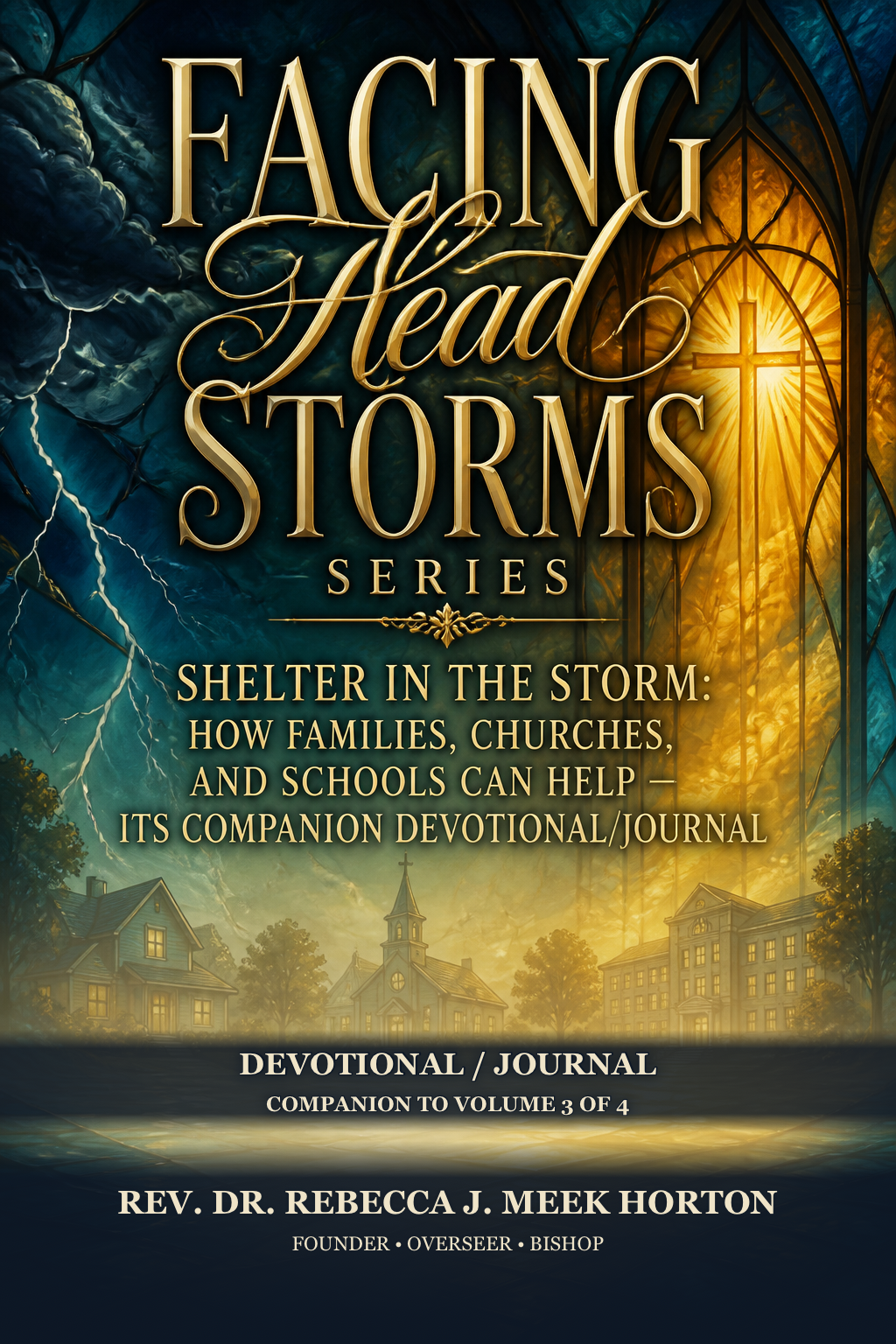
Shelter in the Storm: How Families, Churches, and Schools Can Help — Its Companion Devotional/Journal
A companion devotional and journal for "Shelter in the Storm: How Families, Churches, and Schools Can Help". Each chapter becomes five entries — a KJV Scripture reading, a devotional, a prayer, a journal prompt, and space to write — closing with An Apostolic Prophetic Architect Message and lined jou
Chapter 1 preview
NBCNGMI MASTER KNOWLEDGE LIBRARY Featuring the works of The Sage, Apostle Prophet. Rev. Dr. Rebecca J. Meek Horton, Apostolic Prophetic Architect, NewBeing Creation Network Global Ministries, Inc. Integrated Framework Modalities™
Dedication
I dedicate this companion devotional and journal to every family, church, school, minister, parent, educator, and student learning how to become shelter in someone else’s storm. May these pages help you listen with wisdom, love with courage, pray with faith, and take the next faithful step together.
Purpose
I prepared this companion devotional and journal to help families, churches, and schools slow down, seek God, and respond with wisdom when storms touch the lives of children, students, and those who care for them.
My prayer is that each Scripture, devotional, prayer, and prompt will give the reader a safe place to listen, reflect, and write honestly before the Lord.
I hope these pages help you move from concern to stewardship, from overwhelm to prayerful action, and from isolation to the next faithful step with God.
Preface
I prepared this companion devotional and journal for the people who are trying to help others while carrying storms of their own.
Families know storms.
Churches know storms.
Schools know storms.
Ministers, parents, students, educators, caregivers, and leaders often stand in the gap before they feel fully ready. They answer hard questions. They comfort frightened hearts. They make decisions with limited time, limited resources, and deep concern. Many are asking, “How do we help without becoming overwhelmed? How do we shelter others without losing our own footing?”
This book was created to slow that question down before God.
Psalm 46:1 (KJV) God is our refuge and strength, a very present help in trouble.
Shelter in the Storm: How Families, Churches, and Schools Can Help laid out the teaching and the call. This companion devotional and journal is the place to sit with it, pray through it, and let wisdom become practice. Each chapter becomes five entries so you can return to Scripture, receive a devotional reflection, pray honestly, journal with purpose, and write what the Holy Spirit is helping you see.
I do not want this journal to become another task on your list. I want it to become a quiet place of RE-Flection™, RE-Alignment™, and next-step obedience. Some days you may write much. Some days you may write one sentence. Both can be faithful.
The storm may be personal, relational, spiritual, educational, emotional, or communal. The goal is not to pretend the storm is small. The goal is to remember that God is present, wise, and able to lead us with truth.
As you move through these pages, bring your real concerns. Bring the names you are praying over. Bring the students, children, families, congregations, classrooms, and communities you carry in your heart. Let the Word of God search you before you try to serve others from exhaustion.
Nothing is random. Nothing is wasted.
Before you begin, pause for one minute. Ask God for wisdom, humility, courage, and compassion. Then write one sentence naming the storm you are bringing before Him.
Start there. God can meet you there.
Introduction
This companion devotional and journal was created to help you slow down, listen well, and turn the message of Shelter in the Storm into daily practice.
A storm does not always announce itself with thunder. Sometimes it comes as anxiety in a child, exhaustion in a parent, pressure in a classroom, grief in a congregation, conflict in a home, or silence from someone who used to speak freely. Families, churches, and schools often see the signs before anyone knows what to call them. The question is not whether storms will come. The question is whether we will become wise, steady, and faithful shelters when they do.
Psalm 46:1-3 (KJV) God is our refuge and strength, a very present help in trouble. Therefore will not we fear, though the earth be removed, and though the mountains be carried into the midst of the sea; Though the waters thereof roar and be troubled, though the mountains shake with the swelling thereof. Selah.
God is the true refuge. We are not asked to become saviors. We are asked to become faithful stewards of care, truth, presence, prayer, boundaries, and wise action. That is the heart of this journal.
Each chapter from the main book becomes five devotional entries here. You will receive a KJV Scripture reading, a short devotional, a prayer, a journal prompt, and space to write. This rhythm is simple on purpose. It is not meant to overwhelm you. It is meant to help you carry one truth at a time until that truth becomes something you can live, teach, and practice.
Read slowly. Do not rush to complete pages just to say you finished. Let the Word search you. Let the devotional help you name what is happening. Let the prayer give language to what may feel too heavy to say. Let the prompt move you from reflection into responsibility.
Galatians 6:2 (KJV) Bear ye one another's burdens, and so fulfil the law of Christ.
This work is for ministers who carry people in prayer and leadership. It is for parents who want to help without controlling. It is for educators who see students struggling and need wisdom beyond policy. It is for students who need language for their own storms. It is for churches and schools learning how to respond with compassion and order. It is also for the quiet helper who wonders, “What can I actually do?”
The answer will not always be dramatic. Sometimes help looks like listening without shaming. Sometimes it looks like asking better questions. Sometimes it means referring someone to proper care. Sometimes it means creating a safer room, a calmer response, a clearer boundary, or a faithful next step.
This journal is not a replacement for pastoral care, wise counsel, medical help, mental health support, or necessary intervention. It is a spiritual and reflective companion to help you notice, pray, discern, and act with maturity.
James 1:5 (KJV) If any of you lack wisdom, let him ask of God, that giveth to all men liberally, and upbraideth not; and it shall be given him.
At the end, you will find An Apostolic Prophetic Architect Message and additional lined journal pages. Use them to gather what God has shown you. Write the names, needs, patterns, prayers, and next steps that should not be forgotten.
Begin with honesty. Bring one real storm before God. Then read, pray, write, and take the next faithful step.
Chapter 1 — When the Storm Enters the Room
Entry 1
Scripture Reading
Galatians 6:2 (KJV) Bear ye one another's burdens, and so fulfil the law of Christ.
Devotional
When the storm enters the room, one of the first weights we feel is not knowing.
We may not know if the silence is sadness, danger, exhaustion, shame, fear, trauma, or something we cannot yet name. We may not know whether to knock, wait, call, pray, report, sit, listen, or seek immediate help. Love stands close to pain, and closeness can make discernment harder. The burden is not only what the struggler carries. It is also what the people nearby carry as they ask, What am I supposed to do now?
Galatians 6:2 does not tell us to understand every burden before we help bear it. It tells us to bear one another’s burdens. That does not mean we take over another person’s life. It does not mean we become the savior, counselor, physician, or Holy Ghost. It means we refuse to let someone suffer alone simply because their pain is complicated.
Wise care begins with humble nearness.
A mother outside a bedroom door does not need to have the whole answer before she knocks gently. A pastor does not need to know the full story before responding with care. A teacher does not need to diagnose a student to notice that something has changed. A friend does not need perfect words to say, I am glad you told me. Let us not carry this alone.
Bearing a burden is not control. It is not panic. It is not performing rescue. It is the Christ-shaped willingness to come close, tell the truth, seek wisdom, and help carry what should not be carried in isolation.
There is a holy difference between carrying with someone and carrying for someone. Carrying with someone honors their dignity. Carrying for someone can quietly take away their responsibility and exhaust the helper. The law of Christ teaches love that is both tender and truthful.
Today, you may be near someone whose storm has entered the room. Or you may be carrying the ache of a moment you did not know how to handle. Begin here: you are not asked to know everything. You are asked to love faithfully, seek wisdom, and refuse abandonment.
A shelter does not stop being shelter because the storm is strong. It simply stands, covers, and helps the person take the next safe step.
Prayer
Father, I come to You with the burdens I see and the burdens I do not understand. I confess that I often want quick answers because uncertainty feels heavy. Teach me how to come close without taking control. Help me bear burdens in the spirit of Christ, with humility, patience, and wisdom. Show me when to listen, when to speak, when to pray, when to seek counsel, and when to involve the right help. Keep me from panic, pride, and passivity. Make me steady enough to be safe, honest enough to know my limits, and loving enough not to walk away from complicated pain. Amen.
Journal Prompt
Galatians 6:2 calls me to bear burdens without becoming sovereign over them. Where am I being invited to come close with humility, and what limit do I need to honor?
Space to Write
[Answer Lines]
Entry 2
Scripture Reading
John 15:5 (KJV) I am the vine, ye are the branches: He that abideth in me, and I in him, the same bringeth forth much fruit: for without me ye can do nothing .
Devotional
Love feels responsible. That is part of what makes love beautiful.
A parent feels responsible when a child is hurting. A minister feels responsible when a member withdraws. A teacher feels responsible when a student’s eyes change from bright to guarded. A mentor feels responsible when a young adult speaks lightly about not wanting to continue. Love hears pain and wants to move toward it.
But love is not sovereign.
This is hard to accept because our hearts often confuse faithfulness with control. We begin to think that if we say the right thing, pray the right way, catch every sign, remove every trigger, and stay available at every hour, then we can keep the storm from getting worse. That burden is too heavy for any human soul.
Jesus gives us a correcting mercy: for without me ye can do nothing.
That sentence is not humiliation. It is liberation. It returns the helper to the right place. We are branches, not the vine. We can bear fruit, but we do not generate life apart from Christ. We can offer faithful support, but we cannot become another person’s source. We can pray, listen, guide, refer, protect, and walk patiently, but we cannot replace God.
This truth does not make us passive. Abiding does not mean doing nothing. It means our doing stays connected to Christ. We act from dependence, not panic. We listen from love, not fear. We set boundaries from stewardship, not rejection. We seek help from wisdom, not failure.
Here is a needed RE-Language shift for the helper’s heart:
Not, I have to fix them.
But, I am called to offer faithful support and seek wise help.
Not, If they struggle, I failed.
But, Their storm is real, and my role must stay truthful.
Not, Love means no boundaries.
But, Love must be safe enough to last.
A branch that tries to become the vine will break under the pressure. A branch that abides can bear fruit in season. This is the posture of wise shelter. It stays connected to Christ, accepts its role, and serves without pretending to be the final answer.
Today, breathe again. You are responsible to be faithful. You are not responsible to be God.
Prayer
Father, I confess that I sometimes carry what only You can carry. I want the people I love to be safe, healed, steady, and whole, and that desire can turn into control when I am afraid. Bring me back to abiding in Christ. Teach me to serve as a branch, not as the vine. Help me offer faithful support without becoming consumed. Give me wisdom to pray, listen, act, and seek help in the right way. Release me from false ownership, but not from love. Make my care fruitful because it is rooted in You. Amen.
Journal Prompt
John 15:5 reminds me that I cannot bear fruit apart from Christ. Where have I been trying to carry a role that belongs to God, and what would abiding look like in that situation?
Space to Write
[Answer Lines]
Entry 3
Scripture Reading
1 Thessalonians 5:14 (KJV) Now we exhort you, brethren, warn them that are unruly, comfort the feebleminded, support the weak, be patient toward all men.
Devotional
The room needs less shock and more steadiness.
When someone reveals distress, the first response matters. A frightened face can close a door. A rushed correction can silence a confession. A dismissive answer can teach a wounded person not to speak again. A spiritual accusation can deepen shame in a soul already fighting hard to stay present.
This does not mean we must respond perfectly. Families, churches, and schools are made of human beings. We will miss signs. We will say some things awkwardly. We will learn as we go. But Scripture calls us toward maturity, and 1 Thessalonians 5:14 gives us a wise pattern.
Warn them that are unruly.
Comfort the feebleminded.
Support the weak.
Be patient toward all men.
Different conditions need different care. This is important. Not every silence is rebellion. Not every outburst is manipulation. Not every spiritual struggle is solved by more effort. Not every troubling behavior should be ignored. Wise care asks, What kind of care is needed here?
A person acting destructively may need warning and boundaries. A person crushed by fear may need comfort. A person with little strength left may need support. Every person needs patience.
Steadiness is calm love under pressure. It is not coldness. It is not avoidance. It is not pretending there is no danger when there may be danger. Steadiness knows how to stay present long enough to hear what is really being said. It can ask direct questions without panic. It can say, I am listening. I am glad you told me. I want to make sure you are safe. We may need to bring in the right help, and we will do that with care.
A head storm tries to make everyone in the room storm with it. Fear rises. Old wounds rise. Assumptions rise. Voices may rise. But someone must become anchored. Someone must remember that calm is not weakness. Someone must make room for truth.
In your home, church, classroom, office, or friendship, steadiness may be the first shelter you offer. The storm may not end in that moment. But if your response helps the person stay connected, heard, and safer, shelter has begun.
Prayer
Father, I ask You to make me steady in rooms where pain is speaking. Help me not to react from shock, fear, pride, or impatience. Teach me to discern the difference between behavior that needs warning, pain that needs comfort, weakness that needs support, and every situation that needs patience. Give me words that are truthful and gentle. Help my face, tone, timing, and follow-through communicate safety. When I do not know what to do, slow me down and lead me by wisdom. Let my presence help others feel less alone and more able to take the next safe step. Amen.
Journal Prompt
1 Thessalonians 5:14 shows that different needs require different responses. In the situation I am facing, is the next faithful response warning, comfort, support, patience, or wise referral?
Space to Write
[Answer Lines]
Entry 4
Scripture Reading
Proverbs 11:14 (KJV) Where no counsel is, the people fall: but in the multitude of counsellors there is safety.
Devotional
No one helper should become the whole shelter.
This truth may feel uncomfortable at first, especially for those who love deeply and privately. A mother may carry everything because she does not want anyone to judge her child. A pastor may become the only person receiving late-night crisis calls. A teacher may notice distress but feel unsure about involving others. A friend may become the only emotional outlet for someone who is barely holding on.
At first, being the only helper may feel noble. It may even feel spiritual. But over time, it can become unsafe.
When care centers on one person alone, exhaustion grows. Boundaries blur. Secrets gain power. The struggler may become dependent on one helper. The helper may begin to feel trapped, resentful, fearful, or responsible for outcomes beyond their role. Important needs may be missed because one person cannot see, know, or carry everything.
Proverbs teaches that safety increases in the multitude of counsellors. This does not mean careless exposure. It does not mean gossip. It does not mean making someone’s pain a public announcement. A wise circle is not a spotlight. It protects dignity while increasing safety.
Shared shelter means the right people are brought in the right way for the right reasons.
In a family, that may mean involving another mature adult, a pastor, a counselor, a doctor, or emergency support when needed. In a church, it may mean a trained care team and clear referral relationships. In a school, it may mean following safety protocols, documenting concerns, involving counselors, administrators, and parents or guardians as appropriate. In a friendship, it may mean saying with love, I cannot be the only person who knows this. We need to bring in someone who can help us carry this wisely.
That sentence may feel costly, but it can be an act of love.
A shelter has structure. It has more than one wall. It has a foundation, a covering, a doorway, and support beams. If one wall tries to become the whole building, the shelter cannot stand.
Wise care honors roles. A parent, minister, educator, counselor, mentor, and friend may each offer something needed. Each role matters. Each role has limits. Each role should serve the person, not possess the person.
Today, ask God if your care has become too isolated. The answer is not withdrawal. The answer is wise, protected, dignity-honoring shared support.
Prayer
Father, I ask for wisdom to build shared shelter, not lonely care. Show me where I have been carrying too much alone or allowing someone to depend on me in a way that is not safe. Help me protect dignity without protecting secrecy that increases danger. Teach me who should be included, what should be shared, and how to move with honor. Give me courage to seek counsel without shame. Help our families, churches, schools, and friendships become wise circles of care. Keep me from gossip, fear, and false ownership. Let counsel increase safety and help each person take the next faithful step. Amen.
Journal Prompt
Proverbs 11:14 connects counsel with safety. Is there a burden I am carrying too privately, and who is one wise, appropriate person or support system I may need to involve?
Space to Write
[Answer Lines]
Entry 5
Scripture Reading
James 1:5-6 (KJV) 5 If any of you lack wisdom, let him ask of God, that giveth to all men liberally, and upbraideth not; and it shall be given him. 6 But let him ask in faith, nothing wavering. For he that wavereth is like a wave of the sea driven with the wind and tossed.
Devotional
Becoming shelter will cost something.
It will cost the need for quick answers. We may want to say one perfect sentence and watch the pain lift. But emotional and mental storms rarely move on our preferred schedule. Progress may be slow, uneven, hidden, or interrupted. Wisdom teaches us to walk faithfully without demanding control.
It will cost pride. We may have to say, I do not know enough. We may need to ask for counsel, attend training, apologize for a harmful response, or learn new ways to listen. This is not failure. This is maturity.
It will cost comfort. It is uncomfortable to sit with pain without rushing to fix it. It is uncomfortable to ask direct safety questions when needed. It is uncomfortable to involve the right support when secrecy feels easier. It is uncomfortable to set a boundary and still keep love warm.
It will cost control. This may be the deepest surrender. Helpers often want assurance that if they do the right things, the struggler will immediately become well. But people are not projects. Support is not a remote control. Healing is not always linear. God has not called us to manage another person’s soul. He has called us to love faithfully, act wisely, and steward our role.
James gives us a gracious invitation: if any of you lack wisdom, ask God. Not if you have never missed it. Not if you already know what to do. Not if your emotions are perfectly calm. If any of you lack wisdom.
That includes the parent in the hallway.
That includes the pastor reading the concerning message.
That includes the teacher watching the quiet student.
That includes the friend unsure how to respond.
God gives wisdom without shaming the one who asks. He does not upbraid. He does not mock our need. He invites dependence.
So ask. Before the conversation, ask. After the difficult message, ask. When the situation is beyond your training, ask. When you need courage to involve help, ask. When you need patience for the long road, ask.
Nothing is random. Nothing is wasted when surrendered to God and shaped by wisdom. A home can become calmer. A church can become safer. A school can become more watchful. A mentor can become more responsible. A friend can become more grounded.
Wise shelter begins with asking God for wisdom and then taking the next faithful step.
Prayer
Father, I lack wisdom, and I come to You honestly. I do not want to move by panic, pride, fear, or control. Teach me how to become a safer shelter for those facing storms in the mind and heart. Give me patience when progress is slow, humility when I need help, courage when action is required, and compassion that does not collapse under pressure. Help me ask in faith and then obey the wisdom You give. Shape my home, church, school, relationships, and leadership into places where people are not shamed, abandoned, or controlled, but helped with truth and love. Amen.
Journal Prompt
James 1:5-6 invites me to ask God for wisdom without shame. What specific situation needs wisdom today, and what is one next faithful step I can take after asking?
Space to Write
[Answer Lines]
An Apostolic Prophetic Architect Message
Beloved, hear this clearly: the storm may enter the room, but the storm does not have to govern the room.
God is raising families, churches, schools, mentors, and friends who know how to stand in wisdom without becoming controlling, fearful, or overwhelmed. This is not the hour for shame-based care. This is not the hour for silence that protects appearances while people suffer in secret. This is not the hour for one person to carry the whole storm alone.
This is the hour for wise shelter.
Isaiah 32:2 (KJV) And a man shall be as an hiding place from the wind, and a covert from the tempest; as rivers of water in a dry place, as the shadow of a great rock in a weary land.
There is a kind of person who becomes covering without becoming lord over another soul. There is a kind of home that learns to listen before it labels. There is a kind of church that prays and also knows when to refer. There is a kind of school that notices distress before it only punishes disruption. There is a kind of friendship that refuses abandonment and refuses unhealthy dependence.
That is the work being built in you.
Do not despise the training that comes through the burden. Do not call yourself a failure because you did not know what you were seeing at first. Wisdom grows when humility is allowed to teach. You are not called to be the Savior. You are called to be faithful, watchful, prayerful, honest, and rightly connected.
The Spirit of God can help you become safer in the room. He can govern your face, your tone, your timing, your boundaries, your questions, and your next step. He can teach you when to be quiet, when to speak, when to comfort, when to warn, when to support, and when to bring in help.
Let this truth seal your heart: wise care can become shelter without becoming control.
Now walk it out. Name your role truthfully. Ask God for wisdom. Involve the right support where needed. Keep dignity. Keep prayer. Keep courage. Keep the next faithful step.
The storm is real, but God is present. And with wisdom, you can help make the room safer.
[Journal Page]
[Journal Page]
This is the opening chapter. The complete publication is available in the full edition.
Back to the library