The Grace Blueprint Series · Volume 3
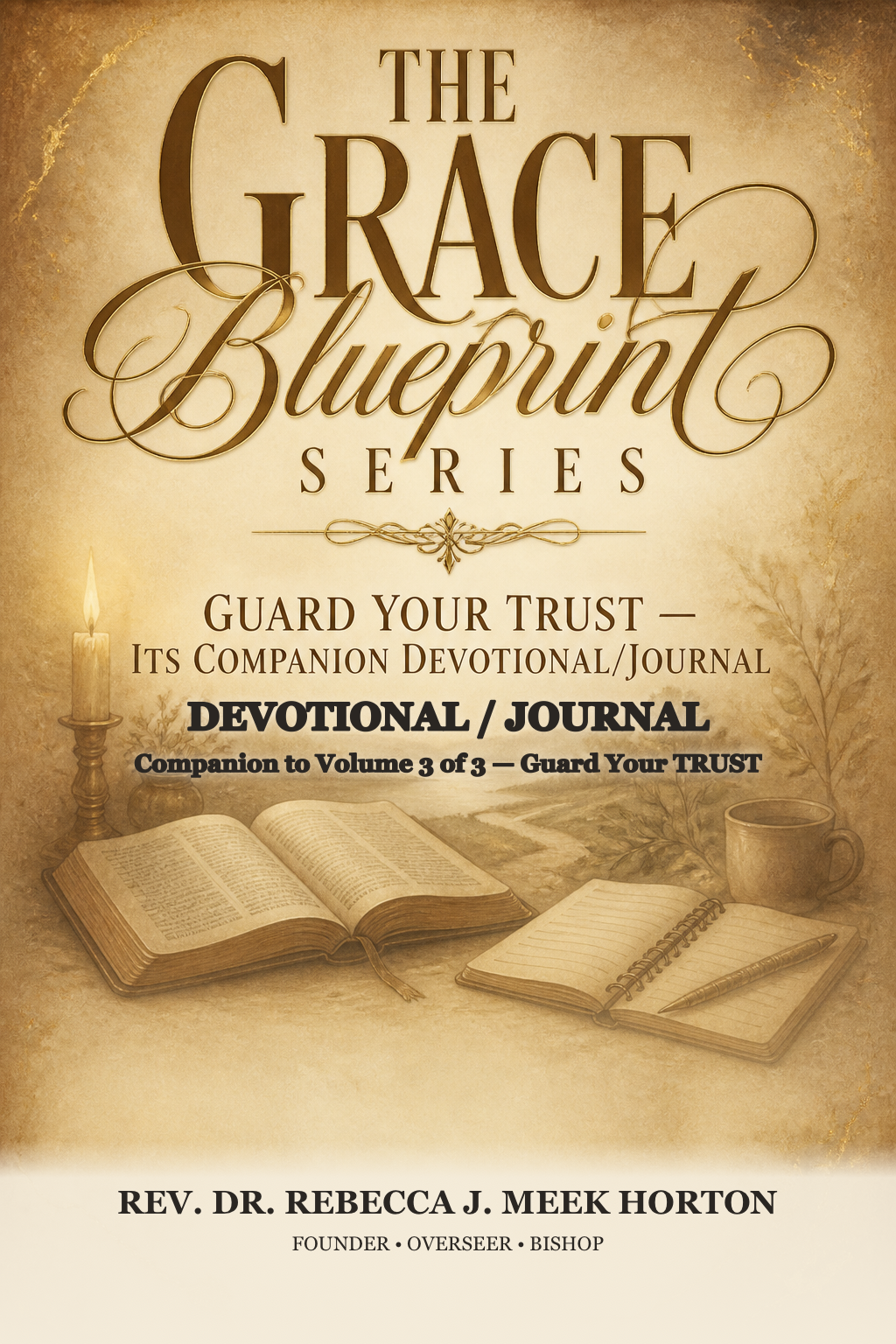
Guard Your TRUST — Its Companion Devotional/Journal
A companion devotional and journal for "Guard Your TRUST". Each chapter becomes five entries — a KJV Scripture reading, a devotional, a prayer, a journal prompt, and space to write — closing with An Apostolic Prophetic Architect Message and lined journal pages.
Chapter 1 preview
NBCNGMI MASTER KNOWLEDGE LIBRARY Featuring the works of The Sage, Apostle Prophet. Rev. Dr. Rebecca J. Meek Horton, Apostolic Prophetic Architect, NewBeing Creation Network Global Ministries, Inc. Integrated Framework Modalities™
Chapter 1 — When Trust Is Under Attack
Entry 1
Scripture Reading
Genesis 3:1–5 (KJV)
Now the serpent was more subtil than any beast of the field which the LORD God had made. And he said unto the woman, Yea, hath God said, Ye shall not eat of every tree of the garden?
And the woman said unto the serpent, We may eat of the fruit of the trees of the garden:
But of the fruit of the tree which is in the midst of the garden, God hath said, Ye shall not eat of it, neither shall ye touch it, lest ye die.
And the serpent said unto the woman, Ye shall not surely die:
For God doth know that in the day ye eat thereof, then your eyes shall be opened, and ye shall be as gods, knowing good and evil.
Devotional
The first attack was not loud. It did not begin with open rebellion. It began with a question.
“Yea, hath God said?” That question was not innocent. It was designed to loosen trust before disobedience appeared reasonable. The serpent knew that if trust in God’s Word could be weakened, obedience would begin to feel optional. If God’s motive could be questioned, His command could be resisted.
This is still one of the enemy’s oldest strategies. He does not always begin by trying to make you deny God. Often, he begins by trying to make you doubt whether God can be trusted in the place where obedience is costly.
He may whisper through fear, pain, delay, disappointment, or comparison. The wording may change, but the root remains the same. “Did God really say?” “Is God really good?” “Is God keeping something from you?” “Would obedience really be worth it?”
When trust is under attack, the first work is not to argue with every thought all day. The first work is to recognize the voice behind the question. Not every question is wrong. Some questions come from a heart that wants to understand so it can obey. But some questions are designed to pull the heart away from surrender.
A sincere question says, “Lord, teach me.” A corrosive question says, “Lord, prove Yourself before I obey.”
There is a difference.
Today, you may be carrying a question. Bring it honestly before God. He is not threatened by your weakness. But do not let suspicion become your teacher. Do not let pain become your interpreter. Do not let another voice take authority over what God has already spoken.
Guard your trust at the first question. Guard it before the thought becomes an argument. Guard it before the argument becomes distance. Guard it before distance becomes disobedience.
God’s Word is not unsafe. God’s boundaries are not hatred. God’s commands are not random. Nothing is random. Nothing is wasted.
The serpent questioned God’s Word in the garden. The believer must answer by returning to what God has said.
Prayer
Father, I come to You with honesty. I recognize that my trust can be pressured quietly before my obedience is tested openly. Help me discern the difference between a sincere question and a question that is trying to pull me away from You. I do not want suspicion to become my teacher. I do not want fear to interpret Your Word for me. Strengthen my heart where the enemy has tried to make Your voice seem unsafe. Bring my thoughts into the light. Teach me to trust what You have spoken, even when I do not understand everything I am walking through. Father, I choose to guard my trust today. Amen.
Journal Prompt
Genesis 3:1–5 shows how the enemy began with a question. What question has been pressing against your trust in God’s Word, goodness, or motive?
[Answer Lines]
Entry 2
Scripture Reading
Genesis 2:16–17 (KJV)
And the LORD God commanded the man, saying, Of every tree of the garden thou mayest freely eat:
But of the tree of the knowledge of good and evil, thou shalt not eat of it: for in the day that thou eatest thereof thou shalt surely die.
Devotional
Before there was a restriction, there was abundance.
God did not begin by saying, “Do not eat.” He began by saying, “Of every tree of the garden thou mayest freely eat.” The boundary was real, but it was not the whole story. God’s command carried both generosity and protection.
This matters because suspicion often grows when we focus only on what God has withheld. The heart can become so fixed on one closed door that it forgets the many open mercies surrounding it. One unanswered prayer can begin to seem louder than years of provision. One delay can feel stronger than every evidence of God’s faithfulness. One “no” can appear larger than all the ways God has said “yes” in wisdom and love.
The serpent’s work was to magnify the boundary until God’s generosity seemed hidden. That is still how distrust works. It narrows our vision. It trains us to rehearse what we do not have until we lose sight of what God has freely given.
A boundary from God is not proof that He is against you. Sometimes it is proof that He is protecting what you cannot yet see. A parent who says, “Do not touch the hot pan,” is not withholding love. The command may feel limiting to the child, but the motive is care.
God’s boundaries are not random. They carry wisdom. They expose whether we trust His character when our desires are not immediately satisfied.
This does not mean boundaries are always easy. Obedience can confront preference. Waiting can stretch the heart. A closed door can grieve us. But the believer must learn to hold the full truth: God is generous, and God is wise. He gives freely, and He also guards faithfully.
Today, ask the Lord to restore your sight. Where have you magnified the restriction and minimized the abundance? Where has a boundary begun to sound like rejection? Where has protection been misread as punishment?
Guard your trust by remembering the whole truth. God has not only said, “Thou shalt not.” He has also said, “Thou mayest freely eat.”
Prayer
Father, I confess that I can become focused on what I do not have and forget what You have freely given. Help me see Your generosity clearly. Help me not to misread Your boundaries as rejection or cruelty. Teach me to trust Your wisdom when You say no, wait, stop, or not yet. I do not want my desires to become louder than Your truth. I do not want one restriction to erase the memory of Your goodness. Father, restore my sight. Let me remember Your provision, receive Your protection, and obey Your Word with a steadier heart. I choose to trust Your boundary as part of Your care. Amen.
Journal Prompt
Genesis 2:16–17 reveals both God’s generosity and His boundary. Where have you been tempted to focus on what God has withheld more than what He has freely given?
[Answer Lines]
Entry 3
Scripture Reading
Numbers 23:19 (KJV)
God is not a man, that he should lie; neither the son of man, that he should repent: hath he said, and shall he not do it? or hath he spoken, and shall he not make it good?
Devotional
Trust is strengthened when we remember who God is.
Numbers 23:19 gives the heart a foundation: God is not a man. He does not lie. He does not manipulate. He does not speak carelessly. He does not promise from weakness or forgetfulness. What He says carries the weight of His character.
Many of our trust battles become harder because we measure God through the behavior of people. People may disappoint. People may speak and not follow through. People may promise beyond their capacity. People may change when pressure comes. People may wound the places they were supposed to protect.
But God is not a man.
This does not mean the pain caused by people is not real. It is real. Betrayal can leave a mark. Broken trust can train the heart to brace for disappointment. But we must be careful not to project human instability onto divine faithfulness.
The enemy loves to use old wounds as a lens. If your heart has been mishandled, he may suggest that God will mishandle it too. If someone abandoned you, he may whisper that God is also distant. If someone lied, he may tempt you to hear God’s Word with caution instead of confidence.
But Scripture calls us back: “hath he said, and shall he not do it? or hath he spoken, and shall he not make it good?”
God’s trustworthiness is not fragile. His Word is not held together by your mood, your timeline, or your ability to understand every detail. He is faithful before you feel steady. He is true when circumstances are confusing. He is not learning how to be God in your situation.
The work today is to separate God’s character from your fear. Bring your disappointment honestly before Him, but do not let disappointment become doctrine. Bring your questions, but do not let questions accuse His nature. Bring your delay, but do not let timing rewrite truth.
Guard your trust by returning to what cannot change: God does not lie. If He has spoken, He is faithful to His Word. Timing is as important as motive. You may not see the full picture today, but you can anchor your heart in the One whose character does not shift.
Prayer
Father, I acknowledge that human disappointment has sometimes shaped the way I hear You. I have carried wounds, delays, and memories that made trust feel risky. But You are not a man, that You should lie. You are not unstable, careless, or deceptive. Help me separate Your character from the failures of people. Heal the places where fear has tried to interpret Your Word. Strengthen me to believe what You have spoken, even before I see how You will make it good. I bring my guarded heart to You today. Teach me to trust You as You truly are, not as pain has tried to describe You. Amen.
Journal Prompt
Numbers 23:19 declares that God does not lie. Where have human disappointments made it difficult for you to trust God’s Word personally?
[Answer Lines]
Entry 4
Scripture Reading
Proverbs 30:5 (KJV)
Every word of God is pure: he is a shield unto them that put their trust in him.
Devotional
Every word of God is pure.
That means His Word is not polluted by deceit, selfishness, manipulation, or confusion. God does not speak to trap His people. He does not command in order to crush them. He does not warn because He enjoys withholding. His Word carries purity because His character is pure.
The verse does not stop there. It says, “he is a shield unto them that put their trust in him.”
Trust is not only a feeling inside the believer. Trust is a place of covering. When we trust God, we come under the safety of His truth. His Word becomes a shield against lies that would distort our thinking, weaken our obedience, and reshape our desires.
A shield does not mean no battle exists. A shield means protection has been provided in the battle. The believer may still hear another voice. The believer may still feel pressure. The believer may still wrestle with thoughts that question God’s goodness. But God has not left us uncovered. He has given His Word.
This is why we must steward what we repeatedly hear. What you hear often can begin to feel true, even when it is not. What you rehearse often can become a pathway for trust or distrust. Some voices do not strengthen discernment; they feed suspicion. Some conversations do not bring clarity; they train the soul to doubt. Some inner narratives do not lead to obedience; they excuse distance.
Guarding trust requires spiritual stewardship. You do not have to entertain every thought. You do not have to give every fear a chair at the table. You do not have to let every accusation against God become a meditation.
The Word of God is pure. Let it cleanse the mixture. Let it correct the distortion. Let it shield the vulnerable place in you that has been listening too long to the wrong voice.
Today, do not only read Scripture as information. Receive it as protection. Let the Word stand between your heart and the lie. Let the Word answer the accusation. Let the Word remind you that God’s voice is safer than suspicion.
Nothing is random. Nothing is wasted. What you allow to govern your heart will shape what you obey.
Put your trust in Him again.
Prayer
Father, I thank You that every word You speak is pure. Your Word is not deceitful, unstable, or unsafe. I ask You to shield my heart today from every lie that has tried to make You seem untrustworthy. Help me recognize the voices, habits, conversations, and thoughts that weaken my trust. Give me grace to turn away from what feeds suspicion and return to what strengthens obedience. I do not want fear to govern me. I do not want accusation to guide me. Father, let Your Word become my covering, my correction, and my confidence. I put my trust in You again today. Amen.
Journal Prompt
Proverbs 30:5 says God is a shield to those who trust Him. What voice, habit, or repeated thought do you need to stop allowing to weaken your trust?
[Answer Lines]
Entry 5
Scripture Reading
John 10:27–29 (KJV)
My sheep hear my voice, and I know them, and they follow me:
And I give unto them eternal life; and they shall never perish, neither shall any man pluck them out of my hand.
My Father, which gave them me, is greater than all; and no man is able to pluck them out of my Father's hand.
Devotional
Jesus said His sheep hear His voice.
This is both comfort and instruction. The believer is not left to wander helplessly among competing voices. The Shepherd speaks. He knows His own. He leads, guards, and holds them.
But hearing His voice must be cultivated. A strange voice may be loud. Fear may sound familiar. Suspicion may sound wise. Pain may sound convincing. The enemy may repeat an old lie until it feels like truth. But none of those voices deserves the place that belongs to the Shepherd.
Trust grows as we learn His voice. His voice will not accuse the Father’s character. His voice will not make disobedience look like safety. His voice will not contradict the Word of God. His voice will not flatter pride and call it wisdom. His voice will not rush you into rebellion and call it freedom.
“My sheep hear my voice, and I know them, and they follow me.”
Notice the movement. Hearing is joined to following. Trust is not proven only by what we say we believe. Trust becomes visible in the steps we take. WISDOM is not yours until YOU WALK IT.
There may be a place today where the Shepherd’s voice is calling you back to simple obedience. Not dramatic. Not public. Not complicated. Just the next faithful step. Apologize. Wait. Refuse the hidden compromise. Turn off the voice that feeds doubt. Open the Word again. Pray honestly. Choose patience. Choose truth.
The enemy wants distrust to create distance. Jesus calls you near.
And the promise is strong: “neither shall any man pluck them out of my hand.” Your trust may be under attack, but you are not outside the Shepherd’s care. You may feel weak, but His hand is not weak. You may feel pressured, but the Father is greater than all.
Guarding trust does not mean you never feel the battle. It means you keep returning to the Shepherd’s voice in the battle. You listen. You follow. You stay near.
Today, let His voice become louder than the accusation. Let His knowing of you become stronger than your fear. Let His hand remind you that you are held while you learn to trust again.
Prayer
Father, I thank You for the voice of Jesus, my Shepherd. I confess that other voices have sometimes sounded louder than His. Fear has spoken. Suspicion has spoken. Pain has spoken. But I want to hear and follow the voice of my Shepherd. Train my heart to recognize what is true. Help me reject every voice that makes disobedience seem safer than trust. I receive the comfort that I am held in Your hand. I am not abandoned in this battle. Father, strengthen me to take the next faithful step today. Let my trust become visible through obedience. Amen.
Journal Prompt
John 10:27–29 connects hearing the Shepherd’s voice with following Him. What is one next faithful step Jesus is calling you to take as you guard your trust?
[Answer Lines]
An Apostolic Prophetic Architect Message
Beloved, guard your trust at the gate.
The first battle is often not over whether you believe God exists. The first battle is over whether you will trust His character when another voice offers a different explanation. The enemy knows that if your trust is weakened, obedience begins to feel unreasonable. If your trust in God’s goodness is shaken, compromise begins to look like care. If your trust in God’s timing is attacked, impatience begins to appear wise.
But hear this with clarity: God is not unstable. God is not careless. God is not cruel. His Word is not against you. His boundary is not hatred. His delay is not abandonment. His correction is not rejection.
Scripture declares:
Isaiah 26:3–4 (KJV)
Thou wilt keep him in perfect peace, whose mind is stayed on thee: because he trusteth in thee.
Trust ye in the LORD for ever: for in the LORD JEHOVAH is everlasting strength:
There is peace connected to where the mind is stayed. There is strength connected to where trust is placed.
This is why you must steward what you hear, what you rehearse, and what you allow to govern your heart. Nothing is random. Nothing is wasted. Repeated suspicion forms a pathway. Repeated truth forms one too. Choose the pathway that leads you back to God’s Word, God’s goodness, and God’s wisdom.
Do not be ashamed because trust has been tested. Testing does not mean you are fake. It means the place of confidence is being pressured. Bring that place into the light. Name the question. Name the fear. Name the accusation. Then bring it under the truth God has already spoken.
This is Governed Movement™ in the inner life: not drifting with every thought, not bowing to every feeling, not rushing because pressure speaks loudly, but returning again and again to the Word of the Lord.
Guard your trust.
At the first crack.
At the first question.
At the first whisper that God cannot be trusted.
Stand there. Pray there. Obey there.
The wall is strengthened when the crack is addressed. The heart is strengthened when trust is guarded. The believer is strengthened when the voice of God becomes greater than the voice of accusation.
Trust in the LORD for ever. In the LORD JEHOVAH is everlasting strength.
[Journal Page]
[Journal Page]
This is the opening chapter. The complete publication is available in the full edition.
Back to the library