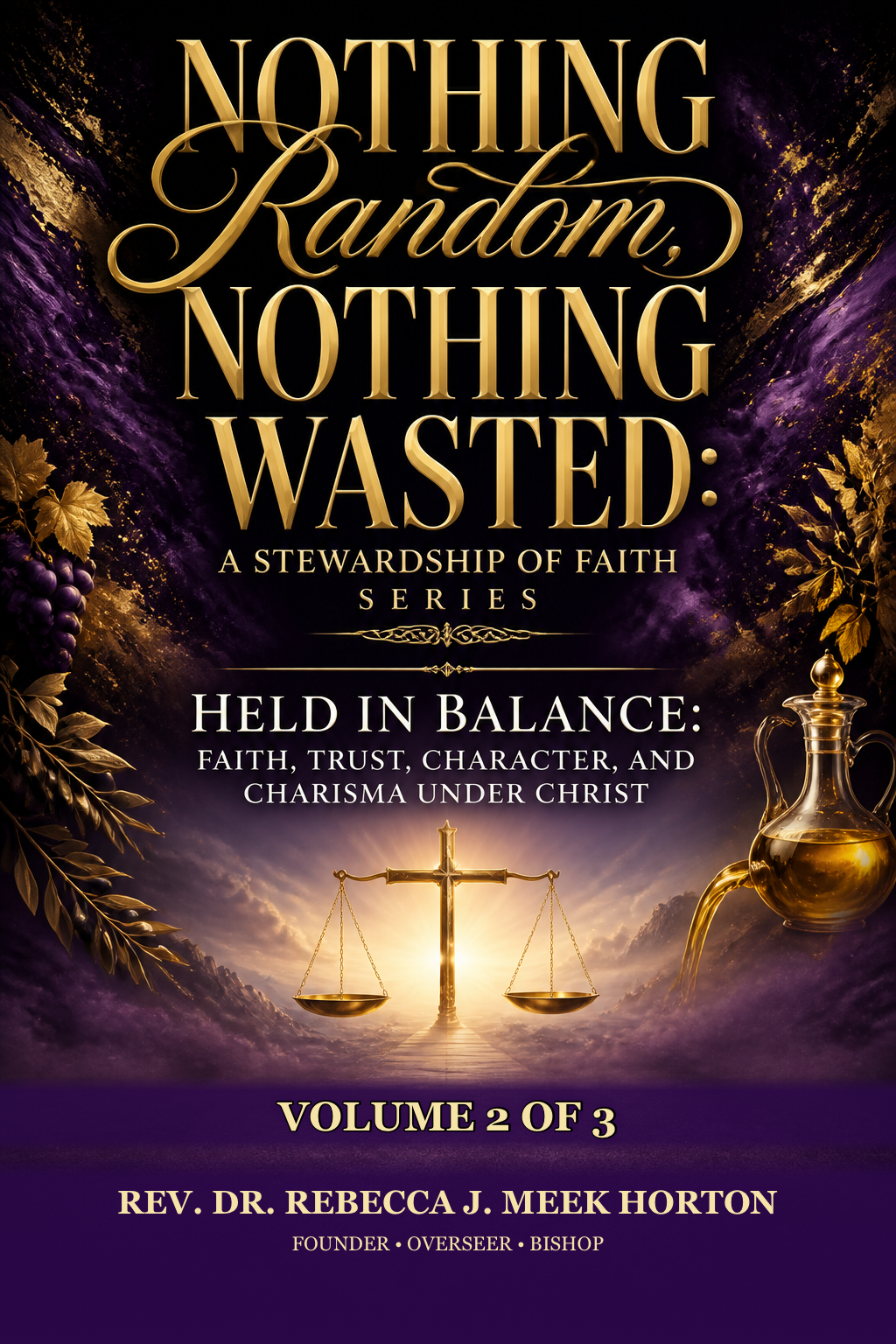
Nothing Random, Nothing Wasted: A Stewardship of Faith Series · Volume 2
Held in Balance: Faith, Trust, Character, and Charisma Under Christ
Part 2 of 3 in the series "Nothing Random, Nothing Wasted: A Stewardship of Faith Series". Series theme: Receiving, Developing, Balancing, and Stewarding Spiritual Gifts, Fruit, Faith, Grace, and Anointing Series arc: This three-book series moves the reader from recognition to responsibility. Book one helps believers receive and name what God has been developing through the journey: spiritual gift
Chapter 1 preview
NBCNGMI MASTER KNOWLEDGE LIBRARY Featuring the works of The Sage, Apostle Prophet. Rev. Dr. Rebecca J. Meek Horton, Apostolic Prophetic Architect, NewBeing Creation Network Global Ministries, Inc. Integrated Framework Modalities™
Dedication
I dedicate this book to every believer learning to trust Christ beyond what can be seen, and to every seeker being drawn toward His faithful hand. May your faith be strengthened, your character be formed, and every gift you carry remain held in balance under Him.
Purpose
I wrote this book because faith must become more than something we confess; it must become trust we practice when the outcome is still unseen. After we recognize what God has placed in us, we must learn how to carry it under Christ with fruit, humility, character, and accountability.
My prayer is that this book helps you examine belief, trust, influence, and motive in the light of Scripture, including Hebrews 11:1, Proverbs 3:5–6, Romans 12:3, 1 Corinthians 13:1–3, and Matthew 7:16–20 (KJV). I hope it strengthens you to walk in obedience, steward what God has entrusted, and keep every gift, grace, and expression of charisma held in balance under Christ.
Preface
I wrote this book because I have seen how easily sincere faith can become unbalanced when it is not governed by trust, character, humility, and accountability.
Many believers love God deeply. They believe His Word. They desire to serve well. Yet somewhere along the way, faith can be reduced to confession without obedience, gifting can be mistaken for maturity, and charisma can be celebrated before character is formed enough to carry it. I have watched this tension in personal lives, families, churches, and ministry settings. I have also had to let the Lord search it in me.
This book was born from that holy searching.
Held in Balance is the second movement in the series Nothing Random, Nothing Wasted: A Stewardship of Faith Series. The first book helped us recognize what God has been developing through the journey. This book asks a deeper question: now that we have received and recognized what God has entrusted, how do we carry it without becoming careless, inflated, fearful, or unstable?
Faith is not only belief. Faith must become trust. Hebrews 11:1 says, “Now faith is the substance of things hoped for, the evidence of things not seen” (KJV). Trust is where faith becomes practiced obedience when the outcome is still unseen. Proverbs 3:5–6 teaches us, “Trust in the LORD with all thine heart; and lean not unto thine own understanding. In all thy ways acknowledge him, and he shall direct thy paths” (KJV).
That kind of trust is not passive. It is not reckless. It is not blind loyalty to people or systems. It is surrendered confidence in God that learns how to discern, obey, wait, ask questions, receive counsel, and walk in truth.
This book is also about balance. Gifts matter. Anointing matters. Influence matters. But character must govern charisma. Fruit must weigh more than performance. Love must remain greater than visibility. As 1 Corinthians 13:1–3 reminds us, spiritual expression without love profits nothing.
My prayer is that these pages help you slow down, examine what you are carrying, and let Christ bring it into order. Not so you shrink back. Not so you fear your gifts. But so you can steward them with clean hands, a sober mind, a teachable heart, and obedient faith.
Nothing is random. Nothing is wasted. But what God entrusts must also be held in balance.
Introduction
Faith is often easier to name than it is to exercise.
Many believers can say, “I believe God.” The harder question is, “Will I trust Him when I cannot see the outcome?” That is where faith begins to mature. Hebrews 11:1 says, “Now faith is the substance of things hoped for, the evidence of things not seen” (KJV). Faith is not empty optimism. It is not denial. It is not pretending uncertainty does not exist. Faith is belief that becomes trust, and trust becomes obedience when the next step is clear but the whole path is not.
This book is the second movement in the series Nothing Random, Nothing Wasted: A Stewardship of Faith Series. Book one helped us receive and recognize what God has been forming through the journey: spiritual gifts, fruit, wisdom, scars, lessons, and grace. This book asks what happens next. Once we recognize what God has entrusted, we must develop it. We must learn how to carry it without being carried away by it.
That is the work of balance.
Gifts are real, but gifts are not enough. Charisma can draw attention, but character must govern influence. Faith can speak boldly, but trust must obey humbly. A person may have visible spiritual activity and still lack the fruit that proves maturity. Jesus said, “Wherefore by their fruits ye shall know them” (Matthew 7:20, KJV). Fruit is not decoration. Fruit is evidence.
This book does not diminish spiritual gifts, grace, anointing, or holy boldness. It honors them by placing them under Christ. Spiritual influence becomes dangerous when it outruns humility, accountability, and obedience. Paul warned the church that even powerful expression without love profits nothing. “Though I speak with the tongues of men and of angels, and have not charity, I am become as sounding brass, or a tinkling cymbal” (1 Corinthians 13:1, KJV).
That warning still stands.
We live in a time when visibility can be mistaken for fruit, confidence can be mistaken for calling, and emotional intensity can be mistaken for spiritual authority. This is not only a ministry issue. It touches families, friendships, marriages, churches, workplaces, and private decision-making. We must learn when to trust, whom to trust, how to trust wisely, and how to remain trustworthy ourselves.
Trust in God is complete surrender. Trust in people requires wisdom, boundaries, time, fruit, and accountability. Proverbs 3:5–6 says, “Trust in the LORD with all thine heart; and lean not unto thine own understanding. In all thy ways acknowledge him, and he shall direct thy paths” (KJV). That kind of trust belongs to God. Human trust must be stewarded carefully. Love may be freely given, but access should be governed by fruit.
As you read, do not rush to apply each chapter to someone else. Let the Word search you first. Ask where belief has not yet become obedience. Ask where charisma has outpaced character. Ask where influence needs stronger safeguards. Ask where you have trusted too quickly, withdrawn too completely, or avoided the cost of mature accountability.
This book will move carefully. First, we will establish the problem and the promise: faith must become practiced trust, and spiritual influence must be brought under Christ. Then each chapter will carry one teachable idea, building from foundation to practice. You will meet discernment scenarios, relationship questions, leadership warnings, family applications, church applications, and ministry safeguards. The goal is not fear. The goal is governed maturity.
Romans 12:3 gives us a necessary posture: “not to think of himself more highly than he ought to think; but to think soberly” (KJV). Sober thinking protects spiritual people from spiritual exaggeration. It helps us receive grace without becoming careless with it. It teaches us to carry what God gives without using it to elevate ourselves.
Read this book slowly. Keep a notebook nearby. After each chapter, do the practice before moving on. Wisdom is not yours until you walk it.
Begin with this prayerful question: Lord, where does my faith need to become trust, and where does my influence need to come under greater fruit, humility, and accountability?
Chapter 1 — When Faith Must Become Trust
The chair was steady, but she still lowered herself into it slowly.
Everyone in the room had already sat down. No one inspected the legs. No one asked who built it. No one tested the screws. They simply trusted what they could not see because they had confidence in what the chair was made to do.
Then she laughed at herself and said, “I know it can hold me. I just still feel nervous sitting down.”
That sentence tells the truth about many believers.
We believe God is able. We believe His Word is true. We believe He is faithful, wise, holy, and good. But when obedience requires us to put weight on what we believe, we hesitate.
This is where faith must become trust.
The controlling idea of this chapter is simple: faith becomes trust when what we believe about God begins to govern what we do before we can see the outcome.
Hebrews 11:1 says, “Now faith is the substance of things hoped for, the evidence of things not seen” (KJV).
Faith is not fantasy. It is not pretending uncertainty does not exist. It is not forcing confidence while fear is still speaking. Faith is the God-given substance that holds us steady when the promise is not yet visible. It is the evidence we carry before the result arrives.
But faith that remains only in confession will eventually be tested by a moment that requires movement.
That moment may come in a decision.
It may come in a relationship.
It may come in a season of waiting.
It may come when God asks for obedience before He provides explanation.
Many believers do not struggle because they have no faith. They struggle because faith has not yet become exercised trust.
Faith Is More Than Agreement
It is possible to agree with truth and still avoid surrender.
A person can say, “God is my provider,” and still live ruled by fear. A person can say, “God forgives,” and still refuse to release shame. A person can say, “God leads,” and still hold every decision hostage until every detail feels safe.
Agreement is important. We must know what is true.
But agreement alone is not the same as trust.
Trust begins when truth receives weight in the real places of life.
Think of a bridge. You can study its design. You can believe engineers built it well. You can tell others the bridge is strong. But you do not actually trust the bridge until you cross it.
Many believers stand at the edge of obedience with accurate theology and anxious feet.
They know what Scripture says. They know what they should do. They may even encourage others to do it. But when the Lord touches their own comfort, reputation, schedule, money, forgiveness, calling, or control, the gap appears.
This gap is not always rebellion. Sometimes it is fear. Sometimes it is immaturity. Sometimes it is pain from past disappointment. Sometimes it is the habit of self-protection.
The Lord is not confused by that gap. He is faithful to mature us there.
Jesus asked a searching question in Luke 6:46: “And why call ye me, Lord, Lord, and do not the things which I say?” (KJV).
That question is not meant to crush us. It is meant to reveal us.
If I call Him Lord, where am I still refusing His leadership?
If I say I believe His Word, where am I delaying obedience?
If I trust His heart, where am I still demanding control?
Faith matures when we allow these questions to search us without shame and without excuse.
A young believer may believe God loves them but still live as if every mistake disqualifies them. A seasoned believer may believe God directs steps but still resist a hard act of obedience because it feels costly. A ministry leader may believe God builds the work but still overwork from fear that everything will collapse without them.
These are not small matters. They are the places where belief must be trained into trust.
Nothing is random. Nothing is wasted. Even the places where we hesitate can become places of formation if we bring them honestly before Christ.
The Unseen Place
Hebrews 11:1 does not remove the unseen.
It teaches us how to live in it.
“Now faith is the substance of things hoped for, the evidence of things not seen” (KJV).
The verse does not say faith is the substance of things already possessed. It does not say faith is the evidence of things already visible. Faith belongs to the space between what God has said and what we can currently see.
That space is where trust is formed.
Most of us want God to remove uncertainty before requiring obedience. We want the full map, the guaranteed result, the closed loophole, the confirmed timeline, the visible provision, and the comfortable feeling.
But trust often grows before those things appear.
A farmer plants seed into soil that looks like burial. He cannot see the harvest when he covers the seed. He does not dig it up every morning to check whether the ground is working. He acts because he understands the nature of seed, soil, and season.
In the same way, trust does not mean we see everything. It means we know enough about God to obey Him with what we have been given.
This does not make obedience easy.
It makes obedience anchored.
There is a difference between blind risk and biblical trust. Blind risk ignores wisdom. Biblical trust responds to God with reverence, patience, and obedience. It does not despise counsel. It does not reject Scripture. It does not confuse impulse with direction.
Faith is not an excuse to be careless.
Faith is the reason we can be faithful.
Second Corinthians 5:7 says, “For we walk by faith, not by sight:” (KJV).
Notice the word walk.
Not float.
Not perform.
Not panic.
Walk.
Walking is usually ordinary. One step follows another. Most obedience is not dramatic. It is daily. It is the next faithful response to what God has already made clear.
Call the person.
Tell the truth.
Forgive before your feelings fully cooperate.
Stop feeding the habit that is weakening your spirit.
Take responsibility for what you keep avoiding.
Wait without manipulating the outcome.
Serve without needing applause.
Pray again.
Begin again.
Trust is not always a leap. Often it is a step.
And the step matters.
Where Belief Gets Stuck
Many believers get stuck between conviction and obedience.
They know the truth, but the truth has not yet reordered the decision.
This is not always because they do not love God. It is often because another voice has become louder in the moment.
Fear says, “What if this fails?”
Pride says, “What will people think?”
Control says, “I need to know first.”
Pain says, “I trusted before and was wounded.”
Comparison says, “Someone else is moving faster.”
Weariness says, “I cannot carry one more thing.”
These voices do not always sound evil. Sometimes they sound reasonable. Sometimes they sound protective. Sometimes they use facts. But they must still be weighed under the Lordship of Christ.
A woman may believe God can restore her peace, but she keeps returning to the same anxious pattern because worry feels like responsibility. A man may believe God calls him to integrity, but he keeps hiding the truth because exposure feels too dangerous. A family may believe God should be first, but their calendar proves that everything else is leading.
Belief gets stuck when we confess one thing and practice another.
This is where RE-Cognition™ matters. We must recognize what is actually happening. Not what we wish were happening. Not what we say on Sunday. Not what we want others to think. What is really governing the decision?
Is it faith?
Is it fear?
Is it wisdom?
Is it control?
Is it obedience?
Is it avoidance?
The point is not to condemn ourselves. Condemnation rarely produces maturity. The point is to tell the truth so grace can train us.
A simple example may help.
A believer says, “I trust God with my future.” Then a door closes. Immediately, they begin striving, forcing conversations, replaying every detail, blaming others, and assuming God has forgotten them.
The closed door did not create the distrust. It revealed where trust needed development.
That revelation is a mercy.
If we let God meet us there, the closed door can become a classroom. We can learn to pray without panic. We can seek counsel without desperation. We can grieve disappointment without accusing God. We can take the next faithful step instead of trying to control the whole future.
Faith becomes trust when we stop using belief as language only and begin allowing it to govern our reactions.
This is slow work.
It is holy work.
It is also necessary work.
Because unexercised faith stays fragile under pressure.
The First Step of Trust
Trust usually begins smaller than we expect.
We may imagine trust as one grand act of courage. Sometimes it is. But most of the time, trust begins with one honest act of obedience.
The first step may be admitting, “Lord, I believe, but I am afraid.”
It may be writing down the decision you have been avoiding.
It may be asking, “What has God already made clear?”
It may be obeying the last instruction before asking for another one.
It may be stopping long enough to wait instead of rushing to relieve the tension.
A man once shared that he had prayed for direction for months. He wanted clarity about a major life decision. But while he kept asking for direction, he was ignoring a clear act of obedience in his current life: he needed to apologize to his brother.
He wanted guidance for the future while resisting obedience in the present.
When he finally made the call, nothing dramatic happened at first. There was no instant open door. No sudden announcement. No complete map.
But something in him shifted.
His heart became quieter. His prayers became cleaner. He was no longer trying to use future obedience to avoid present surrender.
That is often how trust grows.
God strengthens us as we obey what is clear.
Psalm 119:105 says, “Thy word is a lamp unto my feet, and a light unto my path” (KJV).
A lamp does not show the whole road at once. It gives enough light for the next steps.
Many of us want floodlights. God often gives a lamp.
The lamp is not failure. It is invitation.
It teaches dependence.
It trains attention.
It keeps us near.
Trust says, “Lord, I will walk in the light You have given, even while I wait for what I cannot yet see.”
This does not mean every desire is from God. It does not mean every open door is safe. It does not mean every delay is denial. It means the believer learns to stay submitted while discerning.
In this first chapter, we are not trying to solve every question about timing, relationships, gifts, or influence. Those matters will need careful attention. For now, we are naming the foundation.
Faith must become exercised trust.
Not rushed trust.
Not foolish trust.
Not trust in our own interpretation.
Trust in God that becomes obedience under Christ.
The Cost of Leaving Control
Trust will cost us something.
It will cost the illusion of control.
It will cost the need to understand everything before obeying anything.
It will cost the comfort of delayed obedience.
It will cost the habit of calling fear “wisdom” when God has already spoken.
This is where we must be honest. Trust can feel vulnerable. Obedience can feel risky. Waiting can feel like loss. Surrender can feel like dying to the version of life we thought we needed.
The cost is real.
But so is the danger of never trusting.
A life that only believes in theory becomes divided. The mouth confesses God, but the hands cling to control. The mind agrees with Scripture, but the feet refuse movement. The heart wants peace, but the habits keep feeding fear.
Christ does not invite us into that division.
He calls us into a whole life.
Not perfect at once.
Not fearless.
Not without questions.
But whole enough to say, “Lord, teach my belief how to walk.”
The cost of trust is control.
The fruit of trust is formation.
When faith becomes trust, we become steadier. Not because circumstances are always calm, but because Christ is governing more of us. Our belief begins to touch our choices. Our prayers begin to shape our posture. Our obedience becomes less dependent on visible guarantees.
This is how a governed life begins.
Not with noise.
Not with performance.
Not with pretending.
It begins when the believer places the next step under the Lordship of Christ.
Key Takeaways
• Faith is not only belief; it is belief that begins to carry weight in real decisions.
• Trust grows in the unseen place, where obedience comes before full visibility.
• The first step of trust is usually one clear act of obedience with the light God has already given.
Practice
Take ten quiet minutes today and write one sentence:
“I say I believe God about __________, but I struggle to trust Him by __________.”
Then ask the Lord for one clear next step of obedience.
Do not choose a dramatic step to impress anyone. Choose a faithful step you can actually take within the next twenty-four hours.
Pray simply:
“Lord, I believe You. Teach my faith to become trust. Show me the next faithful step, and give me grace to walk it under Christ. Amen.”
This is the opening chapter. The complete publication is available in the full edition.
Back to the library