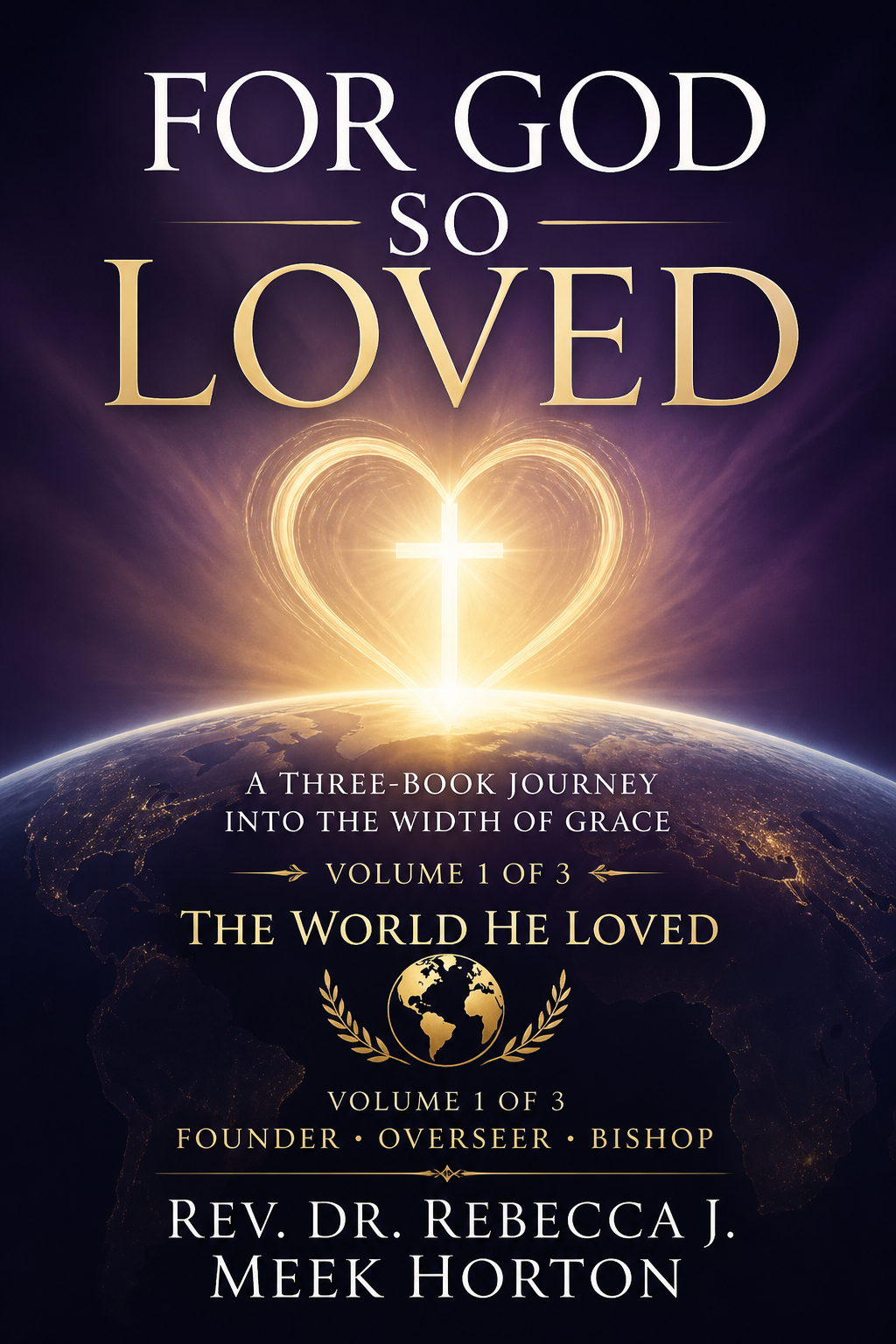
For God So Loved: A Three-Book Journey into the Width of Grace · Volume 1
The World He Loved
Part 1 of 3 in the series "For God So Loved: A Three-Book Journey into the Width of Grace". Series theme: John 3:16 Series arc: This series follows the movement of John 3:16 from revelation to reception to witness. Book One opens the heart of God, showing that His love begins with His own character and reaches the whole world. Book Two walks through the barriers that keep people from receiving tha
Chapter 1 preview
NBCNGMI MASTER KNOWLEDGE LIBRARY Featuring the works of The Sage, Apostle Prophet. Rev. Dr. Rebecca J. Meek Horton, Apostolic Prophetic Architect, NewBeing Creation Network Global Ministries, Inc. Integrated Framework Modalities™
Chapter 1 — The Verse We Thought We Knew
A child stands in a church Christmas program, hands folded, shoes tapping the floor, waiting for her line.
When the moment comes, she takes a breath and says, “For God so loved the world…”
Most of the room knows the rest before she finishes. Some mouth the words with her. Some remember saying them when they were small. Some have seen them painted on signs, printed on cups, stitched into pillows, held up behind goalposts, and quoted at funerals.
John 3:16 may be the most familiar sentence in the Bible.
And familiarity can be a gift.
It can also make us careless.
Sometimes we move so quickly through the verse that we stop hearing its weight. We hear a slogan where Scripture gives us a revelation. We hear comfort, but not cost. We hear “world,” but do not pause to ask what kind of world God loved. We hear “gave,” but forget that love took flesh, entered sorrow, and moved toward a cross.
The controlling idea of this chapter is simple: John 3:16 asks us to slow down and receive the love of God as God reveals it — love that begins in Him, reaches the world, and is made known in the giving of His Son.
Not random love.
Not shallow love.
Not sentimental love.
Holy love.
Costly love.
Saving love.
## The Danger of Knowing the Words Too Well
There is a kind of knowing that becomes thin.
We can know a verse the way we know a street we drive every day. We pass the same houses, the same trees, the same stop sign. Then one day we walk the road slowly and notice the porch light, the cracked sidewalk, the flowers growing near the mailbox. The road was always there. We were the ones moving too fast.
John 3:16 is often treated that way.
> “For God so loved the world, that he gave his only begotten Son, that whosoever believeth in him should not perish, but have everlasting life.” > — John 3:16, KJV
The verse is clear enough for a child to speak and deep enough for a lifetime of worship.
Jesus speaks these words in a conversation with Nicodemus, a religious leader who came to Him at night (John 3:1–2). Nicodemus had knowledge, position, and religious seriousness. But Jesus did not flatter him. He told him he needed to be born again (John 3:3).
That matters.
John 3:16 is not floating by itself as a pleasant religious saying. It comes in the middle of a conversation about new birth, spiritual blindness, human need, and the saving work of God. Jesus is not giving Nicodemus a decorative verse. He is opening the truth of salvation.
That should humble us.
The verse we thought we knew may still be searching us.
For example, a person may quote John 3:16 and still believe God’s love must be earned. Another may quote it and assume God’s love means sin does not matter. Another may quote it and imagine the “world” only includes people they understand, approve of, or feel comfortable around.
But the verse does not bend to our assumptions.
It calls us back to God’s own heart.
## “For God So Loved”
The verse begins where all true love begins.
God.
Not human longing. Not religious effort. Not moral improvement. Not cultural kindness.
“For God so loved…”
This is the first foundation.
God’s love begins in God.
We do not create it. We do not awaken it by becoming impressive. We do not purchase it with obedience. We do not deserve it by being easier to love than someone else.
God loved because God is love.
Later, John writes:
> “Beloved, let us love one another: for love is of God… He that loveth not knoweth not God; for God is love.” > — 1 John 4:7–8, KJV
This does not mean love is whatever we want it to be. It means God is the source, measure, and truth of love.
The world does not teach God how to love.
God teaches the world what love is.
That is important because many of us carry wounded definitions of love. Some have known love as approval only when they performed well. Some have known love as control. Some have known love as affection without faithfulness. Some have known love as words without sacrifice.
Then Scripture says, “For God so loved…”
It gently corrects us.
God’s love is not fragile like ours. It is not moody. It is not selfish. It is not confused. It is not careless with truth. It is not surprised by human weakness.
Imagine a father standing at the edge of a storm, watching the child he loves wander into danger. Real love does not shrug and say, “Be yourself.” Real love moves. Real love warns. Real love reaches. Real love acts.
John 3:16 tells us that God’s love moved.
That movement began in His own heart.
Nothing is random. Nothing is wasted.
Even the order of the verse teaches us: before the world is named, God is named. Before the gift is named, the love is named. Before belief is called for, divine initiative is revealed.
God loved first.
## “The World”
Then the verse widens.
“For God so loved the world…”
Not only Israel. Not only the religious. Not only the morally polished. Not only the people already moving toward Him.
The world.
We must be careful here. This chapter is not yet trying to say everything that must be said about sin, repentance, judgment, and transformation. Those matters are real and will require honest attention. But first, we must let the width of this word stand.
World.
In John’s Gospel, “world” often means humanity in its estrangement from God — the created order and human family marked by darkness, rebellion, blindness, and need. This means John 3:16 is not saying God loved a harmless world. It is saying God loved a needy world.
That makes the verse more beautiful, not less.
God did not look upon the world and find it easy to love. He loved according to His own mercy and purpose.
This matters for the way we see people.
We often shrink the world into categories.
People like us.
People not like us.
People who agree.
People who offend.
People we feel responsible for.
People we would rather avoid.
But John 3:16 will not let us keep such a small vision. The love of God reaches wider than our comfort. It crosses lines of nation, class, history, reputation, personality, and failure.
A church member once described how hard it was for her to pray for someone who had hurt her family. She did not pretend the wound was small. It was not. But over time, she realized she had started speaking of that person as if they were beyond mercy. She was not ready for reconciliation. She still needed boundaries. But she sensed the Spirit confronting her pride.
She said, “I had to remember that God loved the world before I was ready to.”
That is not easy work.
But it is holy work.
John 3:16 does not ask us to deny harm. It does not ask us to call evil good. It does not erase justice. But it does reveal something we must not ignore: there is no human being we can place outside the reach of God’s saving love.
The world He loved is wider than the world we would have chosen.
## “He Gave His Only Begotten Son”
The love of God does not remain an idea.
It becomes a gift.
“For God so loved the world, that he gave his only begotten Son…”
Here the verse becomes serious.
God’s love is not vague kindness. It is revealed in the giving of His Son. The Father does not merely send a message. He gives the Son. The Son does not merely visit human pain. He enters it. He takes on flesh. He walks among the weary, the proud, the sick, the ashamed, the religious, the overlooked, and the resistant.
And He moves toward the cross.
This is where sentimental readings of John 3:16 begin to fail. If we say, “God loves the world,” but never look at the gift of the Son, we may turn divine love into a warm feeling. But Scripture ties love to sacrifice.
God loved, so God gave.
The gift reveals the depth of the love.
Think of someone giving not from excess, but from the deepest place of cost. Not an old item they no longer need. Not a token. Not a gesture. A true gift. A costly gift. A gift that carries the giver’s heart.
John 3:16 says the Father gave His Son.
This does not mean the Father was loving while the Son was unwilling. The witness of Scripture is one united saving work of God. Jesus says, “I lay down my life for the sheep” (John 10:15). The love of God is revealed in the mission of the Son, and the Son gives Himself freely.
Still, we should not rush past the word “gave.”
The love of God has weight.
The gift of the Son tells us that our condition was serious enough to require rescue and that God’s love was deep enough to provide it.
That keeps us from two errors.
First, we must not make God’s love shallow, as if salvation were unnecessary.
Second, we must not make human sin stronger than God’s mercy, as if rescue were impossible.
John 3:16 holds both truths together. We were perishing. God gave His Son. Whoever believes in Him should not perish but have everlasting life.
This is not cheap comfort.
This is holy grace.
## The Cost of Slowing Down
To slow down over John 3:16 will cost us something.
It may cost us our casual religion.
We may have to stop using the verse as a familiar phrase and let it become a mirror. Do I receive God’s love as gift, or do I keep trying to earn it? Do I rejoice that God loves the world, or do I secretly wish His mercy were narrower? Do I speak of the cross with gratitude, or have I grown dull toward the cost?
It may also cost us our small definitions of love.
God’s love is wider than sentiment and deeper than affirmation. It welcomes, but it also saves. It comforts, but it also confronts. It is tender, but it is never careless.
The verse we thought we knew asks us to stand still long enough to be taught again.
That is not a small thing.
Many of us prefer quick inspiration. God often gives slow formation.
We want a verse to carry in our pocket. God gives a truth that carries us, searches us, and reorders us.
John 3:16 is not less powerful because it is familiar.
It may be familiar because it is so powerful.
So we begin this book here, not with arguments about inclusion, not with reactions to culture, not with human ideals of kindness, but with the revealed heart of God.
For God so loved.
The love begins in Him.
The love reaches the world.
The love is revealed in the giving of His Son.
And the invitation is not to hurry past it, but to receive it with reverence.
## Key Takeaways
- John 3:16 is familiar, but it is not light. - God’s love begins in His own holy character. - The gift of the Son reveals the depth and cost of divine love.
## Practice
Read John 3:16–17 slowly three times today.
The first time, notice what the verse says about God.
The second time, notice what it says about the world.
The third time, notice what it says about the Son.
Then write one sentence in response: “God, help me receive Your love as…”
This is the opening chapter. The complete publication is available in the full edition.
Back to the library