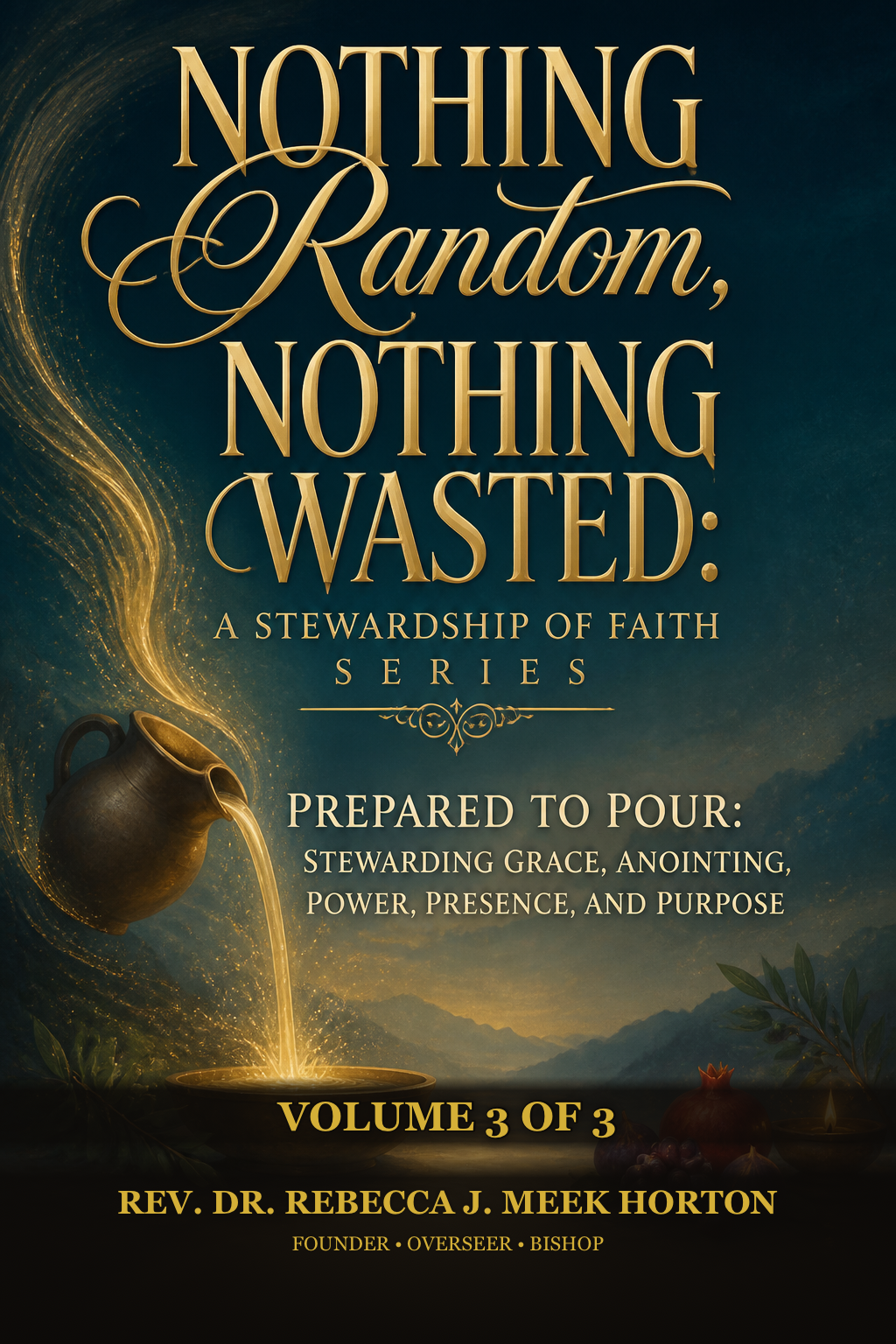
Nothing Random, Nothing Wasted: A Stewardship of Faith Series · Volume 3
Prepared to Pour: Stewarding Grace, Anointing, Power, Presence, and Purpose
Part 3 of 3 in the series "Nothing Random, Nothing Wasted: A Stewardship of Faith Series". Series theme: Receiving, Developing, Balancing, and Stewarding Spiritual Gifts, Fruit, Faith, Grace, and Anointing Series arc: This three-book series moves the reader from recognition to responsibility. Book one helps believers receive and name what God has been developing through the journey: spiritual gift
Chapter 1 preview
NBCNGMI MASTER KNOWLEDGE LIBRARY Featuring the works of The Sage, Apostle Prophet. Rev. Dr. Rebecca J. Meek Horton, Apostolic Prophetic Architect, NewBeing Creation Network Global Ministries, Inc. Integrated Framework Modalities™
Dedication
I dedicate this book to every believer learning to carry what God has given with humility, order, and obedient love. May you know that grace is not earned, anointing is not manufactured, and nothing God has formed in you is random or wasted.
Purpose
I wrote this book to help believers become prepared vessels who can receive, hold, and steward what God supplies without pride, waste, or disorder. Grace is unearned, anointing is not manufactured, and power must remain submitted to the lordship of Jesus Christ. My prayer is that this book helps you examine your capacity, walk in accountable obedience, and pour out what you have received for God’s glory and the good works He prepared for you. Ephesians 2:10; 2 Corinthians 4:7.
Preface
This book was born out of a burden for prepared vessels.
I have watched many believers desire the more of God, but not always know how to carry what He gives. We pray for grace, anointing, power, presence, and purpose. We ask to be used. We want our lives to matter. Yet the greater question is not only, “Can God pour?” He can. The question is, “Are we prepared to receive, hold, and steward what He supplies?”
Jesus said, “Neither do men put new wine into old bottles” Matthew 9:17 (KJV). That Scripture has searched me deeply. New wine requires a prepared vessel. Not a perfect vessel. Not a proud vessel. Not a public vessel first. A prepared vessel.
This final book in the Nothing Random, Nothing Wasted series gathers the journey into stewardship. Book one helped us recognize what God has been forming. Book two helped us bring faith, gifts, fruit, character, and charisma into balance. This book calls us into mature carrying. It asks how we serve with humility, structure, obedience, and accountability under the lordship of Christ.
Grace is not earned. Anointing is not manufactured. Power is not for performance. Presence is not a platform. Purpose is not self-promotion. Everything God gives must be stewarded back to Him.
Paul reminds us, “But we have this treasure in earthen vessels, that the excellency of the power may be of God, and not of us” 2 Corinthians 4:7 (KJV). That is the heart of this book. The treasure is real, but the vessel must stay surrendered. The supply is holy, but the steward must remain humble.
As you read, I invite you to slow down. Do not rush past the questions. Let the Word search your motives, your capacity, your habits, your relationships, and your readiness. Nothing is random. Nothing is wasted. Even the hidden seasons have been part of the preparation.
My prayer is that this book helps you become not merely inspired, but prepared. Not dependent on emotion, but grounded in obedience. Not chasing increase, but stewarding faithfully what has already been placed in your hands.
Begin with this simple posture: Lord, prepare me to pour without wasting what You have entrusted to me.
Introduction
There is a difference between being gifted and being prepared.
Many believers can name what they carry before they have learned how to steward it. We may recognize grace, spiritual gifts, anointing, power, presence, or purpose, yet still struggle with pride, disorder, exhaustion, fear, comparison, or inconsistency. God is generous, but His generosity is not an invitation to waste. What He gives must be received with humility, held with structure, and poured out in obedience.
This book is the third movement in Nothing Random, Nothing Wasted: A Stewardship of Faith Series. Book one helped you recognize what God has been developing through your journey. Book two called faith into exercised trust and brought gifts, fruit, character, and charisma into balance. This final book gathers the whole work into stewardship. The question is no longer only, “What has God given me?” The question becomes, “Am I prepared to carry it well?”
Jesus said, “Neither do men put new wine into old bottles: else the bottles break, and the wine runneth out, and the bottles perish” Matthew 9:17 (KJV). The issue is not the quality of the wine. The issue is the condition and capacity of the vessel. Some things are lost, not because God did not give them, but because the structure holding them was not ready.
Prepared to Pour is about becoming a vessel prepared to receive, hold, and utilize what God supplies. It will not teach you to manufacture anointing. Anointing is not produced by personality, volume, performance, imitation, or platform. It belongs to God. It is entrusted. It is carried under His lordship. This book will also not teach you to earn grace. Grace is unearned. Paul heard the Lord say, “My grace is sufficient for thee: for my strength is made perfect in weakness” 2 Corinthians 12:9 (KJV). Grace is not a reward for being impressive. Grace is God’s supply for obedient dependence.
Yet dependence is not passivity. Scripture says, “But we have this treasure in earthen vessels, that the excellency of the power may be of God, and not of us” 2 Corinthians 4:7 (KJV). The treasure is His. The vessel is accountable. Power is received, but stewardship is practiced. Presence is holy, but daily life must make room. Purpose is prepared by God, but walked out by obedience. “For we are his workmanship, created in Christ Jesus unto good works” Ephesians 2:10 (KJV).
This book will help you examine capacity honestly. You will be invited into a vessel-capacity audit: your inner life, motives, rhythms, obedience, relationships, speech, leadership, rest, and readiness. This is not for shame. It is for RE-Calibration™. These audits are meant to reveal what needs strengthening so nothing entrusted to you is handled carelessly.
Read this book slowly. Do not rush to the parts that sound powerful while avoiding the parts that require surrender. Keep Scripture open. Let the Word search you before you use it to explain yourself. If you are a believer, read as a steward. If you are a seeker, read with honest curiosity. The life of faith is not about self-display. It is about being formed by Christ and made useful for His purpose.
Each chapter will move from truth to practice. You will find daily WALK™ practices: Wait in stillness, Ask honestly, Listen carefully, and Keep the next faithful step. You will build a 30-60-90 day stewardship plan so insight becomes obedience. You will also learn how mature stewardship multiplies through the 5-Gs™: Gather, Ground, Grow, Give, and Glorify. What God matures in you is not meant to end with you.
The cost is real. Stewardship will confront impatience, hidden pride, spiritual performance, disorder, and the desire to be seen before being seasoned. But the promise is greater. “But ye shall receive power, after that the Holy Ghost is come upon you” Acts 1:8 (KJV). Power comes from God. Preparation teaches us how to carry it without corrupting it.
Nothing is random. Nothing is wasted.
Begin with one prayer: Lord, make me a vessel You can trust.
Chapter 1 — The Vessel Is Not the Treasure
A woman stood near the back of the sanctuary after service, holding her Bible against her chest like she was trying to hold herself together.
People had come to her all morning.
“Your prayer changed my life.”
“You have such a powerful gift.”
“When you spoke, I felt the presence of God.”
She smiled. She hugged. She said the right words. But when the last person walked away, her smile fell. She whispered to a trusted friend, “I’m scared I’m starting to believe them.”
That is a holy fear.
Not fear that God uses us. He does.
Not fear that fruit appears. It should.
Not fear that people are helped. That is part of the work.
The fear is this: that we may begin to confuse being used by God with being the source of what God supplied.
This is the first stewardship lesson of this book. We are vessels, not the treasure itself. God may pour grace through us, place anointing upon us, give power for witness, fill us with His presence, and assign purpose to our lives. But none of it begins in us. None of it belongs to us as a possession. None of it is safe when pride takes the seat that belongs to Christ.
Paul says it plainly:
“But we have this treasure in earthen vessels, that the excellency of the power may be of God, and not of us.” 2 Corinthians 4:7 (KJV)
That one verse can steady a whole life.
There is treasure.
There is a vessel.
There is power.
And there is a necessary distinction: “of God, and not of us.”
This chapter begins the final movement of the series. We are no longer only recognizing what God has been developing. We are no longer only learning to balance gifts, fruit, faith, character, and charisma. We are now asking a more mature question:
How do we carry what God supplies without pride, waste, or disorder?
The promise of this book is simple: by the grace of God, we can carry what He gives with humility. We can serve without pretending to be the source. We can pour out without performing. We can steward grace, anointing, power, presence, and purpose under the lordship of Christ.
The Compliment Can Become a Test
A compliment is not always dangerous. Encouragement can strengthen the weary. Honor can affirm faithful labor. Scripture tells us to give honor where honor is due. The problem is not that people notice fruit.
The problem begins when their words start forming our identity.
A believer prays, and someone is comforted.
A teacher explains Scripture, and someone receives understanding.
A singer ministers, and tears fill the room.
A leader makes a wise decision, and a family, business, ministry, or community is helped.
These moments are not small. God uses people. He places treasure in human vessels. But the vessel must learn how to receive affirmation without feeding on it.
A cup can be beautiful, but the thirsty person needs the water.
A lamp can be polished, but the room needs the light.
A messenger can be faithful, but the message belongs to the One who sent it.
When people respond to what God has done through us, we need enough spiritual maturity to say, “Thank You, Lord,” before we say, “Thank you.” Both may be appropriate. But the order matters.
Jesus taught His disciples this dependence clearly:
“I am the vine, ye are the branches: He that abideth in me, and I in him, the same bringeth forth much fruit: for without me ye can do nothing.” John 15:5 (KJV)
Without Him, we can do nothing.
Not less.
Nothing.
That does not make the believer worthless. It makes the believer dependent. Dependency on Christ is not weakness; it is the only safe way to carry spiritual weight.
A branch that forgets the vine may still look alive for a little while. It may still hold leaves for a season. But it has no continuing life in itself.
So when encouragement comes, receive it with sobriety.
Do not reject every kind word in the name of humility. False humility can become pride wearing quiet clothes. You do not need to argue when someone says God used you. A simple response may be enough:
“Thank you. I’m grateful the Lord helped you.”
That language keeps honor in order.
It receives encouragement.
It refuses ownership of glory.
It remembers the Source.
The Treasure Has a Source
Paul does not deny that treasure is present. He says, “we have this treasure.”
That matters.
Some believers think humility means denying anything good is happening in them or through them. They cannot acknowledge grace without apology. They minimize every gift. They shrink back from every assignment. They call fear “humility” and hiding “wisdom.”
But Paul does not say, “There is no treasure.”
He says the treasure is in “earthen vessels.”
An earthen vessel is made of clay. It is useful, but fragile. It can carry something valuable, but it is not the valuable thing. Its worth is connected to the purpose of the one who formed it and the treasure placed within it.
That is a needed word for believers.
God uses real people with real limitations.
People with history.
People with weakness.
People who have been corrected.
People who still need mercy.
People who are learning how to obey.
The treasure does not become less holy because the vessel is earthen. And the vessel does not become divine because the treasure is holy.
This distinction protects us from two errors.
The first error is pride: “God used me because I am exceptional.”
The second error is despair: “God cannot use me because I am weak.”
Both errors center the vessel.
Pride says the vessel is too impressive.
Despair says the vessel is too damaged.
The gospel says the power is of God.
Paul knew this deeply. He had authority, revelation, calling, suffering, and weakness. He was not confused about the source of his ministry. He wrote:
“Not that we are sufficient of ourselves to think any thing as of ourselves; but our sufficiency is of God.” 2 Corinthians 3:5 (KJV)
Our sufficiency is of God.
That sentence can break striving.
It can also break arrogance.
If our sufficiency is of God, we do not have to pretend we are enough in ourselves. We also do not get to boast as if we made ourselves enough.
Grace is received.
Anointing is entrusted.
Power is given.
Presence is hosted with reverence.
Purpose is assigned.
The believer’s responsibility is stewardship.
Stewardship begins with honest language. We must learn to speak about what God is doing without making ourselves the center.
Instead of “my power,” we can say “the power of God at work.”
Instead of “my platform,” we can say “the place of service entrusted to me.”
Instead of “my people,” we can say “the people God has allowed me to serve.”
Instead of “I built this,” we can say “God gave grace, and I obeyed my part.”
This is not wordplay. Language trains the heart.
RE-Language™ helps us move from ownership to stewardship. It teaches us to recognize words that inflate the self and reframe them toward responsibility. We are not erasing human participation. We are putting it in the right order.
Paul said:
“But by the grace of God I am what I am: and his grace which was bestowed upon me was not in vain.” 1 Corinthians 15:10 (KJV)
Notice the balance.
Grace made him.
Grace was not wasted.
Paul labored.
Yet the grace of God remained the source.
That is mature stewardship.
Used Does Not Mean Unbreakable
One of the quiet dangers of being used by God is assuming usefulness equals health.
A person can be gifted and exhausted.
Visible and unhealed.
Anointed for service and still in need of formation.
Fruitful in public and strained in private.
Being used does not mean the vessel needs no care.
Clay vessels can crack. They can be mishandled. They can be overloaded. They can be placed under heat they were not prepared to endure. They can also become so accustomed to being poured from that they never pause to be examined.
This is where many believers stumble. They think if God is still using them, everything must be fine.
But Samson still had strength before he faced the cost of his compromise. Saul still sat on a throne after his heart had turned. Judas still walked among the disciples while betrayal was forming inside him.
Usefulness is not the same as approval in every area.
Activity is not the same as alignment.
Impact is not the same as intimacy.
This should not make us fearful in a tormenting way. It should make us sober.
Peter wrote:
“As every man hath received the gift, even so minister the same one to another, as good stewards of the manifold grace of God.” 1 Peter 4:10 (KJV)
Good stewards pay attention to what has been received.
They do not treat grace casually.
They do not treat people as fuel for their assignment.
They do not keep pouring while ignoring cracks in character, motives, habits, relationships, or obedience.
There is a kind of ministry, leadership, and service that looks generous but is actually ungoverned. The person pours because they do not know how to stop. They say yes because they need to be needed. They serve because silence would force them to face what is happening inside.
That is not sustainable stewardship.
Nothing is random. Nothing is wasted. Even the weariness we feel may be telling the truth about something that needs attention.
Maybe the vessel is not being refilled.
Maybe the schedule is out of order.
Maybe the motive has shifted from love to proving.
Maybe the assignment has expanded beyond present capacity.
Maybe public fruit is hiding private neglect.
God is merciful enough to use us while He is still forming us. But we must not use His mercy as permission to avoid maturity.
Humility says, “Lord, thank You for using me. Now search me.”
Humility Makes the Vessel Safe
Humility is not self-hatred.
It is not pretending you have no gift.
It is not refusing responsibility.
It is not speaking badly about yourself so others will reassure you.
Humility is agreement with truth.
It agrees that God is the source.
It agrees that we are dependent.
It agrees that we are accountable.
It agrees that whatever we carry must serve His will, not our image.
James gives a sober promise:
“But he giveth more grace. Wherefore he saith, God resisteth the proud, but giveth grace unto the humble.” James 4:6 (KJV)
Pride turns the vessel inward.
Humility opens it upward.
Pride asks, “How did I appear?”
Humility asks, “Was Christ honored?”
Pride asks, “Did they notice me?”
Humility asks, “Were they served well?”
Pride asks, “How can I keep this influence?”
Humility asks, “How can I be faithful with what has been entrusted?”
This is not only an attitude. It becomes a practice.
A humble believer can be corrected.
A humble believer can rest.
A humble believer can celebrate another person’s grace without feeling diminished.
A humble believer can say, “I do not know.”
A humble believer can step forward when called and step back when wisdom requires.
A humble believer can carry power without making people dependent on their personality.
Humility makes room for stewardship because it keeps the vessel under authority.
This is essential for every believer, not only those with public ministry. A mother stewarding grace in her home needs humility. A business owner stewarding influence needs humility. A young believer discovering gifts needs humility. A pastor, teacher, intercessor, artist, administrator, caregiver, and encourager all need humility.
The issue is not the size of the platform.
The issue is the posture of the vessel.
Some people are proud with a microphone. Others are proud with no microphone at all. Pride does not need a stage. It only needs an unguarded heart.
Paul gives another needed instruction:
“For I say, through the grace given unto me, to every man that is among you, not to think of himself more highly than he ought to think.” Romans 12:3 (KJV)
Not more highly than he ought.
That means there is a right way to think about yourself.
You do not need to think lower than truth.
You need to think soberly.
Sober thinking says, “God has given me something to steward, and I am responsible to carry it in a way that points back to Him.”
That posture prepares us for the rest of this book.
Before we talk about holding more, we must settle who owns the treasure.
Before we talk about anointing, we must reject performance and imitation.
Before we talk about power, we must remember witness and accountability.
Before we talk about purpose, we must remember that good works are prepared by God, not manufactured by ego.
Stewardship begins here.
The Cost of Staying Clear
There is a cost to this clarity.
It will cost us the right to feed on applause.
It will cost us the comfort of self-importance.
It will cost us the excuse of false humility.
It will cost us the habit of using spiritual language to protect pride.
It will cost us the need to be the source, the answer, the rescuer, or the center.
That cost is real.
Sometimes humility feels like death because pride has been breathing through places we did not recognize.
It can be painful to admit, “I liked being needed.”
It can be painful to confess, “I felt threatened when God used someone else.”
It can be painful to realize, “I started serving from image instead of obedience.”
It can be painful to hear correction after people have praised you.
But this pain is not punishment. It is mercy. It is RE-Calibration™. It is the Lord bringing order to the vessel so the treasure is not misrepresented.
The goal is not to become suspicious of every blessing.
The goal is to become faithful.
God is not asking us to despise being used. He is teaching us to steward being used.
There is joy in this. Deep joy.
When you no longer have to be the source, you can serve with freedom.
When you no longer have to manufacture grace, you can receive it with gratitude.
When you no longer have to perform anointing, you can surrender.
When you no longer have to own power, you can witness faithfully.
When you no longer have to build purpose around your name, you can walk in obedience.
This is the promise: humility does not diminish the pour. Humility protects it.
The treasure remains excellent because it is of God.
The vessel remains useful because it is yielded.
Key Takeaways
• God is the source; we are entrusted vessels.
• Being used by God requires humility, not ownership.
• Stewardship begins when praise, weakness, and responsibility stay in proper order.
Practice
Take ten quiet minutes today with 2 Corinthians 4:7.
Read it slowly:
“But we have this treasure in earthen vessels, that the excellency of the power may be of God, and not of us.” 2 Corinthians 4:7 (KJV)
Then write two short lists.
First list: Where have I seen God place treasure in my life?
Second list: Where am I tempted to act like the source?
Do not rush to fix everything today. Begin with honesty.
Close with this prayer:
Lord, thank You for every grace You have entrusted to me. Keep me clear. Keep me humble. Teach me to carry what is Yours without pride, waste, or disorder. Let the excellency of the power be of You, and not of me. Amen.
This is the opening chapter. The complete publication is available in the full edition.
Back to the library