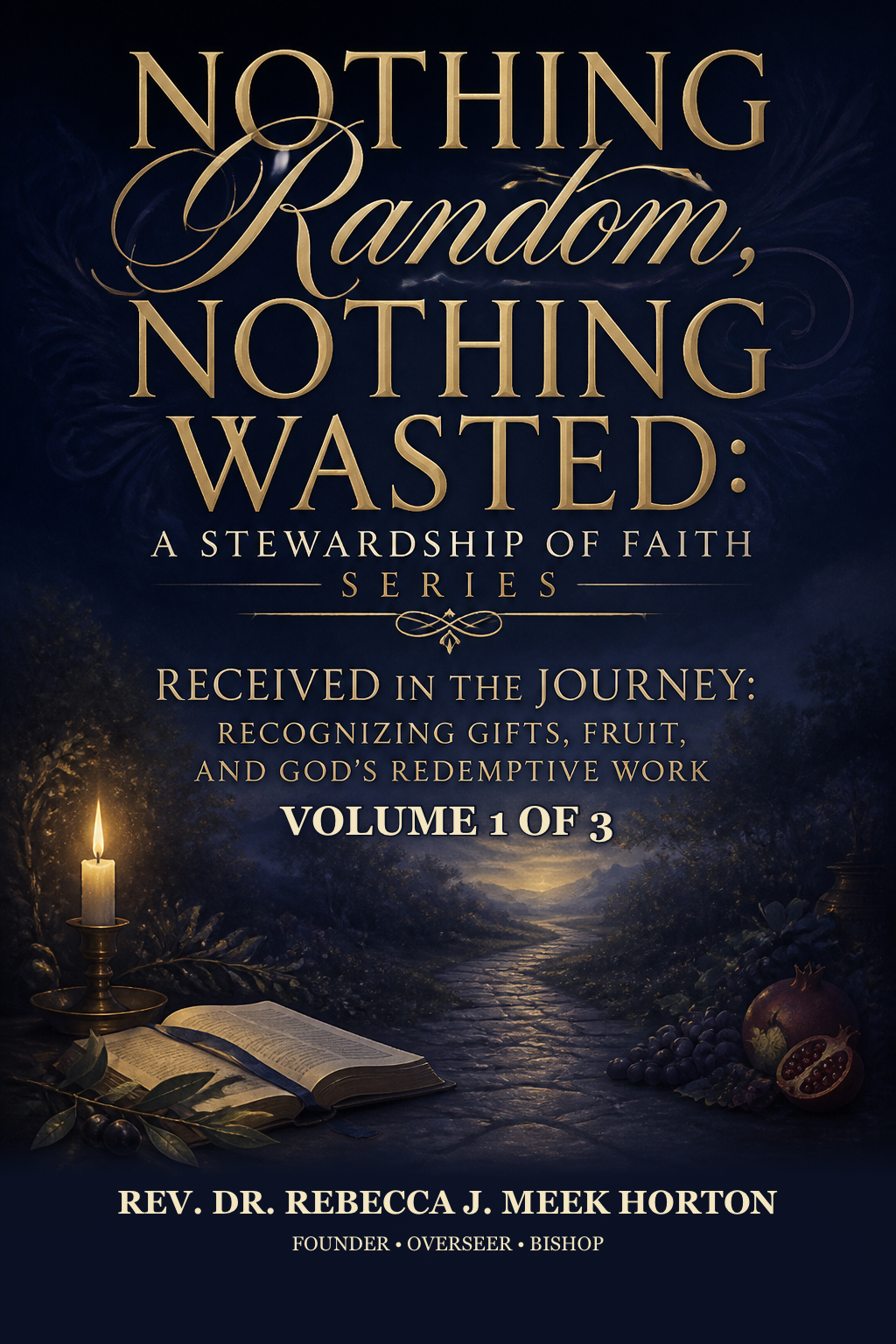
Nothing Random, Nothing Wasted: A Stewardship of Faith Series · Volume 1
Received in the Journey: Recognizing Gifts, Fruit, and God’s Redemptive Work
Part 1 of 3 in the series "Nothing Random, Nothing Wasted: A Stewardship of Faith Series". Series theme: Receiving, Developing, Balancing, and Stewarding Spiritual Gifts, Fruit, Faith, Grace, and Anointing Series arc: This three-book series moves the reader from recognition to responsibility. Book one helps believers receive and name what God has been developing through the journey: spiritual gift
Chapter 1 preview
NBCNGMI MASTER KNOWLEDGE LIBRARY Featuring the works of The Sage, Apostle Prophet. Rev. Dr. Rebecca J. Meek Horton, Apostolic Prophetic Architect, NewBeing Creation Network Global Ministries, Inc. Integrated Framework Modalities™
Dedication
I dedicate this book to every believer and seeker learning to recognize God’s hand in the places they survived, questioned, and grew. May you receive with humility what the Holy Spirit has been forming in you, and may you come to know that nothing is random and nothing is wasted.
Purpose
I wrote this book to help you recognize what God has been forming in you through the journey: the gifts He entrusted, the fruit He is growing, and the wisdom He can redeem from what you have walked through. My hope is that you will receive these things with humility, not as personal possessions, but as works of the Holy Spirit given for God’s glory and the good of others. I also pray this book helps you see redemption truthfully, without calling harm good, and with faith that God can still work all things together for good according to His purpose.
Preface
I wrote this book because many believers are carrying more than they recognize.
Some are looking at their lives and only seeing delay, pain, mistakes, closed doors, survival, or unfinished places. Others can sense that God has been doing something in them, but they do not yet have language for it. They have gifts, but they are unsure how to name them. They have fruit, but they may not see it because it grew slowly through pressure, obedience, and time.
This book began from a simple teaching: gifts and fruit are developed through the journey. But as I sat with that truth, I knew it needed more room. We needed to slow down and ask, What has God entrusted? What has the Holy Spirit been forming? What has the journey revealed? What needs healing, naming, receiving, or surrender?
Scripture teaches, “But the manifestation of the Spirit is given to every man to profit withal” 1 Corinthians 12:7, KJV. Spiritual gifts are not trophies. They are not personal possessions. They are entrusted expressions of the Holy Spirit for the good of others and the glory of God.
The fruit of the Spirit is also His work in us. Galatians 5:22–23 shows us love, joy, peace, longsuffering, gentleness, goodness, faith, meekness, and temperance. These are not performances. They are evidence of formation.
I also want to be clear: redemption does not mean calling harm good. Evil is still evil. Loss is still loss. Wounds still need care. Some parts of the journey require wise counsel, help, repentance, boundaries, and healing. But God is able to work redemptively without pretending the pain was right. Joseph said, “But as for you, ye thought evil against me; but God meant it unto good” Genesis 50:20, KJV.
That is the heart of this book.
Before we rush to develop, balance, or steward what we carry, we must first receive and recognize it. We must let God show us what He has been forming in the hidden places.
My prayer is that as you read, you will begin to see your journey differently. Not as random. Not as wasted. But as a place where God has been present, forming fruit, revealing gifts, strengthening faith, and teaching you how to receive what He has entrusted.
Introduction
Some things in you were not born in a classroom. They were formed on the road.
You learned compassion because you suffered. You learned patience because you waited. You learned discernment because something once looked right and was not. You learned faith because you had to trust God when you could not trace Him. You learned mercy because you needed mercy yourself.
This book begins there: not with a platform, a title, or a public assignment, but with recognition.
Received in the Journey is the first movement in the Nothing Random, Nothing Wasted series. This book is about receiving and naming what God has been forming in you through your walk with Him. Before you develop what you carry, before you balance gifts and character, before you steward grace, anointing, power, presence, and purpose, you must first recognize what has been entrusted.
The central argument of this book is simple: spiritual gifts and spiritual fruit are works of the Holy Spirit, not personal possessions. They are given by God, developed through obedience, tested in the journey, and meant to serve others.
Paul writes, “Now there are diversities of gifts, but the same Spirit” (1 Corinthians 12:4, KJV). He also writes, “But the manifestation of the Spirit is given to every man to profit withal” (1 Corinthians 12:7, KJV). Gifts are not decorations for identity. They are manifestations of grace for service.
The fruit of the Spirit is different from the gifts, but it is not separate from the life of the Spirit. “But the fruit of the Spirit is love, joy, peace, longsuffering, gentleness, goodness, faith, meekness, temperance” (Galatians 5:22–23, KJV). Gifts may reveal what God can do through you. Fruit reveals what God is forming in you.
Both matter.
A gifted believer without fruit can harm people. A fruitful believer who refuses gifts may hide what God intended to use. This book does not ask you to choose between power and character. It invites you to recognize both with humility.
We will also talk honestly about the journey. Romans 8:28 teaches that “all things work together for good to them that love God” (KJV). Genesis 50:20 shows Joseph saying, “ye thought evil against me; but God meant it unto good” (KJV). These Scriptures do not call evil good. They do not excuse harm, abuse, betrayal, neglect, or injustice. They do not tell you to ignore pain, avoid wise counsel, or refuse needed help.
Redemption means God is able to work in what tried to waste you. It means He can bring wisdom, mercy, endurance, discernment, and purpose out of places you would never have chosen. Nothing is random. Nothing is wasted. But some things still must be grieved, named, healed, confronted, and brought into the light.
Read this book slowly. Do not rush to label yourself. Do not force a gift because you admire it in someone else. Do not dismiss fruit because it seems quiet. Do not confuse pain with calling, or charisma with maturity.
Each chapter will help you look again at your life with Scripture, prayer, honesty, and responsibility. You will be invited to map the journey: the places that shaped you, the patterns God exposed, the fruit that has grown, the gifts that have surfaced, and the wisdom you are now responsible to carry.
If you are a believer, read with surrender. If you are seeking, read with openness. You do not have to understand every term at once. Begin with the question beneath the question: What has God been showing me through the journey?
This is not a book about becoming impressive.
It is a book about becoming aware, humble, faithful, and ready for the next obedient step.
Chapter 1 — When the Journey Has Been Teaching You
The box was still in the closet.
She had moved twice since that season ended, but the box came with her every time. Old journals. Printed emails. A conference badge. A hospital bracelet. A church bulletin from a Sunday she almost did not attend. None of it looked important to anyone else.
But one evening, while looking for something completely different, she opened it.
At first, all she saw was pain. Then she noticed something else.
There were prayers in those pages that had changed over time. There were names she no longer feared. There were decisions she would not make again. There was a quiet strength she did not have before. The season had been hard. Some of it had been wrong. Some of it still carried grief.
But the journey had been teaching her.
That is the central truth of this chapter: many believers survive seasons without recognizing what God has been forming in them. We often remember what happened to us, but we do not always discern what was developed in us.
This book begins there.
Not with striving. Not with proving. Not with pretending. But with receiving.
Romans 8:28 says, “And we know that all things work together for good to them that love God, to them who are the called according to his purpose” (KJV).
This verse does not say all things are good. It says God is able to work in all things for good. That difference matters. Wisdom can read the journey without calling every part of the journey good.
What You Survived May Still Be Speaking
Some seasons are so demanding that survival becomes the only goal.
You get through the loss. You keep showing up for work. You raise the children. You keep serving. You keep praying, even if the prayers become shorter. You keep breathing. Then, when the season finally changes, you move on because you are tired.
But moving on is not always the same as receiving.
There may be wisdom in that season that you have not gathered yet. There may be strength you have not named. There may be compassion, discernment, patience, courage, or humility that was formed in hidden places.
Think of someone who cared for a sick parent for several years. During the season, they may have felt weak, stretched, and unseen. They may not have called anything about it “growth.” They were simply doing what love required.
But later, they notice something. They listen better. They pray differently. They are slower to judge people who are tired. They can sit with grief without rushing people through it. Something was formed.
That does not make the suffering pleasant. It does not erase the cost. But it does mean nothing has to be wasted.
This is part of receiving: learning to ask, “Lord, what have You been forming in me that I have not yet recognized?”
The Journey Needs Interpretation
Events do not automatically become wisdom.
A person can go through hardship and come out bitter. Another can go through hardship and come out tender. One may become guarded. Another may become discerning. One may repeat the same cycle. Another may pause for RE-Calibration™ and choose a different way.
The difference is not always the event. Often, it is interpretation.
To interpret the journey wisely means we slow down long enough to see what happened, what it revealed, what it produced, and what still needs healing. We do not rush to make everything meaningful. We do not force a spiritual explanation over real wounds. We also do not assume pain had the final word.
A farmer understands this. After a storm, he walks the field. He does not stand at the window and guess. He goes out and looks. Some branches are broken. Some roots held firm. Some soil washed away. Some seeds were pressed deeper.
The storm must be inspected honestly.
So must the journey.
Believers sometimes feel pressure to sound victorious before they have told the truth. But truth is not the enemy of faith. Truth gives faith a clean place to stand.
Romans 8:28 does not invite denial. It invites confidence in God’s redemptive ability. It teaches us to believe that God can work in what we would never have chosen.
This is why the journey needs interpretation. Without it, we may carry pain but miss wisdom. We may remember the wound but overlook the grace that sustained us. We may see the delay but miss the patience being formed. We may see the betrayal but miss the discernment that now guards our steps.
God Forms More Than We Notice
Much of God’s work in us happens quietly.
We often look for dramatic evidence. A public calling. A visible gift. A clear open door. A powerful moment. Those things may come, but formation often begins in ordinary obedience.
You forgive again.
You tell the truth when silence would protect your image.
You keep your word when no one thanks you.
You learn to wait without quitting.
You ask for help instead of pretending to be fine.
You stop confusing busyness with faithfulness.
These are not small things.
A young believer may think God is only working when they feel inspired. But sometimes God is working when they are learning to apologize. Sometimes God is working when they are learning to say no. Sometimes God is working when they are learning to pray without performing.
The Holy Spirit does not only give gifts for service. He also forms character for carrying what is given. Later chapters will help us name gifts and recognize fruit more clearly, but we begin by noticing this: God’s work is often present before we have language for it.
Consider Peter. Before Pentecost, we see boldness mixed with fear, devotion mixed with impulsiveness. His journey exposed him. But exposure was not the end. The Lord restored him and used him. Peter’s failure did not become his identity. It became part of a redeemed story under the mercy and leadership of Christ.
Many believers need that hope.
You are not only what happened. You are not only what you lost. You are not only what you regret. You are also someone God can teach, heal, correct, strengthen, and send forward with wisdom.
Receiving Begins With Honest Attention
The first movement of this book is receiving.
Receiving sounds simple, but it requires humility. We must admit that we may not have understood our own journey correctly. We may have overlooked grace because we were focused on pain. We may have mistaken delay for abandonment. We may have called ourselves weak when God was teaching us dependence.
Receiving also requires patience. We cannot map every season in one sitting. We cannot name every lesson at once. Some understanding comes slowly. Some memories need care. Some parts of the story should be processed with wise counsel, pastoral support, or professional help.
Faith does not require us to handle everything alone.
The cost of this chapter is honest attention.
It asks you to stop rushing past your life. It asks you to look again, not to relive pain, but to recognize formation. It asks you to let God show you what has been entrusted through the journey.
That may be uncomfortable.
You may have to grieve what you minimized. You may have to admit where you hardened. You may have to give thanks for grace you did not notice at the time. You may have to separate what God formed from what people did wrong.
This is careful work. But it is good work.
Nothing is random. Nothing is wasted.
That does not mean everything was right. It means God is wise enough, faithful enough, and redemptive enough to bring good out of places we could not repair on our own.
The journey has been teaching you. Now it is time to receive with wisdom.
Key Takeaways
• Survival is not the same as receiving what God formed.
• Romans 8:28 teaches redemption, not denial.
• The journey must be read with honesty, Scripture, and wisdom.
Practice
Set aside twenty quiet minutes this week.
Choose one past season that still feels significant. Do not choose the most painful season if you are not ready. Begin with one you can look at honestly.
Write three simple lines:
• What happened in that season?
• What did it reveal in me?
• What grace, wisdom, or growth can I now recognize?
Close with this prayer:
“Lord, help me receive what You have formed without pretending everything was good. Teach me to see with wisdom, give thanks with honesty, and take the next faithful step.”
This is the opening chapter. The complete publication is available in the full edition.
Back to the library