Governed Expansion: The WIRE™ Leadership Series · Volume 2
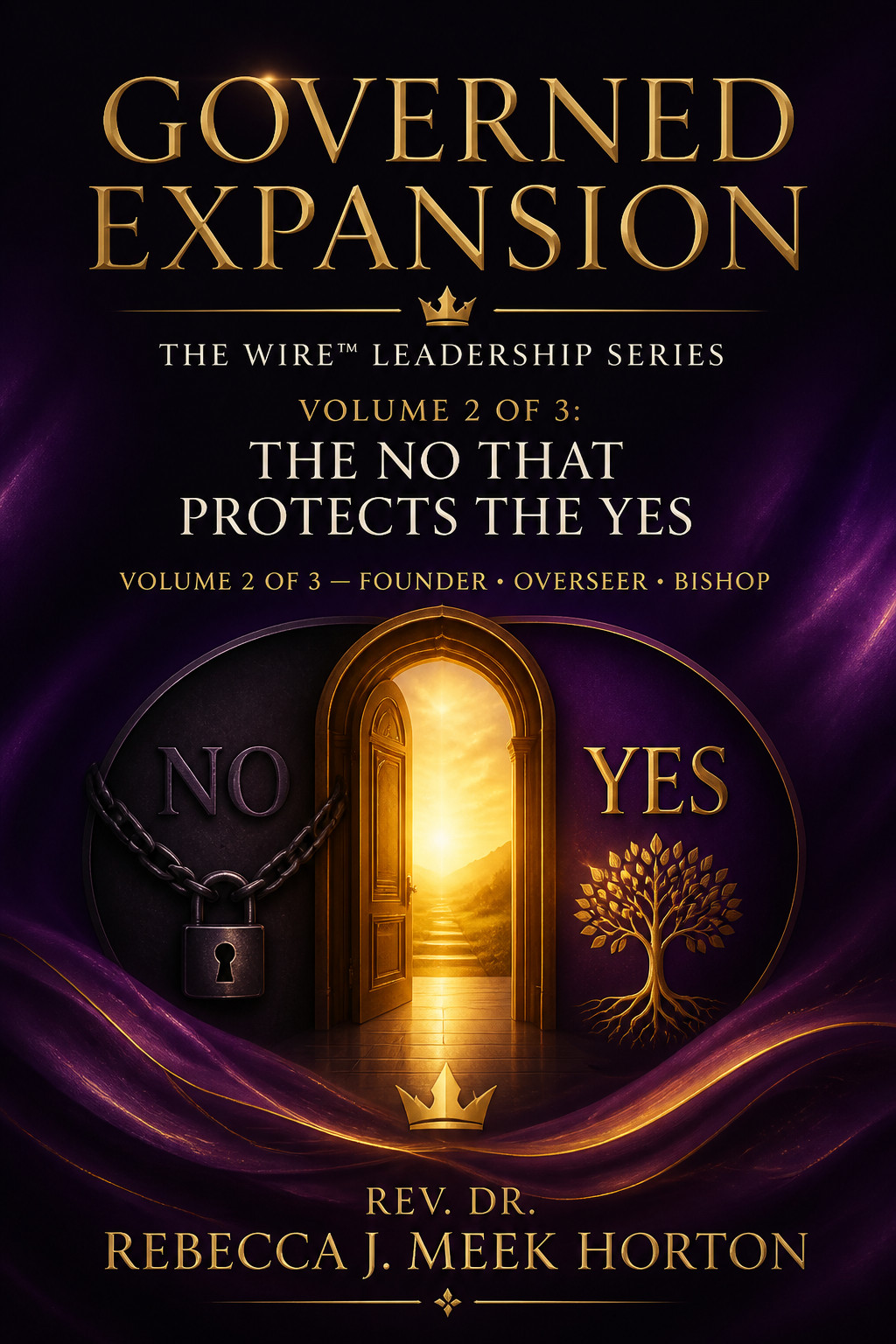
The No That Protects the Yes
Part 2 of 3 in the series "Governed Expansion: The WIRE™ Leadership Series". Series theme: Series arc: The series follows one unifying theme: expansion must be released by GOD, not forced by human pressure. Book one establishes the WIRE™ order of stillness, instruction, authorized release, and governed increase. Book two moves leaders into the cost of covenant, capacity, discernment, and the holy
Chapter 1 preview
NBCNGMI MASTER KNOWLEDGE LIBRARY Featuring the works of The Sage, Apostle Prophet. Rev. Dr. Rebecca J. Meek Horton, Apostolic Prophetic Architect, NewBeing Creation Network Global Ministries, Inc. Integrated Framework Modalities™
Purpose
I wrote this book to help leaders slow down before they agree, because Scripture warns that it is a snare to make a vow too quickly and only afterward count the cost (Proverbs 20:25; Luke 14:28). My hope is that you learn to examine people, places, assignments, opportunities, and seasons without fear, pressure, or presumption.
May this book strengthen you to say no without guilt, yes without bondage, and to walk only in the agreements GOD has truly authorized (Matthew 5:37; Amos 3:3).
Preface
I did not write this book because I enjoy saying no.
I wrote it because I have learned, often through cost, that every unexamined yes eventually asks for payment. Some payments are small. Others touch your peace, your focus, your family, your assignment, your integrity, and your obedience to GOD.
There are seasons when the pressure to agree feels spiritual. The door is open. The need is real. The opportunity sounds good. The relationship carries history. The invitation comes with honor. And yet, beneath the surface, the Spirit of GOD may be warning, slowing, or withholding release.
That is where many leaders struggle.
We are often trained to respond to need before we discern assignment. We mistake access for authorization. We call urgency obedience. We say yes because we do not want to disappoint people, lose momentum, or appear unspiritual. But Proverbs 20:25 warns us that it is a snare to make a vow and only afterward consider what it requires. Jesus said to count the cost before building (Luke 14:28). He also taught us to let our “Yes” be yes and our “No” be no (Matthew 5:37). Amos asked a question every leader must answer honestly: “Can two walk together, except they be agreed?” (Amos 3:3).
This book was born from those questions.
*The No That Protects the Yes* is the second book in the **Governed Expansion: The WIRE™ Leadership Series**. The first book established the order of WIRE™: stillness, instruction, authorized release, and governed increase. This book moves into the relational and organizational weight of that order. It is about covenant discernment. It is about boundaries that protect obedience. It is about the holy no that keeps your yes clean.
My prayer is that these pages strengthen leaders who are tired of being governed by pressure. I am not writing to make you suspicious, hard, or unavailable. I am writing to help you become faithful, clear, and free.
Some no’s are not rejection. They are stewardship.
Some delays are not fear. They are wisdom.
Some exits are not failure. They are obedience.
As you read, do not rush to apply this to everyone around you. Begin with your own agreements. Ask where you have said yes without peace, where you have stayed beyond grace, and where GOD may be calling you to recover the courage of a simple, truthful answer.
May this book help you say no without guilt, yes without bondage, and both under the government of GOD.
Introduction
A leader can lose peace by saying yes too quickly.
Not because the opportunity is evil. Not because the person is wrong. Not because the door is entirely false. Sometimes the danger is simpler: the agreement was made before it was examined.
Scripture gives us sober language for this. “It is a snare to say rashly, ‘It is holy,’ and to reflect only after making vows” (Proverbs 20:25). Jesus teaches us to count the cost before we build (Luke 14:28). He also calls our yes and no into clean speech: “Let what you say be simply ‘Yes’ or ‘No’” (Matthew 5:37). Amos asks the question every leader must learn to ask before walking too far with anyone or anything: “Do two walk together, unless they have agreed to meet?” (Amos 3:3).
This book is about that place.
*The No That Protects the Yes* is the second book in the **Governed Expansion: The WIRE™ Leadership Series**. The first book established the order of WIRE™: stillness, instruction, authorized release, and governed increase. It called leaders back into RE-Alignment™ so expansion would not be forced by pressure, ambition, fear, or imitation.
This book moves from personal alignment into relational and organizational discernment.
Because once a leader begins to hear again, wait again, and move only by authorized release, the next test often comes through agreement. Who will you build with? Where will you commit your strength? Which invitation deserves your yes? Which opportunity looks open but is not assigned? Which relationship has affection but not alignment? Which season has ended, though loyalty makes it hard to admit?
The central argument of this book is simple:
**Every yes creates a covenant of time, attention, authority, resources, and consequence. Therefore, mature leaders must learn the holy no that protects the ordained yes.**
This is not a book about suspicion. It is not permission to become guarded, harsh, unavailable, or difficult to lead. Discernment is not fear wearing spiritual language. Boundaries are not bitterness with better vocabulary.
This is a book about clean leadership.
Clean leadership does not promise what GOD has not authorized. It does not confuse need with assignment. It does not call pressure “urgency” or guilt “compassion.” It does not enter partnerships because the room is emotional, the offer is impressive, or the people are persuasive.
Clean leadership counts the cost.
That cost is real. To discern covenant wisely, you may have to disappoint people you love. You may have to release opportunities that could grow your visibility but weaken your obedience. You may have to slow down when others want speed. You may have to say no before you can explain it fully. You may have to endure being misunderstood while GOD protects what He has actually assigned to you.
This is part of leadership maturity.
A yes without discernment can become bondage. A no without wisdom can become avoidance. But a governed no creates room for a faithful yes.
Read this book slowly. Do not rush to apply it to everyone around you. Begin with your own agreements. Your calendar is an agreement. Your team structure is an agreement. Your open doors are agreements. Your repeated tolerations are agreements. Your silence may be functioning as agreement. Your overextension may be revealing places where your yes was not governed.
As you read, bring five categories before the LORD: **people, places, assignments, opportunities, and seasons**. Ask where you have moved too quickly. Ask where you have stayed too long. Ask where peace has been replaced by pressure. Ask where your yes has become heavier than the grace given to carry it.
You do not need to become afraid of commitment. You need to become faithful in it.
The aim is not to help you say no more often. The aim is to help you say yes with freedom, clarity, and covenant integrity.
Before you continue, take one simple step:
Write down three current agreements in your leadership life that are costing you time, strength, or authority. Then pray honestly over each one: **“LORD, did You authorize this yes, and is Your grace still on it?”**
Chapter 1 — 1. The Pressure to Say Yes
The message came in while the leader was between meetings.
“We would love for you to be part of this. We need your voice. Can we tell the team you’re in?”
It sounded honorable. The people were sincere. The opportunity looked open. The platform was growing. The request came wrapped in affirmation, urgency, and spiritual language.
And underneath it all was pressure.
Not obvious pressure. Not manipulation with a hard edge. Just the quiet pull every leader knows: *If I say no, will they think I am proud? If I ask for time, will the door close? If I do not respond quickly, will I miss what GOD is doing?*
Many leaders do not fall because they refuse GOD. They fall because they agree too quickly to what they have not discerned.
This chapter’s controlling idea is simple: **a rushed yes can become a snare when agreement moves faster than discernment.**
Proverbs gives us the warning plainly:
> “It is a snare to say rashly, ‘It is holy,’ and to reflect only after making vows.” > — Proverbs 20:25
The danger is not only saying yes to something sinful. The danger is calling something holy too soon. The danger is attaching GOD’s name to a commitment before the leader has prayed, counted, listened, and tested the matter.
That is where many leaders lose peace.
Not in rebellion.
In premature agreement.
## The Speed of Pressure
Pressure often moves faster than wisdom.
It asks for an answer before there has been prayer. It asks for loyalty before there has been clarity. It asks for commitment before there has been counsel. It asks the leader to respond from emotion, fear, need, flattery, or fatigue.
A pastor is asked to join a citywide effort. A ministry leader is invited into a partnership. A founder is offered funding with hidden expectations. A worship leader is asked to serve “just for a season,” though the season has no defined end. A business leader is pressured to expand before the internal structure is ready.
None of these may be evil.
That is what makes discernment necessary.
Pressure rarely introduces itself as pressure. It often sounds like opportunity.
“This is a big door.”
“We need to move while there is momentum.”
“Everyone is expecting you.”
“This could really expand your influence.”
“You do not want to miss this.”
But WIRE™ teaches us that expansion must be released by GOD, not forced by human pressure. Stillness comes before instruction. Instruction comes before authorized release. Authorized release comes before governed increase.
Pressure tries to skip the order.
It wants increase without stillness. It wants release without instruction. It wants agreement without examination.
Leaders must learn to slow the moment down.
Not because they are afraid.
Because they are responsible.
Jesus did not entrust Himself to every expression of public excitement. John tells us:
> “But Jesus on his part did not entrust himself to them, because he knew all people.” > — John 2:24
He was not moved by crowd response alone. He discerned what was in people. He knew the difference between attention and assignment.
Leaders must learn that same discipline.
A door is not automatically a directive. A need is not automatically a call. An invitation is not automatically an instruction.
## The Hidden Cost of a Quick Yes
A yes is never empty.
Every yes spends something.
It spends time. It spends attention. It spends emotional strength. It spends relational trust. It spends organizational focus. It spends spiritual weight.
A leader may say yes with the mouth in one moment, but the whole house has to pay for that yes over time.
This is where many leaders miscalculate. They treat agreement as a sentence when it is really a covenantal doorway. They say yes to a meeting and inherit a relationship. They say yes to a project and inherit expectations. They say yes to a platform and inherit pressure. They say yes to a partnership and inherit another person’s pace, values, and burdens.
Proverbs 20:25 calls this a snare.
A snare is not always visible at first. It is designed to look harmless until movement tightens it.
A rushed yes can feel light on the front end and become heavy later. At first, it may bring relief. People are pleased. The leader feels wanted. The opportunity looks promising. The room applauds.
Then the cost begins to appear.
The calendar tightens. The family feels the absence. The team absorbs confusion. The leader begins to resent what they once accepted. Prayer becomes reactive. The original assignment loses focus. What looked like expansion begins to feel like entanglement.
This does not mean every costly yes is wrong. Obedience often costs deeply.
But there is a difference between the cost of obedience and the cost of presumption.
The cost of obedience comes with grace to carry it.
The cost of presumption drains what GOD did not ask you to spend.
A leader must be willing to ask before agreeing: *What will this yes require of me, of my family, of my team, of the people entrusted to my care?*
That question is not selfish.
It is stewardship.
## Why Leaders Feel Compelled to Agree
Leaders often know they need time, but they feel compelled to answer quickly.
Some of that pressure comes from outside. Some comes from within.
There is the pressure to be needed. Leaders can become accustomed to being the answer in every room. If they are not careful, usefulness becomes identity. They begin to feel valuable only when they are saying yes, solving problems, opening doors, and carrying weight.
There is the pressure to be seen. Expansion can appeal to hidden hunger. A larger platform, a more visible room, or a strategic connection may feel like confirmation, even when GOD has not spoken.
There is the pressure to keep people pleased. Leaders who hate disappointing others often agree in the moment and suffer in private. They call it kindness, but sometimes it is fear wearing a gentle face.
There is the pressure of scarcity. The leader thinks, *If I do not take this now, another opportunity may not come.* Scarcity makes a door look like deliverance even when it is a distraction.
There is also spiritual pressure. Sometimes people use holy language to hurry agreement.
“We prayed, and we feel you are supposed to do this.”
“GOD told us you are the person.”
“This is kingdom.”
“We need unity.”
These words should be treated with reverence, not suspicion. But reverence does not require haste. If GOD is truly leading, He is not threatened by obedient discernment.
Paul writes:
> “Do not be hasty in the laying on of hands, nor take part in the sins of others; keep yourself pure.” > — 1 Timothy 5:22
The principle is sobering. Shared agreement can become shared consequence. Leaders are not only responsible for what they do directly. They are responsible for what they authorize, endorse, platform, bless, join, and carry.
This is why a leader cannot afford a yes that is driven by guilt.
Guilt is a poor governor.
Fear is a poor counselor.
Flattery is a poor confirmation.
Urgency is a poor substitute for instruction.
## Agreement Before Discernment Becomes Bondage
Premature agreement creates bondage because it places the leader under expectations that were never tested.
Once the yes is spoken, pressure changes shape. Before the yes, the leader feels pressure to agree. After the yes, the leader feels pressure to stay, even when peace is gone and clarity never came.
This is why Proverbs 20:25 says the snare is in speaking rashly and reflecting afterward.
Reflection is not wrong. Reflection is necessary. But reflection after a vow is different from reflection before a vow. Before the vow, reflection protects freedom. After the vow, reflection often reveals consequence.
A leader may realize too late: *I did not ask enough questions. I did not discern the values. I did not understand the expectations. I did not know who else was involved. I did not know the pace. I did not know the cost. I did not ask whether GOD assigned this to me.*
Now the leader is trying to get free from a commitment they entered under pressure.
This matters because leadership agreements are not private. When a leader says yes, others are affected.
A church feels it. A staff feels it. A spouse feels it. Children feel it. Volunteers feel it. The people assigned to that leader feel the overflow of that decision.
This does not mean leaders should become suspicious, guarded, or hard to work with. That is not wisdom. That is self-protection without love.
The goal is not to become unavailable.
The goal is to become governed.
A governed leader can listen without being rushed. A governed leader can honor an invitation without surrendering discernment. A governed leader can say, “Thank you. I need to pray and review capacity before I answer.” A governed leader can resist the emotional demand for immediate agreement.
Matthew 5:37 says:
> “Let what you say be simply ‘Yes’ or ‘No’; anything more than this comes from evil.” > — Matthew 5:37
Jesus is teaching integrity of speech. Words must not be used carelessly. A leader’s yes should mean yes. A leader’s no should mean no. That kind of clarity begins before the answer is given.
If the yes must be clear, the discernment must be careful.
## The Cost of Slowing Down
Slowing down will cost you.
It may cost applause. Some people celebrate quick agreement more than wise process.
It may cost access. Certain rooms only want leaders who can be hurried.
It may cost approval. People who benefit from your immediate yes may call your discernment hesitation, fear, or pride.
It may cost an opportunity. There are doors that will not wait for prayer, counsel, or peace. That can feel painful, especially when the opportunity looks fruitful.
But leaders must ask a better question: *If this door cannot survive discernment, was it truly assigned?*
Not every delay is disobedience. Sometimes delay is the obedience.
To slow down is to admit that you are not the source. You are a steward. You do not have unlimited strength. You do not have authority to attach GOD’s name to every attractive thing. You do not have the right to spend what He assigned to another purpose.
This is the holy tension of leadership.
You must be available to GOD and honest about your limits.
You must stay open without becoming porous.
You must be willing to move when He speaks and willing to wait when He has not.
That is not weakness. That is governed strength.
The pressure to say yes will not disappear. As influence grows, invitations grow. As favor becomes visible, requests multiply. As your assignment bears fruit, more people will want access to the fruit.
This is why the first discipline is not learning how to say no.
It is learning how not to be rushed.
Before the no.
Before the yes.
Before the explanation.
Stand still long enough to discern.
## Key Takeaways
- A rushed yes can become a snare.
- Pressure often sounds like opportunity.
- Governed leaders discern before they agree.
## Practice
Before your next significant yes, pause and write one sentence:
**“If I agree to this, I am also agreeing to carry __________.”**
Fill in the blank honestly.
Name the time, weight, people, expectations, cost, and spiritual responsibility attached to the agreement. Then pray before you answer:
“Lord, keep me from calling holy what You have not assigned. Give me clarity to obey without pressure and restraint to wait without fear.”
This is the opening chapter. The complete publication is available in the full edition.
Back to the library