When Anxiety Is Too Loud · Volume 3
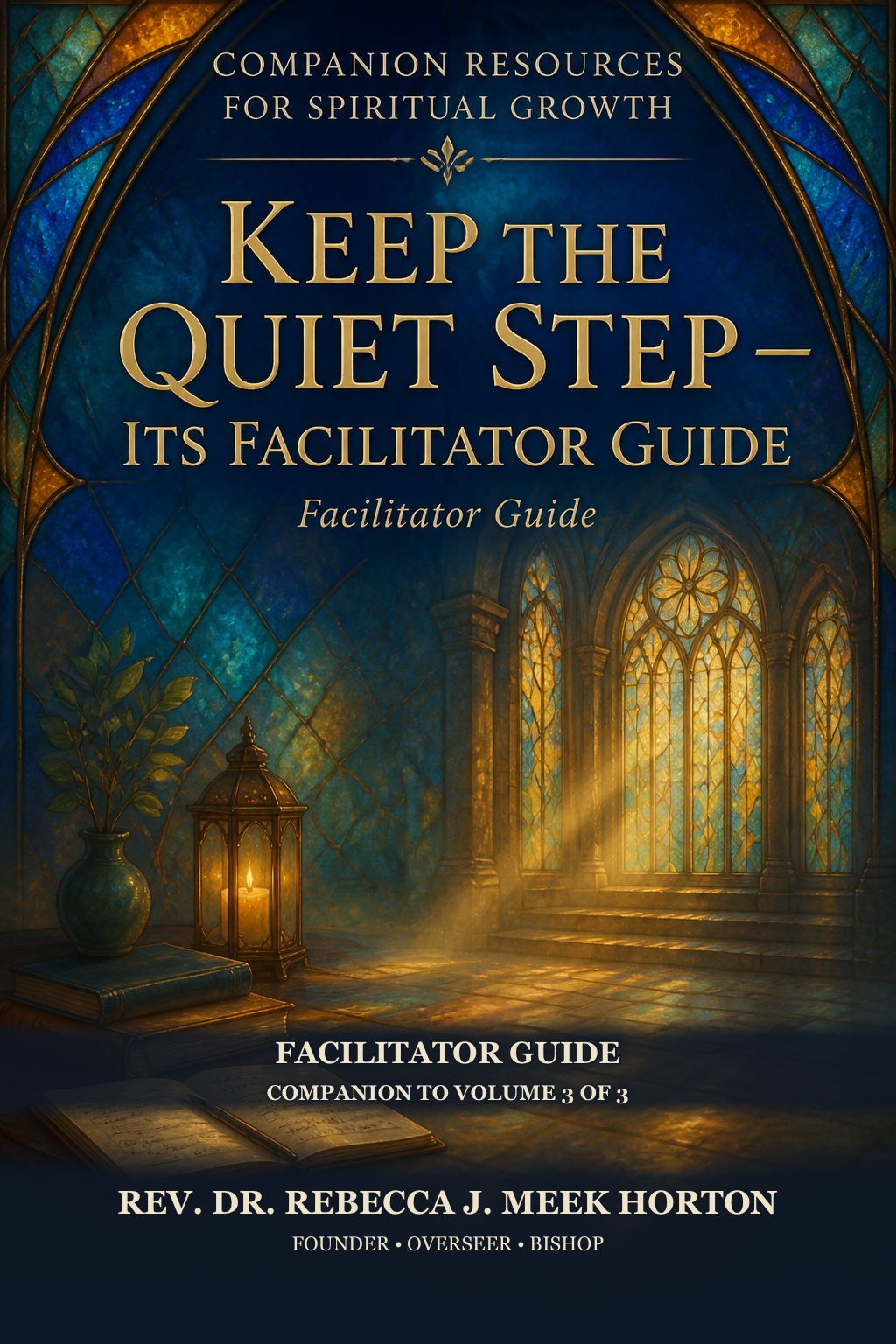
Keep the Quiet Step — Its Facilitator Guide
A facilitator's guide for "Keep the Quiet Step". Every written chapter becomes a 60-minute session: objectives, preparation, timing, teaching outline, discussion questions with suggested answers, an activity, a closing commission, and leader's notes.
Chapter 1 preview
NBCNGMI MASTER KNOWLEDGE LIBRARY Featuring the works of The Sage, Apostle Prophet. Rev. Dr. Rebecca J. Meek Horton, Apostolic Prophetic Architect, NewBeing Creation Network Global Ministries, Inc. Integrated Framework Modalities™
Dedication
To every facilitator who chooses patience over pressure and presence over performance: I dedicate this guide to you. May you help others keep the quiet step with wisdom, courage, and obedience, remembering that nothing is random and nothing is wasted.
Purpose
I wrote this facilitator guide to help leaders carry Keep the Quiet Step with clarity, humility, and order. My hope is that each session helps readers slow down, listen well, and move from understanding to obedient practice, as James 1:22 teaches. This guide exists so quiet faith can become a steady walk, one faithful step at a time.
Preface
I wrote this facilitator guide because quiet steps still need faithful leadership.
Keep the Quiet Step was never meant to be only read. It was meant to be walked. Its message calls us away from noise, rushing, performance, and pressure, and back into a steadier rhythm of obedience before God. But I also know that many people receive truth more deeply when someone helps them slow down, talk honestly, reflect carefully, and practice what they are learning.
That is the heart of this guide.
Each session is designed to help a facilitator lead with clarity, humility, and care. You do not have to perform the lesson. You do not have to carry the room. You are not there to force transformation. You are there to steward space where understanding can grow, where Scripture can search the heart, and where each person can identify one faithful step to keep.
Proverbs 3:5-6 (KJV) Trust in the LORD with all thine heart; and lean not unto thine own understanding. In all thy ways acknowledge him, and he shall direct thy paths.
This work matters because people are tired. Many are carrying decisions, grief, assignments, questions, and responsibilities they do not always have language for. Some are moving too fast. Some are afraid to move at all. Some need permission to wait before they act. Others need courage to obey the step already made clear.
The quiet step is not passive. It is governed movement. It is learning to wait, ask, listen, and keep the next faithful step without forcing what God has not required. It is remembering that wisdom must become practice.
Nothing is random. Nothing is wasted.
My prayer is that this guide will help facilitators create sessions that are simple, honest, and transformational. Use the objectives to stay focused. Use the timing to protect order. Use the questions to invite reflection. Use the activities to move truth from thought into practice. Use the closing commission to send people out with responsibility, not dependency.
Lead gently. Prepare prayerfully. Teach clearly. Leave room for the Holy Spirit’s work.
And when the session ends, help each person name the same thing this book asks of all of us:
What is the next quiet step I must faithfully keep?
Introduction
A quiet step is not a small step. It is a governed step.
This facilitator guide was created to help you lead Keep the Quiet Step with clarity, patience, and spiritual responsibility. The purpose is not to rush people through content. The purpose is to help them slow down long enough to hear, receive, examine, and practice what wisdom requires.
Many people want direction, but fewer want the stillness that makes direction clear. We often want movement before maturity, answers before attention, and outcomes before obedience. Keep the Quiet Step teaches another way: Wait, Ask, Listen, and Keep the next faithful step. This guide helps you carry that message into a group setting without turning it into pressure, performance, or dependency.
Psalm 37:23 (KJV) The steps of a good man are ordered by the LORD: and he delighteth in his way.
The central argument of this guide is simple: transformation is strengthened when teaching becomes practiced wisdom. A session is not complete because the material was covered. It is complete when the learner can name the truth, weigh it honestly, connect it to real life, and take one responsible step forward.
Each written chapter of Keep the Quiet Step becomes a 60-minute session. Every session includes objectives, preparation, timing, a teaching outline, discussion questions with suggested answers, an activity, a closing commission, and leader’s notes. This structure is intentional. Order protects the room. Simplicity protects the message. Practice protects the learner from hearing truth without walking it.
As a facilitator, your role is not to impress the group with how much you know. Your role is to steward the space so understanding can grow. You are not there to force conclusions, solve every personal situation, or become the source of someone’s obedience. You are there to teach faithfully, listen wisely, ask careful questions, and point people back to Scripture, prayer, godly counsel, and the next faithful step.
Read each session before you lead it. Sit with the Scripture. Notice the controlling idea. Mark the tension the chapter names. Prepare the activity with care. Then enter the room with humility. A strong facilitator does not need to dominate the hour. A strong facilitator keeps the hour clear enough for truth to do its work.
Use this guide with groups of any size. It can serve a church class, leadership circle, mentoring group, family study, discipleship setting, or personal development gathering. Adjust examples as needed, but do not lose the rhythm. Each session is designed to move from truth to understanding, from understanding to application, and from application to practice.
Lead slowly. Let silence have room. Some participants will answer quickly. Others will need time. Some will recognize places where they have moved too fast, spoken too soon, delayed obedience, or mistaken noise for wisdom. Do not shame them. Help them take responsibility with grace.
The cost of this work is real. It may ask participants to release urgency, examine motives, receive correction, wait without control, and obey without full visibility. It may ask you, as the facilitator, to trust the process instead of filling every space. But the fruit is worth the patience.
Before you begin, make one commitment: do not simply teach the quiet step. Keep it.
Prepare the next session by reading the chapter, praying over the group, and writing one sentence that names the main truth participants must carry when they leave.
Chapter 1 — When Anxiety Still Speaks
Session Overview
This session helps the group understand that surrendering anxiety to God does not always mean anxiety disappears immediately. Chapter 1 teaches a steady and freeing truth: anxiety may still speak, but it does not have to lead. The leader will guide participants through Isaiah 26:3 and related Scriptures, helping them see that peace begins with God’s keeping power, not personal control or emotional perfection. The session also introduces the practice of a kept step: one small act of obedience held under God’s peace.
Participants should leave with less shame about anxious feelings and more clarity about faithful response. The goal is not to diagnose anxiety, minimize suffering, or pressure people to “just have more faith.” The goal is to help them recognize anxiety’s voice, refuse its leadership, and return their attention to God. This is steady formation. WISDOM is not yours until YOU WALK IT.
Session Objectives
Help participants distinguish anxiety’s presence from anxiety’s leadership.
Teach Isaiah 26:3 as a promise of God’s keeping peace.
Practice RE-Language™ that moves from shame to responsible obedience.
Equip participants to identify one kept step when anxiety speaks.
Encourage steady faithfulness without pretending anxious feelings are gone.
Prepare leaders to respond gently to anxiety-related vulnerability in the group.
Preparation
Read Chapter 1 slowly and mark the sentences that name the central idea: anxiety may still speak, but it does not have to lead.
Read Isaiah 26:3, Philippians 4:6-7, Matthew 6:34, 2 Timothy 1:7, and Psalm 37:23-24 in the King James Version.
Pray over the group, asking God for gentleness, wisdom, and emotional safety.
Prepare paper and pens for each participant.
Have a quiet timer available for the group activity.
Consider in advance how you will respond if someone shares intense anxiety, panic, trauma, or a need for professional support.
Ask the Lord to help you teach without shame, pressure, or quick fixes.
Timing
Welcome and Grounding, 5 minutes
Opening Prayer, 3 minutes
Session Overview and Objectives, 5 minutes
Teaching Movement 1, 8 minutes
Teaching Movement 2, 8 minutes
Teaching Movement 3, 8 minutes
Teaching Movement 4, 6 minutes
Discussion Questions, 10 minutes
Group Activity, 5 minutes
Closing and Commission, 2 minutes
Opening Prayer
Father, quiet our hearts and make this a safe place for truth. Teach us to recognize anxiety without letting it rule us. Help us return our minds to You, receive Your peace, and take the next faithful step with courage and humility. In Jesus’ name, Amen.
Teaching Outline
Movement 1: Anxiety may return after surrender.
Point: Surrender changes leadership, but it does not always remove every anxious feeling immediately.
Isaiah 26:3 (KJV) Thou wilt keep him in perfect peace, whose mind is stayed on thee: because he trusteth in thee.
Leader sentence: Anxiety returning does not mean your surrender was fake; it may mean the work of trust is becoming daily.
Movement 2: Peace begins with God’s keeping power.
Point: Biblical peace is not something we manufacture by control; it is something God keeps us in as we return our minds to Him.
Philippians 4:6-7 (KJV) 6 Be careful for nothing; but in every thing by prayer and supplication with thanksgiving let your requests be made known unto God. 7 And the peace of God, which passeth all understanding, shall keep your hearts and minds through Christ Jesus.
Leader sentence: Our part is to bring the real concern to God; His peace guards the heart and mind in ways we cannot produce by striving.
Movement 3: Anxiety can speak without leading.
Point: The voice that speaks loudest is not always the voice that should guide the next step.
2 Timothy 1:7 (KJV) For God hath not given us the spirit of fear; but of power, and of love, and of a sound mind.
Leader sentence: Fear may pressure us to react, hide, control, or escape, but God forms us to move with power, love, and a sound mind.
Movement 4: A kept step is enough for today.
Point: Steady faithfulness grows when we obey what is clear instead of waiting for every feeling to be calm.
Matthew 6:34 (KJV) Take therefore no thought for the morrow: for the morrow shall take thought for the things of itself. Sufficient unto the day is the evil thereof.
Leader sentence: Jesus does not ask us to carry tomorrow’s weight today; He teaches us to live faithfully with the grace and responsibility of this moment.
Movement 5: God steadies the person who keeps walking.
Point: A faithful life is built through repeated, small steps under God’s care.
Psalm 37:23-24 (KJV) 23 The steps of a good man are ordered by the LORD: and he delighteth in his way. 24 Though he fall, he shall not be utterly cast down: for the LORD upholdeth him with his hand.
Leader sentence: A kept step may look small, but it returns leadership to God and reminds us that He upholds us as we walk.
Discussion Questions with Suggested Answers
1. What stood out to you from the statement, “Anxiety may still speak, but it does not have to lead”?
Suggested Answer: Anxiety’s presence is not the same as anxiety’s authority. A person can feel anxious and still choose obedience, wisdom, and trust.
2. Why do people sometimes feel disappointed or ashamed when anxiety returns after prayer or surrender?
Suggested Answer: Many expect surrender to remove the feeling completely. When anxiety returns, they may think they failed, but the chapter teaches that surrender begins a daily practice of trust.
3. What does Isaiah 26:3 teach us about peace?
Suggested Answer: Peace is connected to God’s keeping power and a mind stayed on Him. The verse does not say we keep ourselves; it says God keeps the one who trusts Him.
4. What is the difference between a wandering mind and a stayed mind?
Suggested Answer: A wandering mind gets pulled in many directions. A stayed mind may still wander, but it knows where to return: to God, His Word, and trust.
5. What are some ways anxiety tries to take leadership?
Suggested Answer: It may push us to react quickly, avoid responsibility, rehearse worst-case outcomes, seek constant reassurance, or make decisions from fear.
6. How does RE-Language™ help when anxiety speaks?
Suggested Answer: It helps us shift from helpless or shame-filled language to responsible, faithful language. For example, “Anxiety is present, and I can take one faithful step.”
7. What does a kept step look like in ordinary life?
Suggested Answer: It may be answering one email, taking a short rest, praying simply, having one honest conversation, asking for wise counsel, or doing the next responsibility without panic.
8. What might it cost to stop letting anxiety lead?
Suggested Answer: It may cost the false relief of quick reactions, the habit of control, the comfort of overthinking, or the belief that certainty must come before obedience.
Group Activity
Kept Step Practice
Give each participant a sheet of paper. Ask them to write one current situation where anxiety has been speaking. Tell them not to write a long explanation. One sentence is enough.
Then invite them to write this sentence exactly:
Anxiety is present, but it is not leading this next step.
After that, ask them to name one faithful action they can take in the next ten minutes, today, or before the next group meeting. Keep it small, clear, and obedient.
Examples may include: pray for two minutes, send one honest message, take a short walk, ask for counsel, stop rehearsing a feared conversation, complete one task, or rest without apology.
Purpose: This exercise helps participants move from anxiety awareness to faithful stewardship. It teaches them to pause, RE-Calibrate™, and choose one kept step instead of waiting for perfect calm.
Closing and Commission
Close by reminding the group that this practice is not about pretending anxiety is gone. It is about returning leadership to God. Encourage them to carry one sentence this week: Anxiety may speak, but it does not have to lead.
Closing Prayer
Father, thank You for being our Keeper. Teach us to return our minds to You when anxiety speaks. Give us courage to take small, faithful steps without shame. Help us walk in power, love, and a sound mind. Guard our hearts, guide our choices, and keep us in Your peace. In Jesus’ name, Amen.
Leader's Notes
Do not shame participants for feeling anxious. The goal is not to prove spiritual maturity by emotional calm.
Avoid saying or implying that all anxiety is caused by weak faith. Anxiety can involve spiritual, emotional, physical, relational, and medical factors.
If someone describes panic attacks, inability to function, self-harm thoughts, trauma responses, or severe distress, encourage appropriate pastoral care and professional support. This session is not a replacement for counseling, medical care, or crisis intervention.
Keep the discussion grounded. Some participants may want to analyze every anxious thought. Gently guide them back to the chapter’s practice: pause, name what is happening, return the mind to God, and take one faithful step.
Watch for over-spiritualized pressure. Statements like “just trust God” may sound true but can land as dismissal. Say instead, “Trust may look like one small obedient step right here.”
Likely question: “If I still feel anxious, does that mean I do not trust God?” A helpful answer is: “Not necessarily. Trust is not proven by never feeling anxiety. Trust is practiced when you return to God and obey what is clear.”
Likely question: “How do I know whether anxiety is warning me or misleading me?” A helpful answer is: “Slow down. Ask what is actually known, what is assumed, what Scripture says, and whether wise counsel is needed. Urgency alone is not wisdom.”
Caution leaders not to rush silence. Some participants may need time before sharing. Let quiet be part of the room.
Encourage confidentiality. People may share tender places. Remind the group to honor one another’s stories.
Notes
[Answer Lines]
[Journal Page]
[Journal Page]
This is the opening chapter. The complete publication is available in the full edition.
Back to the library